BANK COMM(601328)

Search documents
外贸高质量发展,增添金融动能
Qi Lu Wan Bao· 2025-08-14 22:54
Core Insights - The seminar held on August 7 aimed to promote the use of cross-border RMB in goods trade, addressing the needs and challenges faced by foreign trade enterprises in a complex international economic environment [1][2] - The event emphasized the importance of financial support in stabilizing foreign trade and optimizing trade structure, highlighting the achievements of cross-border RMB business since its pilot launch in Jining [1][2] - The People's Bank of China (PBOC) in Jining has been actively promoting cross-border RMB usage, with a cumulative settlement amount exceeding 300 billion yuan since the pilot began in June 2010, covering 148 countries and regions [2] Group 1 - The seminar was co-hosted by the PBOC Jining Branch and the Jining Municipal Bureau of Commerce, with a focus on the theme "Integrating the World, Prioritizing Local Currency" [1] - Keynote speeches analyzed the current foreign trade situation and opportunities, stressing the critical role of finance in supporting foreign trade [1][2] - Experts provided insights on RMB exchange rate trends, helping enterprises manage exchange rate risks and focus on core business development [1][2] Group 2 - The seminar featured a comprehensive interpretation of cross-border RMB policies, providing clear guidance for enterprises to understand and utilize policy benefits [2] - Attendees expressed that the event was a timely opportunity to grasp the latest foreign exchange and cross-border RMB policy directions, enhancing their confidence in international market expansion [2] - The PBOC Jining Branch plans to continue collaborating with commercial banks to optimize the RMB usage environment and enhance financial services for trade and investment [3]

落实个人消费贷款财政贴息,4大行发布公告!
Sou Hu Cai Jing· 2025-08-14 20:00
中国银行 中国银行关于落实个人消费贷款财政贴息工作的公告 为深入贯彻落实党中央、国务院决策部署,助力扩内需促消费,中国银行将全力落实并严格执行《关于 印发<个人消费贷款财政贴息政策实施方案>的通知》(财金〔2025〕80号),确保财政贴息的政策红 利直达广大消费者,为激发消费潜力贡献金融力量。 我行将遵循市场化、法治化原则,于2025年9月1日开始,针对符合政策条件的个人消费贷款开展财政贴 息工作。后续将通过中国银行官微、官网、营业网点等渠道公布办理流程等实施细则,敬请关注。 中国建设银行 中国建设银行关于个人消费贷款财政贴息工作的公告 为落实党中央、国务院决策部署,进一步支持提振和扩大消费,激发消费潜力,提升市场活力,降低居 民消费信贷成本,我行积极响应并严格执行《关于印发<个人消费贷款财政贴息政策实施方案>的通 知》(财金〔2025〕80号),有序开展个人消费贷款贴息相关工作。自2025年9月1日起,对符合上述通 知要求的客户进行贴息。 日前,财政部、中国人民银行、金融监管总局印发《个人消费贷款财政贴息政策实施方案》。8月12 日、8月13日,多家银行发布公告,落实个人消费贷款财政贴息相关工作。(此前报道 ...
好消息!这些贷款可享受财政贴息
Sou Hu Cai Jing· 2025-08-14 12:35
Support Scope - The implementation plan specifies that loans meeting certain conditions can enjoy interest subsidy policies, including consumption loans below 50,000 yuan and above for key areas such as home automobiles, education, and health care [3][7] - For loans above 50,000 yuan, the interest subsidy is capped at the consumption amount of 50,000 yuan, with potential for policy extension and expansion based on implementation effects [3][6] Loan Institutions - The loan processing institutions include six major state-owned commercial banks and twelve national joint-stock commercial banks, as well as five other personal consumption loan issuing institutions [4] Interest Subsidy Standards - The annual interest subsidy rate is set at 1%, with a maximum of 50% of the loan contract interest rate, funded by central and provincial finances at 90% and 10% respectively [5][6] - Each borrower can receive a cumulative interest subsidy cap of 3,000 yuan from one loan institution, corresponding to a total consumption amount of 300,000 yuan [6] Key Areas for Personal Consumption Loan Subsidies - Key areas for subsidies include home automobiles, elderly care, education and training, cultural tourism, home decoration, electronic products, and health care [7][8] Support Scope for Service Industry Loan Subsidies - The plan outlines that loans issued to service industry entities in eight categories, including accommodation, health, and tourism, can also benefit from interest subsidies [10][16] - Loans must be signed between March 16, 2025, and December 31, 2025, and funds must be used to improve consumption infrastructure and service capabilities [10][11] Interest Subsidy Standards for Service Industry - The interest subsidy for loans to service industry entities is also set at 1% annually, with a maximum loan amount of 1 million yuan per entity [13][14]





交行广东省分行:金融暖流注入县域,焕发广东县域消费新生机
Sou Hu Cai Jing· 2025-08-14 12:17
未来,交通银行广东省分行将继续发挥自身优势,紧跟政策导向,积极探索金融创新路径,不断优化消 费权益与支付体验,为广大消费者提供更加优质、高效的金融服务,赋能客户美好生活;不断践行普惠 金融的责任担当,共同推动金融赋能消费升级,紧紧牵住扩内需"牛鼻子",当好提振消费的"稳定 器"和"发动机",为广东县域经济高质量发展贡献更大力量。(来源:交通银行广东省分行) 加大促消费活动力度,增点扩面营造消费氛围 交通银行广东省分行秉持"金融为民"服务理念,深度构建全周期消费促进体系,精准对接节假日经济、 夜间经济及商圈店庆等消费增长极。为让更多县域居民共享金融红利,在周末、节假日期间,交通银行 广东省分行在核心商圈设立专属驻点,成功办理信用卡的新用户即享100元通用刷卡金,可直接在商圈 内任意合作商户使用。 交通银行广东省分行深入实施"百县万店惠民生"专项消费活动,通过构建"金融+民生"服务矩阵,将普 惠金融服务深度嵌入县域经济毛细血管。交行以县域商圈场景化金融服务为抓手,创新打造"消费场景 +金融生态"融合模式,通过精准施策释放县域消费市场潜能,在完善县域金融服务体系、优化消费金 融供给结构等方面形成示范效应,为广东县域 ...
交通银行股价报7.60元 六大行集体落实消费贷款贴息政策
Sou Hu Cai Jing· 2025-08-14 10:06
根据最新消息,财政部、中国人民银行、金融监管总局联合发布《个人消费贷款财政贴息政策实施方 案》,对符合条件的个人消费贷款给予财政贴息。交通银行与其他五大国有银行已明确表态,将按市场 化、法治化原则落实该项贴息政策。 截至2025年8月14日15时,交通银行最新股价为7.60元,较前一交易日收盘价上涨0.02元。当日成交量为 129.8万手,成交金额达9.89亿元。 数据显示,交通银行当日主力资金净流入2035.43万元。近五日主力资金净流出2.75亿元。 交通银行是我国历史最悠久的商业银行之一,总部设在上海。作为国有大型商业银行,其主要经营领域 涵盖公司金融业务、个人金融业务、资金业务等。该行在全球范围内设有分支机构,为客户提供全面的 金融服务。 风险提示:投资有风险,入市需谨慎。 来源:金融界 ...
南华基金管理有限公司关于以通讯方式召开南华瑞盈混合型发起式证券投资基金基金份额持有人大会的第一次提示性公告
Zhong Guo Zheng Quan Bao - Zhong Zheng Wang· 2025-08-14 08:53
Meeting Overview - The South China Fund Management Co., Ltd. announced a meeting for the South China Ruiying Mixed Initiation Securities Investment Fund to discuss the modification of the fund contract termination clause [1][4][34] - The meeting will be held via communication method, with voting starting from August 13, 2025, to September 15, 2025, at 17:00 [2][5] Voting Process - Fund holders can submit their votes through physical ballots, which can be downloaded from the fund management company's website or the China Securities Regulatory Commission's electronic disclosure website [6][8] - The voting rights are based on the number of fund shares held as of the registration date, with each share representing one vote [20][23] Agenda Items - The main agenda item is to review the proposal to modify the termination clause of the fund contract [4][34] - The proposal aims to adapt to market changes and better protect the interests of fund holders [34] Authorization - Fund holders can authorize others to vote on their behalf, with specific requirements for both individual and institutional investors [10][12] - The authorization must be submitted within the voting period, and the effectiveness of the authorization is determined by the last submitted document [17][18] Decision-Making Criteria - The resolution requires at least two-thirds of the voting rights represented by valid votes from fund holders to pass [23][35] - If the meeting does not meet the required quorum, a second meeting may be convened within three to six months [23][35] Fund Management Information - The fund management company is located in Hangzhou, Zhejiang Province, and can be contacted for inquiries [24] - The fund's registered capital has been updated to 250 million RMB [40]
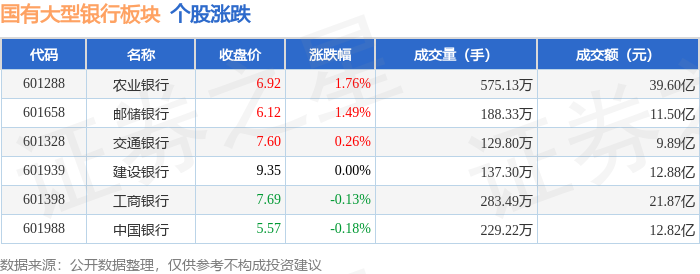
国有大型银行板块8月14日涨0.65%,农业银行领涨,主力资金净流入3.39亿元
Zheng Xing Xing Ye Ri Bao· 2025-08-14 08:33
证券之星消息,8月14日国有大型银行板块较上一交易日上涨0.65%,农业银行领涨。当日上证指数报收 于3666.44,下跌0.46%。深证成指报收于11451.43,下跌0.87%。国有大型银行板块个股涨跌见下表: | 代码 | 名称 | 主力净流入(元) | 主力净占比 游资净流入 (元) | | 游资净占比 散户净流入 (元) | | 散户净占比 | | --- | --- | --- | --- | --- | --- | --- | --- | | 601288 农业银行 | | 3.52亿 | 8.90% | -2.17 乙 | -5.49% | -1.35 Z | -3.41% | | 601658 邮储银行 | | 4546.06万 | 3.95% | 9535.90万 | 8.29% | -1.41 亿 | -12.25% | | 601328 交通银行 | | 2035.43万 | 2.06% | -2907.05万 | -2.94% | 871.61万 | 0.88% | | 601939 建设银行 | | 862.77万 | 0.67% | -1.07亿 | -8.29% | 9820. ...

重大利好,如何享受?看完这篇,立刻学会
天天基金网· 2025-08-14 05:09
Core Viewpoint - The article discusses the implementation plan for the personal consumption loan interest subsidy policy aimed at supporting resident consumption from September 1, 2025, to August 31, 2026, detailing eligibility, subsidy rules, and application processes [1]. Summary by Sections Support Scope - The policy applies to personal consumption loans issued by recognized financial institutions, excluding credit card transactions, where the loan is used for actual consumption. Eligible consumption includes both small daily expenses and larger purchases such as vehicles, home renovations, and electronics. Each individual can receive a maximum subsidy of 500 yuan per transaction, with multiple transactions eligible for cumulative benefits [2]. Subsidy Rules - For transactions under 50,000 yuan, the subsidy is calculated based on the actual amount, with a maximum of 1,000 yuan for multiple transactions at the same institution. For transactions over 50,000 yuan, the subsidy is capped at 3,000 yuan, calculated based on a maximum of 50,000 yuan per transaction. The policy may be extended or expanded based on its effectiveness [3]. Loan Processing Institutions - The policy is limited to 23 recognized financial institutions, including 18 banks and 5 other personal consumption loan providers. The policy supports reasonable borrowing needs and actual consumption behaviors, excluding any non-consumption or fraudulent activities [4]. Subsidy Standards - The average interest rate for personal consumption loans is around 3%. The subsidy rate is set at 1 percentage point, which is approximately one-third of the current commercial bank loan rates, with the central and provincial governments covering 90% and 10% of the subsidy, respectively [5]. Cumulative Subsidy Limits - Each borrower can receive a total subsidy of up to 3,000 yuan from one institution, corresponding to a cumulative consumption amount of 300,000 yuan. For loans under 50,000 yuan, the maximum cumulative subsidy is 1,000 yuan, linked to a consumption amount of 100,000 yuan [6]. Key Areas for Subsidy - The subsidy focuses on several key areas, including household vehicles, home renovations, electronic products, health care, and education training, among others [7][11]. Application Process - Borrowers must authorize the loan processing institution to access transaction information when applying for a personal consumption loan. Existing loans can also be adjusted through supplementary agreements. The institution will calculate the subsidy based on actual consumption and apply it directly to the interest payments, simplifying the process for borrowers [8][9]. Administrative Efficiency - To reduce the burden on borrowers and enhance policy effectiveness, the calculation and application of subsidy funds are primarily managed by the loan processing institutions and local government departments, minimizing additional steps for borrowers [9].





六大行,集体官宣
天天基金网· 2025-08-14 05:09
Core Viewpoint - The article discusses the implementation of a fiscal subsidy policy for personal consumption loans, initiated by the Ministry of Finance, the People's Bank of China, and the Financial Regulatory Bureau, aimed at boosting consumer confidence and stimulating domestic demand [1][24]. Group 1: Implementation of the Policy - The Agricultural Bank of China announced that it will implement the subsidy for eligible personal consumption loans starting from September 1, 2025, following market-oriented and legal principles [2]. - Postal Savings Bank is actively organizing the implementation of the fiscal subsidy policy for personal consumption loans and service industry loans, ensuring that the benefits reach consumers efficiently [4]. - The Bank of Communications stated it will comply with the policy and streamline the loan application process for eligible personal consumption loans [6]. Group 2: Other Banks' Responses - The Industrial and Commercial Bank of China is progressing with the fiscal subsidy work in an orderly manner, ensuring no service fees are charged for the loan subsidy process [8]. - The Bank of China will begin the fiscal subsidy for eligible personal consumption loans on September 1, 2025, aiming to stimulate consumer potential [11]. - China Construction Bank is also set to implement the subsidy for qualifying customers starting September 1, 2025 [14]. Group 3: Broader Participation - Several other banks, including Shanghai Pudong Development Bank, China Merchants Bank, and Guangfa Bank, have announced their commitment to implementing the personal consumption loan subsidy policy [16][18][21]. - A total of 23 financial institutions have been selected as loan processing agencies, including six major state-owned banks and twelve national joint-stock commercial banks [24].

多家银行宣布:个人补贴9月份开始
Da Zhong Ri Bao· 2025-08-14 02:35
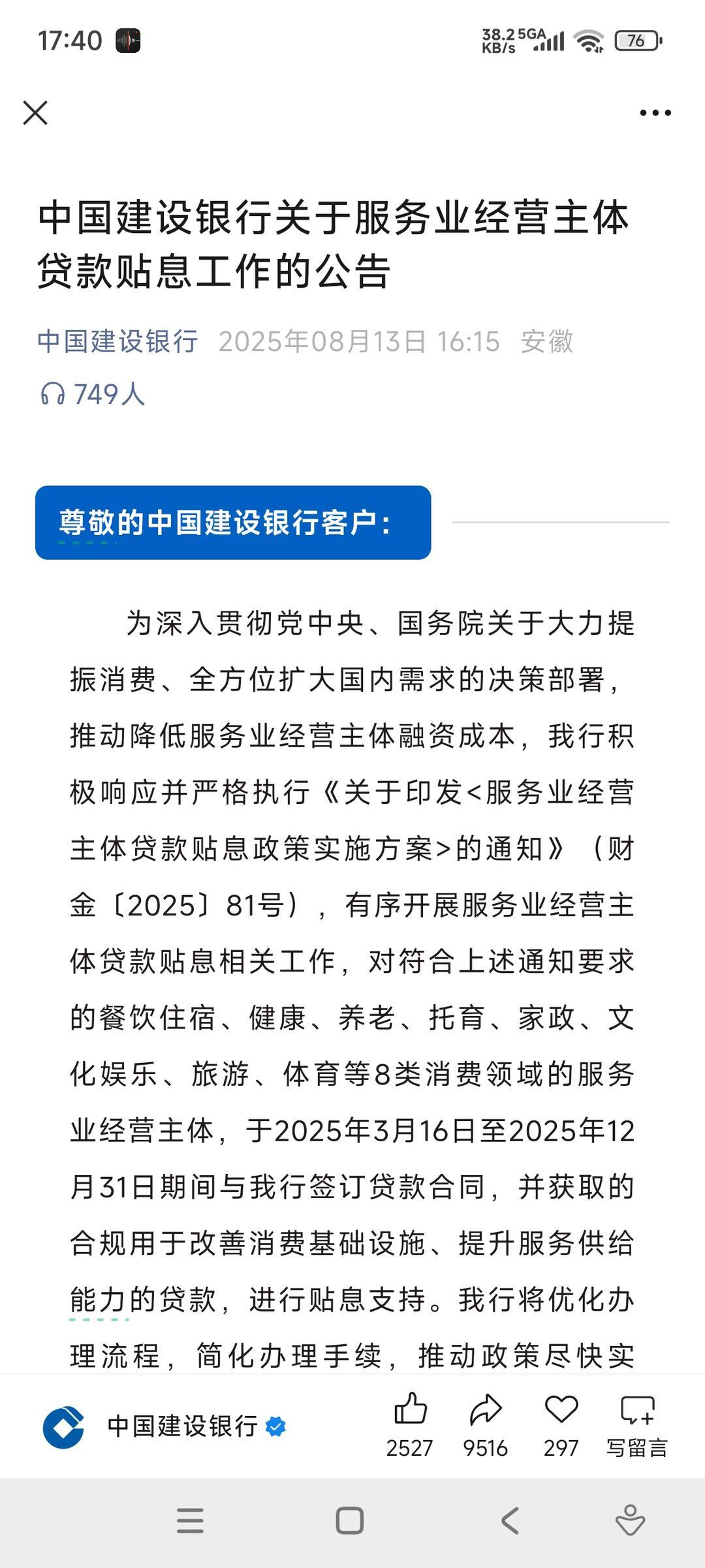
8月13日,包括交通银行和建设银行在内的多家银行公告称,将依法合规推进个人消费贷款与服务业经营主体贷款贴息工作。部分银行表示,将自9月1日 起,对符合要求的客户进行贴息。 建设银行在公告中表示,为落实党中央、国务院决策部署,进一步支持提振和扩大消费,激发消费潜力,提升市场活力,降低居民消费信贷成本,积极响 应并严格执行《关于印发〈个人消费贷款财政贴息政策实施方案〉的通知》(财金〔2025〕80号),有序开展个人消费贷款贴息相关工作。自9月1日起, 对符合上述通知要求的客户进行贴息。 业经营主体贷款贴息工作的公告 交通银行 2025年08月13日 09:48 上海 ( 20人 尊敬的客户: 为深入贯彻落实党中央、国务院决策部署, 有效降低居民信贷成本和服务业经营主体融 资成本, 充分激发消费潜力、提升市场活 力,我行积极响应并严格执行《关于印发< 个人消费贷款财政贴息政策实施方案>的通 知》(财金〔2025〕80号)和《关于印发 <服务业经营主体贷款贴息 ּ政策实施方案> 的通知》(财金〔2025〕81号)精神及相 关要求,依法合规推进个人消费贷款与服务 业经营主体贷款贴息工作。 我行将坚持市场化、法治化原则, ...