LGWH(601599)

Search documents
浙文影业:公司主出品的《谁杀了画眉鸟》、《有间客栈》已杀青并进入后期制作阶段
Mei Ri Jing Ji Xin Wen· 2025-07-30 12:04
Group 1 - The company has announced its upcoming film production and sales plans for the second half of this year and the first half of next year [2] - The main productions include the ancient suspense short drama "Who Killed the Painted Bird" and the youth healing micro-drama "There is a Guesthouse," both of which have completed filming and are in post-production [2] - The company is also set to release the female reality-themed film "The Next Typhoon" at a future date [2] Group 2 - The company will continue to advance the creation of other film projects, including "The Window with a View" and "Southern Has Good Trees," aiming to produce high-quality artistic works that achieve dual effectiveness [2]


浙文影业(601599)7月30日主力资金净流出1137.84万元
Sou Hu Cai Jing· 2025-07-30 10:59
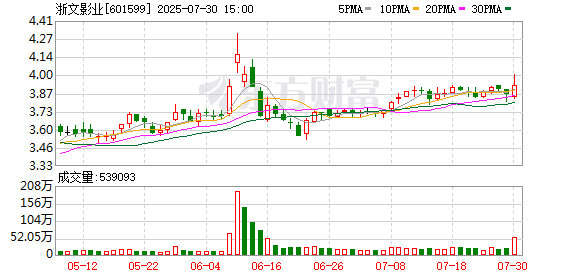
天眼查商业履历信息显示,浙文影业集团股份有限公司,成立于2002年,位于杭州市,是一家以从事广 播、电视、电影和录音制作业为主的企业。企业注册资本116054.2453万人民币,实缴资本116054.2453 万人民币。公司法定代表人为傅立文。 通过天眼查大数据分析,浙文影业集团股份有限公司共对外投资了25家企业,参与招投标项目680次, 知识产权方面有商标信息46条,专利信息170条,此外企业还拥有行政许可14个。 来源:金融界 金融界消息 截至2025年7月30日收盘,浙文影业(601599)报收于3.93元,上涨1.81%,换手率4.65%, 成交量53.91万手,成交金额2.12亿元。 资金流向方面,今日主力资金净流出1137.84万元,占比成交额5.37%。其中,超大单净流出1030.85万 元、占成交额4.87%,大单净流出106.99万元、占成交额0.51%,中单净流出流入1799.75万元、占成交 额8.5%,小单净流出661.91万元、占成交额3.13%。 浙文影业最新一期业绩显示,截至2025一季报,公司营业总收入7.81亿元、同比增长26.78%,归属净利 润3917.55万元,同比增长 ...
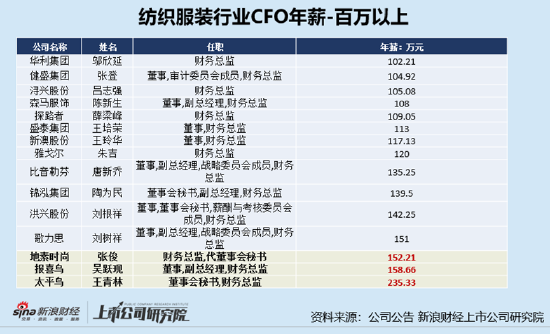
纺织行业上市公司财务总监PK:华孚时尚王国友61岁大专学历、为纺织行业年龄最大财务总监
Xin Lang Zheng Quan· 2025-07-30 06:56
Summary of Key Points Core Viewpoint - The report highlights the significant role of CFOs in A-share listed companies, emphasizing their influence on financial health, strategic decision-making, and overall company performance. The total compensation for CFOs in A-shares reached 4.243 billion yuan, with an average salary of 760,300 yuan [1]. Group 1: CFO Compensation - The highest annual salary for a CFO in the A-share market is 2.3533 million yuan, while the lowest is 81,600 yuan, with the industry average exceeding 500,000 yuan [1]. - A total of 15 listed companies have CFOs earning over 1 million yuan, including companies like Taiping Bird, Baoxini Bird, and Dizuo Fashion, with salaries of 2.3533 million yuan, 1.5866 million yuan, and 1.5221 million yuan respectively [1]. Group 2: CFO Demographics - The majority of CFOs in the industry hold a bachelor's degree, but among the 15 CFOs earning over 1 million yuan, most have a master's degree. Only 5 have a diploma or bachelor's degree [4]. - The average age of CFOs is over 40, with the youngest being Lin Guixian from ST Jinbi, born in 1991, making him 34 years old. The youngest among the high-earning CFOs is Hu Xinyan from Huali Group, born in 1989, at 36 years old [4]. Group 3: Company Performance - Among the companies paying over 1 million yuan in CFO salaries, only 5 experienced a decline in revenue, with year-on-year decreases of 21.18% for Shengtai Group, 3.29% for Jinhong Group, 16.23% for Dizuo Fashion, 1.91% for Baoxini Bird, and 12.7% for Taiping Bird [4].


A股纺织制造板块震荡上升,联发股份封板涨停,华升股份涨超4%,欣龙控股、浙文影业、南山智尚、浔兴股份等跟涨。
news flash· 2025-07-16 01:50
Group 1 - The A-share textile manufacturing sector is experiencing a volatile upward trend, with Lianfa Co., Ltd. hitting the daily limit and achieving a涨停 (limit-up) [1] - Huasheng Co., Ltd. has seen an increase of over 4% in its stock price [1] - Other companies such as Xinlong Holdings, Zhejiang Wenyi, Nanshan Zhishang, and Xunxing Co., Ltd. are also witnessing stock price increases [1]



趋势研判!2025年中国纺织面料行业发展现状及发展趋势分析:纺织面料的发展将更注重功能性和环保性,新型纤维和技术的应用将不断扩大[图]
Chan Ye Xin Xi Wang· 2025-06-30 01:28
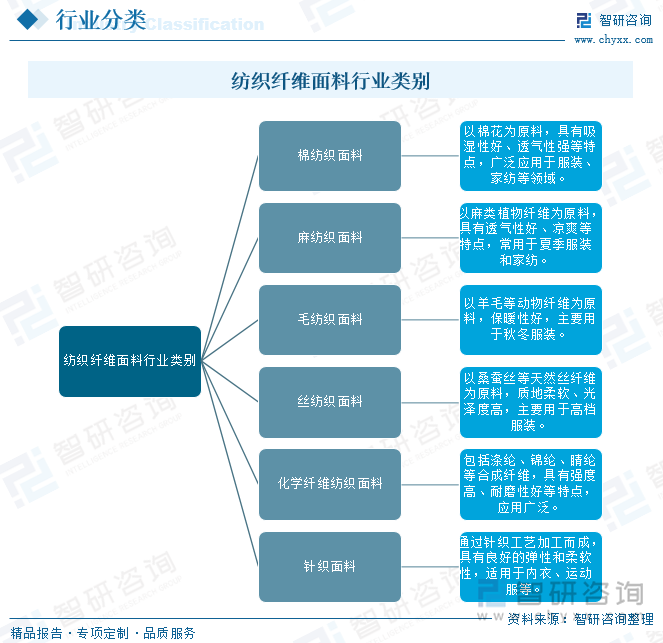
Core Insights - The textile fiber fabric industry is crucial for manufacturing fabrics and garments, divided into natural fiber fabrics and chemical fiber fabrics [3][5] - In 2024, China's cotton textile industry is projected to generate revenue of 1,141.86 billion yuan, accounting for 61.40% of the textile industry, while the chemical textile industry is expected to generate 247.88 billion yuan, representing 13.33% [6][8] - The development of the textile fabric industry is increasingly focused on functionality and environmental sustainability, with the application of new fibers and technologies expanding [22] Industry Definition and Classification - Textile fiber fabrics are elongated materials used for making fabrics and garments, categorized into natural fiber fabrics and chemical fiber fabrics [3] - Natural fibers are favored for their environmental friendliness and comfort, while chemical fibers are essential for their strength and durability [3] Current Development Status - The textile industry has evolved significantly since the Neolithic era, reflecting advancements in technology, art, culture, and economy [5] - The industrial revolution greatly enhanced production efficiency and quality, with cotton becoming a key textile raw material [5] - The 21st century presents new challenges and opportunities, emphasizing sustainable practices and the emergence of innovative materials like nanofibers and smart textiles [5] Industry Chain Structure - The textile fabric industry chain consists of upstream natural fibers (cotton, linen, silk, wool) and chemical fibers (polyester, nylon), midstream fabric production, and downstream applications in clothing, home textiles, and industrial textiles [10] Market Size and Growth - The market size for industrial textiles in China is projected to reach 332.44 billion yuan in 2024, with total industry output valued at 597.74 billion yuan [14] - The silk industry is expected to generate approximately 76.59 billion yuan in revenue in 2024, with a year-on-year growth of 5.75% [12] Competitive Landscape - The textile fabric industry in China is characterized by a diverse and fragmented competitive landscape, with key players including Zhejiang Xin'ao Textile Co., Ltd., Hengli Petrochemical Co., Ltd., and others [16] - Major companies are focusing on product innovation and sustainability, with significant investments in technology and brand development [18] Future Trends - The development of textile fabrics is increasingly influenced by new materials and technologies, emphasizing diversification, functionality, lightweight, and environmental sustainability [22] - The industry is expected to continue evolving to meet consumer demands for high-quality, eco-friendly products [22]


220只股中线走稳 站上半年线
Zheng Quan Shi Bao Wang· 2025-06-09 07:28
Market Overview - The Shanghai Composite Index closed at 3399.77 points, above the six-month moving average, with a gain of 0.43% [1] - The total trading volume of A-shares reached 13126.55 billion yuan [1] Stocks Breaking the Six-Month Moving Average - A total of 220 A-shares have surpassed the six-month moving average today [1] - Notable stocks with significant deviation rates include: - Qitian Technology: 8.76% deviation, closing price at 14.00 yuan, with a daily gain of 16.86% and turnover rate of 21.88% [1] - Haochen Medical: 8.62% deviation, closing price at 3.12 yuan, with a daily gain of 9.86% and turnover rate of 7.25% [1] - Guangyun Technology: 8.13% deviation, closing price at 14.22 yuan, with a daily gain of 9.89% and turnover rate of 6.59% [1] Additional Stocks with Minor Deviations - Stocks with smaller deviation rates that have just crossed the six-month moving average include: - CITIC Special Steel: minor deviation, closing price at 20.30 yuan, with a daily gain of 10.69% [1] - Nanda Optoelectronics: minor deviation, closing price at 36.44 yuan, with a daily gain of 9.99% [1] -沃尔核材: minor deviation, closing price at 25.41 yuan, with a daily gain of 11.75% [1]


重磅!2025年中国及31省市纺织行业政策汇总及解读(全)“纺织行业加速推进高端化”
Qian Zhan Wang· 2025-06-09 02:23
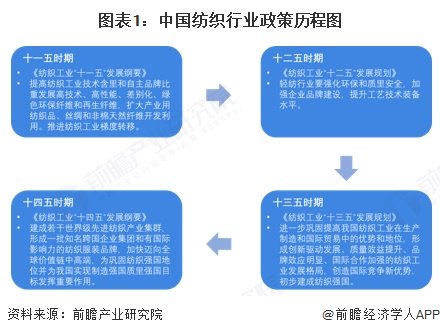
Core Viewpoint - The article discusses the evolution and current policies of China's textile industry, emphasizing the government's support for digital transformation, quality improvement, and sustainable development to enhance the industry's global competitiveness and achieve the goals of becoming a manufacturing and quality powerhouse [1][3]. Policy Evolution - During the "11th Five-Year Plan," the focus was on increasing the technological content and brand proportion in the textile industry, promoting high-tech and environmentally friendly fibers, and expanding the use of non-cotton natural fibers [1]. - The "12th Five-Year Plan" emphasized environmental protection, quality safety, and brand building within the light textile industry [1]. - The "13th Five-Year Plan" aimed to consolidate China's advantages in textile manufacturing and international trade, establishing the country as a textile powerhouse [1]. - The "14th Five-Year Plan" seeks to elevate the textile industry to a higher position in the global value chain, contributing to the goals of becoming a manufacturing and quality strong nation [1]. National Policy Summary and Interpretation - Recent national policies, such as the "Three-Year Action Plan for Digital Transformation of the Textile Industry (2022-2024)" and the "Implementation Plan for Quality Improvement and Upgrading of the Textile Industry (2023-2025)," provide a favorable macro environment and policy support for the industry's development [3][4]. - These policies aim to promote healthy and rapid development across various segments of the textile supply chain and enhance the industry's global competitiveness [3]. Key Policy Details - The "Implementation Plan" outlines goals for 2025, including: - R&D expenditure intensity of 1.3% for large-scale textile enterprises [8]. - 70% of large-scale textile enterprises achieving digital networking [8]. - Reduction in energy and water consumption per unit of industrial added value, along with continuous decreases in major pollutant emissions [8]. - Improvement in the quality and scale of recycled textile products, aiming to establish 20 globally recognized brands [8]. Key Tasks and Focus Areas - Accelerate innovation-driven development and enhance independent innovation capabilities by focusing on key technology breakthroughs and establishing industry innovation platforms [9]. - Promote high-end manufacturing in textiles and expand the application of functional chemical fibers across various sectors of the economy [9]. - Develop smart manufacturing and improve industry quality and efficiency through the adoption of digital technologies [9]. - Advance green and circular low-carbon development by promoting energy-saving and pollution-reducing technologies [9]. - Enhance the resilience of the supply system to meet and lead fashion consumption upgrades [9]. - Optimize regional industrial layouts and foster open cooperation within the textile industry [9]. Provincial Policy Summary - Various provinces have introduced policies to support the development of the textile industry, focusing on high-quality growth, digital transformation, and the promotion of environmentally friendly materials [12][14]. - For example, Guangdong aims to enhance the digital transformation of its textile industry by 2025, achieving over 60% integration of digital technologies [16].
【投资视角】启示2025:中国纺织行业投融资及兼并重组分析(附投融资事件、产业基金和兼并重组等)
Qian Zhan Wang· 2025-05-29 08:10
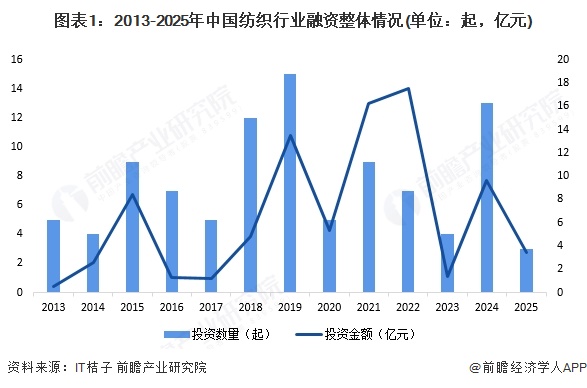
Group 1 - The textile industry in China has experienced fluctuations in investment and financing, with a peak in 2019 and a decline starting in 2020, leading to a total of 13 financing events and an investment amount of 9.65 billion yuan in 2024 [1][20] - Investment rounds in the textile industry are primarily early-stage, focusing on A-round, angel, and strategic investments, indicating a trend towards resource integration and industry chain extension [2] - The majority of financing events are concentrated in Guangdong and Zhejiang provinces, with 21 events each, due to their complete textile industry chain and mature market environment [5] Group 2 - The focus of investment in the textile industry is shifting towards new textile materials, reflecting a strategic direction in the sector [7] - The investment entities in the textile industry are predominantly capital organizations, accounting for 74%, with notable investors including Shenchuang Investment and SoftBank China Capital [11] - There are several textile-related private equity funds established, indicating a growing interest in the sector [14] Group 3 - Horizontal mergers and acquisitions among midstream textile companies have become mainstream as a strategy to expand scale amid intense competition [16][18] - Recent merger and acquisition activities include significant transactions, such as the acquisition of 100% of Longrun Materials by Jiulong Recycling [17] - The overall trend in the textile industry indicates a focus on consolidation through mergers and acquisitions to enhance competitiveness [20]

2025年全球纺织发展现状分析:2024年全球纺织行业产值达1.07万亿美元
Qian Zhan Wang· 2025-05-25 05:06
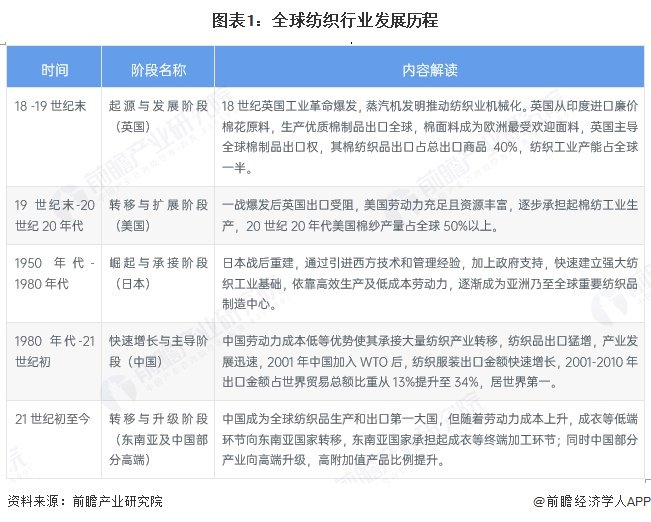
Core Insights - The global textile industry is experiencing a shift towards Southeast Asia, while parts of China's textile sector are upgrading to high-end production [1][4][5] Group 1: Historical Development - The textile industry originated during the 18th century with the British Industrial Revolution, where steam engines significantly increased production efficiency [2] - By the late 19th century, the U.S. began to take over cotton textile production due to labor and resource advantages, with U.S. cotton yarn production exceeding 50% of global output by the 1920s [2] - Japan established a strong textile industry post-World War II through Western technology and government support, becoming a key manufacturing center [2] - China emerged as the world's largest textile producer and exporter in the early 21st century, with textile and apparel exports rising from 13% to 34% of global trade from 2001 to 2010 [2] - Currently, as labor costs rise in China, low-end production is shifting to Southeast Asian countries, while China focuses on high-value products [2][4] Group 2: Market Size and Growth - The global textile industry market value is projected to reach $1.07 trillion in 2024, reflecting a year-on-year growth of approximately 2% [4][5] - The number of companies in the global textile market is estimated at 2.731 million, indicating a significant market presence [5] Group 3: Fiber Production - Global fiber production reached a record high of 124 million tons in 2023, up from 116 million tons in 2022, with polyester fibers accounting for 57% of total fiber production [7] Group 4: Market Structure - The global textile industry exhibits a low concentration level, characterized by a long-tail feature and fragmented competition, with over 3 million registered companies [10] - In the home textile sector, the top three companies hold only 2.31% market share, indicating a highly competitive environment [10] Group 5: Regional Contribution - East Asia dominates the global textile industry, accounting for $717.7 billion, or 66.89% of the total market value [12]
2025年中国纺织行业经营效益分析:行业盈利能力减弱,毛利率周期性波动显著
Qian Zhan Wang· 2025-05-21 07:12
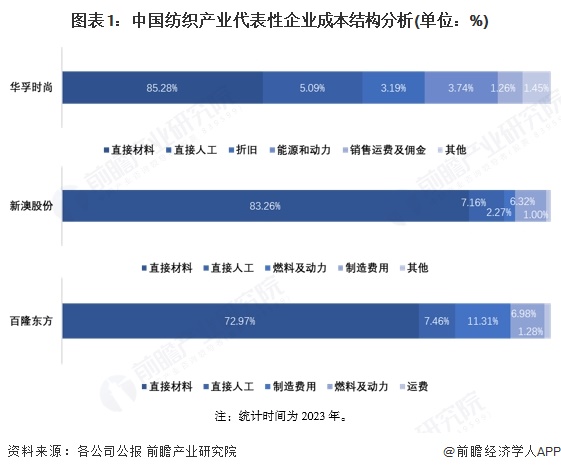
Group 1: Cost Structure Analysis - In the textile industry, direct material costs constitute the primary component of production costs, accounting for approximately 70%-85% of total costs, which significantly impacts pricing and profitability [1][4] - Fluctuations in raw material prices have a notable effect on cost control and profitability, leading companies to adopt strategies such as centralized purchasing, hedging, and advance stocking to mitigate risks [1] Group 2: Price Transmission Mechanism - The textile industry operates through a supply, manufacturing, and sales chain, where costs from the supply side, including raw materials and labor, are transmitted to the manufacturing side as production costs, which then influence consumer pricing through demand elasticity [4] Group 3: Value Distribution in the Textile Industry - Sales represent the most critical segment of the textile value chain, with downstream apparel and home textile brands holding significant bargaining power, while upstream suppliers have limited negotiation capabilities, resulting in intense price competition and low profitability for textile manufacturers [6] Group 4: Industry Operating Efficiency - From 2015 to 2023, the total profit of China's textile industry has shown a downward trend, indicating weakened profitability; however, in 2024, the total profit for textile enterprises (excluding apparel and chemical fiber) is projected to reach 86.87 billion yuan, reflecting a year-on-year increase of 3.5% after two consecutive years of decline [10] Group 5: Profitability of Textile Enterprises - The gross profit margin in the textile industry exhibits significant quarterly cyclicality, typically fluctuating between 10% and 12%, with November generally showing higher margins above 11%, while May and August tend to have lower margins due to seasonal production and sales factors [11]