Lushan New Materials(603051)

Search documents
鹿山新材:已发布机器人皮肤新品,暂时没有形成正式订单
Ge Long Hui· 2026-02-24 07:40
Core Viewpoint - The company has launched a new product, a robotic skin, but has not yet secured formal orders for it [1] Group 1 - The company is committed to accelerating its marketization efforts for the new robotic skin product [1] - The company will disclose significant developments in accordance with relevant regulations [1]

鹿山新材(603051.SH):公司太空封装胶膜暂未通过星链认证,也没有向中国星网直接供货
Ge Long Hui· 2026-02-24 07:38
Core Viewpoint - The company, Lushan New Materials (603051.SH), clarified that its space packaging adhesive film has not yet passed the Starlink certification and has not supplied directly to China Star Network, indicating that the related news is untrue [1] Group 1 - The company has not achieved Starlink certification for its space packaging adhesive film [1] - There is no direct supply relationship between the company and China Star Network [1] - The information regarding the company's certification and supply status is incorrect [1]
鹿山新材(603051.SH):已发布机器人皮肤新品,暂时没有形成正式订单
Ge Long Hui· 2026-02-24 07:38
Core Viewpoint - Lushan New Materials (603051.SH) has launched a new robotic skin product, but has not yet secured formal orders. The company is committed to accelerating its marketization efforts and will disclose significant developments in accordance with relevant regulations [1] Group 1 - The company has introduced a new product in the robotic skin segment [1] - There are currently no formal orders for the new product [1] - The company aims to expedite its marketization process [1]
全球航天强国加码太空光伏!卫星组网驱动产业化提速,海内外共振拉升产业估值中枢
Xin Lang Cai Jing· 2026-02-09 10:09
Core Viewpoint - The articles highlight the growing interest and investment in space photovoltaic technology among various companies in China, indicating a significant potential for growth in this sector by 2026 as commercialization accelerates. Group 1: Company Overview - Xizi Clean Energy (002534) is a leading clean energy equipment manufacturer in China, focusing on high-performance perovskite photovoltaic technology and aiming to become a core supplier of materials for space photovoltaics by 2026 [1][24]. - Shanghai Port Construction (605598) is a major infrastructure company that is expanding into space photovoltaic systems, leveraging its engineering capabilities to support commercial space projects [2][25]. - TuoRi New Energy (002218) has a long-standing presence in the photovoltaic industry and is optimizing its space photovoltaic products, expecting to increase market share by 2026 [3][26]. - Mingyang Smart Energy (601615) is acquiring technology to enhance its capabilities in space solar cell development, aiming to integrate its wind and solar energy expertise [4][28]. - Woge Optoelectronics (603773) specializes in flexible solar wing materials for satellites, with a focus on high-temperature resistant films, anticipating significant growth in the space photovoltaic sector [5][29]. Group 2: Growth Outlook - Companies are expected to benefit from the rapid commercialization of space photovoltaics, with projections indicating substantial growth opportunities by 2026 [1][2][3][4][5]. - The synergy between commercial aerospace and space photovoltaic industries is anticipated to drive rapid business growth for companies like Shanghai Port Construction and Mingyang Smart Energy [2][4]. - The demand for flexible solar wings and high-efficiency photovoltaic materials is expected to surge, positioning companies like Woge Optoelectronics and TuoRi New Energy as key players in the market [3][5]. Group 3: Technological Advancements - Companies are focusing on developing materials that can withstand extreme space conditions, such as high-performance perovskite and flexible solar films, which are crucial for the success of space photovoltaic applications [1][5][6]. - The integration of advanced technologies, such as N-type solar cells and high-efficiency components, is being prioritized by firms like Junda Co. (002865) and Sanan Optoelectronics (600703) to enhance their competitive edge in the space photovoltaic market [6][10][35]. - The ongoing research and development efforts in high-efficiency solar technologies are expected to yield breakthroughs that will facilitate the commercialization of space photovoltaic solutions by 2026 [3][4][5][6].



鹿山新材实控人方拟减持 扣非连亏3年A股2募资共11亿
Zhong Guo Jing Ji Wang· 2026-02-09 07:00
Group 1 - The controlling shareholder and actual controller of Lushan New Materials plan to reduce their holdings by up to 4,848,986 shares, which is no more than 3% of the total share capital [1] - The reduction will occur through centralized bidding and block trading, with a maximum of 1,616,328 shares (1% of total share capital) through centralized bidding and 3,232,657 shares (2% of total share capital) through block trading [1] - As of the announcement date, Lushan Information holds 1,810,850 shares (1.12% of total share capital) and Wang Jiasheng holds 47,869,501 shares (29.62% of total share capital) [1] Group 2 - Lushan New Materials expects a net loss of between 74 million yuan and 37 million yuan for the year 2025, compared to a profit in the previous year [2] - The company's projected revenues for 2023 and 2024 are 2.951 billion yuan and 2.067 billion yuan, respectively, with net losses of 86.31 million yuan and a profit of 16.94 million yuan [2] - The net cash flow from operating activities for 2023 and 2024 is projected to be -155 million yuan and 563 million yuan, respectively [2] Group 3 - The company plans to distribute a cash dividend of 0.4 yuan per share and increase its capital by 0.4 shares per share, resulting in a total share capital of 145,967,219 shares after the distribution [3] - The total cash dividend distribution amounts to approximately 41.70 million yuan [3] - The company was listed on the Shanghai Stock Exchange on March 25, 2022, with an initial offering price of 25.79 yuan per share [3] Group 4 - Lushan New Materials has raised a total of 524 million yuan through the issuance of convertible bonds, with a net amount of approximately 513 million yuan after deducting issuance costs [4] - The total fundraising from both the initial public offering and the convertible bond issuance amounts to 1.117 billion yuan [5]
商业航天深度:太空光伏的技术底层逻辑(附29页PPT)
材料汇· 2026-02-08 15:24
Core Viewpoint - The article discusses the emergence of a new era in satellite technology, emphasizing the urgent need for efficient power supply systems for satellites as China prepares to launch a significant number of satellites by the end of 2025 [6][9]. Group 1: Satellite Launch and Development - By the end of 2025, China plans to submit approximately 203,000 satellites to the ITU, covering 14 satellite constellations, with the Radio Innovation Institute applying for two constellations, each with 96,714 satellites, totaling nearly 193,000 satellites [7][8]. - Major operators and commercial satellite companies are also advancing medium-scale constellations, with China Mobile applying for 2,520 satellites, Yuxin Satellite for 1,296, and Guodian Gaoke for 1,132 [8][10]. - As of December 2025, the overall launch completion rate for major domestic constellations remains low, indicating they are in the early stages of network formation [13]. Group 2: Starlink Program and Launch Trends - The Starlink program exhibits a clear generational rhythm, with cumulative launches reaching approximately 11,034 satellites and applications totaling about 41,943 as of January 2026 [2][16]. - The annual launch volume has increased significantly, with projections for 2025 reaching around 3,200 satellites, reflecting a trend of accelerating deployment [15][20]. - Starlink's V1 to V3 satellites utilize crystalline silicon technology to prioritize supply chain scalability and system-level cost reduction, while V4 may adopt P-type silicon HJT or P-type silicon HJT-perovskite tandem structures [3][4]. Group 3: Photovoltaic Technology in Space - The current mainstream technology for space photovoltaic applications in China is multi-junction gallium arsenide (GaAs), although there is ongoing testing and validation of perovskite systems by various companies [4][26]. - The high unit price of GaAs photovoltaic cells is becoming a significant factor limiting system economics, prompting the industry to explore lower-cost alternatives such as silicon-based and perovskite technologies [21][34]. - The article highlights the unique requirements for photovoltaic cells in space, including radiation resistance, thermal stability, and long-term reliability under extreme conditions [22][25]. Group 4: Industry Outlook and Recommendations - The acceleration of satellite launches and the continuous validation of new photovoltaic technologies indicate a rising industry outlook and long-term growth potential for the space photovoltaic sector [5][6]. - The article recommends a "buy" rating for the space photovoltaic industry, citing key companies such as Maiwei Co., Aotewi, and others as relevant investment targets [5][6].



广州鹿山新材料股份有限公司关于控股股东、实际控制人及其一致行动人减持股份计划的公告
Shang Hai Zheng Quan Bao· 2026-02-06 19:24
登录新浪财经APP 搜索【信披】查看更多考评等级 证券代码:603051 证券简称:鹿山新材 公告编号:2026-003 广州鹿山新材料股份有限公司 关于控股股东、实际控制人及其一致行动人减持股份计划的公告 ● 控股股东、实际控制人及其一致行动人持股的基本情况 截至本公告披露日,广州鹿山新材料股份有限公司(以下简称"公司")股东广州市鹿山信息咨询有限公 司(以下简称"鹿山信息")持有公司股份1,810,850股,占公司总股本的1.12%;汪加胜持有公司股份 47,869,501股,占公司总股本的29.62%。上述股份均来源于IPO前及集中竞价交易取得,均为无限售流通 股。鹿山信息是公司控股股东、实际控制人汪加胜先生和韩丽娜女士的一致行动人。 ● 减持计划的主要内容 股东鹿山信息、汪加胜因资金需求,计划自本减持计划公告之日起15个交易日后的3个月内,拟通过集 中竞价和大宗交易方式减持所持有的公司股票,合计减持数量不超过4,848,986股,即不超过公司总股本 的3%。其中:以集中竞价交易方式减持其所持股份不超过1,616,328股,不超过公司总股本的1%,以大 宗交易方式减持其所持股份不超过32,32,657股 ...
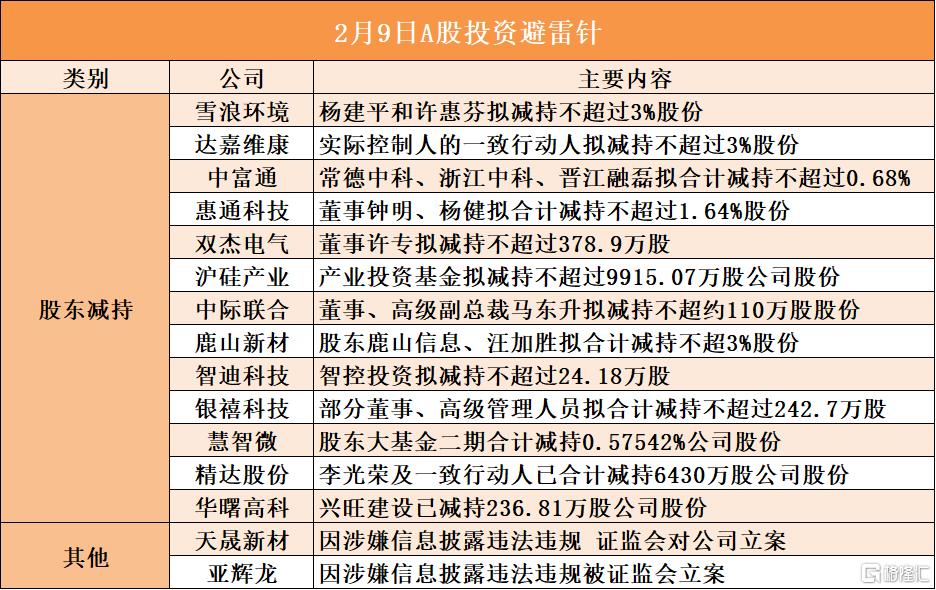
2月9日A股投资避雷针︱天晟新材:因涉嫌信息披露违法违规 证监会对公司立案
Ge Long Hui A P P· 2026-02-06 14:46
Core Viewpoint - Several shareholders across various companies are planning to reduce their stakes, indicating potential shifts in ownership and investor sentiment in the market [1] Shareholder Reductions - Xuelang Environment's shareholders Yang Jianping and Xu Huifen plan to reduce their holdings by no more than 3% [1] - Dajia Weikang's actual controller's concerted actors also intend to reduce their stakes by no more than 3% [1] - Zhongfutong's shareholders, including Changde Zhongke, Zhejiang Zhongke, and Jinjiang Ronglei, plan to collectively reduce their holdings by no more than 0.68% [1] - Huitong Technology's directors Zhong Ming and Yang Jian plan to reduce their stakes by no more than 1.64% [1] - Shuangjie Electric's director Xu Zhuan intends to reduce his holdings by no more than 378.9 thousand shares [1] - Hu Silicon Industry's shareholder investment fund plans to reduce its holdings by no more than 99.15 million shares [1] - Zhongji United's director and senior vice president Ma Dongsheng plans to reduce his holdings by no more than approximately 110 thousand shares [1] - Lushan New Materials' shareholders Lushan Information and Wang Jiasheng plan to collectively reduce their stakes by no more than 3% [1] - Zhidi Technology's Zhikong Investment plans to reduce its holdings by no more than 24.18 thousand shares [1] - Yinxin Technology's directors and senior management plan to collectively reduce their holdings by no more than 242.7 thousand shares [1] - Huizhi Micro's shareholder Great Fund Phase II plans to reduce its holdings by 0.57542% [1] - Jingda Shares' shareholder Li Guangrong and concerted actors have already collectively reduced their holdings by 64.3 million shares [1] - Huashu High-tech's shareholder Xingwang Construction has reduced its holdings by 236.81 thousand shares [1] Regulatory Actions - Tiansheng New Materials is under investigation by the China Securities Regulatory Commission (CSRC) for suspected violations of information disclosure [1] - Yahui Long is also under investigation by the CSRC for suspected violations of information disclosure [1]


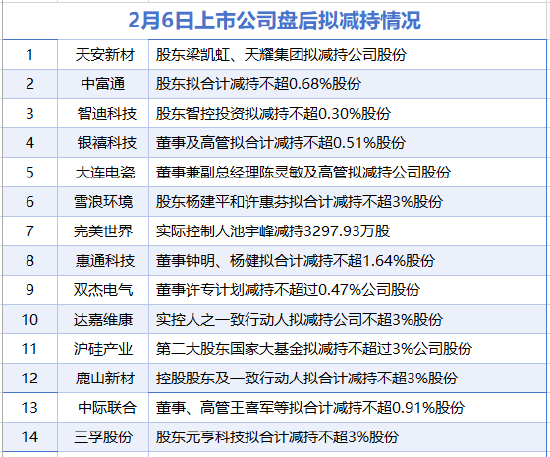
2月6日增减持汇总:天安新材等14家公司拟减持 当日无A股增持(表)




Xin Lang Cai Jing· 2026-02-06 13:55
Summary of Key Points Core Viewpoint - On February 6, 14 A-share listed companies disclosed plans for share reductions, with no companies announcing share increases on the same day [1][3]. Group 1: Companies Disclosing Share Reductions - Tianan New Materials: Shareholders Liang Kaihong and Tianyao Group plan to reduce their holdings [2][4]. - Zhongfutong: Shareholders plan to reduce a total of up to 0.68% of shares [2][4]. - Zhidi Technology: Shareholder Zhikong Investment intends to reduce up to 0.30% of shares [2][4]. - Yinhui Technology: Directors and executives plan to reduce a total of up to 0.51% of shares [2][4]. - Dalian Electric Porcelain: Vice General Manager Miao Shi and executives plan to reduce their holdings [2][4]. - Xuelang Environment: Shareholders Yang Jianping and Xu Huifen plan to reduce a total of up to 3% of shares [2][4]. - Perfect World: Actual controller Chi Yufeng reduced 32.9793 million shares [2][4]. - Huitong Technology: Directors Zhong Ming and Yang Jian plan to reduce a total of up to 1.64% of shares [2][4]. - Shuangjie Electric: Director Xu Zhuan plans to reduce up to 0.47% of shares [2][4]. - Dajia Weikang: One of the actual controllers plans to reduce up to 3% of shares [2][4]. - Hu Silicon Industry: The second largest shareholder, the National Big Fund, plans to reduce up to 3% of shares [2][4]. - Lushan New Materials: Controlling shareholders and concerted actors plan to reduce a total of up to 3% of shares [2][4]. - Zhongji United: Directors and executives, including Wang Xijun, plan to reduce a total of up to 0.91% of shares [2][4]. - Sanfu Shares: Shareholder Yuanheng Technology plans to reduce a total of up to 3% of shares [2][4].
钙钛矿:迎来GW级量产
GOLDEN SUN SECURITIES· 2026-02-06 13:26
Investment Rating - The report maintains a rating of "Increase" for the industry [4] Core Insights - Perovskite solar cells are entering the era of GW-level mass production, with leading companies like JinkoSolar and LONGi Green Energy accelerating capacity release [2][35] - The efficiency of perovskite cells is rapidly improving, with laboratory efficiencies reaching 27.3% for single-junction cells and 35.0% for perovskite-silicon tandem cells, significantly surpassing the maximum efficiency of silicon cells at 27.9% [15][19] - The cost competitiveness of perovskite cells is expected to improve, with unit production costs projected to drop to 1.0 RMB/W by 2026, potentially surpassing silicon cells [2][35] Summary by Sections Section 1: Perovskite as the Next Generation Photovoltaic Solution - Perovskite solar cells utilize a hybrid organic-inorganic metal halide semiconductor as the light-absorbing material, offering advantages such as high efficiency, low cost, and lightweight [8][11] Section 2: Efficiency and Stability Breakthroughs - The report highlights significant advancements in efficiency and stability, with perovskite cells achieving rapid efficiency improvements compared to silicon cells [15][18] - The industry is overcoming stability challenges through material modifications and process optimizations, with some products achieving IEC commercial standard certification [25][26] Section 3: GW-Level Production Era - The first GW-level production line for perovskite solar cells has been launched, marking the beginning of large-scale production [35] - By 2027, global production capacity is expected to exceed 5GW, with a complete supply chain being established [2][35] Section 4: Investment Recommendations - The report suggests focusing on leading companies in the perovskite supply chain, particularly those with clear capacity deployment and advancements in tandem technology, such as LONGi Green Energy and Trina Solar [3] - Equipment manufacturers with high domestic production rates and sufficient orders, like JinkoSolar and Mibet, are also recommended for investment [3]