
Suzhou Rural Commercial Bank(603323)

Search documents
农商行板块9月24日涨1.75%,渝农商行领涨,主力资金净流出63.98万元
Zheng Xing Xing Ye Ri Bao· 2025-09-24 08:46
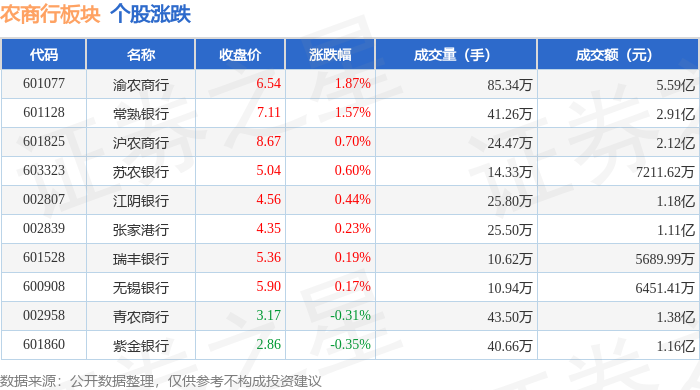
Market Performance - The rural commercial bank sector increased by 1.75% on September 24, with Yunnan Rural Commercial Bank leading the gains [1] - The Shanghai Composite Index closed at 3853.64, up 0.83%, while the Shenzhen Component Index closed at 13356.14, up 1.8% [1] Individual Stock Performance - Yunnan Rural Commercial Bank (601077) closed at 6.54, up 1.87% with a trading volume of 853,400 shares and a transaction value of 559 million [1] - Changshu Bank (601128) closed at 7.11, up 1.57% with a trading volume of 412,600 shares and a transaction value of 291 million [1] - Shanghai Rural Commercial Bank (601825) closed at 8.67, up 0.70% with a trading volume of 244,700 shares and a transaction value of 212 million [1] - Jiangyin Bank (002807) closed at 4.56, up 0.44% with a trading volume of 258,000 shares and a transaction value of 118 million [1] - Qingnong Commercial Bank (002958) closed at 3.17, down 0.31% with a trading volume of 435,000 shares and a transaction value of 138 million [1] Fund Flow Analysis - The rural commercial bank sector experienced a net outflow of 639,800 yuan from main funds, while retail funds saw a net inflow of 28.92 million yuan [1] - Individual stock fund flows showed that Changshu Bank had a main fund net inflow of 22.92 million yuan, while Yunnan Rural Commercial Bank had a net inflow of 9.09 million yuan from main funds [2] - Jiangyin Bank experienced a significant net outflow of 18.43 million yuan from main funds, indicating a potential concern among investors [2]


上市银行中期分红成新风尚!17家银行派发“红包”
Huan Qiu Wang· 2025-09-23 08:34
Core Viewpoint - The mid-term dividend plans of A-share listed banks for 2025 are progressing steadily, reflecting confidence in development and returning value to investors [1] Group 1: Mid-term Dividend Distribution - As of September 22, 17 A-share listed banks have disclosed their mid-term profit distribution plans, with major state-owned commercial banks being the main contributors, each proposing dividends exceeding 10 billion [2] - Notably, Changsha Bank has implemented its first mid-term dividend since its listing, with a payout of 0.20 yuan per share totaling 804 million [2] - The six major state-owned banks maintain a dividend payout ratio around 30%, showcasing their commitment to stable operations and shareholder returns [2] Group 2: Industry Trends and Insights - The participation and enthusiasm for mid-term dividends among listed banks have significantly increased in 2025, becoming a new trend in the industry [4] - Experts attribute this trend to improved bank performance, corporate governance, and market confidence, indicating a strong belief in future profitability [4] - The implementation of mid-term dividends is seen as a proactive measure to boost investor confidence and manage valuations [4] Group 3: Sustainability and Future Outlook - The widespread adoption of mid-term dividends is expected to enhance investor returns and attract long-term capital, fostering a positive market cycle [5] - Experts predict that with the continuous improvement of the macro economy, the profitability of the banking sector is likely to improve steadily, supporting the expansion of dividend scales [5] - Factors such as easing interest margin pressures and the growth of non-interest income from wealth management are expected to further enhance the stability of bank earnings [5]


金融ETF(510230)午前翻红,涨超0.5%!机构:银行中期分红助力板块估值修复
Mei Ri Jing Ji Xin Wen· 2025-09-23 05:43
Core Viewpoint - The financial ETF (510230) has seen a rise of over 0.5%, supported by mid-term dividend announcements from banks, which are aiding in the valuation recovery of the sector [1] Group 1: Dividend Announcements - Changsha Bank announced a dividend of 0.20 CNY per share (before tax), totaling 804 million CNY in payouts [1] - Shanghai Rural Commercial Bank declared a dividend of 0.241 CNY per share (before tax), with total distributions amounting to 2.324 billion CNY [1] - By September 19, 2025, four banks, including Minsheng Bank, Jiangsu Rural Bank, Changsha Bank, and Shanghai Rural Commercial Bank, have released specific mid-term dividend plans [1] Group 2: Market Impact - The gradual rollout of mid-term dividends by listed banks is expected to attract more financial investments from funds that prioritize dividends, thereby driving the recovery of the banking sector's valuations [1] - The financial ETF (510230) tracks the 180 Financial Index (000018), which selects representative securities from the financial sector, including banks, insurance, and securities, to reflect the overall performance of listed companies in the financial industry [1] - The 180 Financial Index is characterized by high industry concentration and style allocation, effectively representing market trends in the financial sector [1]
上市银行中期分红计划稳步推进
Zheng Quan Ri Bao· 2025-09-22 16:31
Core Viewpoint - The mid-term dividend distribution among A-share listed banks is progressing, with several banks announcing their plans for 2025, indicating a positive trend in the banking sector's profitability and governance [1][4]. Group 1: Dividend Announcements - Recently, Hu Nong Commercial Bank and Changsha Bank announced their mid-term cash dividends, totaling 3.128 billion yuan, with Hu Nong distributing 2.324 billion yuan and Changsha distributing 804 million yuan [1][2]. - As of September 22, 17 banks have disclosed their mid-term profit distribution plans for 2025, with several banks, including Changsha Bank and Ningbo Bank, implementing mid-term dividends for the first time since their listings [1][4]. Group 2: Dividend Distribution Details - Hu Nong Commercial Bank's cash dividend is based on a total share capital of 9.644 billion shares, distributing 0.241 yuan per share, while Changsha Bank's distribution is based on 4.022 billion shares at 0.20 yuan per share [2]. - In September, three other banks, including Changshu Bank and Minsheng Bank, completed their mid-term dividend distributions, totaling 6.633 billion yuan [2]. Group 3: Dividend Ratios and Trends - The six major state-owned commercial banks have a cash dividend ratio of around 30%, with some city commercial banks and rural commercial banks exceeding this level [3]. - The expansion of mid-term dividends among listed banks reflects a recovery in bank performance, providing sufficient profit space for such distributions [4]. Group 4: Market Implications - Analysts suggest that mid-term dividends enhance predictability, boost investor confidence, and improve valuations, supported by the current strong performance of listed banks [4]. - The overall improvement in bank performance, driven by easing interest margin pressures and growth in non-interest income, is expected to sustain and potentially increase dividend distributions in the future [4][5].



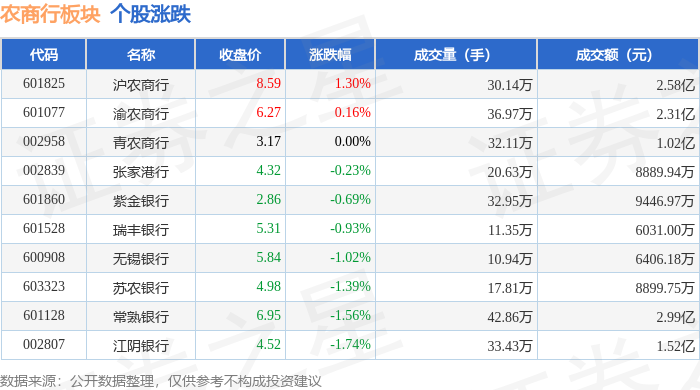
农商行板块9月22日涨0.05%,沪农商行领涨,主力资金净流入6130.1万元
Zheng Xing Xing Ye Ri Bao· 2025-09-22 08:47
Market Performance - On September 22, the rural commercial bank sector rose by 0.05% compared to the previous trading day, with Shanghai Rural Commercial Bank leading the gains [1] - The Shanghai Composite Index closed at 3828.58, up 0.22%, while the Shenzhen Component Index closed at 13157.97, up 0.67% [1] Individual Stock Performance - Shanghai Rural Commercial Bank (601825) closed at 65.8, with a gain of 1.30% and a trading volume of 301,400 shares, amounting to a transaction value of 258 million yuan [1] - Other notable performances include: - Chongqing Rural Commercial Bank (601077) at 6.27, up 0.16% [1] - Qingdao Rural Commercial Bank (002958) at 3.17, unchanged [1] - Zhangjiagang Bank (002839) at 4.32, down 0.23% [1] - Zijin Bank (601860) at 2.86, down 0.69% [1] - Ruifeng Bank (601528) at 5.31, down 0.93% [1] - Wuxi Bank (600908) at 5.84, down 1.02% [1] - Sunong Bank (603323) at 4.98, down 1.39% [1] - Changshu Bank (601128) at 6.95, down 1.56% [1] - Jiangyin Bank (002807) at 4.52, down 1.74% [1] Capital Flow Analysis - The rural commercial bank sector experienced a net inflow of 61.3 million yuan from institutional investors, while retail investors saw a net inflow of 291,200 yuan [1] - Notable capital flows for individual stocks include: - Shanghai Rural Commercial Bank had a net outflow of 35.5 million yuan from institutional investors [2] - Zijin Bank saw a net inflow of 17.5 million yuan from institutional investors [2] - Changshu Bank had a net inflow of 13.0 million yuan from institutional investors [2] - Wuxi Bank had a net inflow of 10.6 million yuan from institutional investors [2] - Jiangyin Bank experienced a net outflow of 11.5 million yuan from institutional investors [2]

本周聚焦:三阶段视角:银行资产质量及拨备计提力度如何?
GOLDEN SUN SECURITIES· 2025-09-21 10:34
Investment Rating - The report maintains a positive outlook on the banking sector, suggesting potential investment opportunities due to favorable policy catalysts and improving fundamentals in certain banks [12]. Core Insights - The report highlights the adequacy of loan loss provisions among listed banks, with a provision coverage ratio of 70.8% for Stage 3 loans, indicating limited future impact on profits [2][12]. - It emphasizes the improvement in asset quality, particularly in Stage 3 loans, with notable reductions in the proportion of such loans for several banks compared to the end of Q4 2024 [1][2]. - The report suggests a focus on banks with positive fundamental changes and continuous improvement in financial statements, recommending specific banks for investment [12]. Summary by Sections 1. Loan Quality and Provisioning - The proportion of Stage 3 loans is relatively low for banks like Chengdu Bank (0.66%) and Ningbo Bank (0.76) [1]. - Significant improvements in Stage 3 loan ratios were observed for Chongqing Bank (-61bp) and Guiyang Bank (-48bp) compared to Q4 2024 [1]. - The provision coverage for Stage 3 loans is high, with leading banks like Qingnong Bank (4.35%) and Yunan Bank (4.16%) showing strong provisioning ratios [2]. 2. Financial Assets - The proportion of Stage 3 financial assets is low, with most banks not exceeding 0.05%, indicating manageable asset quality pressure [4]. - The report notes that the provision coverage for financial investments is also robust, with Zhejiang Bank (3.16%) and Qingdao Bank (2.85%) leading in provisioning ratios [8]. 3. Sector Outlook - The report anticipates that expansionary policies aimed at stabilizing the economy will benefit the banking sector, with a focus on banks like Ningbo Bank and Jiangsu Bank for potential investment [12]. - It highlights the ongoing economic recovery and the potential for interest rate cuts, suggesting a sustained dividend strategy for certain banks [12].




上市银行非利息收入高增背后:下半年增速能否持续?
Zhong Guo Jing Ying Bao· 2025-09-20 13:18
Core Insights - The total operating income of 42 listed banks exceeded 2.9 trillion yuan, with net profit surpassing 1.1 trillion yuan in the first half of the year, indicating strong financial performance [1] - Non-interest income has played a crucial role in improving bank performance, with significant growth observed across major state-owned banks and smaller banks [1][2] Group 1: Non-Interest Income Growth - Major banks reported substantial increases in non-interest income, with China Bank at 1141.87 billion yuan (up 26.43%), ICBC at 1135.16 billion yuan (up 6.5%), and CCB at 1075.64 billion yuan (up 19.64%) [2] - The growth in non-interest income is attributed to various factors, including a rise in fees and commissions, which reached 652.18 billion yuan for CCB, and a notable increase in other non-interest income for China Bank, which grew by 42.02% [2][3] Group 2: Factors Influencing Non-Interest Income - Analysts suggest that the high growth rates in non-interest income are due to the normalization of fee income after previous disruptions and a low base effect from last year's capital market activity [3] - The performance of non-interest income in the second half remains uncertain, with potential pressures from market volatility affecting investment income [3] Group 3: Regional Banks and Differentiation - Some regional banks have achieved remarkable growth in non-interest income, such as Changshu Bank with a 57.26% increase and Zhangjiagang Bank with a 140% rise in fee and commission income [4] - Regional banks are encouraged to leverage their local market knowledge to establish differentiated competitive strategies, focusing on wealth management and tailored financing services for local enterprises [5]
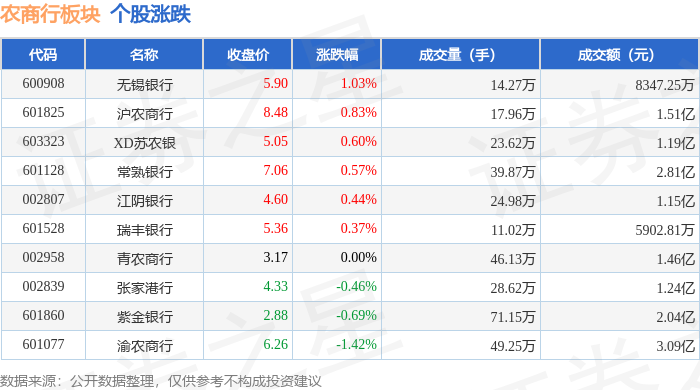
农商行板块9月19日跌0.02%,渝农商行领跌,主力资金净流入9203.16万元
Zheng Xing Xing Ye Ri Bao· 2025-09-19 08:53
Market Overview - On September 19, the rural commercial bank sector experienced a slight decline of 0.02% compared to the previous trading day, with Yunnan Rural Commercial Bank leading the decline [1] - The Shanghai Composite Index closed at 3820.09, down 0.3%, while the Shenzhen Component Index closed at 13070.86, down 0.04% [1] Individual Stock Performance - The following table summarizes the closing prices, percentage changes, and trading volumes of key stocks in the rural commercial bank sector: - Yuanxi Bank: Closed at 5.90, up 1.03%, with a trading volume of 142,700 shares - Shanghai Rural Commercial Bank: Closed at 8.48, up 0.83%, with a trading volume of 179,600 shares - XD Sunan Bank: Closed at 5.05, up 0.60%, with a trading volume of 236,200 shares - Changshu Bank: Closed at 7.06, up 0.57%, with a trading volume of 398,700 shares - Jiangyin Bank: Closed at 4.60, up 0.44%, with a trading volume of 249,800 shares - Ruifeng Bank: Closed at 5.36, up 0.37%, with a trading volume of 110,200 shares - Qingnong Bank: Closed at 3.17, unchanged, with a trading volume of 461,300 shares - Zhangjiagang Bank: Closed at 4.33, down 0.46%, with a trading volume of 286,200 shares - Zijin Bank: Closed at 2.88, down 0.69%, with a trading volume of 711,500 shares - Yunnan Rural Commercial Bank: Closed at 6.26, down 1.42%, with a trading volume of 492,500 shares [1] Fund Flow Analysis - The rural commercial bank sector saw a net inflow of 92.03 million yuan from main funds, while retail funds experienced a net outflow of 44.18 million yuan and 47.85 million yuan respectively [1] - The following table details the fund flow for individual stocks: - Changshu Bank: Main fund net inflow of 37.86 million yuan, retail net outflow of 13.80 million yuan - Yuanxi Bank: Main fund net inflow of 20.16 million yuan, retail net outflow of 13.00 million yuan - Qingnong Bank: Main fund net inflow of 14.38 million yuan, retail net outflow of 10.53 million yuan - Zijin Bank: Main fund net inflow of 9.23 million yuan, retail net outflow of 9.82 million yuan - Shanghai Rural Commercial Bank: Main fund net inflow of 7.25 million yuan, retail net inflow of 0.30 million yuan - Yunnan Rural Commercial Bank: Main fund net inflow of 5.63 million yuan, retail net inflow of 0.37 million yuan - XD Sunan Bank: Main fund net inflow of 3.03 million yuan, retail net outflow of 7.99 million yuan - Jiangyin Bank: Main fund net inflow of 0.90 million yuan, retail net inflow of 2.41 million yuan - Zhangjiagang Bank: Main fund net outflow of 0.76 million yuan, retail net inflow of 0.69 million yuan - Ruifeng Bank: Main fund net outflow of 5.63 million yuan, retail net inflow of 4.36 million yuan [2]
产业资本出手!多家银行获股东、高管增持,17家银行中期分红超2300亿元
Ge Long Hui· 2025-09-18 11:33
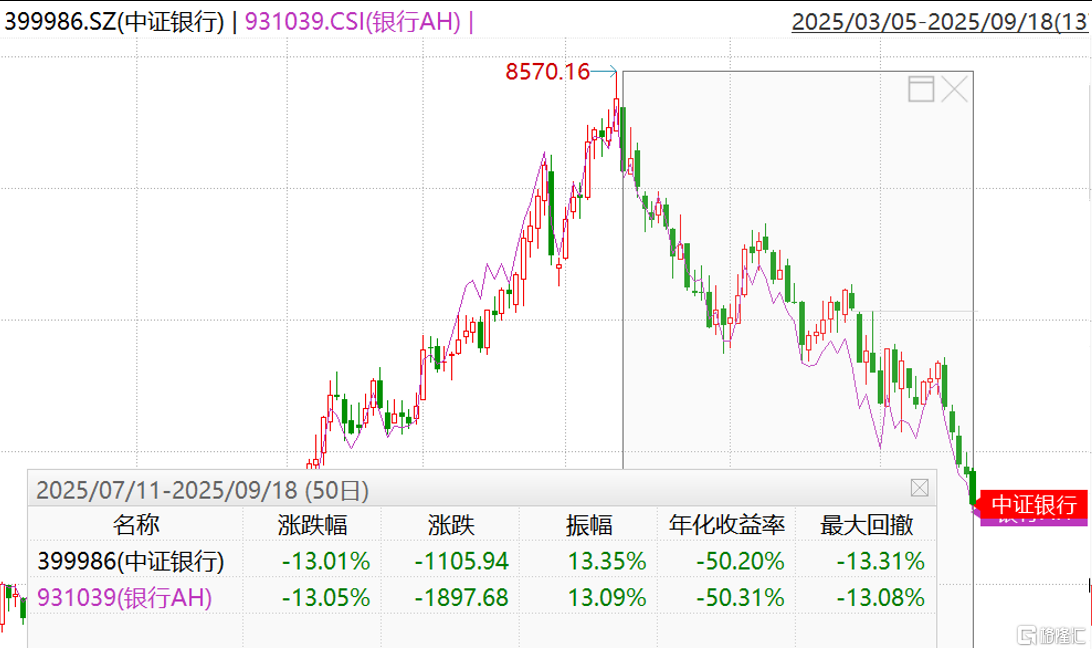
Core Viewpoint - The banking sector is experiencing a downturn with significant declines in stock prices, while the technology sector remains strong. The banking AH index and the CSI banking index have both dropped over 13% since July 11, leading to a breach of the 120-day moving average for the first time in a year [1]. Group 1: Stock Performance and Dividend Yield - As bank stocks continue to decline, the dividend yield for the banking AH index has risen to 4.6%, suggesting potential value for investors [3][10]. - The banking AH index is currently valued at 0.69 times PB, indicating a certain level of investment attractiveness [10]. - The banking AH total return index has increased by 97.48% since January 1, 2019, outperforming the CSI banking total return index by over 10% and the CSI 300 total return index by 20.83% [10]. Group 2: Shareholder Activity - Several banks have reported shareholder increases, with Everbright Bank's controlling shareholder increasing their stake by 1.397 million shares, representing 0.02% of total shares, with an investment of 51.66 million yuan [4]. - Nanjing Bank received support from its major shareholder, Zijin Group, which increased its stake by approximately 5.678 million shares, raising its total holding from 12.56% to 13.02% [4]. - Other banks, including Huaxia Bank and Suzhou Bank, have also seen active participation from their directors and executives in increasing their holdings, reflecting confidence in future growth [4][5]. Group 3: Institutional Investment Trends - Insurance capital's holdings in the banking sector reached 28.24%, an increase of 1.04% from the previous quarter, although the market value held by insurance companies slightly decreased to 6.5% of the A-share market [6]. - Social security funds have also increased their holdings in the banking sector, with a rise to 51.71%, up 2.48 percentage points [7]. - Insurance companies have made 11 significant investments in listed banks this year, primarily in H-shares, indicating continued interest in the sector due to attractive dividend yields and stable performance [7]. Group 4: Dividend Distribution - As of September 17, 2025, 17 listed banks have announced a total dividend distribution of 237.54 billion yuan for the mid-year, with Industrial and Commercial Bank of China leading with a total dividend of 50.396 billion yuan [8][9]. - Other major banks, including China Construction Bank and Agricultural Bank of China, have also announced substantial dividends, further enhancing the stability and sustainability of bank stock dividends [8].


苏农银行注册资本增至20亿元
Zheng Quan Ri Bao Wang· 2025-09-18 10:41
Group 1 - The core point of the article is that Su Nong Bank has increased its registered capital from approximately 1.8 billion to about 2 billion yuan [1] Group 2 - The change in registered capital indicates a potential strengthening of the bank's financial position and capacity for growth [1] - The increase in capital may also reflect the bank's strategy to enhance its competitive edge in the financial industry [1]