
Suzhou Rural Commercial Bank(603323)

Search documents
苏州农商行联合华为落地全国首个区域银行存算分离核心数据库样板
Huan Qiu Wang· 2025-10-13 07:46
Core Insights - Suzhou Rural Commercial Bank, in collaboration with Huawei, has completed a significant transformation of its core system using Huawei's GaussDB database and OceanStor Dorado all-flash storage, marking a key step for regional banks in China [1][3] - The core database is identified as the "heart" of financial IT systems, essential for digital transformation, with a focus on self-innovation, high availability, and performance [1][3] - The bank's core system has achieved a smooth transition from traditional commercial databases to GaussDB, supporting daily transaction volumes of tens of millions, with system performance improved by over 40% and recovery times reduced to seconds [5][7] Industry Challenges and Solutions - The financial industry faces three main challenges: accelerated business iteration requiring higher system elasticity, frequent security threats necessitating stronger architecture, and regulatory and cost pressures driving efficient infrastructure evolution [3] - Huawei emphasizes the need for a self-innovative core database system to maintain development control, proposing the "GaussDB + separation of storage and computing" architecture as a solution [3] Practical Implementation and Recommendations - A white paper released during the event outlines the technology selection, deployment models, and risk control points for regional banks undergoing transformation, recommending a "gradual replacement + dual-active disaster recovery" strategy [5] - Jiang Wei, Assistant General Manager of the Financial Technology Department at Suzhou Rural Commercial Bank, highlighted the successful implementation of a dual-active deployment model, which enhances system resilience and operational efficiency [5][7] Broader Implications - The experience shared by Suzhou Rural Commercial Bank serves as a model for small and medium-sized banks, balancing security, performance, and cost-effectiveness in their transformation efforts [7] - The collaboration between Huawei and Suzhou Rural Commercial Bank is expected to provide a valuable reference path for regional banks in their self-research transformation and digital competitiveness [7]



农商行板块10月10日涨0.52%,张家港行领涨,主力资金净流出179.78万元
Zheng Xing Xing Ye Ri Bao· 2025-10-10 08:46
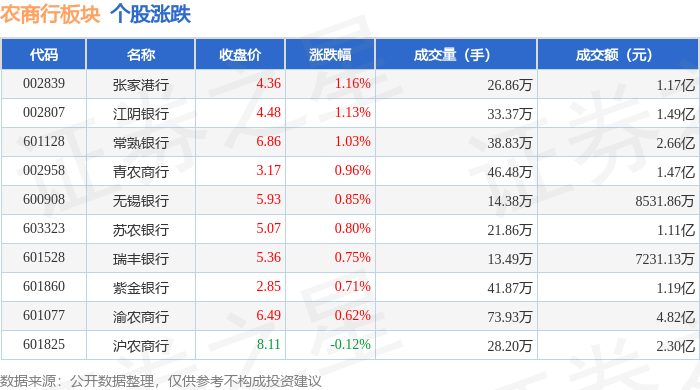
Core Viewpoint - The rural commercial bank sector experienced a slight increase of 0.52% on October 10, with Zhangjiagang Bank leading the gains, while the overall market indices, including the Shanghai Composite Index and Shenzhen Component Index, saw declines of 0.94% and 2.7% respectively [1] Group 1: Market Performance - On October 10, the Shanghai Composite Index closed at 3897.03, down 0.94%, and the Shenzhen Component Index closed at 13355.42, down 2.7% [1] - The rural commercial bank sector's individual stock performance showed varying degrees of increase, with Zhangjiagang Bank rising by 1.16% to a closing price of 4.36 [1] Group 2: Trading Volume and Capital Flow - The trading volume for Zhangjiagang Bank was 268,600 shares, with a transaction value of 117 million yuan [1] - The rural commercial bank sector saw a net outflow of 1.7978 million yuan from main funds and a net outflow of 21.0196 million yuan from speculative funds, while retail investors contributed a net inflow of 22.8173 million yuan [1] Group 3: Individual Stock Capital Flow - For the stocks analyzed, the main capital inflow was observed in Hu Nong Bank with 16.1411 million yuan, while the largest outflow was from Changshu Bank at 13.5807 million yuan [2] - Retail investors showed a significant net inflow in Changshu Bank, amounting to 23.4478 million yuan, despite the main and speculative funds showing outflows [2]





农商行板块10月9日跌0.68%,渝农商行领跌,主力资金净流出950.61万元
Zheng Xing Xing Ye Ri Bao· 2025-10-09 09:03
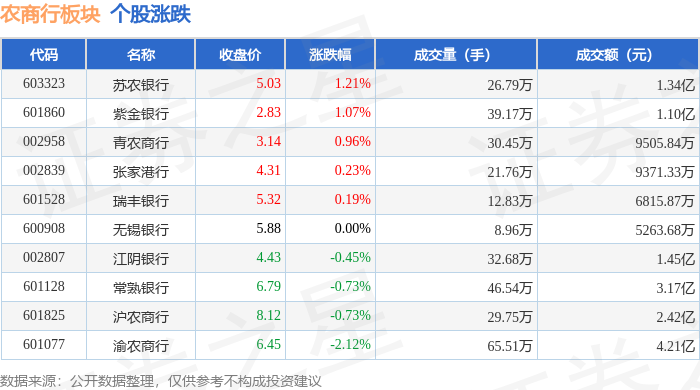
Core Insights - The rural commercial bank sector experienced a decline of 0.68% on October 9, with Yunnan Rural Commercial Bank leading the drop [1] - The Shanghai Composite Index closed at 3933.97, up 1.32%, while the Shenzhen Component Index closed at 13725.56, up 1.47% [1] Sector Performance - The following banks showed varying performance: - Su Nong Bank: Closed at 5.03, up 1.21% with a trading volume of 267,900 shares and a turnover of 134 million yuan [1] - Zijin Bank: Closed at 2.83, up 1.07% with a trading volume of 391,700 shares and a turnover of 110 million yuan [1] - Qing Nong Commercial Bank: Closed at 3.14, up 0.96% with a trading volume of 304,500 shares and a turnover of 95.06 million yuan [1] - Zhangjiagang Bank: Closed at 4.31, up 0.23% with a trading volume of 217,600 shares and a turnover of 93.71 million yuan [1] - Ruifeng Bank: Closed at 5.32, up 0.19% with a trading volume of 128,300 shares and a turnover of 68.16 million yuan [1] - Wuxi Bank: Closed at 5.88, unchanged with a trading volume of 89,600 shares and a turnover of 52.64 million yuan [1] - Jiangyin Bank: Closed at 4.43, down 0.45% with a trading volume of 326,800 shares and a turnover of 145 million yuan [1] - Changshu Bank: Closed at 6.79, down 0.73% with a trading volume of 465,400 shares and a turnover of 317 million yuan [1] - Hu Nong Bank: Closed at 8.12, down 0.73% with a trading volume of 297,500 shares and a turnover of 242 million yuan [1] - Yunnan Rural Commercial Bank: Closed at 6.45, down 2.12% with a trading volume of 655,100 shares and a turnover of 421 million yuan [1] Capital Flow Analysis - The rural commercial bank sector saw a net outflow of 9.51 million yuan from main funds, while speculative funds had a net inflow of 59.77 million yuan, and retail investors experienced a net outflow of 50.26 million yuan [1] - Specific capital flows for selected banks include: - Yunnan Rural Commercial Bank: Main funds net inflow of 61.64 million yuan, speculative funds net inflow of 21.83 million yuan, and retail net outflow of 83.48 million yuan [2] - Ruifeng Bank: Main funds net inflow of 4.05 million yuan, speculative funds net outflow of 1.54 million yuan, and retail net outflow of 2.51 million yuan [2] - Qing Nong Commercial Bank: Main funds net inflow of 2.37 million yuan, speculative funds net outflow of 6.20 million yuan, and retail net outflow of 3.83 million yuan [2] - Zhangjiagang Bank: Main funds net inflow of 1.55 million yuan, speculative funds net outflow of 3.13 million yuan, and retail net inflow of 1.58 million yuan [2] - Wuxi Bank: Main funds net outflow of 0.93 million yuan, speculative funds net inflow of 0.63 million yuan, and retail net inflow of 0.30 million yuan [2] - Zijin Bank: Main funds net outflow of 1.10 million yuan, speculative funds net inflow of 3.72 million yuan, and retail net outflow of 2.62 million yuan [2] - Jiangyin Bank: Main funds net outflow of 5.86 million yuan, speculative funds net outflow of 11.33 million yuan, and retail net inflow of 17.19 million yuan [2] - Hu Nong Bank: Main funds net outflow of 6.30 million yuan, speculative funds net inflow of 6.54 million yuan, and retail net outflow of 0.25 million yuan [2] - Su Nong Bank: Main funds net outflow of 22.55 million yuan, speculative funds net inflow of 20.66 million yuan, and retail net inflow of 0.19 million yuan [2] - Changshu Bank: Main funds net outflow of 42.38 million yuan, speculative funds net inflow of 28.58 million yuan, and retail net inflow of 13.80 million yuan [2]



苏州农商银行上线零售客户360风险画像功能
Jiang Nan Shi Bao· 2025-10-09 02:02
Core Viewpoint - Suzhou Rural Commercial Bank has launched a retail customer 360 risk profiling feature to enhance risk management capabilities and improve customer financial experience through innovative services [1] Group 1: Innovation and Technology - The new feature utilizes big data and artificial intelligence to deeply mine and intelligently integrate multi-dimensional customer information [1] - It creates a comprehensive and three-dimensional customer risk assessment system, addressing issues of information fragmentation and isolation in traditional models [1] Group 2: Efficiency and Decision-Making - The risk profiling system allows approval personnel to quickly understand customer risk status, significantly improving data processing efficiency [1] - Based on precise risk assessments provided by the system, approval personnel can identify risk characteristics in a timely manner, leading to more scientific and prudent credit decisions [1] Group 3: Tailored Risk Management - For low-risk customers with good credit, the process can be simplified to accelerate loan disbursement [1] - For higher-risk customers, stricter risk control measures will be implemented, along with personalized credit solutions, enhancing business efficiency while maintaining risk control [1] Group 4: Future Directions - The launch of the retail customer 360 risk profiling feature is a significant enhancement to the bank's risk management system [1] - The bank plans to continue advancing intelligent risk management and explore more innovative and forward-looking risk control models to ensure financial security and drive high-quality development in retail business [1]
农商行板块9月30日跌1.16%,沪农商行领跌,主力资金净流出193.06万元
Zheng Xing Xing Ye Ri Bao· 2025-09-30 08:51
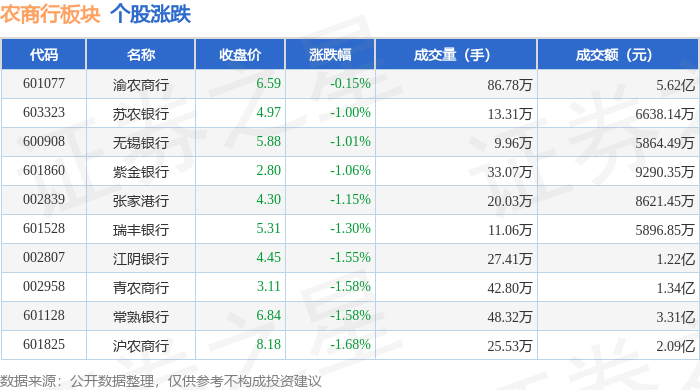
Market Overview - The rural commercial bank sector experienced a decline of 1.16% on September 30, with the Shanghai Rural Commercial Bank leading the drop [1] - The Shanghai Composite Index closed at 3882.78, up 0.52%, while the Shenzhen Component Index closed at 13526.51, up 0.35% [1] Individual Stock Performance - The closing prices and changes for key rural commercial banks are as follows: - Yunnan Rural Commercial Bank: 6.59, -0.15% - Jiangsu Rural Bank: 4.97, -1.00% - Wuxi Bank: 5.88, -1.01% - Zijin Bank: 2.80, -1.06% - Zhangjiagang Bank: 4.30, -1.15% - Ruifeng Bank: 5.31, -1.30% - Jiangyin Bank: 4.45, -1.55% - Qingnong Bank: 3.11, -1.58% - Changshu Bank: 6.84, -1.58% - Shanghai Rural Commercial Bank: 8.18, -1.68% [1] Capital Flow Analysis - The rural commercial bank sector saw a net outflow of 1.93 million yuan from main funds, while speculative funds had a net inflow of 38.39 million yuan, and retail investors experienced a net outflow of 36.46 million yuan [1] - Detailed capital flow for individual banks includes: - Yunnan Rural Commercial Bank: Main funds net inflow of 38.13 million yuan, retail net outflow of 62.35 million yuan - Wuxi Bank: Main funds net inflow of 7.45 million yuan, retail net outflow of 6.08 million yuan - Jiangsu Rural Bank: Main funds net inflow of 3.52 million yuan, retail net outflow of 0.29 million yuan - Ruifeng Bank: Main funds net inflow of 1.14 million yuan, retail net outflow of 2.89 million yuan - Jiangyin Bank: Main funds net inflow of 0.52 million yuan, retail net outflow of 0.55 million yuan - Shanghai Rural Commercial Bank: Main funds net inflow of 0.13 million yuan, retail net inflow of 0.12 million yuan - Zhangjiagang Bank: Main funds net outflow of 10.63 million yuan, retail net inflow of 2.61 million yuan - Zijin Bank: Main funds net outflow of 11.13 million yuan, retail net inflow of 4.80 million yuan - Qingnong Bank: Main funds net outflow of 13.84 million yuan, retail net inflow of 9.58 million yuan - Changshu Bank: Main funds net outflow of 17.22 million yuan, retail net inflow of 22.50 million yuan [2]

农商行板块9月29日涨0.94%,渝农商行领涨,主力资金净流出6645.88万元
Zheng Xing Xing Ye Ri Bao· 2025-09-29 08:45
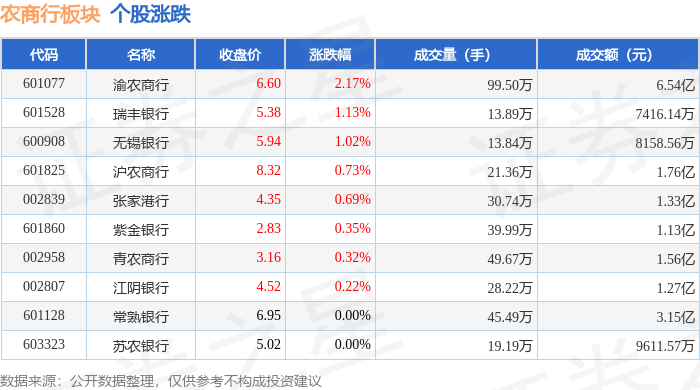
Market Performance - The rural commercial bank sector increased by 0.94% on September 29, with Yunnan Rural Commercial Bank leading the gains [1] - The Shanghai Composite Index closed at 3862.53, up 0.9%, while the Shenzhen Component Index closed at 13479.43, up 2.05% [1] Individual Stock Performance - Yunnan Rural Commercial Bank (601077) closed at 6.60, with a rise of 2.17% and a trading volume of 995,000 shares, amounting to a transaction value of 654 million [1] - Other notable performers include Ruifeng Bank (601528) with a 1.13% increase, Wuxi Bank (600908) with a 1.02% increase, and Shanghai Rural Commercial Bank (601825) with a 0.73% increase [1] Capital Flow Analysis - The rural commercial bank sector experienced a net outflow of 66.4588 million from institutional investors, while retail investors saw a net inflow of 22.9898 million [1] - Specific stocks like Qingnong Bank (002958) had a net inflow of 9.1251 million from institutional investors, while Su Nong Bank (603323) had a net inflow of 613.43 million [2] Detailed Capital Flow for Selected Stocks - Yunnan Rural Commercial Bank had a significant net outflow of 50.7024 million from institutional investors, but a net inflow of 54.2507 million from retail investors [2] - Common trends show that while some banks like Zhangjiagang Bank (002839) attracted retail inflows, others like Changshu Bank (601128) faced substantial outflows from institutional investors [2]
上市银行“十四五回望”之资负结构与息差变迁
CMS· 2025-09-28 15:09
Investment Rating - The report maintains a recommendation for the banking industry [3] Core Insights - The report provides a comprehensive analysis of the asset-liability structure and interest margin changes of 42 A-share listed banks during the "14th Five-Year Plan" period, highlighting a shift towards corporate loans on the asset side and a stronger retail focus on the liability side [12][14] - The asset-liability structure indicates a significant increase in the proportion of corporate loans, rising from 57.02% to 63.22% from the end of 2020 to mid-2025, while the proportion of demand deposits decreased from 41.94% to 30% [12][14] - The report notes a decline in both asset yield and interest margin, with the yield on interest-earning assets dropping from 4.43% to 3.32% and the net interest margin decreasing from 2.23% to 1.53% during the same period [14][15] Summary by Sections Overall Asset-Liability Structure and Interest Margin Changes - The asset-liability structure shows an increase in loan-to-earning asset ratio from 54.19% to 56.49%, with corporate loans making up a larger share of total loans [14][15] - The average yield on interest-earning assets decreased significantly, with the loan yield falling from 5.34% to 3.82% [15] - The net interest margin for listed banks remains higher than that of commercial banks, despite a decline [14][15] Changes in Each Banking Sector's Asset-Liability Structure and Interest Margin - City commercial banks experienced a more significant increase in the proportion of corporate loans, with their interest margin narrowing less compared to other banks [18] - The report highlights that the proportion of deposits in interest-bearing liabilities for state-owned banks decreased, while it increased for rural commercial banks [18] - The decline in interest-bearing liabilities' cost rate was most pronounced in city commercial banks, leading to a smaller reduction in their interest margin [18]






农商行板块9月26日跌0.74%,XD沪农商领跌,主力资金净流出3021.09万元
Zheng Xing Xing Ye Ri Bao· 2025-09-26 08:48
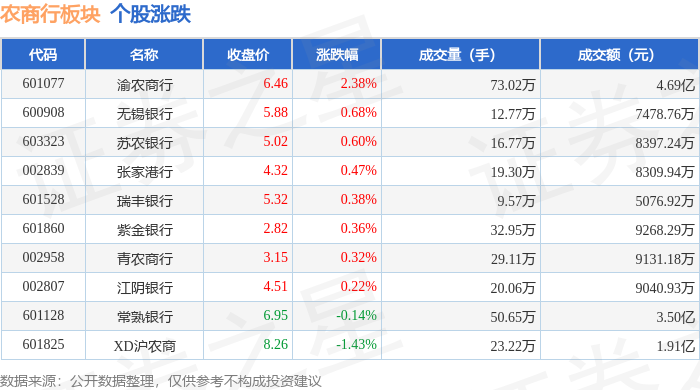
Market Overview - On September 26, the rural commercial bank sector declined by 0.74% compared to the previous trading day, with XD Hu Nong leading the decline [1] - The Shanghai Composite Index closed at 3828.11, down 0.65%, while the Shenzhen Component Index closed at 13209.0, down 1.76% [1] Individual Stock Performance - The following stocks in the rural commercial bank sector showed varying performance: - Chongqing Rural Commercial Bank (601077) closed at 6.46, up 2.38% with a trading volume of 730,200 shares [1] - Wuxi Bank (600908) closed at 5.88, up 0.68% with a trading volume of 127,700 shares [1] - Su Nong Bank (603323) closed at 5.02, up 0.60% with a trading volume of 167,700 shares [1] - Zhangjiagang Bank (002839) closed at 4.32, up 0.47% with a trading volume of 193,000 shares [1] - Ruifeng Bank (601528) closed at 5.32, up 0.38% with a trading volume of 95,700 shares [1] - Other banks like Jiangyin Bank (002807) and Changshu Bank (601128) showed minor fluctuations [1] Capital Flow Analysis - The rural commercial bank sector experienced a net outflow of 30.21 million yuan from institutional investors and 22.38 million yuan from retail investors, while retail investors saw a net inflow of 52.59 million yuan [1] - Specific capital flows for individual banks include: - Changshu Bank (601128) had a net inflow of 8.26 million yuan from institutional investors but a net outflow of 34.30 million yuan from retail investors [2] - Zijin Bank (601860) saw a net inflow of 7.99 million yuan from institutional investors [2] - Other banks like Su Nong Bank (603323) and Zhangjiagang Bank (002839) experienced significant net outflows from institutional investors [2]
农商行板块9月25日跌1.62%,渝农商行领跌,主力资金净流出311.16万元
Zheng Xing Xing Ye Ri Bao· 2025-09-25 08:37
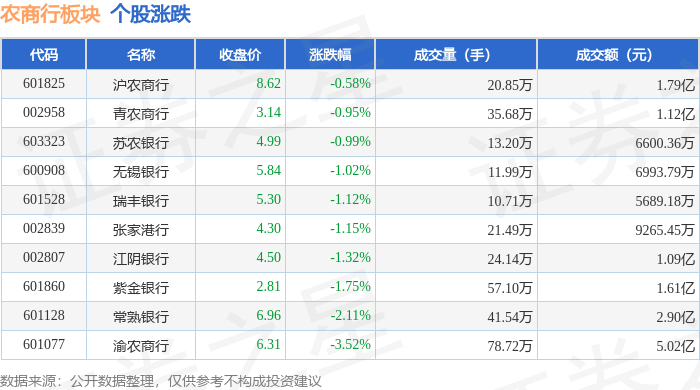
Market Overview - On September 25, the rural commercial bank sector declined by 1.62%, with Chongqing Rural Commercial Bank leading the drop [1] - The Shanghai Composite Index closed at 3853.3, down 0.01%, while the Shenzhen Component Index closed at 13445.9, up 0.67% [1] Individual Stock Performance - The closing prices and changes for key rural commercial banks are as follows: - Hu Nong Commercial Bank: 8.62, down 0.58% - Qing Nong Commercial Bank: 3.14, down 0.95% - Su Nong Bank: 4.99, down 0.99% - Wuxi Bank: 5.84, down 1.02% - Rui Feng Bank: 5.30, down 1.12% - Zhangjiagang Bank: 4.30, down 1.15% - Jiangyin Bank: 4.50, down 1.32% - Zijin Bank: 2.81, down 1.75% - Changshu Bank: 6.96, down 2.11% - Chongqing Rural Commercial Bank: 6.31, down 3.52% [1] Capital Flow Analysis - The rural commercial bank sector experienced a net outflow of 3.11 million yuan from main funds, while speculative funds saw a net inflow of 5.88 million yuan, and retail investors had a net outflow of 2.77 million yuan [1] - Detailed capital flow for individual banks shows: - Jiangyin Bank: Main funds net inflow of 12.09 million yuan, retail net outflow of 14.79 million yuan - Wuxi Bank: Main funds net inflow of 11.99 million yuan, retail net outflow of 8.76 million yuan - Su Nong Bank: Main funds net inflow of 11.61 million yuan, retail net outflow of 8.11 million yuan - Chongqing Rural Commercial Bank: Main funds net outflow of 27.42 million yuan, retail net inflow of 34.26 million yuan - Zijin Bank: Main funds net outflow of 33.66 million yuan, retail net inflow of 16.64 million yuan [2]
信息传播“影响力” 如何转化为高质量发展“生产力”
Jin Rong Shi Bao· 2025-09-25 03:11
Core Viewpoint - Suzhou Rural Commercial Bank has successfully leveraged innovative information dissemination practices to enhance its brand influence and drive high-quality development in a competitive banking environment [1][2][4]. Group 1: Brand Building - High-quality development requires both "hard power" in business and "soft power" in branding, with rural commercial banks in counties outperforming those in urban areas due to stronger brand recognition [2][4]. - Suzhou Rural Commercial Bank has established a multi-channel promotional matrix, including WeChat, Douyin, and its official website, achieving over 1 million followers on its official WeChat account and over 10.23 million views on its short videos [2][3]. Group 2: Content Production - The bank has implemented a structured content production process, including monthly planning meetings to identify promotional focuses and ensure high-quality execution [3][6]. - A four-tier media engagement mechanism has been developed, allowing for targeted messaging across national, provincial, municipal, and district levels, resulting in over 500 published articles this year [3][4]. Group 3: Interactive Platforms - Effective promotional strategies have enabled the bank to transition from a "follower" to a "leader" in the industry, emphasizing the importance of learning from peers and enhancing self-improvement [4][5]. - Internal communication channels have been utilized to share best practices among employees, fostering a culture of knowledge sharing and continuous improvement [5][6]. Group 4: Production Logic - The bank's promotional efforts are integrated into its overall business strategy, with a dedicated team of 150 information officers and a focus on cultivating a "promotional mindset" among all employees [6][7]. - Employees are encouraged to develop skills in creating highlights, generating traffic, and identifying unique promotional angles, which are essential for effective communication in the digital age [7][8]. Group 5: Future Competitiveness - The future of banking competition will hinge on both financial services and the effectiveness of information dissemination, with a call for storytelling and brand building to drive sustainable growth [8][9].