
Jason Furniture (Hangzhou) (603816)

Search documents
研报掘金丨信达证券:居然智家发力AI设计构建新流量入口,海外扩张加速
Ge Long Hui A P P· 2026-02-02 06:37
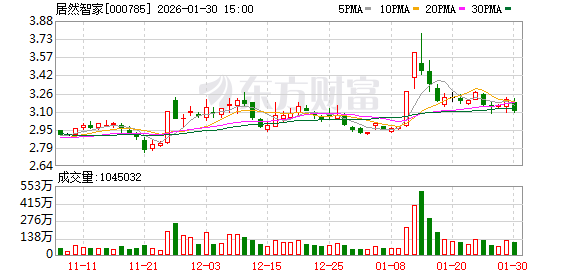
Core Viewpoint - The report from Cinda Securities indicates that the company, Juran Smart Home, is expected to report a net profit attributable to shareholders of between -1.15 billion to -0.85 billion yuan in 2025, a significant decline from 769 million yuan in the same period last year [1] Group 1: Financial Performance - The estimated median net profit for Q4 2025 is projected to be -1.398 billion yuan, compared to 38 million yuan in the same quarter last year [1] - The fair value of the company's investment properties is expected to decrease by approximately 1 billion to 1.6 billion yuan in 2025 due to special unexpected events affecting rental income and leasing [1] Group 2: Business Operations - As of the first half of 2025, the company operates four "Zhongshang World" shopping centers in cities like Changchun and Wuhan, along with three modern department stores and 125 various supermarkets in key urban areas [1] - The company anticipates a gradual recovery in sales revenue and profitability, driven by macroeconomic recovery and optimization of its business model [1] Group 3: Strategic Outlook - The company plans to accelerate its overseas expansion and focus on deepening its core home furnishing business in 2026, while actively exploring home consumption scenarios related to children, pets, and the elderly [1] - The company aims to transform from a "home furnishing retail operator" to a "full-industry digital service provider" by leveraging AI design as a new traffic entry point and smart home solutions as new consumption scenarios [1]


顾家家居股价跌5.06%,创金合信基金旗下1只基金重仓,持有2.67万股浮亏损失4.78万元
Xin Lang Cai Jing· 2026-02-02 03:39
Group 1 - The stock price of Gujia Home Furnishing fell by 5.06% to 33.61 yuan per share, with a trading volume of 178 million yuan and a turnover rate of 0.64%, resulting in a total market capitalization of 27.609 billion yuan [1] - Gujia Home Furnishing Co., Ltd. is located in Hangzhou, Zhejiang Province, and was established on October 31, 2006, with its listing date on October 14, 2016. The company specializes in the research, design, production, and sales of mid-to-high-end soft furniture products for living rooms and bedrooms [1] - The revenue composition of Gujia Home Furnishing includes sofas (57.82%), bedroom products (17.28%), integrated products (11.87%), custom furniture (5.64%), information technology services (3.81%), and other (3.25%) [1] Group 2 - According to data from the top ten heavy stocks of funds, one fund under Chuangjin Hexin holds Gujia Home Furnishing as a significant investment. The Chuangjin Hexin Quantitative Discovery Mixed A Fund (003241) held 26,700 shares in the fourth quarter, accounting for 1.78% of the fund's net value, ranking as the ninth largest heavy stock [2] - The Chuangjin Hexin Quantitative Discovery Mixed A Fund was established on September 27, 2016, with a latest scale of 31.1943 million. Year-to-date returns are 6.88%, ranking 3306 out of 9000 in its category; the one-year return is 27.62%, ranking 4517 out of 8193; and the return since inception is 56.74% [2] - The fund managers, Li Tianfeng and Huang Xiaohu, have cumulative tenures of 4 years and 3 years respectively, with total fund asset scales of 865 million and 1.246 billion. Li's best fund return during his tenure is 51.49%, while Huang's best is 64.93% [2]
顾家家居20260131
2026-02-02 02:22
Summary of Key Points from the Conference Call Company Overview - **Company**: Gujia Home Furnishing - **Industry**: Home Furnishing Core Insights and Arguments - The home furnishing industry is expected to stabilize in pricing starting from the second half of 2025, with easing consumer downgrade factors and a strengthening expectation of real estate bottoming out, leading to a potential recovery in new and second-hand housing transactions, which may shift the industry from a reduction phase to a slight growth phase [2][3] - Gujia Home Furnishing stands out among listed home furnishing companies due to its strong strategic execution, high stability, and significant development potential, enhanced by multi-dimensional management reforms that improve organizational efficiency [2][5] - In the era of stock, furniture companies need to seek breakthroughs through overseas expansion, internal reforms, and technological advancements, with Gujia's overseas revenue exceeding 40% [2][6] - The low concentration in the furniture industry is attributed to incomplete industrialization on the supply side and commoditization on the demand side, necessitating empowerment of distributors and a user-centric approach to enhance data infrastructure and agile supply chain construction [2][7][8] Growth Opportunities - There are growth opportunities in niche markets such as old house renovation, rental market decoration, aging-friendly modifications, smart and green home solutions, and lower-tier markets, with leading companies likely to penetrate these areas and drive new growth [2][9] - The top five companies in the furniture industry hold less than 15% market share, indicating significant potential for concentration improvement [9] Company Performance - Gujia Home Furnishing has shown strong performance in the current market environment, with revenue growth exceeding the industry average since Q1 2025, and a reported 10% year-on-year revenue increase in the mid-year report [12] - The gross margin for domestic sales improved from 37.3% in 2022 to 39.6% in the first half of 2025, with net profit margin also increasing [12] - Single-store revenue grew from 2.67 million yuan in 2022 to 3.09 million yuan in 2024, reflecting a year-on-year growth of 3% and 12% respectively [12][13] Strategic Initiatives - Gujia Home Furnishing is enhancing overall operational efficiency through retail transformation, establishing a retail-driven organizational culture, and empowering distributors [11] - The company has implemented a comprehensive retail model focusing on user insights, product design, traffic conversion, customer in-store experience, and product delivery [11] - The governance structure has undergone significant changes, transitioning to a model led entirely by professional managers, which has contributed to improved operational performance [18][19] Future Outlook - Revenue is projected to grow steadily, with an expected growth rate of 7%-8% in 2026, potentially accelerating in the second half of the year [20] - Profit growth may exceed 10% in 2026, with further acceleration anticipated in 2027, supported by improved operational efficiency through retail transformation [20] - Current valuation corresponds to a price-to-earnings ratio of approximately 12-13 times for 2026, with potential recovery to 15-20 times as the real estate market stabilizes, indicating significant upside potential for Gujia Home Furnishing [20]
居然智家:预计2025年度净利润亏损8.5亿元~11.5亿元
Mei Ri Jing Ji Xin Wen· 2026-01-30 12:07
Group 1 - The core viewpoint of the news is that the company,居然智家, is forecasting a significant net profit loss for 2025, ranging from 850 million to 1.15 billion yuan, marking a shift from profit to loss compared to the previous year [1] - The expected basic earnings per share for 2025 are projected to be a loss of 0.14 to 0.19 yuan, contrasting with a profit of 0.12 yuan in the same period last year [1] - The primary reasons for the performance change include a deep adjustment in the real estate market, leading to a decline in new and second-hand housing transactions, which in turn reduces home renovation and home furnishing consumption [1] - The company also cites a lack of effective demand due to consumers' cautious approach to discretionary spending, compounded by special unexpected events affecting the company's operations in 2025 [1] - Additionally, the fair value of the company's investment properties is expected to decrease by approximately 1 billion to 1.6 billion yuan in 2025 [1]

居然智家:预计2025年净利润亏损8.5亿元-11.5亿元
Xin Lang Cai Jing· 2026-01-30 10:47
Core Viewpoint - The company, Juran Smart Home, anticipates a net profit loss of 850 million to 1.15 billion yuan for the fiscal year 2025, contrasting with a profit of 769 million yuan in the same period last year [1] Group 1: Financial Performance - The projected net profit loss for 2025 is significantly impacted by a deep adjustment in the real estate market, leading to a decline in both new and second-hand property transactions [1] - The previous year's profit was 769 million yuan, indicating a substantial shift in financial performance for the upcoming year [1] Group 2: Market Conditions - The downturn in the real estate market has resulted in reduced demand for home renovations and home goods, as consumers are becoming more cautious with discretionary spending [1] - There is a noted lack of effective demand in the market, which is further exacerbated by the anticipated special unexpected events affecting the company in 2025 [1] Group 3: Revenue Impact - The company's rental income from shopping malls and the fair value of investment commercial properties are expected to decline due to the adverse market conditions [1]
居然智家:预计2025年净亏损8.5亿元-11.5亿元
Di Yi Cai Jing· 2026-01-30 10:44
Group 1 - The company, Juran Smart Home, announced an expected net profit loss attributable to shareholders of 850 million to 1.15 billion yuan for the fiscal year 2025, compared to a profit of 769 million yuan in the same period last year [2]

顾家家居股份有限公司关于持股5%以上股东部分股份被司法拍卖的进展公告
Shang Hai Zheng Quan Bao· 2026-01-28 19:09
登录新浪财经APP 搜索【信披】查看更多考评等级 证券代码:603816 证券简称:顾家家居 公告编号:2026-004 顾家家居股份有限公司 关于持股5%以上股东部分股份 被司法拍卖的进展公告 本公司董事会及全体董事保证本公告内容不存在任何虚假记载、误导性陈述或者重大遗漏,并对其内容 的真实性、准确性和完整性承担法律责任。 重要内容提示: ● 截至本公告披露日,TB Home Limited(以下简称"TB Home")持有顾家家居股份有限公司(以下简 称"公司"或"本公司")41,176,766股股票,占本公司总股本的5.01%。杭州德烨嘉俊企业管理有限公司 (由顾家集团有限公司变更名称而来,以下简称"德烨嘉俊")持有本公司88,471,483股股票,占本公司 总股本的10.77%,TB Home及德烨嘉俊累计持有本公司129,648,249股股票,占本公司总股本的 15.78%。上述股份目前均处于冻结状态。 ● TB Home被司法拍卖的股票数量为14,508,700股,占其所持有本公司股数的35.24%,占本公司总股本的 1.77%。上述股份司法拍卖由买受人龚贺华竞价成功,成交金额人民币380,858 ...
顾家家居:德烨嘉俊所持本公司股份累计被冻结和司法标记约8847万股
Mei Ri Jing Ji Xin Wen· 2026-01-28 12:22
每经AI快讯,顾家家居1月28日晚间发布公告称,截至本公告披露日,杭州德烨嘉俊企业管理有限公司 (由顾家集团有限公司变更名称而来,以下简称"德烨嘉俊")持有顾家家居股份有限公司(以下简 称"公司"或"本公司")88,471,483 股股票,占本公司总股本的10.77%;德烨嘉俊所持本公司股份累计被 冻结(含轮候冻结)和司法标记88,471,483股,占其所持有本公司股数的 100%,占本公司总股本的 10.77%。TB Home Limited(以下简称"TB Home")持有本公司 41,176,766 股股票,占本公司总股本的 5.01%;TB Home 所持本公司股份累计被冻结(含轮候冻结)和司法标记41,176,766股,占其所持有本 公司股数的 100%,占本公司总股本的 5.01%。 (记者 曾健辉) 每经头条(nbdtoutiao)——从极寒测试到万套装车!半固态电池今年有望搭载多款新车:各大厂商摩 拳擦掌,动力电池技术迎来迭代年 ...
顾家家居(603816) - 关于持股5%以上股东部分股份被司法拍卖的进展公告
2026-01-28 11:17
2025 年 10 月 23 日 10 时至 2025 年 10 月 24 日 10 时(延时的除外),浙江 省杭州市中级人民法院在淘宝网司法拍卖网络平台对 TB Home 持有的本公司 14,508,700 股无限售流通股票的价值进行公开拍卖。上述股份司法拍卖由买受 人龚贺华竞价成功,成交金额人民币 380,858,000 元。具体内容详见公司在上海 证券交易所网站(www.sse.com.cn)及公司指定披露媒体《中国证券报》《上海 证券报》《证券日报》《证券时报》刊登的《关于持股 5%以上股东部分股份将被 司法拍卖的提示性公告》(公告编号:2025-072)及《关于持股 5%以上股东部分 股份被司法拍卖的结果公告》(公告编号:2025-075)。 本公司董事会及全体董事保证本公告内容不存在任何虚假记载、误导性陈述 或者重大遗漏,并对其内容的真实性、准确性和完整性承担法律责任。 重要内容提示: 截至本公告披露日,TB Home Limited(以下简称"TB Home")持有顾家 家居股份有限公司(以下简称"公司"或"本公司")41,176,766 股股票,占 本公司总股本的 5.01%。杭州德烨嘉俊企业 ...
顾家家居(603816) - 关于持股5%以上股东部分股份解除轮候冻结的公告
2026-01-28 11:15
证券代码:603816 证券简称:顾家家居 公告编号:2026-005 顾家家居股份有限公司 关于持股 5%以上股东部分股份解除轮候冻结的公告 本公司董事会及全体董事保证本公告内容不存在任何虚假记载、误导性陈述 或者重大遗漏,并对其内容的真实性、准确性和完整性承担法律责任。 重要内容提示: 截至本公告披露日,杭州德烨嘉俊企业管理有限公司(由顾家集团有限 公司变更名称而来,以下简称"德烨嘉俊")持有顾家家居股份有限公司(以下 简称"公司"或"本公司")88,471,483 股股票,占本公司总股本的 10.77%; 德烨嘉俊所持本公司股份累计被冻结(含轮候冻结)和司法标记 88,471,483 股, 占其所持有本公司股数的 100%,占本公司总股本的 10.77%。TB Home Limited (以下简称"TB Home")持有本公司 41,176,766 股股票,占本公司总股本的 5.01%; TB Home 所持本公司股份累计被冻结(含轮候冻结)和司法标记 41,176,766 股, 占其所持有本公司股数的 100%,占本公司总股本的 5.01%。 (www.sse.com.cn)及公司指定信息披露媒体《中 ...