Jason Furniture (Hangzhou) (603816)

Search documents
顾家家居股份有限公司 关于持股5%以上股东部分股份解除轮候冻结的公告
Zhong Guo Zheng Quan Bao - Zhong Zheng Wang· 2026-01-26 23:37
德烨嘉俊所持本公司88,471,483股股票被浙江省杭州市中级人民法院轮候冻结,具体内容详见公司于 2025年6月19日在上海证券交易所网站(www.sse.com.cn)及公司指定信息披露媒体《中国证券报》 《上海证券报》《证券日报》《证券时报》刊登的《关于持股5%以上股东股份被轮候冻结的公告》 (公告编号:2025-047)。 公司近日收到通知,德烨嘉俊上述轮候冻结股票已被浙江省杭州市中级人民法院解除轮候冻结,具体情 况如下: 一、本次股份解除轮候冻结情况 ■ 截至本公告披露日,德烨嘉俊持有的本公司88,471,483股股票及TB Home持有的本公司41,176,766股股票 仍全部处于冻结(含轮候冻结)和司法标记状态。 二、其他事项 登录新浪财经APP 搜索【信披】查看更多考评等级 本公司董事会及全体董事保证本公告内容不存在任何虚假记载、误导性陈述或者重大遗漏,并对其内容 的真实性、准确性和完整性承担法律责任。 重要内容提示: ● 截至本公告披露日,杭州德烨嘉俊企业管理有限公司(由顾家集团有限公司变更名称而来,以下简 称"德烨嘉俊")持有顾家家居股份有限公司(以下简称"公司"或"本公司")88,471 ...

造纸轻工周报2026、01、19-2026、01、23:地产情绪升温,家居板块估值底部向上,关注金属包装提价-20260126
Shenwan Hongyuan Securities· 2026-01-26 10:08
Investment Rating - The report maintains a positive outlook on the home furnishing sector, indicating that valuations are at a bottom and are expected to rise due to favorable real estate policies [2][5][17] Core Insights - The home furnishing sector is poised for valuation recovery driven by improved real estate policies and market stabilization, with a focus on companies with high dividend safety margins such as Gujia Home, Sophia, and Oppein [2][5][6] - The metal packaging industry is seeing price increases for two-piece cans, leading to improved profitability and a more consolidated industry structure [2][5][6] - The AI glasses market is expected to grow significantly, with Meta's optimistic shipment forecasts and partnerships enhancing production capabilities [2][10][11] - The paper industry is stabilizing in the short term, with potential for improved supply-demand dynamics and profitability in the medium term [2][14][15] Summary by Sections Home Furnishing - The sector is experiencing a bottoming out of valuations, with real estate policies expected to catalyze upward movement. The central economic work conference emphasizes stabilizing the real estate market, which is anticipated to improve demand for home furnishings [6][17] - The increase in second-hand housing transactions is expected to support demand recovery, while industry consolidation is accelerating, with mid-tier companies exiting the market [6][7][17] - Key companies to watch include Gujia Home, Sophia, Oppein, Mousse, and Xilinmen, which are positioned well for valuation recovery [2][5][6] Metal Packaging - The industry is witnessing price increases for two-piece cans, with a confirmed profit margin turning point in 2026. The consolidation of leading companies is enhancing pricing power and profitability [2][5][6][8] - The demand from downstream sectors, particularly beer and carbonated beverages, is expected to drive growth, with significant room for improvement in can penetration rates compared to developed markets [7][8] AI Glasses - Meta's production capacity for AI glasses is rapidly increasing, with expectations to double output to 20 million units by the end of 2026. This growth is supported by strong market demand and technological advancements [10][11] - Partnerships with companies like EssilorLuxottica and the establishment of joint ventures are expected to accelerate the rollout of AI glasses [11][12] Paper Industry - The short-term stability of boxboard prices is noted, with medium-term improvements in supply-demand dynamics anticipated to enhance profitability [14][15] - The report highlights the importance of integrated supply chains and cost advantages for companies like Sun Paper and Nine Dragons Paper, which are well-positioned to benefit from market recovery [14][15]


顾家家居(603816) - 关于持股5%以上股东部分股份解除轮候冻结的公告
2026-01-26 09:30
证券代码:603816 证券简称:顾家家居 公告编号:2026-003 顾家家居股份有限公司 关于持股 5%以上股东部分股份解除轮候冻结的公告 本公司董事会及全体董事保证本公告内容不存在任何虚假记载、误导性陈述 或者重大遗漏,并对其内容的真实性、准确性和完整性承担法律责任。 公司近日收到通知,德烨嘉俊上述轮候冻结股票已被浙江省杭州市中级人民 法院解除轮候冻结,具体情况如下: | 股东名称 | 德烨嘉俊 | | --- | --- | | 本次解除轮候冻结股份 | 88,471,483 股 | | 占其所持股份比例 | 100.00% | | 占公司总股本比例 | 10.77% | 一、本次股份解除轮候冻结情况 | 解除轮候冻结时间 | 2026 年 1 月 23 日 | | --- | --- | | 持股数量 | 88,471,483 股 | | 持股比例 | 10.77% | | 剩余被轮候冻结股份数量 | 88,471,483 股 | | 剩余被轮候冻结股份数量占其所持股份比例 | 100.00% | | 剩余被轮候冻结股份数量占公司总股本比例 | 10.77% | 截至本公告披露日,德烨嘉俊持有的本公 ...
中国消费行业:2026 年 GCC 会议要点 -估值仍具吸引力,消费复苏迹象显现-China Consumer Sector_ 2026 GCC takeaways_ Sector valuation remains attractive with signs of consumption recovery
2026-01-26 02:50
Summary of Key Points from the Conference Call Industry Overview - **Sector**: China Consumer Sector - **Key Insights**: The sector shows signs of consumption recovery despite a near-term property market downturn. Valuation remains attractive, approximately 1 standard deviation below 10-year averages, indicating that a consumption recovery is not yet priced in [2][21]. Consumer Staples - **Baijiu**: Anticipated demand support for mid-end baijiu due to easing alcohol bans and private consumption growth. Companies are expected to accelerate channel transformations for sustainable EPS growth [3][8]. - **Beer**: Premiumization continues through product diversification and in-home channel expansion, despite on-trade softness. CR Beer expects low-single-digit volume growth in 2025, with Heineken volumes projected to grow by 20% YoY [3][8]. - **Dairy**: Liquid milk sales are expected to recover modestly in 2026, driven by marketing and innovation, despite a weak 2025. Fresh milk shows resilience with double-digit growth [3][8]. - **Freshly-Made Beverages (FMB)**: Guming is expected to maintain steady SSSG in 2026 through category expansion and dine-in growth, despite the phase-out of delivery subsidies [3][8][19]. - **Condiments**: Sequentially improving demand is expected, with Haitian focusing on multi-product categories and Jonjee anticipating a cleaner 2026 after a weak 4Q25 [3][8]. Consumer Discretionary - **Home Appliances**: Companies like Midea and Haier expect higher overseas growth compared to domestic markets in 2026. Strategies include price hikes and operational efficiencies [4][10]. - **Jewelry**: Brands with unique designs may consolidate post-VAT reform. Laopu is expected to achieve strong sales growth due to increased focus on value-added services [4][10]. - **Restaurants**: Intense competition leads to divergent strategies, with some companies lowering prices while others upgrade offerings. DPC Dash is on track for expansion despite market uncertainties [4][10]. Stock Implications - **Most Preferred Stocks**: CR Beer, Guming, MIXUE, China Foods, YUM China, among others, are highlighted as preferred investments due to their growth potential [5]. - **Least Preferred Stocks**: Companies like Swellfun, Nongfu, and Gree are noted as less favorable due to various challenges [5]. Key Risks - Risks include demand recovery uncertainties, cost inflation or deflation, and changes in the competitive landscape. These factors could significantly impact the consumer sector's performance [21]. Additional Insights - **Pet Food**: The industry is shifting towards online sales, with over 85% of sales occurring digitally. Competition is intensifying, pushing brands towards innovation and product differentiation [13]. - **Snack Sector**: Rapid category diversification and channel restructuring are creating growth opportunities, particularly through snack discounters [9][12]. This summary encapsulates the essential insights and projections from the conference call, providing a comprehensive overview of the current state and future outlook of the China consumer sector.





轻工制造:地产预期改善,关注家居估值修复弹性
Huafu Securities· 2026-01-25 07:48
Investment Rating - The report maintains a "Strong Buy" rating for the home furnishing sector, indicating a positive outlook for the industry as it is expected to recover from historical low valuations [4]. Core Insights - The home furnishing sector is anticipated to benefit from improving real estate sentiment and policy expectations, leading to a valuation recovery. Key companies recommended include Gujia Home, Oppein Home, and Sophia [3][4]. - The report highlights the expected profit growth for companies like Minhua Holdings and Goodbaby International, with both receiving a "Buy" rating due to their low current valuations and potential for performance improvement [3][4]. Summary by Sections Home Furnishing - The home furnishing sector is experiencing a valuation recovery driven by improved sentiment in the real estate chain. The report suggests focusing on leading companies such as Gujia Home, Oppein Home, and Sophia, as well as undervalued stocks like Minhua Holdings and Zhibang Home [3][4]. - In January, the retail sales of furniture showed a year-on-year increase of 14.6% for the full year 2025, although December saw a decline of 2.2% [5][43]. Paper and Packaging - As of January 23, 2026, prices for various paper products have shown slight declines, with white cardboard prices at 4,269 RMB/ton and boxboard prices at 3,519.2 RMB/ton. Major paper companies are planning price increases in late February and early March [8][52]. - The report recommends companies like Sun Paper and Huawang Technology, which are expected to benefit from improved domestic sales and dividend increases [8][52]. Light Industry Consumption - The report notes a positive trend in the personal care sector, with companies like Dengkang Oral Care and Baiya Co. expected to perform well due to product upgrades and expanded distribution channels [8][46]. - The sports and entertainment goods sector is also highlighted, with a year-on-year retail sales increase of 9.0% in December [8][114]. Textile and Apparel - The textile and apparel sector has shown resilience, with companies like Anta and Li Ning recommended for their stable growth prospects [8][30]. - The report indicates that the textile and apparel industry has outperformed the market, with significant stock price increases for companies like Tianchuang Fashion and Dream Clean [26][30].
小红日报 | 奥特维收涨14.41%,标普A股红利ETF华宝(562060)标的指数上涨0.83%创新高
Xin Lang Cai Jing· 2026-01-23 01:16
Group 1 - The article highlights the top 20 stocks in the S&P China A-Share Dividend Opportunity Index (CSPSADRP) based on their daily and year-to-date performance as of January 22, 2026 [1][5] - The stock "奥特维" (code: 688516.SH) leads with a daily increase of 14.41% and a year-to-date increase of 65.73%, with a dividend yield of 3.21% [1][5] - Other notable performers include "九丰能源" (code: 605090.SH) with a daily increase of 5.95% and a year-to-date increase of 21.51%, and "中国海滩" (code: 600938.SH) with a daily increase of 4.12% and a year-to-date increase of 5.43% [1][5] Group 2 - The overall dividend yield for the index is reported at 4.76%, with a historical price-to-earnings (P/E) ratio of 11.75 times and an expected P/E ratio of 11.07 times [2] - The data indicates a positive trend in stock performance, with several companies showing significant year-to-date gains, suggesting a favorable investment environment [4][8]






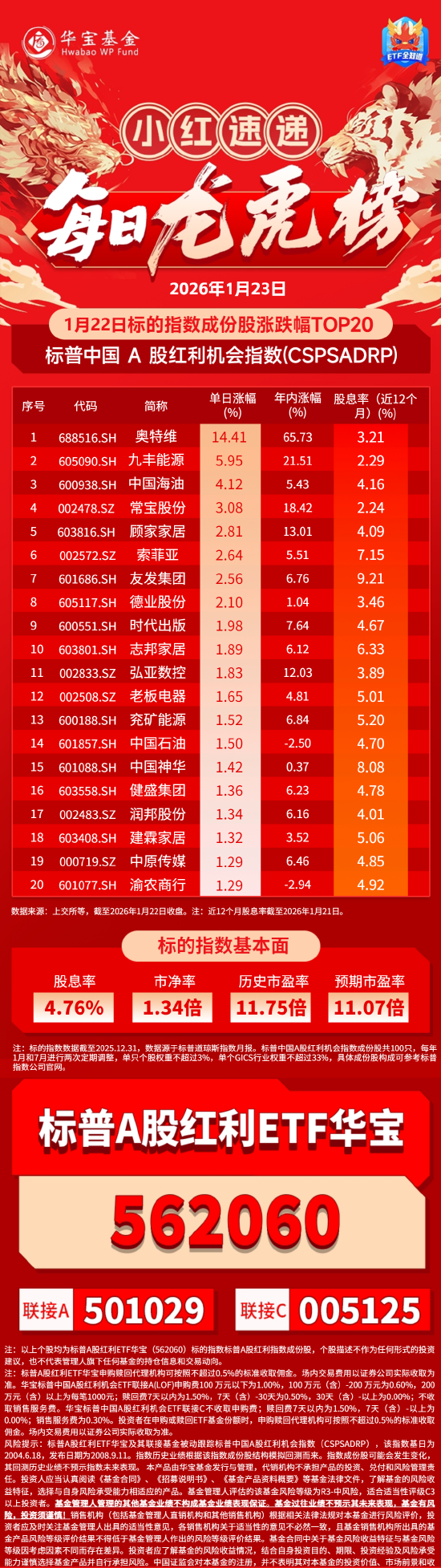
小红日报 | 顾家家居、南山铝业领涨!标普A股红利ETF华宝(562060)标的指数收涨0.74%续创新高两连阳
Xin Lang Cai Jing· 2026-01-21 01:03
Core Insights - The article highlights the top-performing stocks in the S&P China A-Share Dividend Opportunity Index as of January 20, 2026, showcasing significant daily and year-to-date gains along with dividend yields [1][5]. Group 1: Stock Performance - The top stock, Gujia Home Furnishing (603816.SH), experienced a daily increase of 7.82% and a year-to-date increase of 9.95%, with a dividend yield of 4.40% [1][5]. - Nanshan Aluminum (600219.SH) ranked second with a daily rise of 7.49% and a year-to-date increase of 22.68%, offering a dividend yield of 6.35% [1][5]. - Other notable performers include Jia Fei Industry (002572.SZ) with a daily increase of 5.63% and a year-to-date increase of 4.85%, and Hongya CNC (002833.SZ) with a daily rise of 4.73% and a year-to-date increase of 9.47% [1][5]. Group 2: Dividend Yields - The average dividend yield for the index is reported at 4.76%, with historical and expected price-to-earnings ratios at 1.34 times and 11.75 times, respectively [2]. - The dividend yields of the top stocks range from 2.42% for Jiufeng Energy (605090.SH) to 7.40% for Jia Fei Industry (002572.SZ) [1][5]. Group 3: Technical Indicators - The article mentions the formation of a MACD golden cross signal, indicating a positive trend for the stocks listed [4][8].





超半数装修建材股实现增长 康欣新材股价涨幅10.02%
Bei Jing Shang Bao· 2026-01-20 11:32
Core Viewpoint - The renovation and building materials sector experienced growth, closing at 17,486.43 points with a rise of 1.30% [1] Group 1: Stock Performance - Kangxin New Materials led the sector with a closing price of 4.72 CNY per share, increasing by 10.02% [1] - Sankeshu followed with a closing price of 48.38 CNY per share, also rising by 10.00% [1] - Gujia Home Furnishing closed at 33.80 CNY per share, with a rise of 7.81% [1] - Meike Home Furnishing saw a decline, closing at 2.86 CNY per share, down by 8.33% [1] - Xiong Plastic Technology closed at 10.70 CNY per share, decreasing by 4.12% [1] - Yuexin Health closed at 5.08 CNY per share, down by 2.68% [1] Group 2: Market Outlook - Huafu Securities indicated that the supply-side reform expectations and the acceleration of anti-involution may signal a turning point in the building materials capacity cycle [1] - The expectation of declining interest rates is likely to restore home buying willingness, supported by storage and urban renewal initiatives [1] - The marginal recovery in home buying willingness and capacity is expected to increase the probability of stabilization in the real estate market fundamentals, which may also drive the recovery of post-real estate cycle demand [1]



家居用品板块1月20日涨1.36%,顾家家居领涨,主力资金净流出2.06亿元
Zheng Xing Xing Ye Ri Bao· 2026-01-20 08:51
Group 1 - The home goods sector increased by 1.36% on January 20, with Gujia Home leading the gains [1] - The Shanghai Composite Index closed at 4113.65, down 0.01%, while the Shenzhen Component Index closed at 14155.63, down 0.97% [1] - Gujia Home's stock price rose by 7.81% to 33.80, with a trading volume of 141,200 shares and a transaction value of 465 million yuan [1] Group 2 - Other notable gainers included Meng Tian Home (+7.04%), Sophia (+5.63%), and Filinger (+4.79%) [1] - The home goods sector experienced a net outflow of 206 million yuan from main funds, while retail investors saw a net inflow of 155 million yuan [2] - The trading data indicates that retail investors were more active in the home goods sector compared to institutional investors [2][3]

高分红+稳现金流资产配置需求上升 现金流ETF嘉实(159221)受益
Jin Rong Jie· 2026-01-20 08:49
Group 1 - The Shenzhen Composite Index fell by 1.22% and the ChiNext Index dropped by 1.83% as of 11:30 AM on January 20, indicating a bearish trend in the market [1] - Notable stock performances included Nanshan Aluminum rising over 7%, Satellite Chemical and Conch Cement increasing by over 5%, and several other companies like Gujia Home, China Chemical, and Oppein Home gaining over 4% [1] Group 2 - The cash flow ETF managed by Harvest (159221) decreased by 0.08%, with a trading volume of 10.194 million yuan and a turnover rate of 1.29% [2] - There is an increasing market demand for high-dividend and stable cash flow assets, as funds are rotating from momentum-driven bubbles to high-value opportunities under the current "slow bull" market in A-shares [2] - The cash flow index, which includes non-ferrous metals and basic chemicals, benefits from the pricing of physical assets and high operating rates, showing significant cyclical alpha characteristics [2] - During the 14th Five-Year Plan, the State Grid is expected to invest 4 trillion yuan in fixed assets, a 40% increase compared to the previous plan, which directly benefits index components related to grid equipment and energy [2]