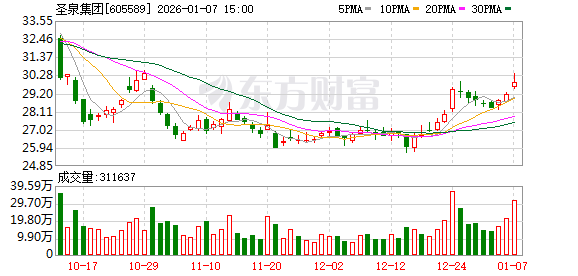
Shengquan Group(605589)

Search documents
国际油价小幅上涨,丁二烯、环氧丙烷价格上涨
Zhong Guo Neng Yuan Wang· 2026-01-19 06:53
Core Viewpoint - The report highlights the current trends in the chemical industry, focusing on price movements, supply and demand dynamics, and investment opportunities in undervalued leading companies amid a backdrop of geopolitical tensions and changing market conditions [1][4][8]. Industry Dynamics - In the week of January 12-18, 49 out of 100 tracked chemical products saw price increases, while 20 experienced declines, and 31 remained stable. The average monthly price of 49% of products rose compared to the previous month [3]. - The average price of WTI crude oil futures increased by 0.54% to $59.44 per barrel, while Brent crude oil futures rose by 0.66% to $63.76 per barrel during the same week [4]. - As of January 9, U.S. crude oil production averaged 13.753 million barrels per day, a decrease of 58,000 barrels from the previous week but an increase of 272,000 barrels year-on-year. Total U.S. oil demand was 21.009 million barrels per day, up by 178,200 barrels from the previous week [4]. Price Movements - The price of butadiene rose by 4.04% to 9,663 yuan per ton as of January 18, with a month-on-month increase of 25.98% but a year-on-year decrease of 20.8%. The production of butadiene was 109,300 tons, down 2.85% from the previous week [5]. - Epoxy propane prices increased by 8.84% to 8,620 yuan per ton, with a year-on-year rise of 9.88%. The market operating rate was 65.38%, reflecting a 1.51% increase from the previous week [6][7]. Investment Recommendations - As of January 18, the price-to-earnings ratio (TTM) for the SW basic chemical sector is 14.68, at the 59.64% historical percentile, while the price-to-book ratio is 1.54, at the 40.20% historical percentile. The SW oil and petrochemical sector has a TTM P/E ratio of 13.44, at the 39.81% historical percentile [8]. - Investment suggestions include focusing on undervalued leading companies, the impact of "anti-involution" on supply in related sub-industries, and the growing importance of self-sufficiency in electronic materials and certain new energy materials amid rising prices [2][8]. - Recommended stocks include Wanhua Chemical, Hualu Hengsheng, and others, with a focus on sectors like semiconductor materials, OLED materials, and new energy materials [8][9].




光刻胶国产替代迎来机会!美国关税倒逼+政策红利护航+头部企业技术破壁,头部企业A+H股上市助力行业加速
Xin Lang Cai Jing· 2026-01-15 14:09
Group 1 - Nanda Optoelectronics is a core enterprise in the semiconductor materials field, focusing on the R&D and mass production of ArF photoresists, having achieved breakthroughs that disrupt the monopoly of Japanese and American companies in the mid-to-high-end photoresist market [1][38][39] - The company has established deep cooperation with foundries in the Yangtze River Delta and has successfully validated its ArF photoresist for 28nm processes, leading to significant order growth and capacity expansion following the introduction of U.S. semiconductor tariffs in 2026 [1][39] - The National Big Fund has provided financial support for its photoresist projects, enhancing its first-mover advantage in the domestic photoresist market [1][39] Group 2 - Tongcheng New Materials, based in Shanghai, is a leading domestic rubber additive company that has entered the photoresist market through the acquisition of Beixu Electronics, focusing on the R&D and production of KrF photoresists [2][40] - The company has established stable partnerships with major domestic foundries, achieving large-scale production of KrF photoresists widely used in memory chips and power devices [2][40] - Plans for an H-share listing in 2026 aim to raise funds for high-end photoresist R&D and capacity expansion, further enhancing its competitive edge in the domestic market [2][40] Group 3 - Dinglong Co., headquartered in Wuhan, is a leader in printing and copying consumables, diversifying into semiconductor materials with a focus on polishing pads and supporting materials for photoresists [3][41] - The company has established close cooperation with major foundries like SMIC, achieving import substitution for its CMP polishing pads, which supports its photoresist business [3][41] - Following the U.S. semiconductor tariffs, there has been a surge in demand for localized supporting materials, leading to increased orders for its photoresist and related products [3][41] Group 4 - Yake Technology, located in Jiangsu, has entered the semiconductor photoresist market through the acquisition of South Korea's UP Chemical, focusing on KrF and ArF photoresists [4][42] - The company has integrated the technical advantages of the Korean team with domestic market resources, positioning itself as a core supplier of mid-to-high-end photoresists in the global semiconductor supply chain [4][42] - The electronic specialty gas business complements its photoresist offerings, providing a one-stop material solution for foundries [4][42] Group 5 - Dongcai Technology, based in Sichuan, specializes in high polymer resin materials for photoresists, leveraging its chemical industry foundation in the Southwest [5][43] - The company has achieved batch supply of resin products for various photoresist models, including G/I line and KrF, validated by multiple domestic photoresist manufacturers [5][43] - The demand for localized raw materials has surged following the U.S. semiconductor tariffs, leading to increased production capacity and a focus on high-end resin materials for ArF photoresists [5][43] Group 6 - Lianhong New Materials, located in Shandong, produces core raw materials such as monomers and solvents for photoresists, achieving low-cost production with quality meeting import standards [6][44] - The company has established long-term partnerships with downstream photoresist manufacturers, enhancing product adaptability and market share [6][44] - The acceleration of domestic substitution due to U.S. tariffs has led to a significant increase in orders for its photoresist raw materials [6][44] Group 7 - Shengquan Group, based in Shandong, focuses on developing phenolic and epoxy resins for photoresists, achieving breakthroughs in green and high-performance materials [7][45] - The company has become a core supplier for downstream photoresist manufacturers, benefiting from the growing demand for upstream resin materials following the U.S. semiconductor tariffs [7][45] - Increased R&D investment aims to develop high-end resin materials for KrF photoresists, further extending its position in the semiconductor materials industry [7][45] Group 8 - Shanghai Xinyang, a leader in semiconductor cleaning liquids, has diversified into the photoresist market, focusing on G/I line and electroplating photoresists [8][46] - The company has achieved large-scale production of G/I line photoresists, becoming a major supplier for domestic packaging applications [8][46] - The introduction of U.S. tariffs has accelerated the domestic adoption of photoresist materials, significantly increasing order volumes for its products [8][46] Group 9 - Jingrui Electric Materials, located in Jiangsu, is a leader in microelectronic materials, with its photoresist business covering multiple models including G/I line and KrF [9][48] - The company has accumulated extensive experience in photoresist R&D and production, with KrF photoresists entering the customer validation phase [9][48] - The U.S. semiconductor tariffs have led to a significant increase in domestic procurement of photoresists, resulting in notable revenue growth for the company [9][48] Group 10 - Huamao Technology, based in Fujian, has entered the photoresist market through the acquisition of XuZhou Bokan, focusing on ArF photoresist R&D [10][49] - The company aims to leverage its technical reserves to achieve breakthroughs in the production of mid-to-high-end photoresists, particularly in automotive semiconductor applications [10][49] - The acceleration of domestic substitution due to U.S. tariffs positions the company favorably in the ArF photoresist market [10][49] Group 11 - Jingfang Technology, headquartered in Jiangsu, specializes in semiconductor packaging and testing, relying on photoresists as a core consumable in its processes [11][50] - The company is enhancing cooperation with domestic photoresist manufacturers to optimize supply chain costs amid the push for domestic substitution [11][50] - The growth in demand from automotive electronics and AIoT sectors is driving the expansion of its packaging business, indirectly benefiting from the photoresist market [11][50] Group 12 - Xinlai Yingcai, based in Jiangsu, is a leader in ultra-pure fluid equipment, providing clean production equipment for photoresist manufacturing [12][51] - The company is expanding its product offerings to include ultra-clean equipment suitable for ArF and EUV photoresist production [12][51] - The demand for clean equipment has surged following the U.S. semiconductor tariffs, leading to significant order growth [12][51] Group 13 - Hubei Yihua, located in Hubei, is a leader in basic chemicals, producing raw materials for photoresists such as chlorobenzene and phosphorus trichloride [13][53] - The company has achieved large-scale production of photoresist raw materials, benefiting from the growing demand for localized supply following U.S. tariffs [13][53] - Its integrated chemical industry advantages help reduce production costs, enhancing its competitiveness in the photoresist supply chain [13][53]


济南圣泉集团股份有限公司关于为全资子公司提供担保的公告
Shang Hai Zheng Quan Bao· 2026-01-14 17:49
Core Viewpoint - The company has provided a guarantee of 900 million RMB for its wholly-owned subsidiary, Daqing Shengquan Green Wind Power Co., Ltd., to support its financing needs for production and project construction [1][3]. Group 1: Guarantee Details - The guarantee is a joint liability guarantee for a loan of 900 million RMB from China Merchants Bank Harbin Branch [1]. - The guarantee agreement is effective from the date of signing until the debt is due or three years after the advance payment [2]. - The total amount of guarantees authorized for the year 2025 is capped at 3.25 billion RMB, which includes mutual guarantees among the company and its subsidiaries [2]. Group 2: Necessity and Reasonableness of the Guarantee - The guarantee aligns with the company's overall development strategy and is beneficial for the company's interests [3]. - The company maintains control over the subsidiary's operations and financial status, making the guarantee risk manageable [3]. - The board of directors has approved the guarantee, affirming that the subsidiary has sufficient debt repayment capacity and that the guarantee complies with relevant laws and regulations [3]. Group 3: Cumulative Guarantee Situation - As of the announcement date, the company's total external guarantees amount to 77.1727 million RMB, representing 0.77% of the latest audited net assets [3]. - All guarantees provided are exclusively for wholly-owned and controlled subsidiaries, with no overdue guarantees reported [3].

圣泉集团:无逾期担保情况
Zheng Quan Ri Bao· 2026-01-14 12:39
Group 1 - The company, Shengquan Group, announced that it does not provide guarantees to its controlling shareholders, actual controllers, or their related parties [2] - There are no overdue guarantees reported by the company [2]

圣泉集团(605589) - 圣泉集团关于为全资子公司提供担保的公告
2026-01-14 08:15
证券代码:605589 证券简称:圣泉集团 公告编号:2026-001 济南圣泉集团股份有限公司 关于为全资子公司提供担保的公告 本公司董事会及全体董事保证本公告内容不存在任何虚假记载、误导性陈述 或者重大遗漏,并对其内容的真实性、准确性和完整性承担法律责任。 重要内容提示: 担保对象及基本情况 | 被担保人名称 | 本次担保金额 | 实际为其提供的 | | 是否在前期预计 | 本次担保是否有 | | --- | --- | --- | --- | --- | --- | | | | 担保余额(不含本 次担保金额) | | 额度内 | 反担保 | | 大庆圣泉绿色风电 | 90,000.00 万元 | 0.00 | 万元 | 是 | 否 | | 有限公司 | | | | | | 累计担保情况 | 对外担保逾期的累计金额(万元) | 0.00 | | --- | --- | | 截至本公告日上市公司及其控股 子公司对外担保总额(万元) | 7,717.27 | | 对外担保总额占上市公司最近一 期经审计净资产的比例(%) | 0.77 | | 特别风险提示 | □担保金额(含本次)超过上市公司最近一 | | | ...
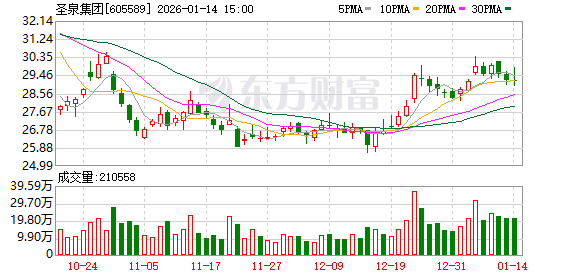
圣泉集团涨2.02%,成交额3.38亿元,主力资金净流入1236.27万元
Xin Lang Zheng Quan· 2026-01-14 04:06
Group 1 - The core viewpoint of the news is that Shengquan Group has shown a positive stock performance with a year-to-date increase of 5.34% and a market capitalization of 25.23 billion yuan as of January 14 [1] - The company reported a revenue of 8.072 billion yuan for the period from January to September 2025, reflecting a year-on-year growth of 12.87%, and a net profit attributable to shareholders of 760 million yuan, which is a 30.81% increase compared to the previous year [2] - Shengquan Group's main business revenue composition includes synthetic resins and derivatives at 87.89%, biomass products at 9.64%, and other products at 1.70% and 0.76% respectively [1] Group 2 - As of September 30, 2025, the number of shareholders for Shengquan Group increased by 15.57% to 31,100, while the average circulating shares per person decreased by 13.47% to 25,135 shares [2] - The company has distributed a total of 1.29 billion yuan in dividends since its A-share listing, with 942 million yuan distributed over the past three years [3] - Among the top ten circulating shareholders, Hong Kong Central Clearing Limited is the second-largest shareholder with 34.13 million shares, an increase of 27.16 million shares from the previous period [3]
聚苯醚(PPO)研究:算力时代的底层基石与高端制造的国产替代先锋(附42页PPT)
材料汇· 2026-01-12 13:52
Core Viewpoint - The article emphasizes the transformative role of Polyphenylene Oxide (PPO) in various industries, particularly in high-performance applications such as AI servers and electric vehicles, highlighting its transition from a general-purpose material to a strategic specialty material [4][18]. Summary by Sections Introduction - The evolution of engineering plastics, particularly PPO, is linked to significant industrial transformations, akin to the role of steel in the industrial revolution [3]. Overview of PPO - PPO, known for its high production barriers and stringent polymerization processes, is recognized as one of the five major engineering plastics globally [4]. - Its unique molecular structure provides several core physical advantages, including low dielectric loss, excellent thermal stability, and high mechanical strength [7][9][11]. Development History - The commercialization of PPO has evolved through various phases, from initial discovery in the 1950s to the current phase of domestic production breakthroughs in China [12][13]. Classification and Forms of PPO - PPO can be categorized into various types, including pure PPO, modified PPO, and functionalized PPO, each with distinct properties and applications [14][15]. Core Application Scenarios - PPO is extensively used in strategic fields such as new energy vehicles, photovoltaic energy, and aerospace, with its most critical value being in AI servers and data centers due to its low signal loss characteristics [16][17]. Industry Chain Analysis - The PPO industry chain is characterized by high technical and capital intensity, with a clear division from upstream raw materials to downstream applications [20][21]. - The production chain includes the synthesis of the core monomer 2,6-Dimethylphenol, followed by polymerization and modification processes [23][25][29]. Market Analysis - The global PPO market is projected to grow from approximately 22.55 billion yuan in 2023 to nearly 30.68 billion yuan by 2030, with a CAGR of 3.5% [33]. - The Chinese PPO market is also expanding, with a forecasted demand of 245,000 tons by 2030, accounting for 22% of the global market [35]. Supply and Demand Dynamics - The supply side of the PPO market is dominated by a few key players, including SABIC and Asahi Kasei, while domestic production in China is rapidly increasing [39][42]. - Demand drivers include the surge in AI computing needs and the electrification of vehicles, with PPO being essential for high-frequency applications [46][50]. Technical Analysis - PPO's competitive edge lies in its unique molecular structure and the complexity of its polymerization process, which presents significant barriers to entry for new competitors [55][56]. - The modification techniques for PPO are crucial for enhancing its processability and functional properties, enabling its application in high-end markets [59].
发行公告扎堆亮相,可转债成能源企业融资“新宠”
中国能源报· 2026-01-12 02:54
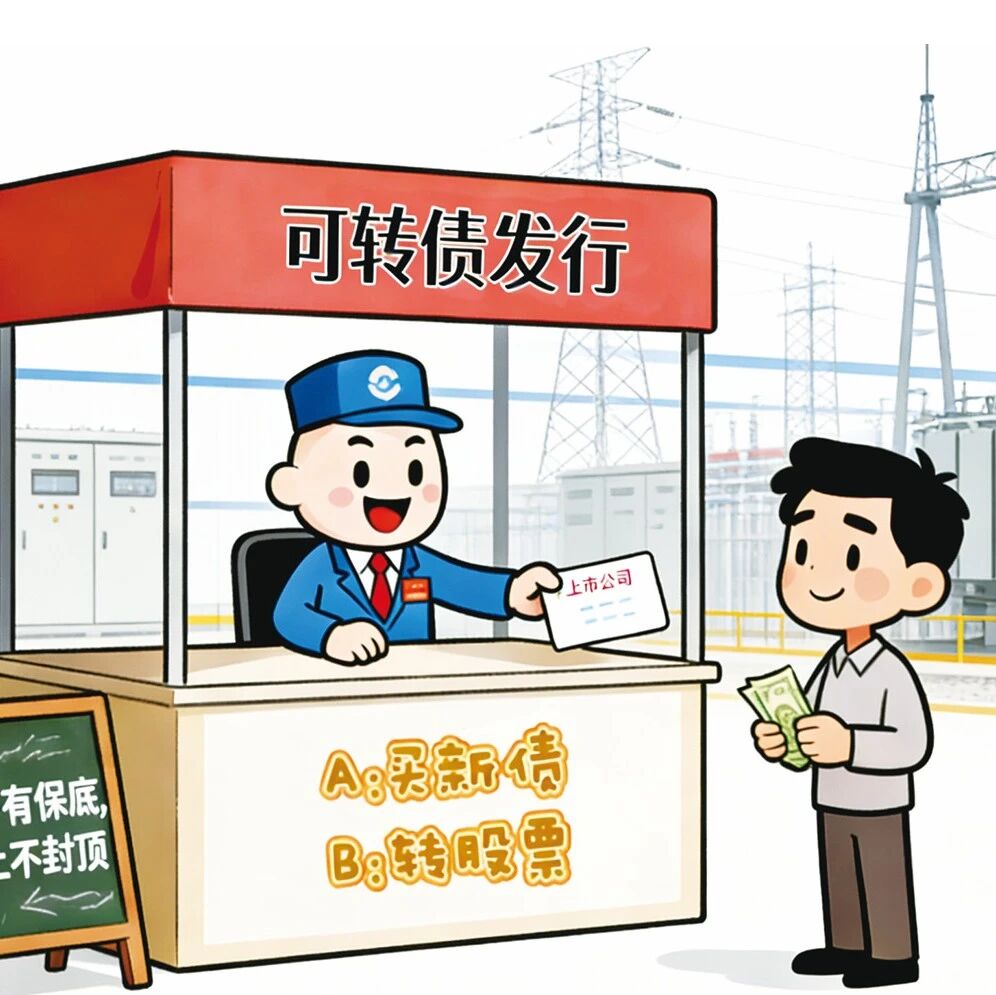
Core Viewpoint - The article discusses the growing trend of convertible bond issuance in China, highlighting its role as a financial lever for companies to invest in new productive forces, particularly in technology innovation and capital empowerment [2][3]. Group 1: Convertible Bond Issuance - Several companies, including Jinpan Technology, Changgao Electric, Huichuangda Technology, and Jinan Shengquan Group, have announced plans to issue convertible bonds to raise funds for projects in data center power supply, smart manufacturing of power equipment, and new energy battery materials [5][6]. - Jinpan Technology plans to raise a total of 1.6715 billion yuan through a 6-year convertible bond for projects related to data center power modules and energy-efficient power equipment [5]. - Changgao Electric aims to raise approximately 750 million yuan for projects focused on enhancing its production capabilities in the electric power equipment sector [5]. - Huichuangda intends to raise up to 650 million yuan for projects related to power batteries and energy storage systems, as well as to supplement working capital [5]. - Shengquan Group plans to issue 2.5 billion yuan in convertible bonds, with 2 billion yuan allocated for green energy battery material projects [6]. Group 2: Market Trends and Opportunities - The issuance of convertible bonds indicates a significant capital flow towards emerging industries, particularly in the technology and manufacturing sectors [8][9]. - The data center market is experiencing rapid growth, with power supply modules becoming increasingly dominant, suggesting a substantial future market space [8]. - Shengquan Group's project aims to produce 10,000 tons of silicon-carbon anode materials and 15,000 tons of porous carbon, addressing the rising demand for high-energy-density batteries in electric vehicles and consumer electronics [9]. - Despite an overall contraction in the convertible bond market in 2025, bonds in the technology and manufacturing sectors are highly sought after, reflecting a focus on supporting technological innovation and green transformation [9]. Group 3: Financial and Governance Aspects - The current interest rate reduction cycle provides an opportune environment for companies to issue convertible bonds, as it lowers financing costs [11]. - Convertible bonds offer a dual benefit of fixed income and potential equity conversion, allowing companies to manage shareholder dilution more gradually compared to direct stock issuance [11]. - The issuance of convertible bonds is accompanied by increased external oversight, requiring companies to demonstrate effective use of raised funds and maintain transparency in governance [11][12]. - Companies are strategically aligning their convertible bond projects with their future development plans to enhance core competitiveness and profitability [12][13].


圣泉集团:公司在定期报告中对报告期末股东人数及相关情况进行披露
Zheng Quan Ri Bao Wang· 2026-01-07 12:41
Group 1 - The core viewpoint of the article is that Shengquan Group (605589) emphasizes its commitment to providing equal access to information for all investors by disclosing the number of shareholders and related information in its regular reports [1] Group 2 - The company responded to investor inquiries on its interactive platform, indicating transparency in its communication practices [1] - The disclosure of shareholder numbers is part of the company's efforts to ensure fair information dissemination among investors [1]
圣泉集团:目前大庆“年产100万吨生物质精炼一体化”项目主要产品包括秸秆浆生活用纸、糠醛和木质素产品
Zheng Quan Ri Bao· 2026-01-07 11:45
Core Viewpoint - Shengquan Group is actively developing high-value lignin products to support its Daqing project in achieving its goals of reducing losses and increasing efficiency [2] Group 1 - The Daqing project has an annual production capacity of 1 million tons of biomass refining integration [2] - Main products from the Daqing project include straw pulp for household paper, furfural, and lignin products [2] - Lignin products focus on biochar, hard carbon anode materials, dye dispersants, and zero-carbon fuels [2]