BCHT(688276)

Search documents
4家流感疫苗企业年销售额干不过一款奥司他韦
第一财经· 2025-11-26 14:11
Core Viewpoint - The article discusses the challenges and market dynamics of the influenza vaccine industry in China, highlighting the low vaccination rates and the dominance of antiviral medications in sales compared to vaccines [3][4]. Group 1: Market Performance - In 2024, the sales figures for major influenza vaccine companies in China are as follows: Hualan Biological (10.73 billion), Jindike (808.03 million), and Zhonghui Biological (260 million) [4]. - The total sales of these four companies (Hualan, Jindike, Zhonghui, and Baike Biological) do not exceed 1.6 billion, which is significantly lower than the sales of Dongyang Sunshine Pharmaceutical's antiviral drug Oseltamivir, which reached approximately 2.6 billion [6]. Group 2: Economic Burden of Influenza - The economic burden of influenza for outpatient patients ranges from 801 to 1,320 yuan, while for hospitalized patients, it can be between 9,832 and 23,833 yuan [6]. Group 3: Vaccination Challenges - The low vaccination rate in China is attributed to public misconceptions about the necessity and effectiveness of vaccines, as well as concerns about side effects [8][9]. - "Vaccine hesitancy" is identified as a significant barrier to increasing vaccination rates, with public education and improved access to vaccination services recommended as necessary measures [9].




4家流感疫苗企业年销售额干不过一款奥司他韦,流感疫苗缘何推广困难重重
Di Yi Cai Jing· 2025-11-26 13:46
Core Viewpoint - The flu vaccine is considered the "first line of defense" against influenza, significantly reducing the risk of infection and severe complications, yet its uptake in China remains low, hovering in single digits compared to the more successful flu treatment drug market [1] Group 1: Market Performance - In 2024, the sales figures for flu vaccine companies in A-shares and Hong Kong include: Hualan Vaccine at 1.073 billion yuan, Jindike at 80.827 million yuan, and Zhonghui Biological at 260 million yuan [2] - The total sales for the four major flu vaccine companies, including Baike Biological, are projected to be under 1.6 billion yuan, which is significantly lower than the 2.6 billion yuan sales of the flu treatment drug Oseltamivir by Dongyangguang Pharmaceutical [3] Group 2: Economic Burden and Benefits - The economic burden of influenza for outpatient patients ranges from 801 to 1,320 yuan, while for hospitalized patients, it can be between 9,832 and 23,833 yuan, indicating that flu vaccination can effectively reduce related medical costs and improve economic outcomes [3] Group 3: Challenges in Vaccine Promotion - Public misconceptions about the necessity and effectiveness of the flu vaccine, as well as concerns over side effects, hinder its promotion and uptake [5] - Vaccine hesitancy, recognized as a global health threat, leads to underestimation of the flu's severity and a lack of understanding of vaccine efficacy, impacting vaccination rates [6] - To improve vaccination rates, it is essential to enhance public education, increase accessibility to vaccination services, and develop better funding mechanisms for vaccine costs [6]
流感「抬头」,疫苗价「雪崩」,行业协会坐不住了
36氪· 2025-11-26 13:39
Core Viewpoint - The article discusses the ongoing price war in China's vaccine industry, driven by changes in supply and demand dynamics, leading to significant price reductions and financial losses for companies [4][15][22]. Group 1: Price War Dynamics - The price of a three-valent flu vaccine has dropped to 5.5 yuan, cheaper than a cup of milk tea, indicating a severe price competition in the vaccine market [5][11]. - The China Vaccine Industry Association has issued an initiative to combat "involution-style" competition, urging members to avoid bidding below cost and threatening penalties for violations [6][8][10]. - The price war has persisted for two years, with the association's initiative being the first formal stance against low-price competition, although it may not resolve the underlying issue of overcapacity [6][10][22]. Group 2: Supply and Demand Changes - The supply side is characterized by homogenization and overcapacity, with many companies entering the vaccine market, leading to intense competition and price wars [16][17]. - Demand is also under pressure, with declining public trust in vaccines and a decrease in vaccination rates, particularly for flu vaccines, which averaged below 4% in China from 2020 to 2023 [17][19]. - The shift in focus from childhood vaccines to adult vaccines due to declining birth rates has intensified competition in the adult vaccine market [17][19]. Group 3: Financial Impact on Companies - The financial repercussions of the price war are evident, with vaccine companies experiencing a 60% drop in revenue and a 113% decline in net profit in the first half of 2025 [19][20]. - Major companies like Zhifei Biological and Wantai Biological have reported significant losses, with Zhifei's revenue down 66.53% and net profit loss of 12.06 billion yuan [20][21]. - Despite some companies showing growth in sales, the overall trend indicates that increased revenue does not equate to increased profit due to drastic price reductions [21][22]. Group 4: Future Outlook and Strategies - Experts suggest that the industry is in a "deep cold moment," requiring a period of consolidation and restructuring that could last five to ten years [23]. - Companies are exploring two main strategies to navigate the competitive landscape: expanding into emerging markets and focusing on differentiated products to meet unmet clinical needs [24].



当带状疱疹疫苗开始“买一送一”
3 6 Ke· 2025-11-26 12:15
Core Insights - The article discusses the competitive landscape of the shingles vaccine market in China, highlighting the unexpected price war initiated by GSK's vaccine, Shingrix, which is being promoted through a "buy one get one free" offer [1][2][4]. Market Dynamics - Shingrix's original price for two doses is 3,260 yuan, but with the promotion, the cost is reduced to 1,652 yuan, effectively a 50% discount [2]. - The vaccine has shown exceptional efficacy, reducing the risk of shingles by 97.2% in individuals aged 50 and above, and offers long-lasting immunity [2][7]. Competitive Landscape - Following GSK's price reduction, domestic competitor, Baike Biological, has also adjusted its pricing strategy, with its vaccine now priced around 1,400 yuan, and further discounts being offered [4]. - The domestic market for shingles vaccines has not met expectations, with Baike Biological reporting a significant drop in sales and revenue due to high return rates and low demand [8]. Consumer Behavior and Market Potential - Despite the high demand for shingles vaccines among the elderly population, the uptake has been low, with only 0.1% vaccination rate among those aged 50 and above in 2021 [9][11]. - The mismatch between the high cost of the vaccine and the financial capability of the target demographic is a significant barrier to market growth [11]. Challenges in Market Expansion - The competitive landscape in China is more fragmented compared to overseas markets, with both imported and domestic vaccines vying for market share, complicating the expansion efforts for Shingrix [11][13]. - There is a lack of awareness and understanding of the vaccine among the target demographic, which hinders its adoption [12][13].
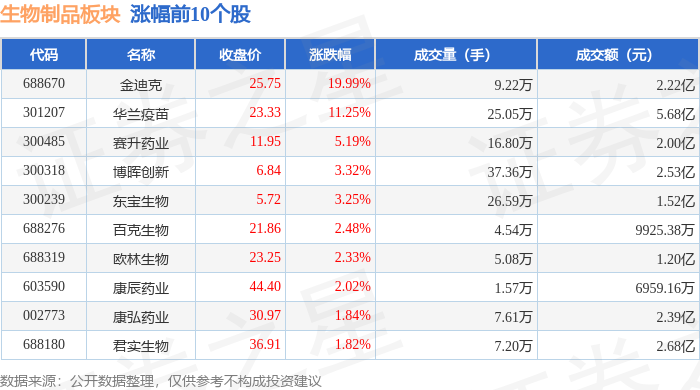
生物制品板块11月25日涨0.83%,金迪克领涨,主力资金净流入4087.68万元
Zheng Xing Xing Ye Ri Bao· 2025-11-25 09:10
Market Overview - The biopharmaceutical sector increased by 0.83% on November 25, with Jindike leading the gains [1] - The Shanghai Composite Index closed at 3870.02, up 0.87%, while the Shenzhen Component Index closed at 12777.31, up 1.53% [1] Top Gainers in Biopharmaceutical Sector - Jinke (688670) closed at 25.75, up 19.99% with a trading volume of 92,200 shares [1] - Hualan Biological (301207) closed at 23.33, up 11.25% with a trading volume of 250,500 shares [1] - Saiseng Pharmaceutical (300485) closed at 11.95, up 5.19% with a trading volume of 168,000 shares [1] - Other notable gainers include Bohui Innovation (300318) at 6.84 (+3.32%) and Dongbao Biological (300239) at 5.72 (+3.25%) [1] Market Capital Flow - The biopharmaceutical sector saw a net inflow of 40.88 million yuan from institutional investors, while retail investors experienced a net outflow of 147 million yuan [2] - The sector's overall capital flow indicates a strong interest from institutional investors despite retail selling pressure [2] Individual Stock Capital Flow - Jinke (688670) had a net inflow of 39.66 million yuan from institutional investors, while retail investors showed a net outflow of 13.72 million yuan [3] - Other stocks like Watson Bio (300142) and Hualan Bio (002007) also experienced significant net inflows from institutional investors, indicating positive sentiment [3] - Conversely, stocks like Dongbao Biological (300239) and Bohui Innovation (300318) faced net outflows from retail investors, suggesting mixed investor sentiment [3]


九价HPV与带状疱疹疫苗多地促销,最低3折至打一送一
Cai Jing Wang· 2025-11-22 05:54
【#带状疱疹及九价HPV疫苗促销席卷多地# 多家企业参与】九价HPV与带状疱疹疫苗在国内多个省市 地区已开展促销,让利幅度从最低3折到"打一送一"不等,参与企业包括智飞生物、百克生物等。有参 与促销的企业表示,"这是惠民降价,主要为配合加强公众疾病预防意识等。"但也有业内人士告诉智通 财经记者,当前一些头部疫苗企业存货数量较多,因为存在有效期,促销是减少库存的最佳手段。(智 通财经) ...
带状疱疹疫苗、九价HPV疫苗促销活动席卷多地
Xin Lang Cai Jing· 2025-11-22 04:05
Core Insights - The promotion of nine-valent HPV and shingles vaccines has been initiated in various provinces and cities in China, with discounts ranging from 30% to "buy one get one free" [1] - Participating companies include Zhifei Biological and Baike Biological, indicating a competitive market environment [1] - The promotions are aimed at enhancing public awareness of disease prevention, although some industry insiders suggest that high inventory levels among leading vaccine companies are driving these promotional efforts [1] Company Insights - Zhifei Biological and Baike Biological are actively participating in the promotional campaigns, reflecting their strategies to boost sales and market presence [1] - The promotional activities may indicate a shift in pricing strategies within the vaccine sector, as companies seek to attract more consumers [1] Industry Insights - The current promotional efforts highlight a trend in the vaccine industry towards price reductions and increased accessibility for consumers [1] - The presence of significant inventory among leading vaccine manufacturers suggests potential challenges in inventory management and product expiration [1]
“反内卷”风吹向疫苗行业 严禁以低于成本报价参与竞标
Bei Jing Shang Bao· 2025-11-21 00:00
Core Viewpoint - The Chinese vaccine industry is facing intense price competition, leading to significant profit declines for many companies. The China Vaccine Industry Association has called for members to resist disorderly low-price competition and adhere to fair pricing practices to stabilize the market and promote innovation [1][2][3]. Group 1: Industry Challenges - The price war in the vaccine industry has intensified, with the price of the bivalent HPV vaccine dropping to as low as 27.5 yuan per dose, and flu vaccines reaching as low as 5.5 yuan per dose [4][6]. - In the first three quarters of this year, 71.43% of A-share vaccine companies reported a decline in net profit, with notable losses from companies like Wantai Biological Pharmacy and BCG Biological [6][7]. Group 2: Association's Initiative - The China Vaccine Industry Association has issued an initiative to promote high-quality development in the vaccine sector by advocating for self-discipline, innovation, and fair competition [2][3]. - The initiative emphasizes compliance with national laws and industry self-regulation, urging members to set prices based on production costs and market demand, while strictly prohibiting bidding below cost [2][3]. Group 3: Long-term Outlook - Experts believe that if the association's initiative is effectively implemented, it could lead to a more orderly competitive landscape, enhancing the industry's sustainability and improving vaccine safety and efficacy [3][7]. - The vaccine industry is seen as a crucial segment of the biopharmaceutical sector, with potential for growth as public health awareness and innovation capabilities improve [7].

一支流感疫苗公费价便宜过一杯咖啡!疫苗协会倡议抵制无序低价竞争
Di Yi Cai Jing· 2025-11-19 14:23
Core Viewpoint - The Chinese Vaccine Industry Association has issued an initiative to combat "involution" competition in the vaccine sector, aiming to promote high-quality development and establish a healthy competitive environment in the industry [1][2]. Group 1: Initiative Details - The initiative mandates all members of the Chinese Vaccine Industry Association to adhere to the Vaccine Administration Law and the Price Law of the People's Republic of China, ensuring fair and legal pricing based on production costs and market demand [1]. - Members are required to resist disorderly low-price competition and are prohibited from participating in bidding with prices below cost, thereby ensuring product and service quality standards [1][2]. Group 2: Industry Context - The association currently has over 330 member units and 35 branches, encompassing major vaccine and biological product companies, as well as upstream and downstream service providers in the biopharmaceutical industry [4]. - A price war has emerged in the public market, with significant price drops observed. For instance, the bid price for a trivalent flu vaccine from Shanghai Biological Products Research Institute was set at 5.5 yuan per dose in September, marking a new low in the public flu vaccine market [4]. - The price of a bivalent HPV vaccine from Watson Bio was reduced to 27.5 yuan per dose in a procurement project, humorously compared to the cost of a cup of milk tea [4]. Group 3: Financial Impact - The price war reflects a phenomenon of homogenized competition within the industry, leading to financial pressure on vaccine companies. In the first three quarters of this year, 10 out of 14 listed vaccine companies reported a year-on-year decline in net profit [5]. - Notably, five companies, including Zhifei Biological Products and Kanglaite, reported significant losses, totaling over 12 billion yuan for Zhifei alone [5]. - Industry insiders have expressed concerns that some companies are engaging in price wars to survive or capture market share, hoping for further national measures to address the issue of "involution" [5].

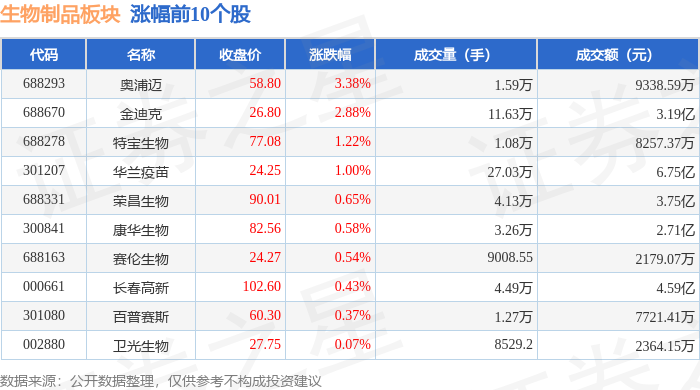
生物制品板块11月18日跌0.98%,禾元生物领跌,主力资金净流出9.81亿元
Zheng Xing Xing Ye Ri Bao· 2025-11-18 08:15
Core Insights - The biopharmaceutical sector experienced a decline of 0.98% on November 18, with He Yuan Bio leading the drop [1] - The Shanghai Composite Index closed at 3939.81, down 0.81%, while the Shenzhen Component Index closed at 13080.49, down 0.92% [1] Stock Performance Summary - Notable gainers included: - Aopu Mai (688293) with a closing price of 58.80, up 3.38% on a trading volume of 15,900 shares and a transaction value of 93.39 million [1] - Jin Hu Ke (688670) at 26.80, up 2.88% with a volume of 116,300 shares and a transaction value of 319 million [1] - Te Bao Bio (688278) at 77.08, up 1.22% with a volume of 10,800 shares and a transaction value of 82.57 million [1] - Notable decliners included: - Bu Yuan Bio (688765) at 79.95, down 3.89% with a volume of 56,800 shares and a transaction value of 458 million [2] - San Sheng Guo Jian (688336) at 67.60, down 3.87% with a volume of 68,100 shares and a transaction value of 469 million [2] - Wo Wu Bio (300357) at 31.77, down 3.23% with a volume of 77,900 shares and a transaction value of 250 million [2] Capital Flow Analysis - The biopharmaceutical sector saw a net outflow of 981 million from institutional investors, while retail investors contributed a net inflow of 819 million [2] - Key stocks with significant capital flow included: - Hua Lan Vaccine (301207) with a net inflow of 48.51 million from institutional investors [3] - Rong Chang Bio (688331) with a net inflow of 23.62 million from institutional investors [3] - Jin Ke (688670) with a net inflow of 5.53 million from institutional investors [3]