
Breo(688793)

Search documents
倍轻松:目前有少量动漫IP周边产品
Mei Ri Jing Ji Xin Wen· 2025-10-13 09:53
Core Viewpoint - The company has a limited range of anime IP peripheral products, which may be suitable as surrounding products for the millet economy [1] Group 1 - An investor inquired whether the company's products are suitable as peripheral items for the millet economy [1] - The company responded that it currently offers a small number of anime IP peripheral products [1]

倍轻松:暂未在业务中运用区块链技术
Mei Ri Jing Ji Xin Wen· 2025-10-13 09:52
Core Viewpoint - The company, Beiliang (688793.SH), has not yet implemented blockchain technology in its business as of October 13, 2023, and will disclose any future plans in accordance with information disclosure regulations [1] Summary by Categories - **Company's Current Technology Use** - As of now, Beiliang has not utilized blockchain technology in its operations [1] - **Future Plans and Disclosure** - The company stated that if there are any plans to apply blockchain technology or related business layouts in the future, it will strictly adhere to information disclosure rules and announce them in a timely manner [1]
倍轻松(688793) - 2025年第四次临时股东会会议资料
2025-10-10 10:45
深圳市倍轻松科技股份有限公司 2025 年第四次临时股东会会议资料 证券代码:688793 证券简称:倍轻松 深圳市倍轻松科技股份有限公司 2025 年第四次临时股东会 会议资料 二零二五年十月 1 深圳市倍轻松科技股份有限公司 2025 年第四次临时股东会会议资料 深圳市倍轻松科技股份有限公司 深圳市倍轻松科技股份有限公司 2025 年第四次临时股东会会议须知 2025 年第四次临时股东会会议资料目录 一、2025 年第四次临时股东会会议须知 二、2025 年第四次临时股东会会议议程 三、2025 年第四次临时股东会会议议案 议案一:《关于公司未弥补亏损达到实收股本总额三分之一的议案》 议案二:《关于独立董事任期满六年辞任暨补选独立董事、董事会专门委员会委 员的议案》 2 深圳市倍轻松科技股份有限公司 2025 年第四次临时股东会会议资料 为维护广大投资者的合法权益,保障股东在本次股东会期间依法行使权利,根据《中 华人民共和国公司法》、《中华人民共和国证券法》、中国证券监督管理委员会《上市公 司股东会规则》以及《深圳市倍轻松科技股份有限公司章程》和《深圳市倍轻松科技股份 有限公司股东会议事规则》等有关规定, ...
小家电板块10月10日跌0.11%,石头科技领跌,主力资金净流出1.46亿元
Zheng Xing Xing Ye Ri Bao· 2025-10-10 08:45
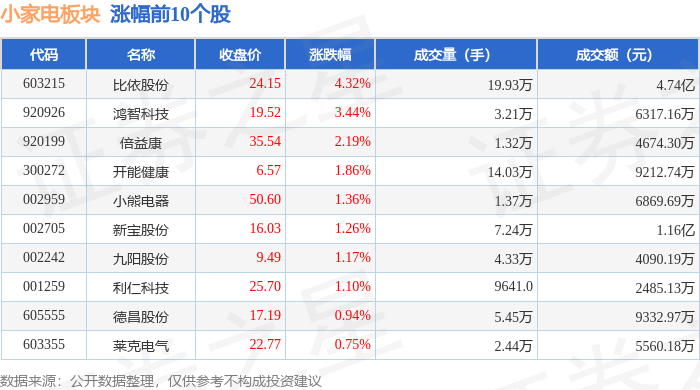
Core Viewpoint - The small home appliance sector experienced a slight decline of 0.11% on October 10, with Stone Technology leading the drop. The Shanghai Composite Index closed at 3897.03, down 0.94%, while the Shenzhen Component Index closed at 13355.42, down 2.7% [1]. Small Home Appliance Sector Performance - The small home appliance sector saw mixed performance among individual stocks, with notable gainers including: - Biyi Co., Ltd. (603215) closed at 24.15, up 4.32% with a trading volume of 199,300 shares and a transaction value of 474 million yuan [1]. - Jizhi Technology (920926) closed at 19.52, up 3.44% with a trading volume of 32,100 shares and a transaction value of 63.17 million yuan [1]. - Beiyikang (6610Z6) closed at 35.54, up 2.19% with a trading volume of 13,200 shares and a transaction value of 46.74 million yuan [1]. - Conversely, Stone Technology (688169) led the decline, closing at 197.79, down 2.47% with a trading volume of 43,700 shares and a transaction value of 88.1 million yuan [3]. Capital Flow Analysis - The small home appliance sector experienced a net outflow of 146 million yuan from institutional investors, while retail investors saw a net inflow of 13.22 million yuan [3]. - Specific stock capital flows included: - Biyi Co., Ltd. had a net inflow of 20.41 million yuan from institutional investors, but a net outflow of 27.13 million yuan from retail investors [4]. - Dechang Co., Ltd. (605555) saw a net inflow of 7.70 million yuan from institutional investors, but a net outflow of 7.58 million yuan from retail investors [4]. - New Treasure Co., Ltd. (002705) had a net inflow of 2.34 million yuan from institutional investors, with a net outflow of 3.53 million yuan from retail investors [4].





倍轻松10月9日获融资买入325.44万元,融资余额7795.09万元
Xin Lang Cai Jing· 2025-10-10 01:30
Group 1 - The core viewpoint of the news is that Beilingsong's stock performance and financial metrics indicate a challenging period, with significant declines in revenue and net profit, while financing activities show a relatively high level of engagement [1][2][3] Group 2 - As of October 9, Beilingsong's stock price increased by 0.87%, with a trading volume of 17.03 million yuan, and a net financing purchase of 557,100 yuan [1] - The total financing and securities balance for Beilingsong reached 77.95 million yuan, accounting for 3.02% of its market capitalization, indicating a high level compared to the past year [1] - For the first half of 2025, Beilingsong reported a revenue of 385 million yuan, a year-on-year decrease of 36.22%, and a net profit attributable to shareholders of -36.11 million yuan, a decline of 238.19% [2] - The number of shareholders increased by 10.36% to 4,835, while the average circulating shares per person decreased by 9.39% to 17,775 shares [2] - Since its A-share listing, Beilingsong has distributed a total of 66.94 million yuan in dividends, with no dividends paid in the last three years [3]
数读小家电半年报|倍轻松毛利率居首净利率垫底石头科技经营性现金净流出8.23亿
Xin Lang Cai Jing· 2025-09-30 10:39
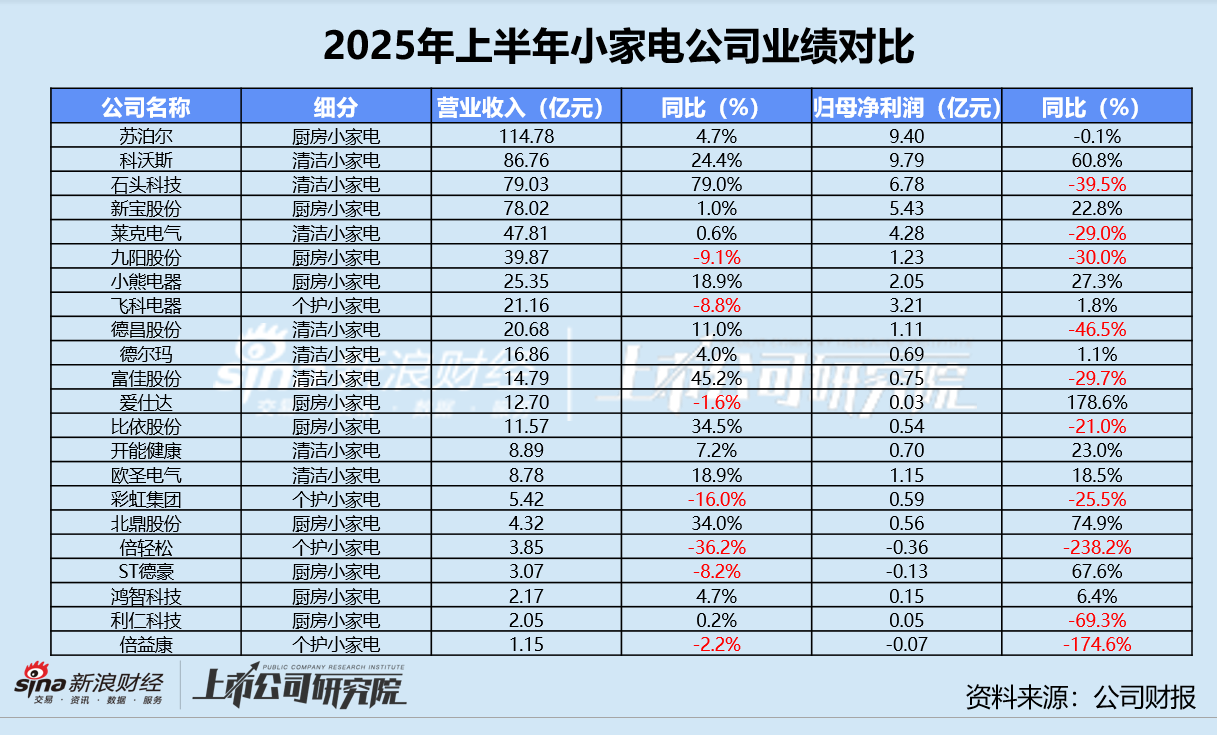
Core Viewpoint - The domestic home appliance market in China shows resilience with both volume and revenue growth driven by the "trade-in" policy, although there is significant internal differentiation within the small home appliance sector [1] Group 1: Market Performance - In the first half of 2025, the total revenue of 22 listed white goods companies reached 60.909 billion yuan, an increase of 12.1% compared to the same period in 2024 [1] - The total revenue of 10 kitchen small appliance companies was 29.391 billion yuan, with a net profit of 1.930 billion yuan, representing increases of 3.4% and 6.7% respectively compared to the first half of 2024 [1] Group 2: Company Performance - Companies such as Joyoung, Rainbow Group, Beike, and Beiyikang experienced declines in both revenue and net profit, with Beike and Beiyikang turning from profit to loss [1] - Supor led in revenue with 11.478 billion yuan, 1.32 times that of the second-ranked Ecovacs, and nearly 3.7 billion yuan higher than the third-ranked Xinbao [1] Group 3: Cost Control - Small appliance companies generally saw an increase in operating costs, with about half of the companies experiencing a growth rate in costs that exceeded revenue growth [1] - Dechang's operating cost ratio was notably high at 86.0%, with a sales gross margin decrease of 3.7 percentage points to 14.0% [1] Group 4: Expense Efficiency - Companies like Feike Electric, Aishida, Rainbow Group, and Joyoung reduced sales, management, and R&D expenses year-on-year, while others like Beike, Ecovacs, and Stone Technology saw all three types of expenses increase [1] - ST Dehao had the highest management expense ratio at approximately 15.0% among the 22 companies, but also recorded the largest decrease in management expenses compared to the first half of 2024 [1] Group 5: R&D Investment - The R&D expense ratio for small appliance companies generally remained between 2.5% and 6.0%, with Beike reaching 9.0%, and Stone Technology and Beike also above their peers at 8.7% and 7.0% respectively [1] Group 6: Profitability - Ecovacs and Supor had similar net profits of 979 million yuan and 940 million yuan respectively, outperforming competitors in the same segment [1] - Feike Electric led in sales net profit margin at 15.2%, a slight increase of 1.6% compared to 2024, while Beike ranked last with -9.4% [1] Group 7: Cash Flow and Inventory Management - Companies like Ecovacs, Bear Electric, Biyi, and Aishida reported positive operating cash flow, while others like Beike and Rainbow Group experienced net cash outflows from operating activities [1] - Rainbow Group's inventory turnover days increased significantly to 338 days, with a year-end inventory balance of approximately 567 million yuan [1]


DeepSeek V3.2发布,推动国产AI生态链崛起:计算机行业重大事项点评
Huachuang Securities· 2025-09-30 10:13
Investment Rating - The report maintains a "Recommendation" rating for the computer industry, expecting the industry index to rise more than 5% over the next 3-6 months compared to the benchmark index [15]. Core Insights - The release of DeepSeek V3.2-Exp model is expected to drive the development of the domestic AI ecosystem, showcasing the synergy between domestic chips and large models, which leads to significant improvements in computational efficiency and cost reduction [5]. - The introduction of the DeepSeek Sparse Attention mechanism allows for a substantial enhancement in long text processing efficiency, overcoming traditional computational complexity limitations [5]. - The cost of AI applications is anticipated to decrease significantly, with the DeepSeek API prices reduced by over 50%, making advanced AI models more accessible to developers and businesses [5]. - Investment focus is recommended on domestic chip manufacturers like Cambricon and Hygon, as well as companies within the Huawei supply chain and various AI application firms [5]. Industry Basic Data - The computer industry comprises 337 listed companies with a total market capitalization of approximately 61,619.92 billion and a circulating market capitalization of about 55,710.57 billion [2]. Relative Index Performance - The absolute performance of the computer industry over the past 1 month, 6 months, and 12 months is -1.6%, 24.3%, and 72.1% respectively, while the relative performance is -4.3%, 6.3%, and 47.3% [3].





数读小家电半年报 | 倍轻松毛利率居首净利率垫底 石头科技经营性现金净流出8.23亿
Xin Lang Zheng Quan· 2025-09-30 09:28
Core Insights - The domestic home appliance market in China showed resilience in growth during the first half of 2025, driven by the "trade-in" policy, with an increase in both volume and revenue [1] - The small home appliance sector experienced significant internal differentiation, with kitchen appliances seeing a retail volume decline of 1.2% but a revenue increase of 9.3% [1][2] - The cleaning appliance segment saw substantial growth, with sales of robotic vacuums, floor washers, and vacuum cleaners increasing by 41.1%, 30.3%, and 10.6% respectively [1] - Personal care appliances had a mixed performance, with electric shavers and toothbrushes seeing revenue growth of 10.5% and 0.5%, while hair dryers experienced a 10.5% decline [1] Revenue and Profitability - A total of 22 listed white goods companies in A-shares reported a combined revenue of 60.909 billion yuan, a 12.1% increase from the same period in 2024, while net profit attributable to shareholders totaled 4.792 billion yuan, down from 5.103 billion yuan in 2024 [1][2] - Among kitchen appliance companies, total revenue reached 29.391 billion yuan, with a net profit of 1.930 billion yuan, marking increases of 3.4% and 6.7% respectively compared to 2024 [2] - The cleaning appliance segment generated 28.360 billion yuan in revenue, with a net profit of 2.525 billion yuan, reflecting a revenue increase of 27.7% but a profit decline of 12.0% [2] - Personal care appliance companies reported a total revenue of 3.158 billion yuan, with a net profit of 0.337 billion yuan, showing declines of 14.3% and 21.4% respectively [2] Company Performance - Supor led the revenue rankings with 11.478 billion yuan, significantly higher than its competitors, while Stone Technology reported a remarkable revenue growth of 79.0% [3][5] - The lowest revenue was recorded by Beikang, with only 0.115 billion yuan, which is less than the top personal care appliance company, Feike Electric [5] - Cost control remains a challenge, with many companies experiencing a rise in operating costs that outpaced revenue growth, particularly Stone Technology, which saw a 114.8% increase in costs [5][6] Profit Margins and Cash Flow - The gross profit margin for many small appliance companies remained between 50%-80%, with Dechang's margin dropping to 14.0% [6] - The highest gross profit margin was held by Beikang at 62.6%, while Stone Technology's margin fell significantly due to price competition [6][12] - Operating cash flow was positive for companies like Covos and Aishida, while others like Beikang and Stone Technology reported cash outflows [15] Efficiency and R&D Investment - Companies like Feike Electric and Aishida managed to reduce their sales, management, and R&D expenses, while others like Beikang and Stone Technology saw increases across all expense categories [9] - R&D expense ratios for small appliance companies generally ranged from 2.5% to 6.0%, with Beikang leading at 9.0% [10] Inventory and Receivables Management - Companies like Fuhua and Dechang reported accounts receivable turnover days exceeding 100 days, while others like Xiaoxiong Technology had a much quicker turnover of only 13 days [17] - Rainbow Group's inventory turnover days increased significantly to 338 days, indicating potential inventory management issues [17]
“我是股东”活动走进倍轻松 “中医×科技”解锁智能康养新范式
Zhong Zheng Wang· 2025-09-30 06:17
Core Insights - The event "I am a Shareholder" organized by China Merchants Securities allowed investors to visit the headquarters of Beiqing Song, showcasing the company's commitment to investor relations and market value management [1][2] - Beiqing Song integrates traditional Chinese medicine with modern technology, creating a differentiated barrier in the health technology sector [1] - The company is transitioning from hardware sales to a health technology ecosystem service model, focusing on "technology products + quick-effect massage" [1] Company Overview - Beiqing Song has developed four core technology systems: high bionic system, high power system, traditional Chinese medicine diagnosis system, and health management system [1] - The product line covers multiple body parts and extends to various applications, including moxibustion and massage seats for new energy vehicles [1] Business Strategy - The company is actively pursuing a global expansion strategy, accelerating its global offline layout through various models [1] - The vision is to become a global leader in intelligent health solutions, with the deep integration of "traditional Chinese medicine × technology" as the core path to achieve this goal [2] Investor Engagement - The event provided investors with hands-on experience with products like head and neck massagers, enhancing their understanding of the technology and application scenarios [1] - Investors recognized the potential for intelligent upgrades in the traditional health and wellness industry, reflecting the company's strong technical capabilities in the "traditional Chinese medicine × technology" field [2]
深圳市倍轻松科技股份有限公司关于独立董事任期满六年辞任暨补选独立董事、董事会专门委员会委员的公告
Shang Hai Zheng Quan Bao· 2025-09-29 21:01
Group 1 - The company announced the resignation of independent director Li Yong, who has served for nearly six years, and will no longer hold any position after his resignation [2][3][5] - The board of directors approved the nomination of Li Yi as the independent director candidate, whose term will last until the end of the current board's term [2][6][7] - Li Yong's resignation will not affect the normal operation of the board or the company's daily business [3][4] Group 2 - The company will hold its fourth extraordinary general meeting on October 16, 2025, with both on-site and online voting options available [9][11][12] - The meeting will be held at the company's headquarters in Shenzhen, and shareholders must register in advance to attend [12][19][20] - The voting will be conducted through the Shanghai Stock Exchange's online voting system, with specific time slots for participation [13][17]