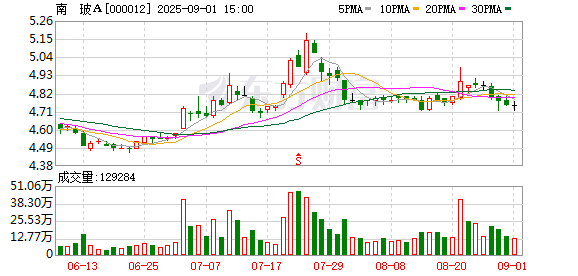
CSG(000012)

Search documents
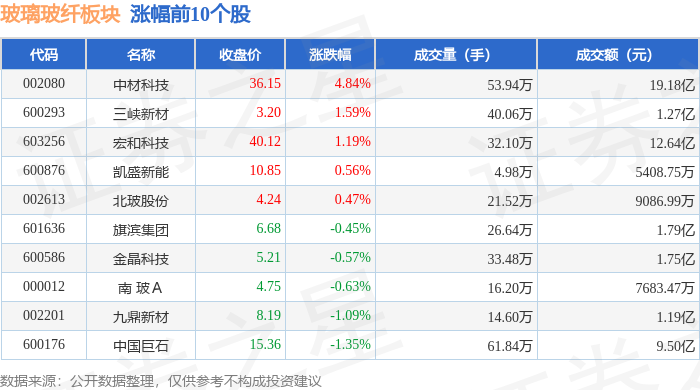
玻璃玻纤板块9月15日涨0.59%,中材科技领涨,主力资金净流出3818.64万元
Zheng Xing Xing Ye Ri Bao· 2025-09-15 08:43
Market Overview - On September 15, the glass and fiberglass sector rose by 0.59% compared to the previous trading day, with Zhongcai Technology leading the gains [1] - The Shanghai Composite Index closed at 3860.5, down 0.26%, while the Shenzhen Component Index closed at 13005.77, up 0.63% [1] Stock Performance - Zhongcai Technology (002080) closed at 36.15, up 4.84% with a trading volume of 539,400 shares and a transaction value of 1.918 billion [1] - Other notable performers include: - Sanxia New Material (600293) at 3.20, up 1.59% [1] - Honghe Technology (603256) at 40.12, up 1.19% [1] - Conversely, China Jushi (600176) closed at 15.36, down 1.35% with a trading volume of 618,400 shares and a transaction value of 950 million [1][2] Capital Flow - The glass and fiberglass sector experienced a net outflow of 38.1864 million from institutional investors and 41.0712 million from speculative funds, while retail investors saw a net inflow of 79.2575 million [2] - The capital flow for key stocks includes: - Zhongcai Technology with a net inflow of 196 million from institutional investors [3] - Honghe Technology with a net inflow of 20.4092 million from institutional investors [3] - China Jushi with a net outflow of 11.5422 million from institutional investors [3]





南玻A:青海高纯晶硅项目处在试生产阶段
Zheng Quan Ri Bao Wang· 2025-09-12 08:41
Group 1 - The core viewpoint of the article is that the company Nanfang A has confirmed that its Qinghai high-purity silicon project is currently in the trial production phase and is progressing according to plan for reaching full production standards [1] Group 2 - The company is actively engaging with investors through an interactive platform to provide updates on its project status [1] - The project is significant for the company's operations in the high-purity silicon sector, which is crucial for the solar energy industry [1]

南 玻A(000012) - 2025年第二次临时股东大会决议公告
2025-09-09 11:30
证券代码:000012;200012 证券简称:南玻 A;南玻 B 公告编号:2025-042 中国南玻集团股份有限公司 2025 年第二次临时股东大会决议公告 本公司及董事会全体成员保证公告内容的真实、准确和完整,没有虚假记载、误导性陈 述或者重大遗漏。 特别提示 在本次会议召开期间未增加、否决或变更提案。 一、会议召开和出席的情况 1、会议召开情况 ①现场会议召开时间为:2025 年 9 月 9 日(星期二)下午 14:45 ②网络投票时间为:2025 年 9 月 9 日 通过深圳证券交易所交易系统进行网络投票的具体时间为:2025 年 9 月 9 日上午 9:15~9:25,9:30~11:30,下午 13:00~15:00; 通过深圳证券交易所互联网投票系统进行网络投票的具体时间为:2025 年 9 月 9 日上午 9:15 至当日下午 15:00 的任意时间。 ③会议召开方式:本次股东大会采取现场投票与网络投票相结合的方式。 ④现场会议召开地点:广东省深圳市南山区蛇口工业六路南玻集团新办公楼 二楼报告厅。 ⑤召集人:公司董事会 ⑥会议主持人:董事长陈琳女士 2、会议的出席情况 ①出席总体情况 参加本 ...
南 玻A(000012) - 北京植德律师事务所关于中国南玻集团股份有限公司2025年第二次临时股东大会的法律意见书
2025-09-09 11:30
北京植德律师事务所 关于中国南玻集团股份有限公司 2025 年第二次临时股东大会的 法律意见书 植德京(会)字[2025]0113 号 二〇二五年九月 北京市东城区东直门南大街 1 号来福士中心办公楼 12 层 邮编:100007 12 th Floor, Raffles City Beijing Office Tower, No.1 Dongzhimen South Street, Dongcheng District, Beijing 100007 P.R.C 电话(Tel):010-56500900 传真(Fax):010-56500999 www.meritsandtree.com 1 北京植德律师事务所 关于中国南玻集团股份有限公司 2025年第二次临时股东大会的 1. 本所律师仅就本次股东大会的召集、召开程序、出席本次股东大会人员 的资格、召集人资格、审议提案、表决程序及表决结果的合法性发表意见,不对 本次会议所审议的议案内容及该等议案所表述的事实或数据的真实性、准确性和 完整性发表意见; 2. 本所律师无法对网络投票过程进行见证,参与本次会议网络投票的股东 资格、网络投票结果均由相应的证券交易所 ...
建筑材料行业跟踪周报:8月建筑业PMI略超季节性,推荐水泥和洁净室工程-20250902
Soochow Securities· 2025-09-02 05:56
Investment Rating - The report maintains an "Overweight" rating for the construction materials industry [1] Core Views - The construction materials sector is expected to benefit from a slight recovery in cement demand, particularly in southern regions as rainfall decreases. However, demand in areas like Beijing-Tianjin-Hebei, Shandong, and Henan is weakening due to stricter environmental controls [2][14] - The report highlights the potential for price increases in cement, driven by improved demand and supply-side discipline, with a focus on leading companies such as Conch Cement and Huaxin Cement [4][5] - The report emphasizes the importance of government policies aimed at boosting domestic demand and stabilizing the real estate market, which are expected to positively impact the home improvement and building materials sectors [17] Summary by Sections 1. Sector Overview - The construction materials sector saw a slight increase in the PMI for August, indicating a seasonal uptick in activity, particularly in major infrastructure projects initiated in July [4] - The construction materials index showed a marginal increase of 0.14% during the week, underperforming compared to the broader market indices [4] 2. Bulk Construction Materials 2.1 Cement - The national average price for high-standard cement is reported at 344.3 RMB/ton, reflecting a week-on-week increase of 1.7 RMB/ton but a year-on-year decrease of 35.2 RMB/ton [22][23] - The average cement inventory level among sample enterprises is 63.6%, down 1.0 percentage points from the previous week [25] - The report anticipates a potential price stabilization and recovery in the cement market, particularly in the second half of the year [5][14] 2.2 Glass - The average price for float glass is reported at 1189.7 RMB/ton, down 16.1 RMB/ton from the previous week and down 176.6 RMB/ton year-on-year [4] - The report suggests that supply-side adjustments are likely to improve the supply-demand balance in the glass industry, with a focus on leading companies benefiting from cost advantages [16] 2.3 Fiberglass - The report notes a stable pricing environment for fiberglass, with the average price for non-alkali roving at 3100-3700 RMB/ton, remaining stable compared to previous periods [4] - The demand for specialty fiberglass products is expected to grow significantly, driven by technological advancements and increased applications in various industries [15] 3. Home Improvement Materials - The report highlights the positive impact of government policies aimed at stimulating domestic consumption, particularly in the home improvement sector, with expectations for a recovery in demand [17] - Leading companies in the home improvement materials sector are encouraged to explore new business models and enhance their market positioning [17]


南玻集团回购股份进展:已回购超5374万股,占总股本1.7504%
Xin Lang Zheng Quan· 2025-09-01 16:41
Core Viewpoint - Nanfang Glass Group announced the latest progress on its share repurchase plan, detailing the adjustments in repurchase prices and the current status of shares repurchased as of August 31, 2025 [1][2][3]. Summary by Sections Share Repurchase Overview - The company held meetings on February 13 and March 4, 2025, to approve the repurchase of A-shares and B-shares, with a repurchase report prepared [2]. - The maximum repurchase price for A-shares was adjusted from 7.6 RMB to 7.53 RMB per share, with an expected repurchase quantity between 44.44 million and 76.58 million shares. For B-shares, the price was adjusted from 3.13 HKD to 3.05 HKD, with an expected quantity between 22.14 million and 38.53 million shares [2]. Progress as of August 31, 2025 - As of August 31, 2025, the company repurchased a total of 35,533,160 A-shares and 18,215,496 B-shares, representing 1.7504% of the total share capital [3]. - The highest and lowest transaction prices for A-shares were 5.04 RMB and 4.54 RMB, respectively, with a total expenditure of approximately 169 million RMB [3]. - For B-shares, the highest and lowest transaction prices were 1.94 HKD and 1.65 HKD, with a total expenditure of approximately 32.84 million HKD, equivalent to about 29.93 million RMB [3]. Compliance and Regulations - The company confirmed that the timing, quantity, and pricing of the share repurchase comply with relevant regulations, ensuring no major impacts on trading prices occurred during significant events [4]. - Nanfang Glass Group committed to adhering to regulations and will make repurchase decisions based on market conditions while fulfilling disclosure obligations [4].
南玻A:公司出海业务主要有工程玻璃、光伏玻璃、浮法玻璃
Zheng Quan Ri Bao Wang· 2025-09-01 11:11
Core Viewpoint - The company, Nanbo A, has confirmed its overseas business primarily involves engineering glass, photovoltaic glass, and float glass [1] Group 1 - The company is actively engaged in international markets with a focus on engineering glass [1] - The photovoltaic glass segment is a significant part of the company's overseas operations [1] - Float glass is also a key product in the company's export portfolio [1]
南玻A:截至2025年8月20日公司股东总数为129768户
Zheng Quan Ri Bao Wang· 2025-09-01 11:11
Group 1 - The company, Nanbo A, stated on September 1 that as of August 20, 2025, the total number of shareholders is 129,768 [1]
南玻A:目前公司青海高纯晶硅项目处在试生产阶段
Zheng Quan Ri Bao Wang· 2025-09-01 09:46
Group 1 - The company Nanfang A announced on September 1 that its high-purity silicon project in Qinghai is currently in the trial production phase [1]
南玻A:有关公司光伏玻璃经营情况请见定期报告
Zheng Quan Ri Bao· 2025-09-01 09:41
Core Viewpoint - The company, Nanfang Glass A, addressed investor inquiries regarding its photovoltaic glass operations, directing them to the company's periodic reports for detailed information [2] Group 1 - The company is actively engaging with investors through an interactive platform [2] - Investors are encouraged to refer to the company's disclosed periodic reports for insights into the photovoltaic glass business [2]