
Gold Mantis(002081)

Search documents
2025年1-8月中国电梯、自动扶梯及升降机产量为88.4万台 累计下降5.7%
Chan Ye Xin Xi Wang· 2025-10-24 03:29
Core Viewpoint - The report highlights a decline in the production of elevators, escalators, and lifts in China, indicating a challenging market environment for the industry from 2025 onwards [1] Industry Summary - In August 2025, the production of elevators, escalators, and lifts in China was 119,000 units, representing a year-on-year decrease of 2.5% [1] - From January to August 2025, the cumulative production of these devices reached 884,000 units, showing a cumulative decline of 5.7% [1] - The data is sourced from the National Bureau of Statistics and compiled by Zhiyan Consulting, a leading industry consulting firm in China [1]







装修装饰板块10月23日涨1.75%,广田集团领涨,主力资金净流出2444.05万元
Zheng Xing Xing Ye Ri Bao· 2025-10-23 08:20
Market Overview - The decoration and renovation sector increased by 1.75% on October 23, with Guangtian Group leading the gains [1] - The Shanghai Composite Index closed at 3922.41, up 0.22%, while the Shenzhen Component Index closed at 13025.45, also up 0.22% [1] Key Stocks Performance - Guangtian Group (002482) saw a significant rise of 10.05%, closing at 2.08 with a trading volume of 818,300 shares and a turnover of 170 million [1] - Other notable performers included ST Keli Da (603828) with a 5.06% increase, closing at 6.02, and ST Dongyi (002713) with a 5.02% increase, closing at 9.42 [1] - The overall trading volume and turnover for various stocks in the sector were substantial, with ST Keli Da achieving a turnover of approximately 55.18 million [1] Fund Flow Analysis - The decoration and renovation sector experienced a net outflow of 24.44 million from institutional investors, while retail investors saw a net inflow of 5.40 million [2] - The main stocks with significant fund flows included Guangtian Group, which had a net inflow of 35.03 million from institutional investors, but a net outflow from retail investors [3] - Other stocks like Jin Tanglang (002081) and ST Ruihe (002620) also showed mixed fund flow patterns, with varying degrees of net inflow and outflow from different investor categories [3]


2025年1-4月中国电梯、自动扶梯及升降机产量为39万台 累计下降6.9%
Chan Ye Xin Xi Wang· 2025-10-23 01:17
Core Viewpoint - The Chinese elevator industry is experiencing a decline in production, with significant year-on-year decreases reported for early 2025 [1][2]. Industry Summary - In April 2025, the production of elevators, escalators, and lifts in China reached 119,000 units, representing a year-on-year decrease of 8.5% [1]. - From January to April 2025, the cumulative production of these units totaled 390,000, marking a cumulative decline of 6.9% [1]. Company Summary - Listed companies in the elevator sector include 康力电梯 (Kangli Elevator), 森赫股份 (Senhe Co.), 广日股份 (Guangri Co.), 上海机电 (Shanghai Mechanical), 金螳螂 (Jin Tanglang), 快意电梯 (Kuaiji Elevator), 梅轮电梯 (Meilun Elevator), and 远大智能 (Yuanda Intelligent) [1].

金螳螂涨2.26%,成交额5062.17万元,主力资金净流入366.67万元
Xin Lang Cai Jing· 2025-10-21 02:49
Core Viewpoint - Jin Tanglang's stock price has shown a modest increase this year, with a notable rise in recent trading days, reflecting positive market sentiment and potential growth in the construction and decoration industry [2]. Group 1: Stock Performance - As of October 21, Jin Tanglang's stock price increased by 2.26%, reaching 3.62 CNY per share, with a trading volume of 50.62 million CNY and a turnover rate of 0.53%, resulting in a total market capitalization of 9.612 billion CNY [1]. - Year-to-date, Jin Tanglang's stock price has risen by 4.32%, with a 1.40% increase over the last five trading days, a 0.84% increase over the last 20 days, and a 2.95% decrease over the last 60 days [2]. Group 2: Financial Performance - For the first half of 2025, Jin Tanglang reported a revenue of 9.528 billion CNY, representing a year-on-year growth of 2.49%, and a net profit attributable to shareholders of 358 million CNY, reflecting a growth of 3.95% [2]. - Since its A-share listing, Jin Tanglang has distributed a total of 4.429 billion CNY in dividends, with 794 million CNY distributed over the past three years [3]. Group 3: Shareholder Information - As of June 30, 2025, the number of shareholders for Jin Tanglang was 64,600, a decrease of 3.89% from the previous period, with an average of 40,957 circulating shares per shareholder, an increase of 4.08% [2]. - Among the top ten circulating shareholders, Hong Kong Central Clearing Limited is the third-largest, holding 46.0382 million shares, an increase of 22.0057 million shares from the previous period, while Southern CSI 1000 ETF is the eighth-largest, holding 14.7437 million shares as a new shareholder [3].
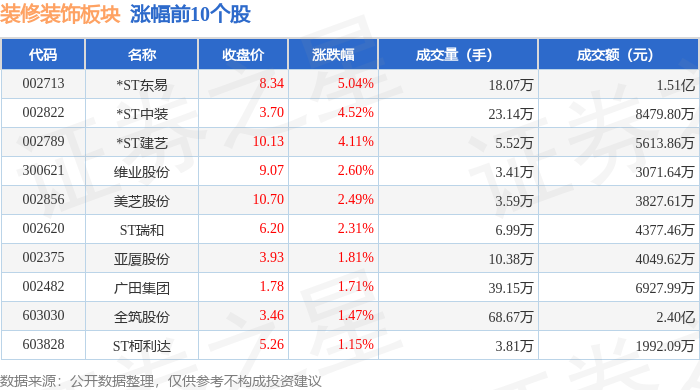
装修装饰板块10月20日涨0.74%,*ST东易领涨,主力资金净流出7668.51万元
Zheng Xing Xing Ye Ri Bao· 2025-10-20 08:27
Market Overview - The decoration and renovation sector increased by 0.74% compared to the previous trading day, with *ST Dongyi leading the gains [1] - The Shanghai Composite Index closed at 3863.89, up 0.63%, while the Shenzhen Component Index closed at 12813.21, up 0.98% [1] Stock Performance - The top-performing stocks in the decoration and renovation sector included: - *ST Dongyi: Closed at 8.34, up 5.04% with a trading volume of 180,700 shares and a turnover of 151 million yuan [1] - *ST Zhongzhuang: Closed at 3.70, up 4.52% with a trading volume of 231,400 shares and a turnover of 84.8 million yuan [1] - *ST Jianyi: Closed at 10.13, up 4.11% with a trading volume of 55,200 shares and a turnover of 56.1 million yuan [1] Capital Flow - The decoration and renovation sector experienced a net outflow of 76.68 million yuan from institutional investors, while retail investors saw a net inflow of 138 million yuan [2] - The capital flow for specific stocks showed: - *ST Zhongzhuang had a net inflow of 14.56 million yuan from institutional investors [3] - Jin Tanglong saw a net inflow of 10.21 million yuan from institutional investors [3] - Yaxia Co. had a net inflow of 4.51 million yuan from institutional investors [3]



金螳螂:建筑装饰行业并非“夕阳产业”,城市更新、医疗康养正创造巨大市场需求
Cai Jing Wang· 2025-10-14 10:06
Core Viewpoint - The construction and decoration industry is not a "sunset industry" as it is experiencing significant market demand driven by urban renewal, public space enhancement, healthcare, and high-quality building supply in the context of China's new stage of urbanization [1] Company Summary - The company has proactively completed strategic adjustments, focusing on a development pattern centered around non-residential business and multi-track collaboration [1] - The business focus has largely shifted away from reliance on the traditional real estate cycle, significantly enhancing operational stability and resilience [1] - In the first half of 2025, the company achieved revenue of 9.528 billion yuan, a year-on-year increase of 2.49%, and a net profit attributable to shareholders of 358 million yuan, a year-on-year increase of 3.95% [1]
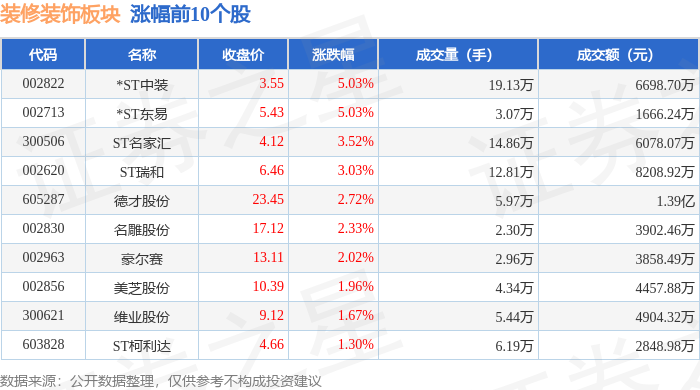
装修装饰板块9月29日涨0.9%,*ST中装领涨,主力资金净流入44.94万元
Zheng Xing Xing Ye Ri Bao· 2025-09-29 08:45
Core Viewpoint - The renovation and decoration sector experienced a 0.9% increase on September 29, with *ST Zhongzhuang leading the gains [1] Group 1: Market Performance - The Shanghai Composite Index closed at 3862.53, up 0.9%, while the Shenzhen Component Index closed at 13479.43, up 2.05% [1] - The top-performing stocks in the renovation and decoration sector included *ST Zhongzhuang, which rose by 5.03% to a closing price of 3.55, and *ST Dongyi, which also increased by 5.03% to 5.43 [1] Group 2: Trading Volume and Value - *ST Zhongzhuang had a trading volume of 191,300 shares and a transaction value of 66.987 million yuan [1] - Other notable stocks included ST Mingjiahui with a closing price of 4.12, up 3.52%, and a trading volume of 148,600 shares, resulting in a transaction value of 60.7807 million yuan [1] Group 3: Capital Flow - The renovation and decoration sector saw a net inflow of 44.94 million yuan from institutional investors, while retail investors contributed a net inflow of 94.455 million yuan [2] - Conversely, speculative funds experienced a net outflow of 989.49 million yuan [2]
2025年1-7月中国电梯、自动扶梯及升降机产量为76.9万台 累计下降5.6%
Chan Ye Xin Xi Wang· 2025-09-29 02:15
Core Viewpoint - The Chinese elevator industry is experiencing a decline in production, with a notable decrease in output for the year 2025 compared to previous years [1] Industry Summary - In July 2025, the production of elevators, escalators, and lifts in China reached 115,000 units, representing a year-on-year decrease of 3.4% [1] - From January to July 2025, the cumulative production of these devices was 769,000 units, showing a cumulative decline of 5.6% [1] - The data indicates a downward trend in the elevator industry, which may impact investment opportunities and market dynamics [1] Company Summary - Listed companies in the elevator sector include 康力电梯 (Kangli Elevator), 森赫股份 (Senhe Co.), 广日股份 (Guangri Co.), 上海机电 (Shanghai Mechanical & Electrical), 金螳螂 (Jin Tanglang), 快意电梯 (Kuaiji Elevator), 梅轮电梯 (Meilun Elevator), and 远大智能 (Yuan Da Intelligent) [1] - The report by 智研咨询 (Zhiyan Consulting) provides insights into the competitive landscape and future trends of the elevator industry from 2025 to 2031 [1]

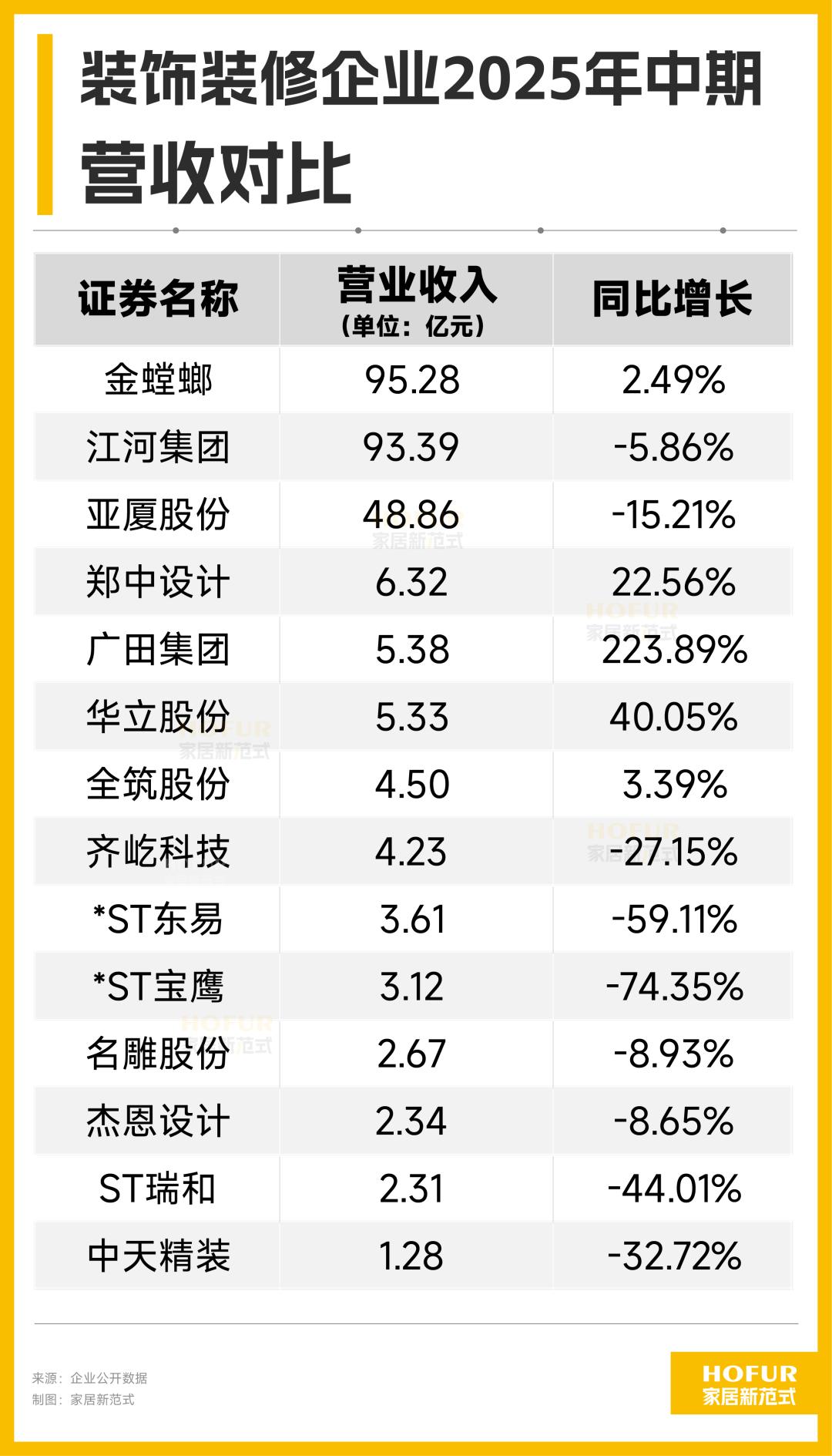
装饰装修行业:亏损收窄、毛利润均21%、债务高企,市场加快洗牌!
3 6 Ke· 2025-09-26 02:09
Group 1 - The revenue of 14 listed decoration and renovation companies has shown significant divergence, reflecting a clear "Matthew Effect" in the industry, with a revenue decline exceeding 64% for many companies [2][5] - Among the companies, Jin Tanglong, Jianghe Group, and Yasha Co. lead in revenue, achieving 9.528 billion, 9.339 billion, and 4.886 billion respectively, while the remaining 11 companies collectively generated only 4.110 billion [4][5] - Only 5 companies reported revenue growth, with Guotian Group achieving a remarkable 223.89% increase, albeit from a low base [4][6] Group 2 - Out of the 14 companies, 6 reported profits, with Jin Tanglong, Jianghe Group, and Yasha Co. showing strong profitability, with net profits of 358 million, 328 million, and 153 million respectively [6][8] - The average gross profit margin across the companies is 20.6%, with some companies like Zhongzhong Design achieving a net profit margin of 14.88%, indicating strong cost control [12][16] Group 3 - The overall debt risk is high, with an average asset-liability ratio of 66.92% among the companies, and two companies, Dongyi Risheng and Baoying Co., exceeding 100% [19][21] - Dongyi Risheng is undergoing a pre-restructuring process due to severe financial distress, with an asset-liability ratio of 170.34% [19][24] Group 4 - Despite being the largest companies, Jin Tanglong, Jianghe Group, and Yasha Co. have the lowest cash flow from operating activities, with negative cash flows of -1.023 billion, -1.028 billion, and -582 million respectively [25][29] - Only 5 companies reported positive cash flow from operating activities, indicating a significant cash flow challenge for larger firms [29] Group 5 - In response to the challenges posed by the real estate market downturn, companies are adopting strategies such as expanding into overseas markets, developing new business segments, and leveraging technology to reduce costs [30][31] - The industry is experiencing a bifurcation, where leading companies face cash flow pressures while some mid-sized firms achieve better profitability through refined cost control [31]

2025年1-5月中国电梯、自动扶梯及升降机产量为51.7万台 累计下降6.5%
Chan Ye Xin Xi Wang· 2025-09-26 01:11
Core Viewpoint - The Chinese elevator industry is experiencing a decline in production, with significant year-on-year decreases reported for 2025 [1][2]. Industry Summary - In May 2025, the production of elevators, escalators, and lifts in China reached 124,000 units, representing a year-on-year decrease of 8.1% [1]. - From January to May 2025, the cumulative production of elevators, escalators, and lifts was 517,000 units, showing a cumulative decline of 6.5% [1]. Company Summary - Listed companies in the elevator sector include 康力电梯 (Kangli Elevator), 森赫股份 (Senhe Co.), 广日股份 (Guangri Co.), 上海机电 (Shanghai Mechanical), 金螳螂 (Jintanglang), 快意电梯 (Kuaiyi Elevator), 梅轮电梯 (Meilun Elevator), and 远大智能 (Yuanda Intelligent) [1].
