
Shanghai RAAS(002252)

Search documents
生物制品板块1月29日跌1.3%,华兰疫苗领跌,主力资金净流出8.66亿元
Zheng Xing Xing Ye Ri Bao· 2026-01-29 09:03
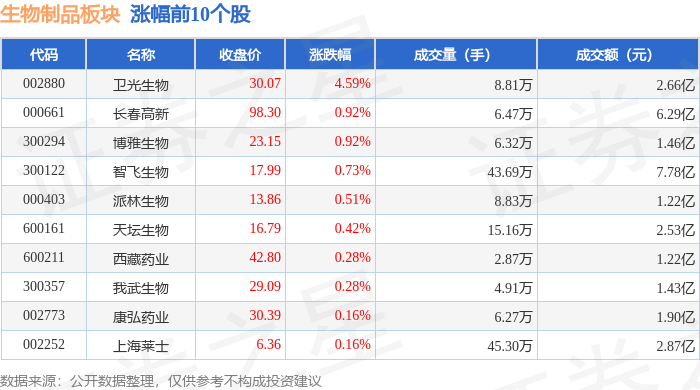
Market Overview - The biopharmaceutical sector experienced a decline of 1.3% on January 29, with Hualan Vaccine leading the drop [1] - The Shanghai Composite Index closed at 4157.98, up 0.16%, while the Shenzhen Component Index closed at 14300.08, down 0.3% [1] Individual Stock Performance - Weigao Bio (002880) saw a closing price of 30.07, with an increase of 4.59% and a trading volume of 88,100 shares, totaling a transaction value of 266 million yuan [1] - Changchun High-tech (000661) closed at 98.30, up 0.92%, with a trading volume of 64,700 shares and a transaction value of 629 million yuan [1] - Other notable performers include Boya Bio (300294) and Zhifei Biological (300122), both with a closing price increase of 0.92% and 0.73% respectively [1] Declining Stocks - Hualan Bio (301207) reported a significant decline of 9.05%, closing at 22.62, with a trading volume of 300,600 shares and a transaction value of 689 million yuan [2] - Junshi Biosciences (688180) fell by 6.02%, closing at 36.82, with a trading volume of 266,100 shares and a transaction value of 1 billion yuan [2] - Other stocks such as Jinkang (688670) and Bohui Innovation (300318) also experienced declines of 5.81% and 4.95% respectively [2] Capital Flow Analysis - The biopharmaceutical sector saw a net outflow of 866 million yuan from institutional investors, while retail investors contributed a net inflow of 682 million yuan [2] - Notable net inflows from retail investors were observed in stocks like Shanghai Laishi (002252) and Weigao Bio (002880) [3] - Conversely, stocks such as Zhixiang Quantai (688443) and Weigao Bio (002880) experienced significant net outflows from institutional and speculative investors [3]




上海莱士:公司无相关产品用于尼帕病毒检测
Zheng Quan Ri Bao Wang· 2026-01-28 13:38
Group 1 - The company Shanghai Laishi (002252) stated that it currently has no products for Nipah virus testing [1] - The company also mentioned that there is no collaboration with Shanghai Institute of Pharmaceutical Industry at this time [1]
上海莱士(002252.SZ):目前公司无相关产品用于尼帕病毒检测
Ge Long Hui· 2026-01-28 10:25
Group 1 - The company Shanghai Laishi (002252.SZ) has stated that it currently does not have any products for Nipah virus testing [1] - There is no collaboration with Shanghai Institute of Pharmaceutical Industry at this time [1]
生物制品板块1月28日跌1.98%,百普赛斯领跌,主力资金净流出12.52亿元
Zheng Xing Xing Ye Ri Bao· 2026-01-28 08:58
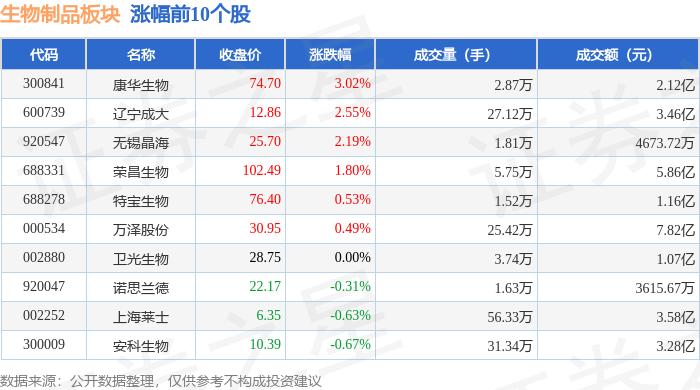
Group 1 - The biopharmaceutical sector experienced a decline of 1.98% on January 28, with Baipusais leading the drop [1] - The Shanghai Composite Index closed at 4151.24, up 0.27%, while the Shenzhen Component Index closed at 14342.9, up 0.09% [1] - Notable gainers in the biopharmaceutical sector included Kanghua Biological, which rose by 3.02% to a closing price of 74.70, and Liaoning Chengda, which increased by 2.55% to 12.86 [1] Group 2 - Baipusais saw a significant drop of 10.57%, closing at 58.18, with a trading volume of 57,400 shares and a transaction value of 342 million [2] - Other notable decliners included Kangla Weishi, down 6.16% to 10.97, and Jinchuan Protein, down 5.90% to 46.58 [2] - The biopharmaceutical sector experienced a net outflow of 1.252 billion in main funds, while retail investors saw a net inflow of 653 million [2] Group 3 - Rongchang Biological had a net inflow of 38 million from main funds, representing 6.49% of its total, while it faced a net outflow of 58.99 million from retail investors [3] - Liaoning Chengda also saw a net inflow of 14.86 million from main funds, but a net outflow of 15.01 million from retail investors [3] - The overall trend indicates a mixed sentiment in the biopharmaceutical sector, with main funds withdrawing while retail investors are actively buying [3]


上海莱士:公司将审慎评估回购可行性与合理性
Zheng Quan Ri Bao Zhi Sheng· 2026-01-23 14:17
Group 1 - The company, Shanghai Laishi, is considering the feasibility and rationality of a potential share buyback plan based on its current operating cash flow, daily production and operational funding needs, and research and development investments [1] - The company will fulfill its announcement obligations in accordance with information disclosure rules if it decides to implement a buyback plan in the future [1]
上海莱士:权益分派事项应当在上市公司股东会审议通过利润分配方案后两个月内完成
Zheng Quan Ri Bao Zhi Sheng· 2026-01-22 13:37
(编辑 丛可心) 证券日报网讯 1月22日,上海莱士在互动平台回答投资者提问时表示,按照相关规则,权益分派事项应 当在上市公司股东会审议通过利润分配方案后两个月内完成。公司于2025年12月15日召开的2025年第三 次临时股东会,会上审议通过了《2025年前三季度利润分配方案》,公司将按照前述规则要求及时完成 权益分派事项,具体分派时间以公司公告为准。 ...
上海莱士:截至2026年1月20日,公司股东总户数为110824户
Zheng Quan Ri Bao Wang· 2026-01-22 13:12
证券日报网讯1月22日,上海莱士(002252)在互动平台回答投资者提问时表示,截至2026年1月20日, 公司股东总户数为110824户。 ...
上海莱士:公司代理进口人血白蛋白产品以美元结算为主
Zheng Quan Ri Bao· 2026-01-22 13:07
证券日报网讯 1月22日,上海莱士在互动平台回答投资者提问时表示,公司代理进口人血白蛋白产品以 美元结算为主,假设除汇率以外的其他变量不变,人民币升值可增加公司净利润。 (文章来源:证券日报) ...
上海莱士:目前公司运营一切正常,各项业务均有序推进
Zheng Quan Ri Bao Wang· 2026-01-16 12:16
证券日报网讯1月16日,上海莱士(002252)在互动平台回答投资者提问时表示,目前公司运营一切正 常,各项业务均有序推进。 ...
上海莱士:通过合规渠道向国内各类医疗机构供应符合国家标准的产品
Sou Hu Cai Jing· 2026-01-08 03:48
Core Viewpoint - The company, Shanghai Laishi, emphasizes its focus on producing and selling blood products while adhering to national regulations and procurement management standards [1]. Group 1: Company Operations - Shanghai Laishi's main business involves the production and sale of blood products, ensuring compliance with national drug management regulations [1]. - The company supplies products that meet national standards to various domestic medical institutions to fulfill clinical emergency and routine medical needs [1]. Group 2: Procurement and Disclosure - The company stated that any significant procurement cooperation will be disclosed in accordance with regulatory requirements and information disclosure rules [1].