
血液制品

Search documents
国泰海通|“远望又新峰”2026春季策略会观点集锦(下)——消费、医药、科技、先进制造、金融
国泰海通证券研究· 2026-03-24 14:00
Group 1: Food and Beverage Industry - The core investment strategy for the food and beverage sector in 2026 emphasizes the importance of price increases, with a focus on resilient segments such as condiments, beer, and beverages [4][5] - The white liquor industry is nearing the end of its adjustment phase, transitioning from a "U-shaped" to a "V-shaped" recovery, with expectations of a quicker bottoming process starting from Q3 2025 [4] - The beer sector is expected to improve due to the stabilization of dining scenarios and a gradual recovery in consumer spending, with historical trends indicating profitability benefits during periods of rising CPI [5] Group 2: Consumer Goods - The consumer goods sector is witnessing a bottoming out, with a focus on companies that can effectively pass on price increases amidst diminishing cost advantages [5] - The demand for condiments is anticipated to recover, with expectations of price increases and improved profitability in the dairy sector as supply and demand cycles align [5] Group 3: Beauty and Personal Care - The beauty and personal care industry is experiencing a recovery in demand, with significant growth in the cosmetics and personal care segments, particularly in online sales [7][8] - The market is seeing a resurgence in high-end and affordable brands, with domestic brands maintaining rapid growth amidst a competitive landscape [8] Group 4: Service Consumption - The service consumption sector is benefiting from favorable policies, with a focus on travel and leisure services, as well as improvements in traditional retail [10][11] - The education sector is expected to see robust demand, particularly in vocational training and skill development, supported by policy initiatives [10] Group 5: Home Appliances - The home appliance industry is awaiting a recovery in domestic demand, with a focus on companies that possess pricing power amidst rising costs [15] - The global supply chain for home appliances is becoming more resilient, with expectations of improved export conditions [15] Group 6: 3D Printing Industry - The 3D printing market is projected to grow significantly, driven by both industrial and consumer demand, with a forecasted CAGR of 18% from 2024 to 2034 [18][19] - The demand for PLA materials in consumer-grade 3D printing is expected to increase, with domestic manufacturers ramping up production capabilities [19] Group 7: Textile and Apparel - The textile and apparel sector is showing signs of recovery, with strong growth in retail sales and exports, particularly in the context of rising cotton prices [23][24] - The market is expected to see a shift towards mid-to-high-end products, with brands focusing on innovation and sustainability [24] Group 8: Agriculture - The agricultural sector is anticipated to benefit from rising commodity prices, with a focus on the recovery of pig farming and the potential for pet product valuations to rebound [27] Group 9: Pharmaceutical Industry - The pharmaceutical sector is witnessing a shift towards innovative drugs, with a focus on oncology and metabolic treatments, as well as improvements in domestic demand for medical devices [30][31] Group 10: Financial Services - The financial services sector is focusing on wealth management and internationalization, with a notable increase in demand for investment consulting services [59][62] - The insurance industry is expected to see stable growth in premium income, driven by savings demand and improved asset-liability management [66]


博雅生物2月25日获融资买入1233.54万元,融资余额6.83亿元
Xin Lang Cai Jing· 2026-02-26 01:26
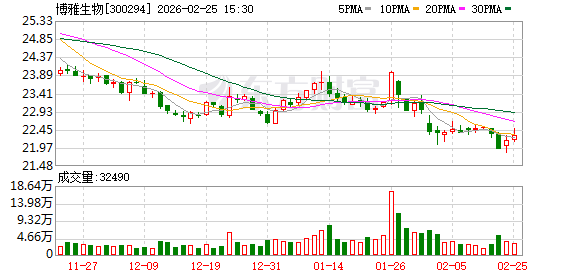
Core Viewpoint - Boya Bio's stock performance shows a slight increase, with significant financing activities indicating high investor interest and potential volatility in the market [1][2]. Financing Summary - On February 25, Boya Bio recorded a financing buy amount of 12.34 million yuan, with a net financing purchase of 2.61 million yuan, indicating strong demand for its shares [1]. - The total financing and securities balance reached 686 million yuan, representing 6.07% of the circulating market value, which is above the 80th percentile of the past year [1]. - The company also experienced a high level of short selling, with a short selling balance of 2.73 million yuan, exceeding the 90th percentile of the past year [1]. Business Performance - For the period from January to September 2025, Boya Bio achieved a revenue of 1.47 billion yuan, reflecting a year-on-year growth of 18.38%, while the net profit attributable to shareholders decreased by 16.90% to 343 million yuan [2]. - The company's main business segments include blood products (84.58% of revenue), biochemical drugs (8.63%), distribution business (6.12%), and other businesses (0.65%) [1]. Shareholder Information - As of February 13, the number of shareholders for Boya Bio was 31,600, a decrease of 0.27% from the previous period, while the average circulating shares per person increased by 0.27% to 15,959 shares [2]. - The top ten circulating shareholders include Hong Kong Central Clearing Limited, which holds 8.88 million shares, a decrease of 1.82 million shares from the previous period [3].

博雅生物:截至目前,公司共计拥有2张血液制品生产牌照、21个单采血浆站
Mei Ri Jing Ji Xin Wen· 2026-02-25 14:30
Group 1 - The core inquiry from investors is whether China Resources Group possesses blood station resources and if it will inject these into Boya Bio [2] - Boya Bio (300294.SZ) confirmed on the investor interaction platform that it is part of the China Resources Health sector's blood products platform [2] - As of now, Boya Bio holds a total of 2 blood product production licenses and operates 21 single plasma collection stations, including 4 under the Green Cross brand [2]
上海莱士:血液制品中的罕见病药物仍适用3%简易征收
Zheng Quan Ri Bao Wang· 2026-02-25 03:00
Group 1 - The core viewpoint of the article is that Shanghai Laishi (002252) has responded to investor inquiries regarding the impact of the new national VAT policy on blood products, specifically that rare disease medications will still be subject to a simplified 3% tax rate, while other blood product businesses will no longer benefit from this rate [1] - The adjustment in tax policy is described as an industry-wide unified policy, indicating that it will affect the entire sector [1] - The company plans to mitigate the impact of this policy change by optimizing procurement management and enhancing input tax deduction management in compliance with regulations [1]

上海莱士:血液制品中的罕见病药物仍适用3%简易征收,其他血液制品业务不再适用3%简易征收
Sou Hu Cai Jing· 2026-02-24 07:21
Group 1 - The core issue raised by investors is the potential change in VAT collection method from 3% simplified taxation to 13% general taxation, and its expected impact on tax costs and company profits [1] - Shanghai Laishi responded that rare disease drugs within blood products will still be subject to the 3% simplified taxation, while other blood product businesses will no longer benefit from this rate, indicating a unified industry policy adjustment [1] - The company acknowledged that the adjustment will have a certain impact on the industry, but it plans to mitigate the effects through optimized procurement management and enhanced input tax deduction management [1]
博雅生物:公司已确定聚焦血液制品的发展战略,对于非血液制品业务将适时进行处置或剥离
Mei Ri Jing Ji Xin Wen· 2026-02-12 13:43
Group 1 - The core viewpoint of the article is that Boya Bio-Pharmaceutical (300294.SZ) has confirmed its strategic focus on the development of blood products and plans to dispose of or divest its non-blood product business at an appropriate time [2][3] - The company has stated that it will fulfill its information disclosure obligations promptly if there are any developments regarding the disposal or divestment of its non-blood product business [2]
博雅生物近期股价震荡下行,高管薪酬与业绩表现受关注
Jing Ji Guan Cha Wang· 2026-02-12 07:23
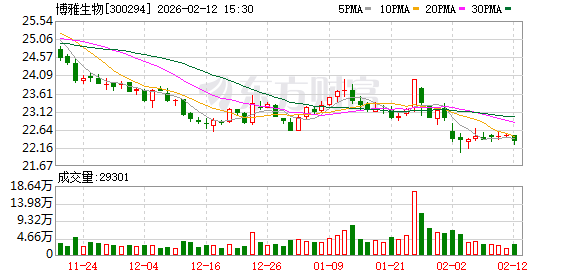
Group 1 - The core issue revolves around corporate governance and performance concerns at Boya Bio-Pharmaceutical (300294), with investor skepticism regarding executive pay amidst operational losses [1] - The company emphasized its focus on the blood products core business, indicating uncertainty in external mergers and acquisitions, while disclosing that the controlling shareholder, China Resources Pharmaceutical, has no new holding plans [1] - Boya Bio-Pharmaceutical's net profit for 2025 is expected to decline significantly, underperforming compared to its peers among six listed companies [1] Group 2 - Boya Bio-Pharmaceutical's stock price has shown a downward trend, closing at 22.33 yuan on February 12, 2026, with a daily drop of 0.76% and a cumulative decline of 0.53% over the past five days [2] - The stock has experienced a 4.08% decline over the past 20 days, with a net outflow of 4.74 million yuan in principal funds on the latest trading day [2] - The stock's short-term technical support level is at 22.01 yuan, while the resistance level is at 23.75 yuan, indicating weaker performance compared to the pharmaceutical and biotechnology sector, which fell by 0.44% [2]
大药企卖疫苗等生物制品 不再按3%简易计税
Sou Hu Cai Jing· 2026-02-08 17:01
Core Viewpoint - The simplified tax policy for biological products, including vaccines, will be canceled starting this year, with a transition to general tax calculation methods by 2026, impacting the tax burden on related enterprises [1][2][3]. Group 1: Tax Policy Changes - The simplified tax rate of 3% for biological products will no longer apply from this year, as stated in the recent announcement by the Ministry of Finance and the State Administration of Taxation [1][2]. - From January 1, 2026, general taxpayers selling biological products will need to determine applicable tax rates based on specific product types, moving away from the simplified tax method [2][3]. - The announcement specifies that the simplified tax policy for biological products will cease, aligning with the broader changes in the VAT law [1][3]. Group 2: Impact on Enterprises - The cancellation of the simplified tax policy may lead to increased tax burdens for some biological product enterprises, particularly those with insufficient input tax credits [5]. - Companies with well-established supply chains and sufficient input tax deductions may see a balanced or reduced tax burden under the general tax method [5]. - Enterprises are advised to reassess their supplier and customer relationships and adjust pricing strategies to adapt to the new tax policy [5][6]. Group 3: Retained Tax Benefits - Certain biological products, such as anti-cancer drugs and rare disease medications, will continue to benefit from the 3% simplified tax rate until December 31, 2027 [6]. - The announcement outlines four specific policies that will remain effective for these products, ensuring continued support for critical healthcare needs [6].
大药企卖疫苗等生物制品不再按3%简易计税
Di Yi Cai Jing· 2026-02-08 08:36
Core Viewpoint - The simplified tax policy for biological products, including vaccines, will be canceled starting this year, impacting the tax obligations of medium and large pharmaceutical companies selling these products [2][4]. Tax Policy Changes - The Ministry of Finance and the State Administration of Taxation announced the cancellation of the simplified tax calculation method for biological products, which allowed companies to pay VAT at a rate of 3% based on sales revenue [2][3]. - From January 1, 2026, companies will need to determine the applicable tax rate based on the specific type of biological product and calculate VAT using the general method, which allows for input tax deductions [2][4]. Impact on Pharmaceutical Companies - The cancellation of the simplified tax policy may lead to increased tax burdens for some pharmaceutical companies that lack sufficient input tax credits, while larger companies with well-established supply chains may see a balanced tax burden [5][6]. - Companies are advised to reassess their supplier and customer relationships and adjust pricing strategies to adapt to the new tax policy [5][6]. Recommendations for Companies - Companies in the biological products sector should conduct an immediate assessment of the tax burden impact, optimize supplier selection, and ensure compliance in obtaining VAT invoices [5][6]. - It is recommended that companies consider tax burden changes in product pricing and contract negotiations, and maintain communication with downstream customers [5][6]. Retained Tax Policies - Certain simplified tax policies for anti-cancer drugs and rare disease medications will remain in effect until December 31, 2027, providing continued tax relief for these specific categories [6].
大药企卖疫苗等生物制品不再按3%简易计税,有何影响?
Di Yi Cai Jing· 2026-02-08 03:09
Core Viewpoint - The cancellation of the simplified VAT policy for biological products, effective from this year, will impact the tax burden of related enterprises, particularly those with insufficient input tax credits, potentially leading to increased tax liabilities [1][2][5]. Group 1: Policy Changes - The Ministry of Finance and the State Administration of Taxation announced the cancellation of the simplified VAT policy for biological products, which allowed companies to calculate VAT at a rate of 3% based on sales revenue [1][2]. - From January 1, 2026, general taxpayers selling self-produced biological products will no longer be able to use the 3% simplified tax rate and must determine the applicable tax rate based on the specific type of biological product [2][3]. Group 2: Impact on Enterprises - The cancellation of the simplified VAT policy may lead to an increase in tax burdens for some biological pharmaceutical companies that lack sufficient input tax credits, while leading companies with complete supply chains may see a balanced or reduced tax burden [5]. - Companies are advised to quickly assess their supplier and customer situations and adjust pricing mechanisms to adapt to the changes in tax policy [5]. Group 3: Recommendations - It is recommended that biological product manufacturers and operators conduct an immediate assessment of the tax burden impact, optimize supplier selection, and ensure compliance in obtaining VAT invoices [5]. - Companies should consider the changes in tax burden when pricing products and signing contracts, and maintain communication with downstream customers [5]. Group 4: Exceptions - Certain biological products, such as anti-cancer drugs and rare disease medications, will still retain the 3% simplified VAT policy until December 31, 2027, as specified in the recent announcement [6].