
Hongqi Chain(002697)

Search documents
蜜雪“攻打”美国市场!糖度拉到200%
东京烘焙职业人· 2025-12-23 08:33
Core Viewpoint - The article discusses the entry of Mixue Ice City into the U.S. market, highlighting its pricing strategy and unique sugar options that cater to local consumer preferences. Group 1: Pricing and Product Offering - Mixue Ice City has launched a pre-sale package in Los Angeles, featuring two tea drinks and one ice cream for a promotional price of $3.99 (approximately 28 RMB), significantly lower than the local average of $5 to $7 for similar products [1]. - The pre-sale package includes flavors such as Taro Grape and Taro Milk Tea, which are known to have inherent sweetness even without added sugar [3]. Group 2: Sugar Options and Consumer Preferences - The introduction of sugar options such as "120% sugar," "150% sugar," and "200% sugar" has sparked curiosity among consumers, with some comments suggesting that such high sugar levels may be excessive [2][5]. - The article notes that American consumers generally prefer sweeter flavors, which contrasts with the lower sugar preferences in China. This localization strategy aims to attract local customers by offering flavors that align with their taste [5]. Group 3: Market Expansion - Mixue Ice City is reportedly opening new stores in major U.S. cities, including New York and Los Angeles, with locations in Manhattan's Chinatown and Hollywood Boulevard [8].


盘点:2025新茶饮年度大戏,暂停加盟,跨界卖酒,创始人结婚上热搜…
3 6 Ke· 2025-12-23 07:33
Group 1 - The tea beverage industry is entering a new phase characterized by significant changes in growth strategies and market dynamics [1] - Heytea has announced a temporary halt on franchise applications, indicating a shift from aggressive expansion to a focus on brand differentiation and user experience [3][7] - The overall growth of the tea beverage market is slowing, with major brands like Yihuo Tang and Tienla La also reducing their expansion plans [8][10] Group 2 - A food safety controversy involving Mixue Ice City regarding the use of "overnight lemon slices" sparked widespread public discussion, but the brand managed to turn the situation around through effective communication [11][12] - The summer of 2025 saw a price war in the new tea beverage sector, with platforms like JD, Meituan, and Ele.me offering extreme discounts, leading to a surge in orders but raising concerns about long-term customer loyalty [13][15] Group 3 - Health consciousness among consumers is rising, with brands like Nayuki Tea and Heytea introducing initiatives focused on natural ingredients and nutritional standards [16][18] - The trend of "cross-border" product offerings is growing, with brands like Mixue Ice City and Guming expanding their menus to include breakfast items and coffee, aiming to enhance store efficiency and capture new revenue streams [19][21] Group 4 - Mixue Ice City has acquired a stake in a craft beer brand, reflecting a broader trend of capital integration and strategic investments within the tea beverage industry [26][28] - The wedding of the founder of Bawang Tea Ji became a viral topic, showcasing the brand's ability to leverage personal stories for marketing and consumer engagement [29][30]
内贸流通板块领跌,下跌1.03%


Di Yi Cai Jing· 2025-12-23 05:06
Group 1 - The domestic trade circulation sector experienced a decline of 1.03% [1] - Among the companies, Baida Group saw a significant drop of 9.74% [1] - Nanjing Commercial Travel fell by 8.68% [1] - Central Plaza decreased by 8.38% [1] - Hongqi Chain, Liqun Co., and Cuiwei Co. all dropped over 5% [1]
年内第三次!红旗连锁或再遭永辉超市减持
Shen Zhen Shang Bao· 2025-12-23 03:52
Core Viewpoint - Yonghui Supermarket plans to reduce its stake in Hongqi Chain, indicating financial needs and ongoing challenges for both companies in a declining consumer market [1][2][3] Group 1: Hongqi Chain - Hongqi Chain received a notice from Yonghui Supermarket regarding a planned reduction of shares, with a maximum of 13.6 million shares through centralized bidding and 27.2 million shares through block trading, representing up to 3% of total shares [1] - As of the announcement date, Yonghui Supermarket holds 122.23 million shares in Hongqi Chain, accounting for 8.99% of total shares [1] - For the first three quarters of 2025, Hongqi Chain reported total revenue of 7.11 billion yuan, a year-on-year decrease of 8.48%, and a net profit of 383 million yuan, down 1.89% [2] Group 2: Yonghui Supermarket - Yonghui Supermarket's revenue for the first three quarters of 2025 was 42.43 billion yuan, a decline of 22.21%, with a net loss of 710 million yuan [3] - The company has experienced a continuous decline in revenue over the past four years, with total losses exceeding 9.5 billion yuan from 2021 to 2024 [3] - Yonghui Supermarket received a warning from the China Securities Regulatory Commission for failing to timely disclose changes in shareholding after reducing its stake in Hongqi Chain [3]

红旗连锁:股东永辉超市拟减持不超3%公司股份
Cai Jing Wang· 2025-12-23 03:23
(企业公告) 12月22日,红旗连锁发布公告称,公司于2025 年12月22日接到持股5%以上股东永辉超市股份有限公司 (以下简称"永辉超市")《关于计划减持成都红旗连锁股份有限公司股份的告知函》,永辉超市拟通过 集中竞价减持所持公司股份不超过1360万股,占公司总股本比例不超过1%;拟通过大宗交易方式减持 所持有的公司股份不超过2720万股,占公司总股本比例不超过2%。若本次减持股份计划实施期间,公司 有送股、资本公积金转增股本、配股或缩股等股份变动事项,前述预计减持股份数量上限将作相应调 整。减持期间为自本减持计划的预披露公告发布之日起15个交易日后的3个月内,且在任意连续90日内通 过集中竞价减持股份的总数不超过公司总股本的1%,大宗交易减持股份的总数不超过公司总股本的 2%。 ...
12月23日重要公告一览
Xi Niu Cai Jing· 2025-12-23 02:40
Group 1 - Kangnibei Group plans to transfer up to 5,065,900 shares, representing no more than 2% of the total share capital, to its controlling shareholder, Zhejiang Pharmaceutical Group, through a block trade [1] - Guiguan Network elected Dai Qingsong as the chairman of the fifth board of directors, who will also act as the general manager [2] - Huayin Technology's shareholders plan to transfer a total of 10,725,600 shares, accounting for 3.93% of the total share capital [3] Group 2 - Wireless Media's subsidiary won a bid for an AI-enabled media platform project with a contract amount of 4.8895 million yuan [4] - Chaosheng Electronics plans to invest 1.008 billion yuan in a high-performance HDI circuit board expansion and upgrade project, aiming to increase production capacity by 240,000 square meters annually [5] - Yingfeng Co., Ltd. disclosed a plan to raise no more than 522 million yuan through a private placement for various projects [6] Group 3 - Yongtai Technology's executives plan to collectively increase their holdings by no less than 5 million yuan without a price range [7] - Guangdong Construction's subsidiary's wind power project has successfully connected its first unit to the grid, contributing to a total installed capacity of 5,094.52 MW [8] - *ST Jiaotou was selected as the first candidate for a sewage treatment plant project with an estimated contract value of 128 million yuan [9] Group 4 - Sanhua Intelligent Control expects a net profit of 3.874 billion to 4.649 billion yuan for 2025, representing a year-on-year increase of 25% to 50% [10] - Aolian Electronics is planning a change in control, leading to a temporary suspension of its stock [11] - ST Zhengtong will resume trading on December 24 after lifting risk warnings and changing its stock name [12] Group 5 - China Nonferrous Metal Industry's subsidiary acquired a 99.9004% stake in Raura Company for 106 million USD, which includes a zinc polymetallic mine in Peru [13] - Xusheng Group's actual controller will change to the Guangzhou Municipal Government, with stock resuming trading [14] - Hualian Holdings plans to acquire 100% of Argentum Lithium S.A. for approximately 1.75 billion USD [15] Group 6 - Yichang Technology is planning a change in control, leading to a temporary suspension of its stock [16] - Runyang Technology's controlling shareholder intends to transfer 5% of the company's shares at a price of 30.08 yuan per share [17] - Hongqi Chain's shareholder, Yonghui Supermarket, plans to reduce its holdings by up to 3% [18][19] Group 7 - Jiaojian Co., Ltd.'s actual controller is under criminal investigation, but the company's control has not changed [20][29] - Tianji Technology is facing a lawsuit for alleged collusion in bidding [21] - Yuehai Feed's controlling shareholder plans to reduce its holdings by up to 3% [22][23] Group 8 - Bojie Co., Ltd. plans to distribute a cash dividend of 0.94 yuan per 10 shares for the 2025 interim period [24] - Dongjiang Environmental plans to invest up to 12 million yuan in a capital increase for a technology company [25] - Taiankang's product received a drug registration certificate for a combination treatment for benign prostatic hyperplasia [26] Group 9 - Lingyun Optical plans to invest up to 5 million USD in a cornerstone investment for an IPO [27] - Canar Co., Ltd. intends to acquire 70% of Jiangxi Fenglin for 21 million yuan [28] - Enjie Co., Ltd.'s subsidiary received a government subsidy of 20 million yuan, accounting for 3.6% of the latest audited net profit [34] Group 10 - China Nuclear Construction plans to introduce investors for a total capital increase of 5 billion yuan, maintaining control over its subsidiaries [35] - Xinzhu Co., Ltd. signed a framework cooperation agreement for an integrated energy project in Tibet [36] - Beibo Co., Ltd. plans to establish a holding subsidiary focused on high-temperature industrial equipment [37] Group 11 - Emei Mountain A plans to establish a wholly-owned subsidiary for tea industry integration with an investment of 10 million yuan [38] - Tianpu Co., Ltd. confirmed the results of a tender offer, with a total of 201 shares accepted [39] - *ST Dongtong's stock will be delisted, entering a 15-day delisting period [40] Group 12 - Zhuoran Co., Ltd.'s subsidiary signed a significant order worth 4.033 billion yuan for a project, representing 142.09% of the company's expected revenue for 2024 [41]



百货零售板块走低 多股跌超6%
Xin Lang Cai Jing· 2025-12-23 01:40
百货零售股早盘走弱,红旗连锁、中央商场、利群股份、百大集团跌超6%,永辉超市、大连友谊、合 百集团等纷纷走低。 ...

国资正式入主,“T链”细分龙头明起复牌!| 盘后公告精选


Jin Shi Shu Ju· 2025-12-23 01:36
Group 1 - Xusheng Group's actual controller has changed to the Guangzhou Municipal Government, with stock resuming trading on December 23, 2025 [1] - Lingyun Light plans to invest up to $5 million in the IPO of Zhipu Hong Kong as a cornerstone investor [1] - Ningbo Huaxiang's subsidiary has signed a strategic cooperation agreement with Dahuan Robotics to enhance collaboration in the development of dexterous hands [2] Group 2 - Hualian Holdings intends to acquire 100% of the Canadian company Argentum Lithium S.A. for $175 million, which is approximately 1.235 billion yuan [3] - Shiyuan Zhaoye plans to raise no more than 550 million yuan through a convertible bond issuance for the Zhuhai Shiyuan Jingguan Garden project [4] - ST Quanwei and its subsidiary are involved in a civil mediation agreement involving 69.0158 million yuan [4] Group 3 - Jiao Jian Co.'s actual controller has been subjected to criminal coercive measures, but the company's control has not changed [5] - Tianji Technology is facing a lawsuit for alleged collusion in bidding, but its operations remain normal [5] - Jinpan Technology plans to issue 1.672 billion yuan in convertible bonds for data center power modules and other projects [5] Group 4 - Hongqi Chain's shareholder Yonghui Supermarket plans to reduce its stake by up to 3% [6] - Shuangqiang Technology's director did not implement a planned share reduction [7] - Zhuoran Co.'s subsidiary has signed a significant order worth 4.033 billion yuan [8] Group 5 - ST Zhitong's stock will have its risk warning lifted on December 24, 2025, with a change in trading limits [9] - Yingwei Co. plans to reduce its stake by up to 0.56% [10] - Huaxia Happiness's board rejected five temporary proposals from China Ping An Life Insurance [11] Group 6 - China Nonferrous Metals plans to acquire 99.9% of Raura Company for $106 million [11] - Sanhua Intelligent Control expects a net profit of 3.874 billion to 4.649 billion yuan for 2025, a year-on-year increase of 25% to 50% [11] - Chaoxun Communication received a government subsidy of 18.0455 million yuan [12] Group 7 - Jiangfeng Electronics plans to transfer 4% of Shanghai Runping's equity for 60 million yuan [12] - Dingyang Technology has launched a 20 GHz high-bandwidth digital oscilloscope [13] - Linyi Intelligent plans to acquire 35% of Dongguan Liminda Electronics for 875 million yuan [14] Group 8 - Trina Solar has sold its U.S. 5GW module factory to T1, receiving $100 million in cash and shares [14] - Aihua Packaging's major shareholder reduced its stake by 700,000 shares during the stock's abnormal fluctuation period [14] - China Merchants Bank has approved a comprehensive credit limit of 165 billion yuan for China Merchants Group [15] Group 9 - Lingwei Technology plans to acquire 70% of Jiangsu Huimai for 50.2 million yuan [16] - Yongding Co. is increasing its capital by 600 million yuan for its polysilicon subsidiary [19] - Zhong'an Technology's subsidiary is voluntarily extending its share lock-up period by six months [19] Group 10 - Xiangyu Medical's brain-computer interface products have entered over 500 top-tier hospitals, with a target of 700 by the Spring Festival [18] - Wenda Technology's major shareholder has terminated its share reduction plan [18] - Wenta Technology's major shareholder reduced its stake by 1.2097 million shares [18]
12月23日投资避雷针:两家上市公司同步发布公告 实控人被采取刑事强制措施
Sou Hu Cai Jing· 2025-12-23 00:13
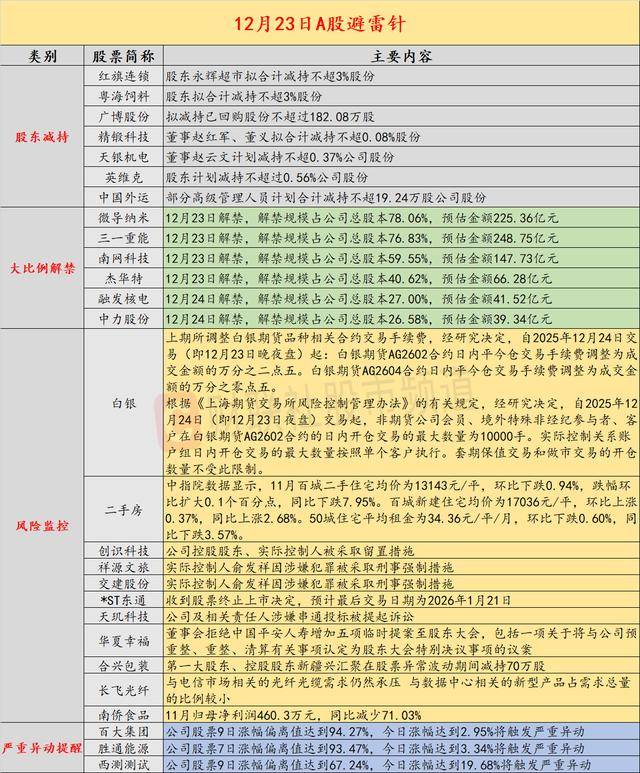
Economic Information - The Shanghai Futures Exchange has adjusted the trading fees for silver futures contracts, effective from December 24, 2025. The trading fee for the AG2602 contract will be 0.025% of the transaction amount, while the AG2604 contract will be 0.005% [2] - The average price of second-hand residential properties in 100 cities in November was 13,143 yuan per square meter, a month-on-month decrease of 0.94% and a year-on-year decrease of 7.95%. The average price of new residential properties was 17,036 yuan per square meter, with a month-on-month increase of 0.37% and a year-on-year increase of 2.68% [2] Company Alerts - Chuangshi Technology's controlling shareholder and actual controller has been placed under detention [5] - Xiangyuan Cultural Tourism's actual controller, Yu Faxiang, has been subjected to criminal coercive measures due to suspected criminal activity [5] - Jiao Jian Co., Ltd.'s actual controller, Yu Faxiang, has also been subjected to criminal coercive measures [5] - Hongqi Chain's shareholder Yonghui Supermarket plans to reduce its holdings by no more than 3% [5] - Yuehai Feed's shareholders plan to reduce their holdings by no more than 3% [5] - *ST Dongtong has received a decision for stock delisting, with the last trading date expected to be January 21, 2026 [5] - Tianji Technology and related responsible persons are facing litigation for suspected collusion in bidding [5] Overseas Alerts - The Japanese government is increasingly likely to intervene in the foreign exchange market as the yen continues to depreciate following the recent interest rate hike by the Bank of Japan [7] - A report from a German economic research institute indicates that Germany's exports to the U.S. have significantly declined by 7.8% in the first three quarters of this year due to increased tariffs [7]



国家航天局统筹民商遥感卫星的“太空打星”模式 ;脑机接口医疗器械工作推进会召开,政策红利可期——《投资早参》
Mei Ri Jing Ji Xin Wen· 2025-12-22 23:19
Market News - The three major US stock indices closed higher, with the S&P 500 up 0.64%, Nasdaq up 0.52%, and Dow Jones up 0.47%. Major tech stocks had mixed results, with Tesla and Nvidia rising over 1%, while Intel and Netflix fell over 1% [1] - International oil prices increased, with WTI crude oil rising 2.48% to $57.92 per barrel and Brent crude oil rising 2.38% to $61.48 per barrel. Gold prices also surged, with spot gold reaching a record high of $4449.16, up 2.42% [1] Industry Insights - The National Space Administration is establishing a virtual observation constellation for commercial remote sensing satellites to enhance emergency disaster observation capabilities. This initiative aims to improve data acquisition efficiency and satellite utilization [2] - The satellite communication industry is projected to exceed 200 to 400 billion yuan by 2030, with an annual compound growth rate of 10% to 28%. The industry is transitioning from concept validation to large-scale application, driven by technological maturity and cost reduction [2] - The humanoid robot industry is expected to see significant growth, with an estimated shipment of 5,000 units by 2025 and nearly 60,000 units by 2030, reflecting a compound annual growth rate of over 95% [3] - The brain-computer interface (BCI) medical device market is projected to reach $40 billion by 2030 and $145 billion by 2040, indicating substantial potential in the healthcare sector for treating neurological disorders [4][5] Company Updates - Tianyin Electric announced that its general manager plans to reduce his shareholding by up to 155,810 shares, representing 0.37% of the total share capital [6] - Invech disclosed that a shareholder intends to reduce its stake by up to 549,490 shares, approximately 0.56% of the total share capital [6] - China National Foreign Trade announced that its executives plan to reduce their holdings by a total of approximately 19,240 shares [6] - Hongqi Chain reported that a major shareholder intends to reduce its stake by up to 13.6 million shares, not exceeding 1% of the total share capital [6] - Yuehai Feed announced plans for significant share reductions by its controlling shareholder and executives, totaling up to 20.9 million shares [6]

