Hongqi Chain(002697)

Search documents
红旗连锁:公司将坚持做好主营业务,抓住顾客需求
Zheng Quan Ri Bao Wang· 2026-02-02 11:13
Core Viewpoint - Hongqi Chain (002697) is committed to enhancing its main business operations, focusing on customer needs, actively reducing costs, and improving operational performance [1] Group 1 - The company emphasizes the importance of maintaining its core business activities [1] - There is a strategic focus on understanding and meeting customer demands [1] - The company aims to implement cost reduction and efficiency improvement measures [1]

9块9的咖啡,需要千平门店吗?
Xin Lang Cai Jing· 2026-02-02 02:06
Core Insights - The new tea beverage brands are increasingly focusing on large offline flagship stores, moving away from the traditional takeaway and delivery models, aiming to create immersive experiences for consumers [1][4][5] - Brands like Mixue Ice City, Luckin Coffee, and Heytea are strategically opening large stores in key urban areas to enhance brand image and consumer engagement, despite the high costs associated with such expansions [4][5][12] - The trend of large flagship stores is seen as a double-edged sword, generating initial traffic but raising concerns about long-term profitability and sustainability in a competitive market [5][41] Group 1: Mixue Ice City - Mixue Ice City is rapidly expanding its flagship stores, with over 25 planned locations, including the "Snow King Castle" in Hangzhou, which has attracted significant attention and sales [5][12] - The flagship stores feature unique offerings, such as 22 exclusive drinks and themed merchandise, aiming to create a comprehensive brand experience [7][9] - The company is focusing on high-performing franchisees for its flagship stores, indicating a shift towards quality over quantity in store expansion [12][58] Group 2: Luckin Coffee - Luckin Coffee has adopted a different model compared to traditional coffee shops, emphasizing quick service and online orders, with a significant portion of its revenue coming from delivery [4][28] - The company has invested heavily in flagship stores, with Q3 financial reports showing a 47.7% year-on-year increase in revenue from self-operated stores, despite rising operational costs [28][41] - Luckin's strategy includes creating visually appealing stores to attract social media attention, although many of these locations lack amenities for prolonged customer stays [29][41] Group 3: Heytea - Heytea is rebranding and upgrading its stores, with over 130 locations transformed into "Inspiration Tea Rooms," reflecting a focus on high-end tea experiences [47][58] - The company has paused new franchise applications, indicating a strategic shift towards enhancing existing stores and focusing on direct control over brand experience [58][73] - Heytea's new store formats and limited-time offerings are designed to elevate the brand's market position and create a unique consumer experience [54][73] Group 4: Market Trends - The new tea beverage market is approaching saturation, prompting brands to explore new revenue streams and innovative product offerings [74][75] - The large store concept is seen as a marketing strategy rather than a guaranteed profit model, with the potential for high risk and high reward [73][75] - The industry is witnessing a shift towards creating unique consumer experiences, with brands leveraging flagship stores to differentiate themselves in a crowded market [73][75]



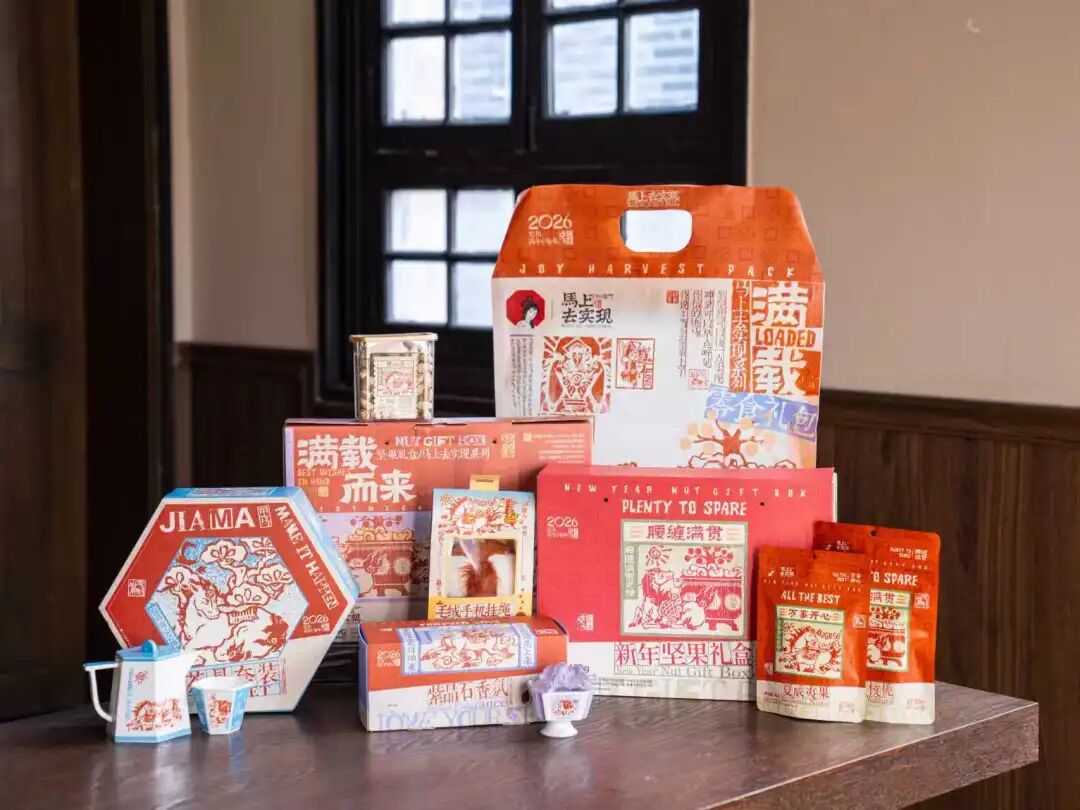
年轻人涌到奶茶店“抢年货”,蜜雪、喜茶、茶颜赢麻了
3 6 Ke· 2026-02-02 01:55
Core Insights - Young consumers are increasingly purchasing New Year goods from tea shops, indicating a shift in holiday shopping behavior towards personalized and unique products [2][5][17] Group 1: Consumer Behavior - The trend shows that the purchasing power for New Year goods is shifting to the younger generation, particularly those born after 2000, who prioritize emotional value over traditional necessities [6][10] - Young consumers are moving away from conventional New Year items like nuts and candies, seeking products that are interesting, innovative, and capable of expressing individuality [8][10] Group 2: Product Offerings - Popular items include the "Snow King Big Gift Pack" from Mixue Ice City priced at 39.9 yuan, which contains 12 types of snacks and tea bags, appealing to a wide audience [2][11] - Tea brands like Cha Yan Yue Se and Yi Tea are launching limited edition products and themed gift boxes that resonate with cultural elements, enhancing their appeal [2][4] Group 3: Sales and Market Trends - The retail segment of tea brands is becoming increasingly significant, with Mixue Ice City's retail business accounting for 70% of total revenue, while Cha Yan Yue Se maintains around 30% [11][13] - The overall trend indicates that tea brands are expanding their product lines beyond beverages to include snacks and other retail items, aiming to capture a broader range of consumer occasions [15][17] Group 4: Marketing Strategies - Brands are leveraging social media and live streaming to promote their New Year products, with significant sales achieved through platforms like Tmall [4][11] - The marketing strategies focus on creating a lifestyle connection with young consumers, positioning tea products as integral to various social and festive occasions [15][17]
商贸零售行业周报:商社板块2025年四季度前瞻-20260201
GOLDEN SUN SECURITIES· 2026-02-01 10:40
Investment Rating - The report maintains an "Accumulate" rating for the industry [5] Core Insights - The retail sector is expected to show varied performance in Q4 2025, with significant growth in certain segments like gold and jewelry, while others like supermarkets and department stores are projected to decline [1][2][4] - The report highlights the importance of the upcoming Spring Festival season, suggesting that sectors with performance elasticity, such as duty-free shops and certain tourist attractions, should be closely monitored [9] - The report emphasizes the potential of AI applications in enhancing e-commerce marketing, indicating a shift towards new retail strategies [9] Summary by Relevant Sections Retail Sector Outlook - Gold and Jewelry: - Lao Feng Xiang: Expected net profit growth of -15% to 5% in Q4 2025 - Zhou Da Sheng: Expected net profit growth of 15% to 30% in Q4 2025 - Chao Hong Ji: Forecasted net profit of 1.2 to 2.2 billion, with a year-on-year increase of 125% to 175% - Cai Bai Co.: Expected net profit growth of 150% to 254% in Q4 2025 - Yu Garden Co.: Forecasted loss of 4.312 billion in Q4 2025, compared to a loss of 1.03 billion in the same period last year [1] - Trendy Toys: - Miniso: Expected revenue growth of 25% to 30% in Q4 2025, with adjusted net profit growth of 10% to 20% [1] Supermarkets and Department Stores - Chongqing Department Store: Expected net profit of 1.021 billion, a decline of 22.4% year-on-year, with a projected drop of 92.5% in Q4 2025 - Wangfujing: Expected net profit loss of 0.45 to 0.23 billion, with a growth rate of -6.6% to 7.3% in Q4 2025 - Yonghui Supermarket: Expected loss of 2.14 billion, with a net profit growth rate of -3.1% in Q4 2025 - Home Home Joy: Expected net profit of 198 to 228 million, with a growth rate of 50.1% to 72.8% in Q4 2025 [2] Cross-Border and E-commerce - Small Commodity City: Expected net profit growth of 5% to 15% in Q4 2025 - Anker Innovation: Expected net profit growth of 10% to 20% in Q4 2025 - Su Mei Da: Expected net profit of 1.355 billion, with a growth rate of 70.8% in Q4 2025 [3] Social Services Sector Outlook - Duty-Free: China Duty-Free Group: Expected net profit growth of 29% to 173% in Q4 2025 - Tourism: - Songcheng Performance: Expected net profit growth of -204% to 294% in Q4 2025 - Jiuhua Tourism: Expected net profit growth of 0% to 15% in Q4 2025 [4] Investment Recommendations - The report recommends focusing on sectors with performance elasticity during the Spring Festival, including duty-free, certain tourist attractions, and gold and jewelry [9] - For 2026, the report suggests looking at service consumption and product consumption, particularly in duty-free and travel chains, as well as undervalued segments with improving fundamentals [9]



商贸零售行业周报:商社板块2025年四季度前瞻
国盛证券有限责任公司· 2026-02-01 10:24
Investment Rating - The report maintains an "Accumulate" rating for the industry [5] Core Views - The report emphasizes the importance of focusing on sub-sectors with performance elasticity during the upcoming Spring Festival peak season, including duty-free, certain scenic spots, supermarkets, and gold jewelry [9] - It suggests that the recent fundamentals of duty-free and travel chains have improved, warranting ongoing observation and validation [9] - For 2026, the report recommends focusing on service consumption and product consumption, particularly in the duty-free and travel chain sectors, as well as the gold jewelry sector and Miniso, which have high valuation attractiveness [9] Summary by Relevant Sections Retail Sector Outlook for Q4 2025 - Gold Jewelry: - Lao Feng Xiang: Expected net profit growth of -15% to 5% - Zhou Da Sheng: Expected net profit growth of 15% to 30% - Chao Hong Ji: Forecasted net profit of 436 million to 533 million, a year-on-year increase of 125% to 175% - Cai Bai Co.: Expected net profit of 1.06 billion to 1.23 billion, corresponding to a growth of 150% to 254% - Yu Garden Co.: Forecasted loss of 4.312 billion, primarily due to asset impairment provisions [1] - Trendy Toys: - Miniso: Expected revenue growth of 25% to 30%, with adjusted operating profit and net profit growth of 10% to 20% [1] Supermarket and Department Store Outlook for Q4 2025 - Chongqing Department Store: Expected net profit of 1.021 billion, a year-on-year decrease of 22.4% - Wangfujing: Expected net profit of -45 million to -23 million, with a growth rate of -6.6% to 7.3% - Yonghui Supermarket: Expected loss of 2.14 billion, with a growth rate of -3.1% - Jiajiayue: Expected net profit of 198 million to 228 million, growth of 50.1% to 72.8% - Hongqi Chain: Expected net profit growth of -10% to 0% [2] Cross-Border and E-commerce Outlook for Q4 2025 - Small Commodity City: Expected net profit growth of 5% to 15% - Anker Innovation: Expected net profit growth of 10% to 20% - Saiwei Times: Expected net profit of 90 million to 130 million - Huakai Yibai: Expected net profit of 80 million to 110 million, driven by improved operational efficiency [3] Social Services Sector Outlook for Q4 2025 - Duty-Free: China Duty-Free Group: Expected net profit growth of 29% to 173% - Tourism: - Songcheng Performance: Expected net profit growth of -204% to 294% - Tianmu Lake: Expected net profit growth of -10% to 5% [4] Investment Recommendations - The report recommends focusing on companies such as Small Commodity City, China Duty-Free, Huazhu Group, Shoulu Hotel, Jinjiang Hotel, Chao Hong Ji, Jiuhua Tourism, Ruoyu Chen, Qingmu Technology, and Miniso, while also keeping an eye on other companies with potential [10]
麦当劳肯德基相继调价 背后是外卖成本压力?
2 1 Shi Ji Jing Ji Bao Dao· 2026-01-31 01:11
Core Insights - The article discusses the recent price adjustments made by major fast-food chains like KFC and McDonald's, as well as various coffee and tea brands, primarily targeting delivery services to cope with rising operational costs [1][2]. Price Adjustments - KFC China announced a price increase of 0.8 yuan on delivery products while keeping dine-in prices unchanged, citing operational cost changes as the reason [1][2]. - McDonald's also raised prices on certain menu items by 0.5 to 1 yuan, with delivery prices adjusted accordingly [2]. - Other brands like Salvia, Nayuki, and Luckin Coffee have also increased their prices, typically by 1 to 2 yuan, to balance costs and profits [1][2]. Market Dynamics - The competitive landscape has shifted due to an intense delivery price war, which has altered the profit margins for many restaurants [1][4]. - The increase in raw material costs, as indicated by a 0.8% rise in the Consumer Price Index (CPI) and a 4.4% increase in fresh fruit prices, is contributing to the need for price adjustments [3][4]. Impact on Smaller Brands - Smaller businesses are adopting more discreet and flexible pricing strategies compared to larger chains, which can afford to raise prices openly [5][6]. - Many small brands are experiencing significant profit reductions, with some reporting a 60% decrease in net profits due to low-price subsidies [6]. Long-term Implications - The ongoing price adjustments reflect a broader trend of brands reassessing their reliance on delivery channels and seeking to improve in-store experiences [7]. - The adjustments may help the industry move away from a low-price competition model, fostering a healthier market environment as subsidy pressures ease [7].


第29届四川年货节开幕 10万种优质年货任您选
Si Chuan Ri Bao· 2026-01-31 00:59
Core Insights - The 29th China (Sichuan) Spring Festival Shopping Festival opened on January 30, featuring over 1,000 domestic and international enterprises from 36 countries and regions, and nearly 30 provinces in China, showcasing 100,000 quality products [1][2] Group 1: Event Overview - The event is themed "Shopping Global New Year Goods, Sharing a Beautiful Life" and includes various themed pavilions such as liquor and candy, specialty agricultural products, and lifestyle products [1] - The festival will run from January 30 to February 11, 2024, and will host a series of activities including the Sichuan liquor market and the third Ruoergai Food Festival [2] Group 2: Participation and Promotions - The festival features collaboration with over 2,000 offline Hongqi chain supermarkets in Sichuan for joint promotional activities [1] - The event also serves as a platform for showcasing regional specialties, with activities like "Xinjiang Goodies Go to Sichuan and Chongqing" and the introduction of various famous teas from different regions [2] Group 3: Product Highlights - Notable products include the 29-degree low-alcohol fragrant liquor "Wuliangye·Yijianqingxin" and various high-quality items such as caviar and silk from Nanchong [1] - The imported goods pavilion will feature international products like French wine, German beer, and Belgian chocolate, along with kitchenware and cultural creative products [2]

10万种优质年货任您选
Si Chuan Ri Bao· 2026-01-30 22:08
Group 1 - The 29th China (Sichuan) Spring Festival Shopping Festival opened in Chengdu, featuring participation from over 1,000 domestic and international enterprises across 36 countries and regions, and nearly 30 provinces in China [1][2] - The event showcases 100,000 high-quality New Year goods, including traditional crafts and modern technology products, through themed exhibition halls such as liquor and candy, specialty agricultural products, and lifestyle goods [1] - A new promotional strategy combining exhibitions with over 2,000 offline Red Flag chain supermarkets in the province was implemented, enhancing consumer engagement and sales opportunities [1] Group 2 - The festival serves as a platform for exchanging unique products from across the country and globally, with activities like "Xinjiang Goodies Go to Sichuan and Chongqing" featuring local teas and other specialties [2] - An import goods pavilion will open on February 4, showcasing international products such as French wine, German beer, and Belgian chocolate, along with kitchenware and cultural crafts [2] - The festival will run from January 30 to February 11, including a series of events like the Sichuan liquor market and the third Ruoergai Food Festival [2]
未知机构:红旗连锁调研精要20260128门店数字化转型云值守-20260129
未知机构· 2026-01-29 02:25
Summary of Key Points from the Conference Call Company Overview - The company discussed is Hongqi Lianchuan, focusing on its digital transformation and operational strategies in the retail sector. Digital Transformation - **Cloud Guard Stores Progress**: - Initiated last year, currently has around 300 Cloud Guard stores, with over 500 total 24-hour stores (including some previously staffed stores), aiming to expand to over 1,000 this year [1] - Operating hours for Cloud Guard are from 10:30 PM to 8:00 AM, requiring hardware upgrades such as automatic scanning doors, enhanced monitoring equipment, and self-service payment devices [1] - Positive outcomes observed: increased nighttime foot traffic, revenue, and profit, currently in a pilot and dynamic adjustment phase, with expectations for more stable data next year [1][1] Product and Supply Chain Strategy - **Sichuan Product Layout**: - Launched a three-year action plan for cultivating the Sichuan brand, focusing on deepening the exploration of local products [1] - Currently, revenue from Sichuan-made products exceeds 50%, with plans to further enhance collaboration with local enterprises and establish new product display areas for Sichuan products [1] Fresh Produce and Product Strategy - **Fresh Produce Business**: - Launched online pre-sale for fresh products in the second half of last year, introducing one or two products weekly to reduce waste, receiving positive consumer feedback [2] - **Co-branded Products Strategy**: - Collaborating with manufacturers to launch co-branded products (both logos displayed), focusing on brands with a certain consumer base rather than private label products, resulting in lower investment costs [2] - **Product Adjustment Logic**: - Continuously phasing out old products and introducing new ones, but due to smaller store sizes (average over 180 square meters), adjustments are gradual and less extensive compared to larger supermarkets [2] Financial Performance - **Revenue Goals**: - The revenue target for 2026 is to maintain stability without pursuing significant growth [2] - **Gross Margin Stability**: - Aiming for stable gross margins [3] - **Core Business Performance**: - Excluding Xinwang Bank, the core business net profit showed stable growth by Q3 2025 [3] Competitive Landscape - **Regional Competition in Sichuan**: - The company maintains a solid position in the Sichuan retail sector; competition includes FamilyMart and 7-Eleven (some franchise stores), with pressure primarily from consumer purchasing power [3] - **Impact of Snack Brands**: - Brands like "Snacks Are Busy" have some influence, but the company’s business model differs significantly from these brands [4] - **Standard Convenience Store Model**: - The company operates as a standard convenience store, offering a range of food products including grains and oils, while snack brands focus primarily on snacks [5]
1月28日增减持汇总:暂无增持 中新集团等9股减持(表)
Xin Lang Zheng Quan· 2026-01-28 14:41
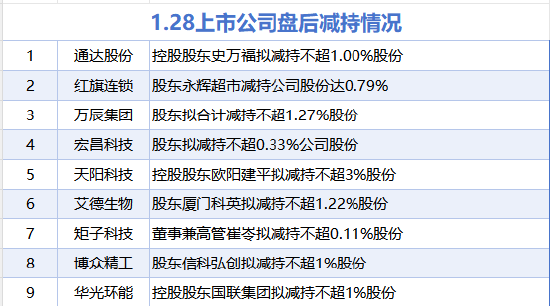
Core Viewpoint - On January 28, no A-share listed companies disclosed any increase in shareholding, while nine companies announced share reductions, indicating a trend of shareholder divestment in the market [1]. Group 1: Share Reduction Details - Tongda Co., Ltd. plans to reduce its shareholding by no more than 1.00% [2] - Hongqi Chain's shareholder Yonghui Supermarket has reduced its stake by 0.79% [2] - Wancheng Group's shareholders intend to collectively reduce their holdings by no more than 1.27% [2] - Hongchang Technology's shareholders plan to reduce their holdings by no more than 0.33% [2] - Tianyang Technology's controlling shareholder Ouyang Jianping intends to reduce his stake by no more than 3% [2] - Aide Biology's shareholder Xiamen Keying plans to reduce its holdings by no more than 1.22% [2] - Juzitech's director and executive Cui Cen intends to reduce his stake by no more than 0.11% [2] - Bozhong Precision's shareholder Xinke Chuang plans to reduce its holdings by no more than 1% [2] - Tianyang's controlling shareholder Guolian Group intends to reduce its stake by no more than 1% [2]