StarNeto(002829)

Search documents
“政策+技术+市场”三重共振 星网宇达竞逐卫星通信产业星辰大海
Quan Jing Wang· 2025-11-25 09:23
Core Insights - The satellite communication industry in China is entering a golden development period, driven by policy support, technological advancements, and increasing demand, with a market potential exceeding trillions [2][3] - The Ministry of Industry and Information Technology has set a target of over 10 million satellite communication users by 2030, promoting new business models such as direct satellite connectivity for mobile phones [1][2] - StarNet Yuda is positioned as a key player in the industry, leveraging its "technology + products + experience" advantages to provide comprehensive communication solutions across various domains [1][4] Industry Overview - Satellite communication is recognized as a strategic infrastructure supporting the digital economy, with its importance growing in national security and global competition [2] - A robust policy framework has been established to support the industry, including the promotion of low-orbit satellite internet and innovative terminal device connectivity [2][3] - The market for satellite communication equipment in China is projected to reach 66.34 billion yuan by 2025, with the global market expected to grow to 728.88 billion yuan by 2032, reflecting a compound annual growth rate of 17.32% [3] Company Positioning - StarNet Yuda has built a competitive edge through its unique technological capabilities, product offerings, and industry experience, establishing high barriers to entry [4][6] - The company has developed a complete product chain from core components to terminal devices and system-level solutions, enabling it to provide one-stop services [5] - StarNet Yuda's long-standing experience in defense and military sectors has created a strong trust barrier, allowing it to adapt quickly to civilian market needs [6] Application Expansion - The company is expanding its applications from traditional sectors like maritime and aviation to consumer markets, industrial interconnectivity, and emergency response [3][7] - In the consumer sector, StarNet Yuda's solutions are addressing connectivity challenges in remote areas, supporting rural revitalization and disaster response [7] - The company's technology is also facilitating digital transformation in industries such as smart transportation, logistics, and energy, providing stable data transmission and remote control capabilities [7][8] Future Outlook - StarNet Yuda aims to capitalize on the booming satellite communication market by focusing on technological innovation and application scenarios [9] - The company plans to enhance its product performance and cost competitiveness while expanding its presence in emerging fields like vehicle networking and satellite IoT [9] - With the support of national strategies, StarNet Yuda is transitioning from a device supplier to a solution provider, aiming for global market expansion [9]

航天装备板块11月25日涨0.32%,航天环宇领涨,主力资金净流出9119.28万元
Zheng Xing Xing Ye Ri Bao· 2025-11-25 09:09
Core Insights - The aerospace equipment sector experienced a slight increase of 0.32% on November 25, with Aerospace Hanyu leading the gains [1] - The Shanghai Composite Index closed at 3870.02, up 0.87%, while the Shenzhen Component Index closed at 12777.31, up 1.53% [1] Sector Performance - Aerospace Hanyu (688523) saw a significant rise of 15.82%, closing at 34.48, with a trading volume of 388,400 shares and a transaction value of 1.29 billion [1] - China Satellite (600118) increased by 1.16%, closing at 42.61, with a trading volume of 607,300 shares and a transaction value of 2.61 billion [1] - Zhongtian Rocket (003009) rose by 0.64%, closing at 55.45, with a trading volume of 145,300 shares and a transaction value of 810 million [1] - StarNet Yuda (002829) and China Telecom (601698) had minimal increases of 0.15% and 0.10%, respectively [1] - Aerospace Electronics (600879) decreased slightly by 0.09%, while Xinyu Guoke (300722) fell by 3.37% and 3.47%, respectively [1] Capital Flow - The aerospace equipment sector experienced a net outflow of 91.19 million from institutional investors, while retail investors saw a net inflow of 74.52 million [1] - China Satellite had a net inflow of 45.91 million from institutional investors, while Aerospace Hanyu had a net inflow of 43.61 million [2] - Other companies like Zhongtian Rocket and Aerospace Electronics faced significant net outflows of 46.68 million and 53.24 million, respectively [2]





星网宇达:截至2025年11月10日股东人数为31032户
Zheng Quan Ri Bao Wang· 2025-11-19 09:13
Core Viewpoint - The company, Xingwang Yuda, reported that as of November 10, 2025, it has a total of 31,032 shareholders [1] Group 1 - The company has engaged with investors through an interactive platform [1] - The reported number of shareholders indicates a potential growth in investor interest [1]
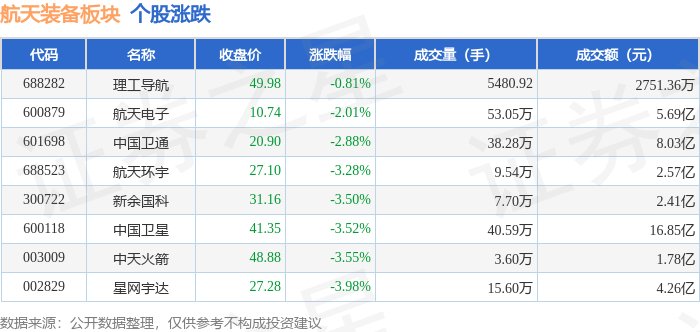
航天装备板块11月18日跌2.92%,星网宇达领跌,主力资金净流出4.67亿元
Zheng Xing Xing Ye Ri Bao· 2025-11-18 08:11
Core Insights - The aerospace equipment sector experienced a decline of 2.92% on November 18, with Xingwang Yuda leading the drop [1] - The Shanghai Composite Index closed at 3939.81, down 0.81%, while the Shenzhen Component Index closed at 13080.49, down 0.92% [1] Stock Performance - The following stocks in the aerospace equipment sector showed notable declines: - Ligong Navigation: Closed at 49.98, down 0.81% with a trading volume of 5480.92 lots and a transaction amount of 27.51 million [1] - Aerospace Electronics: Closed at 10.74, down 2.01% with a trading volume of 530,500 lots and a transaction amount of 5.69 billion [1] - China Wontong: Closed at 20.90, down 2.88% with a trading volume of 382,800 lots and a transaction amount of 803 million [1] - Aerospace Huayu: Closed at 27.10, down 3.28% with a trading volume of 95,400 lots and a transaction amount of 257 million [1] - Xinyu Guoke: Closed at 31.16, down 3.50% with a trading volume of 77,000 lots and a transaction amount of 241 million [1] - China Inner Star: Closed at 41.35, down 3.52% with a trading volume of 405,900 lots and a transaction amount of 1.685 billion [1] - Zhongtian Rocket: Closed at 48.88, down 3.55% with a trading volume of 36,000 lots and a transaction amount of 178 million [1] - Xingwang Yuda: Closed at 27.28, down 3.98% with a trading volume of 156,000 lots and a transaction amount of 426 million [1] Capital Flow - The aerospace equipment sector saw a net outflow of 467 million from main funds, while retail investors contributed a net inflow of 373 million [1] - The following details highlight the capital flow for specific stocks: - Ligong Navigation: Main funds net outflow of 1.11 million, retail net inflow of 585,900 [2] - Aerospace Huanyu: Main funds net outflow of 7.15 million, retail net inflow of 5.68 million [2] - Xinyu Guoke: Main funds net outflow of 24.44 million, retail net inflow of 31.73 million [2] - Zhongtian Rocket: Main funds net outflow of 33.60 million, retail net inflow of 35.37 million [2] - Xingwang Yuda: Main funds net outflow of 50.94 million, retail net inflow of 45.52 million [2] - Aerospace Electronics: Main funds net outflow of 53.62 million, retail net inflow of 39.86 million [2] - China Wontong: Main funds net outflow of 106 million, retail net inflow of 90.14 million [2] - China Satellite: Main funds net outflow of 191 million, retail net inflow of 124 million [2]
卫星导航指数盘中跌超2%,成分股多数下跌
Mei Ri Jing Ji Xin Wen· 2025-11-18 02:41
Group 1 - The satellite navigation index experienced a decline of over 2% during intraday trading, with most constituent stocks falling [1] - Aerospace Zhizhuang saw a significant drop of 8.16%, while Shanghai Huigong decreased by 7.36% [1] - Other notable declines included Morningstar Aviation at 6.77%, Aerospace Hanyu at 5.60%, and Xingwang Yuda at 5.24% [1]



星网宇达股价跌5.03%,华夏基金旗下1只基金位居十大流通股东,持有392.54万股浮亏损失561.33万元
Xin Lang Cai Jing· 2025-11-18 02:27
Core Points - StarNet Yuda's stock price dropped by 5.03% to 26.98 CNY per share, with a trading volume of 163 million CNY and a turnover rate of 4.07%, resulting in a total market capitalization of 5.607 billion CNY [1] Company Overview - StarNet Yuda Technology Co., Ltd. was established on May 20, 2005, and went public on December 13, 2016. The company is located in Beijing Economic and Technological Development Zone [1] - The main business involves the development and application of inertial technology, focusing on the research, production, and sales of inertial navigation, measurement, and stabilization products. It provides high-dynamic perception and control services for various sectors including aviation, aerospace, marine, electronics, oil, surveying, transportation, and communications [1] - The revenue composition of the main business includes: Unmanned Systems 45.41%, Information Perception 35.18%, Satellite Communication 16.91%, and Others 2.49% [1] Shareholder Information - Among the top ten circulating shareholders, one fund from Huaxia Fund holds a significant position. Huaxia Industry Prosperity Mixed A (003567) increased its holdings by 474,200 shares in the third quarter, totaling 3.9254 million shares, which accounts for 2.69% of the circulating shares. The estimated floating loss today is approximately 5.6133 million CNY [2] - Huaxia Industry Prosperity Mixed A (003567) was established on February 4, 2017, with a latest scale of 8.972 billion CNY. Year-to-date returns are 51.91%, ranking 785 out of 8140 in its category; the one-year return is 50.5%, ranking 762 out of 8057; and since inception, the return is 366.23% [2] Fund Management - The fund manager of Huaxia Industry Prosperity Mixed A is Zhong Shuai, who has been in the position for 5 years and 115 days. The total asset scale of the fund is 13.26 billion CNY, with the best fund return during his tenure being 172.61% and the worst being -4.15% [3]
军工行业2026年度策略:军贸放量叠加新质战力,四大主线引领军工新周期
Soochow Securities· 2025-11-17 14:32
Core Insights - The report highlights a significant turning point for the defense and military industry in 2025, with a strong recovery in both fundamentals and market performance, indicating a shift from policy expectations to actual performance realization [4][9][11] - The industry is entering a new phase characterized by rigid demand, structural upgrades, and improved financial health, with five core judgments outlined for 2026 [4][6][24] Industry Trends - The defense and military sector saw a cumulative increase of 16.39% in the Shenwan Defense Index by October 31, 2025, closely aligning with the performance of the CSI 300 index but lagging behind the growth-driven ChiNext index [9] - The market experienced a "Q1 bottoming, Q2 recovery, Q3 acceleration, and Q4 consolidation" rhythm, with the driving force shifting from policy expectations to performance realization [9][10] Financial Performance - The industry ended the "increasing revenue without increasing profit" dilemma, with significant improvements in operating cash flow and profitability quality, marking a transition to a new phase of high-quality development [4][24][26] - By November 10, 2025, the PE-TTM (excluding negative values) for the defense sector was approximately 70 times, indicating a structural revaluation rather than a systemic bubble [20][24] Revenue and Profitability - The report indicates a recovery in revenue and profit growth in 2025, with a notable increase in operating cash flow, signaling a turnaround from previous years of negative cash flow [24][31] - The industry experienced a significant rebound in profitability, with a 17.29% year-on-year increase in net profit attributable to shareholders in Q3 2025, reflecting effective cost control and improved operational efficiency [26][31] Investment Focus - The investment strategy focuses on four main lines: the main battle equipment supply chain from a military trade perspective, advanced combat capabilities, military-civilian integration sectors, and reform and asset securitization [4][6][26] - Key companies to watch include AVIC Shenyang Aircraft Corporation, China Aerospace Science and Technology Corporation, and others involved in military trade and advanced combat technologies [4][6][26]


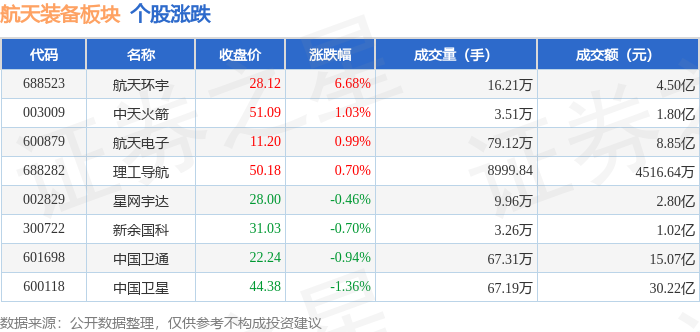
航天装备板块11月13日跌0.49%,中国卫星领跌,主力资金净流入1.51亿元
Zheng Xing Xing Ye Ri Bao· 2025-11-13 08:45
Market Overview - The aerospace equipment sector experienced a decline of 0.49% on November 13, with China Satellite leading the drop [1] - The Shanghai Composite Index closed at 4029.5, up 0.73%, while the Shenzhen Component Index closed at 13476.52, up 1.78% [1] Stock Performance - Notable stock performances in the aerospace equipment sector include: - Aerospace Huanyu (688523) rose by 6.68% to a closing price of 28.12 [1] - Zhongtian Rocket (003009) increased by 1.03% to 51.09 [1] - Aerospace Electronics (600879) gained 0.99% to 11.20 [1] - China Satellite (600118) fell by 1.36% to 44.38 [1] - StarNet Yuda (002829) decreased by 0.46% to 28.00 [1] Capital Flow - The aerospace equipment sector saw a net inflow of 151 million yuan from institutional investors, while retail investors experienced a net outflow of 184 million yuan [1] - Detailed capital flow for key stocks includes: - China Satellite (600118) had a net inflow of 66.05 million yuan from institutional investors [2] - Aerospace Huanyu (688523) saw a net inflow of 38.99 million yuan from institutional investors [2] - Aerospace Electronics (600879) recorded a net inflow of 32.70 million yuan from institutional investors [2] - StarNet Yuda (002829) experienced a net outflow of 0.29 million yuan from retail investors [2]

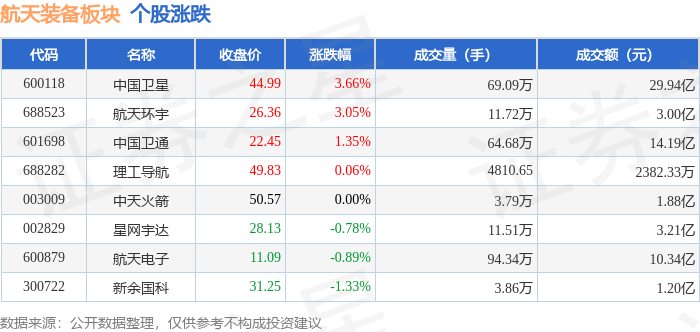
航天装备板块11月12日涨1.31%,中国卫星领涨,主力资金净流出2.6亿元
Zheng Xing Xing Ye Ri Bao· 2025-11-12 08:49
Core Insights - The aerospace equipment sector experienced a rise of 1.31% on November 12, with China Satellite leading the gains [1] - The Shanghai Composite Index closed at 4000.14, down 0.07%, while the Shenzhen Component Index closed at 13240.62, down 0.36% [1] Sector Performance - China Satellite (600118) closed at 44.99, up 3.66%, with a trading volume of 690,900 shares and a transaction value of 2.994 billion [1] - Aerospace Huanyu (688523) closed at 26.36, up 3.05%, with a trading volume of 117,200 shares and a transaction value of 300 million [1] - China Satcom (601698) closed at 22.45, up 1.35%, with a trading volume of 646,800 shares and a transaction value of 1.419 billion [1] - Other notable performances include: - Ligong Navigation (688282) at 49.83, up 0.06% - Zhongtian Rocket (003009) at 50.57, unchanged - Xingwang Yuda (002829) at 28.13, down 0.78% - Aerospace Electronics (600879) at 11.09, down 0.89% - Xinyu Guoke (300722) at 31.25, down 1.33% [1] Capital Flow Analysis - The aerospace equipment sector saw a net outflow of 260 million from institutional investors, while retail investors contributed a net inflow of 209 million [1] - The detailed capital flow for key stocks includes: - Aerospace Electronics (600879) with a net outflow of 32.0185 million from institutional investors [2] - Xingwang Yuda (002829) with a net inflow of 750.72 thousand from retail investors [2] - China Satellite (600118) experienced a significant net outflow of 268 million from institutional investors [2]
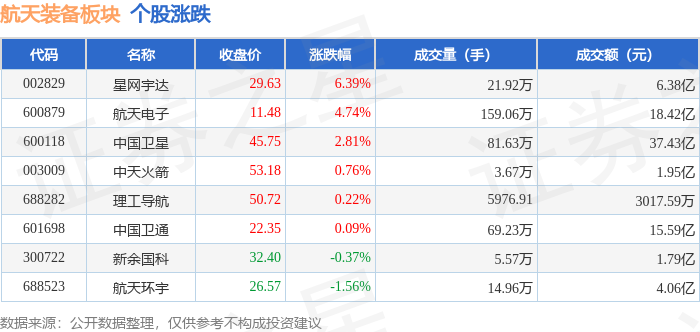
航天装备板块11月10日涨1.67%,星网宇达领涨,主力资金净流出2470.98万元
Zheng Xing Xing Ye Ri Bao· 2025-11-10 08:49
Core Insights - The aerospace equipment sector experienced a 1.67% increase on November 10, with Xingwang Yuda leading the gains [1] - The Shanghai Composite Index closed at 4018.6, up 0.53%, while the Shenzhen Component Index closed at 13427.61, up 0.18% [1] Sector Performance - Xingwang Yuda (002829) closed at 29.63, up 6.39% with a trading volume of 219,200 shares and a transaction value of 638 million [1] - Aerospace Electronics (600879) closed at 11.48, up 4.74% with a trading volume of 1,590,600 shares and a transaction value of 1.842 billion [1] - China Satellite (600118) closed at 45.75, up 2.81% with a trading volume of 816,300 shares and a transaction value of 374.3 million [1] - Other notable performances include Zhongtian Rocket (003009) up 0.76% and LIGONG Navigation (688282) up 0.22% [1] Capital Flow Analysis - The aerospace equipment sector saw a net outflow of 24.7098 million from institutional investors, while retail investors experienced a net outflow of 88.2521 million [1] - Conversely, speculative funds recorded a net inflow of 113 million [1] - Aerospace Electronics had a net inflow of 99.7684 million from institutional investors, while retail investors saw a net outflow of 7.5183 million [2] - Xingwang Yuda experienced a net inflow of 54.7523 million from institutional investors but a significant net outflow of 5.50624 million from retail investors [2]