
Desay SV(002920)

Search documents
突发!16天12板包装印刷大牛股明起停牌核查|盘后公告集锦
Xin Lang Cai Jing· 2026-01-06 14:44
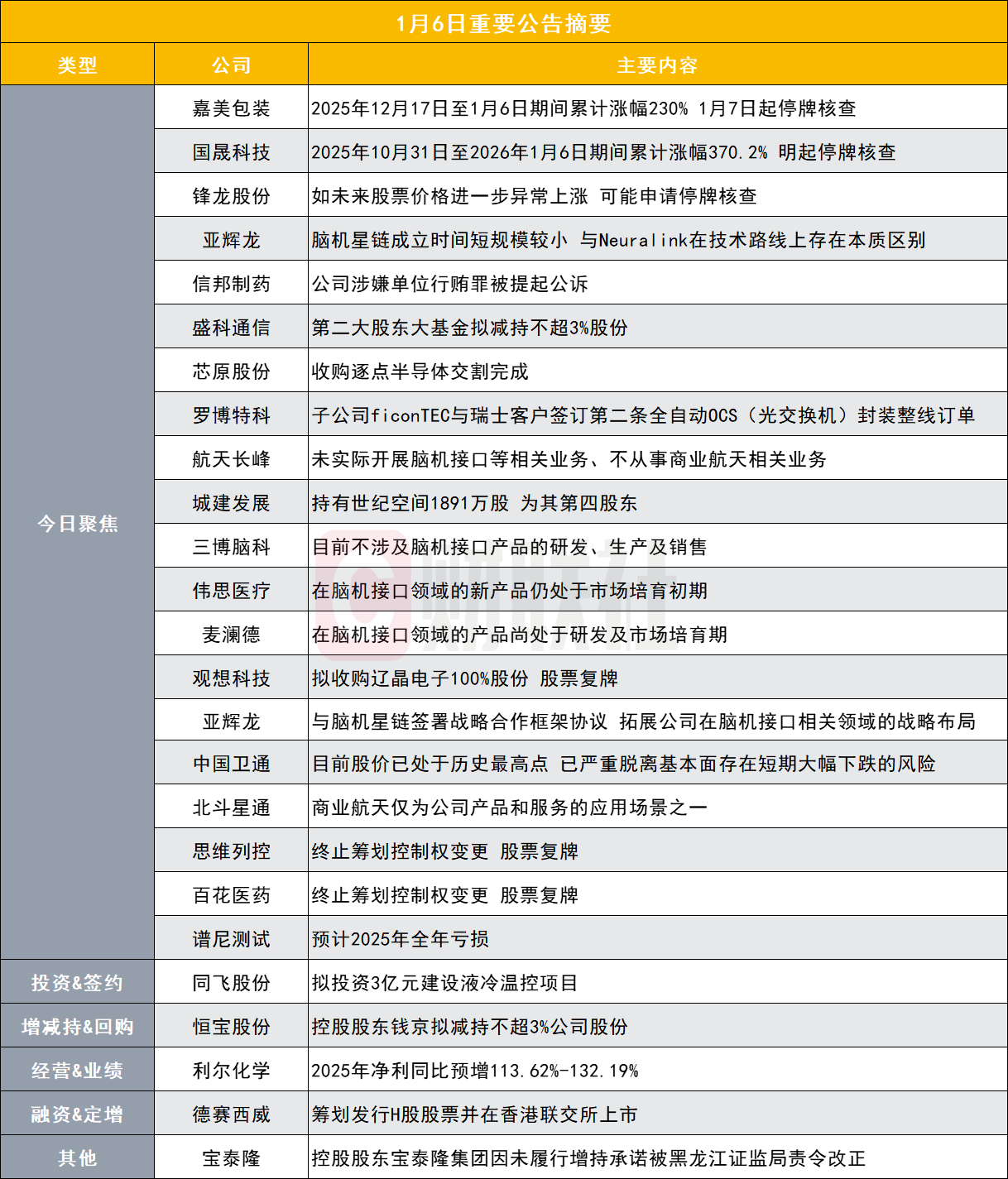
Company Announcements - Jia Mei Packaging's stock price increased by 230% from December 17, 2025, to January 6, 2026, leading to a suspension for investigation starting January 7, 2026 [2] - Guosheng Technology's stock rose by 370.2% during the same period, prompting a suspension for investigation effective January 7, 2026 [3] - Fenglong Co., Ltd. indicated that it may apply for a suspension if its stock price continues to rise abnormally [4] - Xinfang Pharmaceutical is facing public prosecution for alleged unit bribery [7] - Shengke Communication's second-largest shareholder plans to reduce its stake by no more than 3% [8] - Chip Origin Technology completed the acquisition of Zhudian Semiconductor [9] - Robotech's subsidiary signed a significant contract for automatic optical switch packaging with a Swiss client [10] - Aerospace Changfeng clarified that it does not engage in brain-computer interface or commercial aerospace businesses [12] - Chengjian Development holds 18.91 million shares of Century Space, making it the fourth-largest shareholder [13] - Sanbo Brain Science is not involved in the research, production, or sales of brain-computer interface products [14] - Weisi Medical's new products in the brain-computer interface field are still in the early market cultivation stage [16] - Mairande's products in the brain-computer interface area are also in the research and market cultivation phase [17] - Guankang Technology plans to acquire 100% of Liaojing Electronics, with stock resuming trading [19] - Yahui Long signed a strategic cooperation framework agreement with Brain Machine Star Chain to expand its presence in the brain-computer interface field [20] - China Satellite Communications warned that its stock price is at a historical high and may experience a significant drop [21] - Beidou Star Communication stated that commercial aerospace is just one application scenario for its products and services [22] Financial Performance - Lier Chemical expects a net profit increase of 113.62% to 132.19% for 2025 [39] - Zhongtai Co., Ltd. anticipates a net profit of 420 million to 480 million yuan for 2025, recovering from a previous loss [38] Financing and Capital Increase - Desai Xiwai is planning to issue H-shares and list on the Hong Kong Stock Exchange [40] - Xingye Yinx is also preparing to issue H-shares for listing on the Hong Kong Stock Exchange [41] Other Significant Events - Baotailong's controlling shareholder was ordered to rectify its failure to fulfill a shareholding increase commitment [42] - *ST Changyao's stock may face termination of listing due to negative net assets and other financial issues [43]







德赛西威筹划赴港上市 推进国际化战略布局
Zheng Quan Shi Bao Wang· 2026-01-06 14:33
Core Viewpoint - Desay SV's announcement of planning to issue H-shares and list on the Hong Kong Stock Exchange aims to enhance its international strategy and brand influence while accelerating overseas business expansion [1] Group 1: Company Developments - Desay SV's stock reached a limit-up on January 6, closing at 137.39 yuan per share, with a market capitalization of 82 billion yuan [2] - The company focuses on three main areas: smart cockpits, intelligent driving, and connected services, maintaining a leading position in the industry [2] - In the first half of 2025, the sales revenue from the smart cockpit business is projected to reach 9.459 billion yuan, an increase of 18.76% year-on-year, while the intelligent driving business is expected to generate 4.147 billion yuan, up 55.49% year-on-year [2] Group 2: Client and Market Engagement - Desay SV's fourth-generation smart cockpit has been mass-produced for clients such as Li Auto, Xiaomi, and Geely, with new project orders from GAC Passenger Vehicle and others [2] - The company holds the top market share in the domestic auxiliary driving domain, providing flagship auxiliary driving controllers to major automakers including Xiaomi, Li Auto, Great Wall Motors, and others [2] - Desay SV has deepened strategic cooperation with global core chip manufacturers and OEMs, securing new project allocations from VW and Toyota in the first half of 2025 [2] Group 3: Global Expansion and Supply Chain - The company is building an international supply chain system with global R&D and manufacturing capabilities, having established branches in key countries such as Germany, France, Spain, Japan, and Singapore [3] - Desay SV's production capacity will begin contributing in Indonesia by May 2025, enhancing supply chain resilience in Southeast Asia, while a plant in Monterrey, Mexico, will provide localized services for the Americas [3] - The smart factory in Spain is expected to start production in 2026, offering advanced products in the smart cockpit and auxiliary driving sectors for the European market [3] Group 4: Financial Performance - For the first three quarters of 2025, Desay SV achieved a revenue of 22.337 billion yuan, reflecting a year-on-year growth of 17.72%, and a net profit of 1.788 billion yuan, up 27.08% year-on-year [3]
德赛西威:公司主要为销售汽车电子产品
Zheng Quan Ri Bao Wang· 2026-01-06 14:16
证券日报网讯1月6日,德赛西威(002920)在互动平台回答投资者提问时表示,目前公司主要为销售汽 车电子产品,另外,公司在稳固核心主业根基的同时,积极把握市场机遇,前瞻性布局具有战略意义的 新产品与新业务领域。依托在汽车电子领域沉淀的核心技术与体系化能力,以及智能驾驶域控产品、传 感器、算法等方向的发展积累,公司持续开展机器人领域探索与研究,并已正式发布机器人智能基座 AICube,相关战略合作处于保密阶段,后续如有可公布的进展可留意公司官方发布的信息。 ...
德赛西威:目前已与多家知名机器人企业达成战略合作
Xin Lang Cai Jing· 2026-01-06 14:09
Core Viewpoint - Desay SV's launch of the AI Cube robot intelligent base marks a significant advancement in the integration of mature technology from the autonomous driving sector into robotics [1] Group 1: Product Features - The AI Cube utilizes a modular design with a "plug-and-play" core board, allowing for flexible integration of various sensor suites including cameras, millimeter-wave radar, and LiDAR [1] - The product offers customized services such as mature underlying drivers, middleware, and ISP debugging, which significantly shorten development cycles and enhance R&D efficiency while reducing costs [1] Group 2: Strategic Partnerships - Desay SV has established strategic collaborations with several well-known robotics companies, indicating strong market interest and potential for growth in the robotics sector [1]
德赛西威(002920.SZ):筹划发行H股股票并在香港联合交易所上市
Ge Long Hui A P P· 2026-01-06 11:34
格隆汇1月6日丨德赛西威(002920.SZ)公布,为进一步推进惠州市德赛西威汽车电子股份有限公司国际 化战略布局,提升公司品牌国际影响力,加快海外业务拓展,打造国际化资本运作平台,助力公司高质 量发展,提升公司整体竞争力,德赛西威正在筹划境外发行股份(H股)并在香港联合交易所有限公司 (简称"香港联交所")上市事项。截至目前,公司正在就本次H股发行上市的相关工作进行商讨,相关 细节尚未最终确定,本次H股发行上市不会导致公司控制权发生变化。 ...
德赛西威(002920.SZ)筹划赴港上市事项
智通财经网· 2026-01-06 11:18
智通财经APP讯,德赛西威(002920.SZ)公告,公司正在筹划境外发行股份(H股)并在中国香港联交所上 市事项。 ...
德赛西威筹划赴港上市事项
Zhi Tong Cai Jing· 2026-01-06 11:18
德赛西威(002920)(002920.SZ)公告,公司正在筹划境外发行股份(H股)并在中国香港联交所上市事 项。 ...
德赛西威:筹划发行H股股票并在香港联合交易所有限公司上市
Xin Lang Cai Jing· 2026-01-06 10:49
德赛西威公告,为进一步推进惠州市德赛西威汽车电子股份有限公司国际化战略布局,提升公司品牌国 际影响力,加快海外业务拓展,打造国际化资本运作平台,助力公司高质量发展,提升公司整体竞争 力,德赛西威正在筹划境外发行股份(H股)并在香港联合交易所有限公司上市事项。 ...
德赛西威:筹划发行H股股票并在香港联交所上市
Ge Long Hui· 2026-01-06 10:49
格隆汇1月6日|德赛西威(002920.SZ)公告称,为推进国际化战略布局,提升国际影响力和海外业务拓 展,公司正在筹划境外发行股份(H股)并在香港联交所上市事项。目前相关细节尚未最终确定,预计 不会改变公司控制权。该事项需提交董事会和股东会审议,并经中国证监会备案和香港联交所、香港证 监会等监管机构审核和批准。存在较大不确定性。公司将及时履行信息披露义务,敬请投资者关注后续 公告并注意投资风险。 ...
德赛西威(002920) - 关于筹划发行H股股票并在香港联合交易所有限公司上市的提示性公告
2026-01-06 10:45
惠州市德赛西威汽车电子股份有限公司 的提示性公告 证券代码:002920 证券简称:德赛西威 公告编号:2026-001 惠州市德赛西威汽车电子股份有限公司 关于筹划发行 H 股股票并在香港联合交易所有限公司上市 公司将依据相关法律法规的要求,根据本次 H 股发行上市的后续进展情况及时履行信 息披露义务,切实保障公司及全体股东的合法权益。敬请广大投资者关注公司后续公告, 注意投资风险。 特此公告。 惠州市德赛西威汽车电子股份有限公司 董事会 2026 年 1 月 6 日 本公司及董事会全体成员保证公告内容的真实、准确和完整,没有虚假记载、误导性 陈述或重大遗漏。 为进一步推进惠州市德赛西威汽车电子股份有限公司(以下简称"德赛西威"、"公 司")国际化战略布局,提升公司品牌国际影响力,加快海外业务拓展,打造国际化资本 运作平台,助力公司高质量发展,提升公司整体竞争力,德赛西威正在筹划境外发行股份 (H 股)并在香港联合交易所有限公司(以下简称"香港联交所")上市事项(以下简称 "本次 H 股发行上市")。截至目前,公司正在就本次 H 股发行上市的相关工作进行商 讨,相关细节尚未最终确定,本次 H 股发行上市不会 ...