Blue Focus(300058)

Search documents
股市必读:蓝色光标(300058)预计2025年全年归属净利润盈利1.8亿元至2.2亿元
Sou Hu Cai Jing· 2026-01-29 16:12
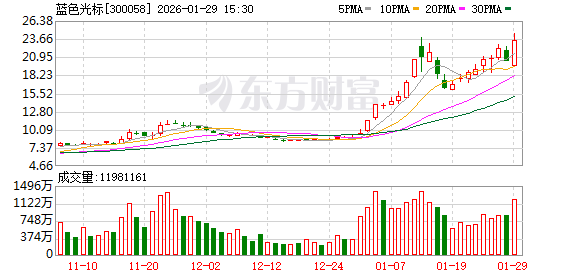
截至2026年1月29日收盘,蓝色光标(300058)报收于23.4元,上涨14.93%,换手率34.43%,成交量 1198.12万手,成交额273.4亿元。 当日关注点 交易信息汇总资金流向 1月29日主力资金净流入28.98亿元;游资资金净流出17.17亿元;散户资金净流出11.81亿元。 北京蓝色光标数据科技集团股份有限公司发布2025年度业绩预告,预计归属于上市公司股东的净利润为 18,000万元至22,000万元,上年同期为-29,067.56万元;扣除非经常性损益后的净利润为22,000万元至 26,000万元,上年同期为-33,102.72万元。业绩扭亏为盈主要得益于出海业务收入增长,预计2025年收 入约720亿元人民币,未发生大额长期股权投资减值损失,加强客户信用管理和应收账款管控,股权激 励摊销成本降低。本次业绩预告未经注册会计师审计,具体数据以2025年年度报告为准。 以上内容为证券之星据公开信息整理,由AI算法生成(网信算备310104345710301240019号),不构成 投资建议。 来自【交易信息汇总】:1月29日主力资金净流入28.98亿元,显著高于游资与散户资金动向。 来 ...

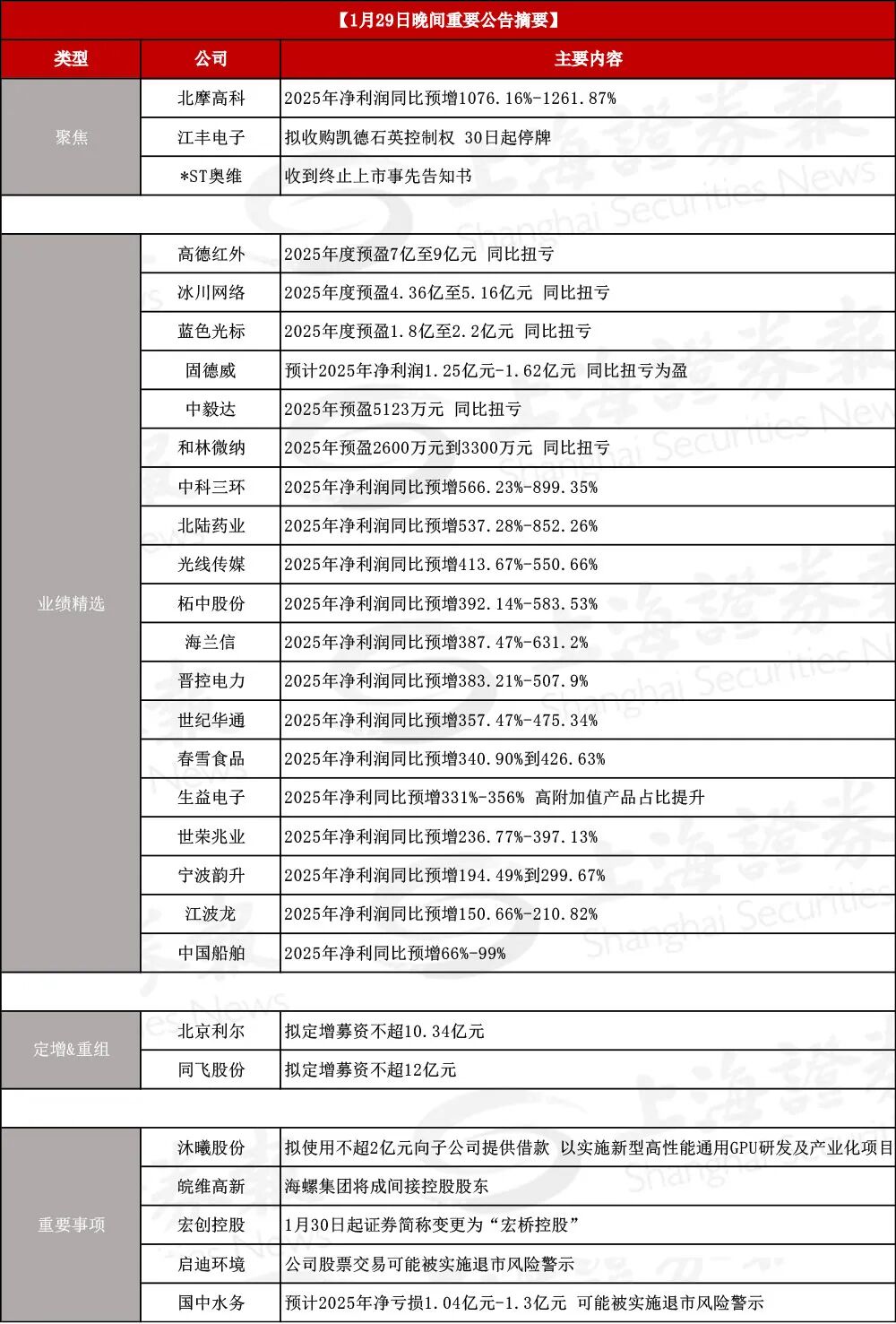
公告精选|北摩高科:净利预增超1000%;江丰电子:拟收购凯德石英控制权 30日起停牌;*ST奥维:收到终止上市事先告知书
Shang Hai Zheng Quan Bao· 2026-01-29 16:00
Core Insights - The article highlights significant profit forecasts for various companies in 2025, indicating a trend of recovery and growth across multiple sectors, with some companies projecting substantial increases in net profit compared to the previous year. Company Performance Forecasts - **Beimo High-Tech**: Expected net profit for 2025 is between 190 million to 220 million yuan, a year-on-year increase of 1076.16% to 1261.87% [2] - **Jiangfeng Electronics**: Plans to acquire control of Kaide Quartz, with stock suspension starting January 30 [3] - **ST Aowei**: Received a notice of termination of listing due to market capitalization falling below 500 million yuan for 20 consecutive trading days [4] - **GaoDe Infrared**: Forecasted net profit of 700 million to 900 million yuan for 2025, recovering from a loss of 447 million yuan in the previous year [6] - **Bingchuan Network**: Expected net profit of 436 million to 516 million yuan, recovering from a loss of 247 million yuan [6] - **BlueFocus**: Anticipated net profit of 180 million to 220 million yuan, recovering from a loss of 291 million yuan [7] - **Godewei**: Projected net profit of 125 million to 162 million yuan, turning from loss to profit [6] - **Zhongyida**: Expected net profit of 51.23 million yuan, recovering from a loss [8] - **Helin Micro-Nano**: Forecasted net profit of 26 million to 33 million yuan, turning from loss to profit [8] - **Zhongke Sanhuan**: Expected net profit of 80 million to 120 million yuan, a year-on-year increase of 566.23% to 899.35% [9] - **Beilu Pharmaceutical**: Projected net profit of 87 million to 130 million yuan, a year-on-year increase of 537.28% to 852.26% [9] - **Light Media**: Expected net profit of 1.5 billion to 1.9 billion yuan, a year-on-year increase of 413.67% to 550.66% [9] - **Zhezhong Co.**: Forecasted net profit of 360 million to 500 million yuan, a year-on-year increase of 392.14% to 583.53% [10] - **Hailanxin**: Expected net profit of 40 million to 60 million yuan, a year-on-year increase of 387.47% to 631.2% [10] - **Jin Control Power**: Projected net profit of 155 million to 195 million yuan, a year-on-year increase of 383.21% to 507.9% [11] - **Century Huatong**: Expected net profit of 5.55 billion to 6.98 billion yuan, a year-on-year increase of 357.47% to 475.34% [12] - **Chunxue Food**: Forecasted net profit of 36 million to 43 million yuan, a year-on-year increase of 340.90% to 426.63% [13] - **Shirong Zhaoye**: Expected net profit of 126 million to 186 million yuan, a year-on-year increase of 236.77% to 397.13% [13] - **Ningbo Yunsheng**: Projected net profit of 280 million to 380 million yuan, a year-on-year increase of 194.49% to 299.67% [14] - **Jiangbolong**: Expected net profit of 1.25 billion to 1.55 billion yuan, a year-on-year increase of 150.66% to 210.82% [16] - **China Shipbuilding**: Forecasted net profit of 7 billion to 8.4 billion yuan, a year-on-year increase of 65.89% to 99.07% [17] Fundraising and Restructuring - **Beijing Lier**: Plans to raise no more than 1.034 billion yuan through a private placement [21] - **Tongfei Co.**: Plans to raise no more than 1.2 billion yuan through a private placement [21] - **Muxi Co.**: Plans to provide up to 200 million yuan in loans to its subsidiary for GPU development [23] - **Wanhua High-Tech**: Haihua Group will become an indirect controlling shareholder through a cash increase of 4.998 billion yuan [23]




今日晚间重要公告抢先看——中国黄金称公司股票交易存在市场情绪过热 可能存在短期涨幅较大后的下跌风险;白银有色称公司黄金、白银产品的收入占总营业收入比重较低
Jin Rong Jie· 2026-01-29 13:53
Major Announcements - China Gold announced that its stock trading shows signs of market sentiment overheating, which may lead to a risk of short-term declines after significant price increases. The company's P/E ratio is 55.63, significantly higher than the industry median of 28.60 [1] - Zhaojin Mining stated that the prices of its gold and gold concentrate products are highly influenced by fluctuations in gold prices, which could significantly impact its operating performance if gold prices experience large swings [2] - Silver (Core Stock) Nonferrous reported that the revenue from its gold and silver products constitutes a low proportion of total operating income, with gold product sales accounting for 18.67% and silver product sales for 4.54% of total revenue [3] Company-Specific Risks - Hunan Silver (Core Stock) indicated that it has a relatively low amount of proven metal resources compared to industry peers, which poses a resource reserve risk. The company also faces risks from silver price fluctuations and has a low gross margin of 6.54% compared to mining companies [4] - TianShun Wind Energy decided to implement a long-term shutdown of six wholly-owned subsidiaries due to increasing market competition, aiming to optimize resource allocation and focus on core businesses like offshore wind power [5] - Qidi Environment expects a negative net asset value by the end of 2025, which may lead to a risk warning for its stock trading if the audited net assets are confirmed to be negative [6] Performance Forecasts - BlueFocus anticipates a net profit of 1.8 billion to 2.2 billion yuan for 2025, benefiting from growth in overseas business and improved credit management [12] - Shengyi Technology expects a net profit of 3.25 billion to 3.45 billion yuan for 2025, representing a year-on-year increase of 87% to 98% due to rising sales of copper-clad laminates [13] - Sichuan Gold forecasts a net profit of 420 million to 480 million yuan for 2025, up 69.23% to 93.4% year-on-year, driven by increased sales volume and rising gold prices [14] - Dongfang Communication predicts a net profit of approximately 360 million yuan for 2025, a year-on-year increase of about 138.5%, primarily due to significant investment gains from the disposal of financial assets [15] Other Notable Announcements - Yunnan Copper confirmed that its production and operations are normal, with no undisclosed significant matters, despite its stock experiencing a 20% price fluctuation [9] - Liou Co. reported that its operations are normal, with no undisclosed significant matters, and its stock has also seen a significant price fluctuation [10] - Guosheng Securities expects a net profit of 210 million to 280 million yuan for 2025, reflecting a year-on-year increase of 25.44% to 67.25% due to robust business development [29]


蓝色光标(300058.SZ):预计2025年净利润1.8亿元~2.2亿元 同比扭亏为盈
Ge Long Hui A P P· 2026-01-29 13:28
Core Viewpoint - BlueFocus (300058.SZ) expects a net profit attributable to shareholders of 180 million to 220 million yuan in 2025, marking a turnaround from losses in the previous year, with a net profit excluding non-recurring gains and losses projected between 220 million and 260 million yuan, also indicating a return to profitability [1] Financial Performance - The company anticipates revenue growth in 2025, projected to reach approximately 72 billion yuan [1] - There were no significant long-term equity investment impairment losses reported for the current year [1] - The company has strengthened customer credit management and accounts receivable period control, contributing to improved financial performance [1] Cost Management - The cost of stock incentive amortization has decreased in the current period, positively impacting overall net profit compared to the same period last year [1]
蓝色光标(300058.SZ)发预盈,预计2025年度归母净利润1.8亿元至2.2亿元
智通财经网· 2026-01-29 13:20
Core Viewpoint - BlueFocus Communication Group (300058.SZ) has disclosed its earnings forecast for the year 2025, projecting a net profit attributable to shareholders of between 180 million and 220 million yuan, with a net profit excluding non-recurring gains and losses expected to be between 220 million and 260 million yuan [1] Financial Performance - The company anticipates a net profit of 180 million to 220 million yuan for 2025 [1] - The forecasted net profit after excluding non-recurring items is expected to be between 220 million and 260 million yuan [1]
白酒股大涨,多只消费主题基金单日涨超5%
Mei Ri Jing Ji Xin Wen· 2026-01-29 12:51
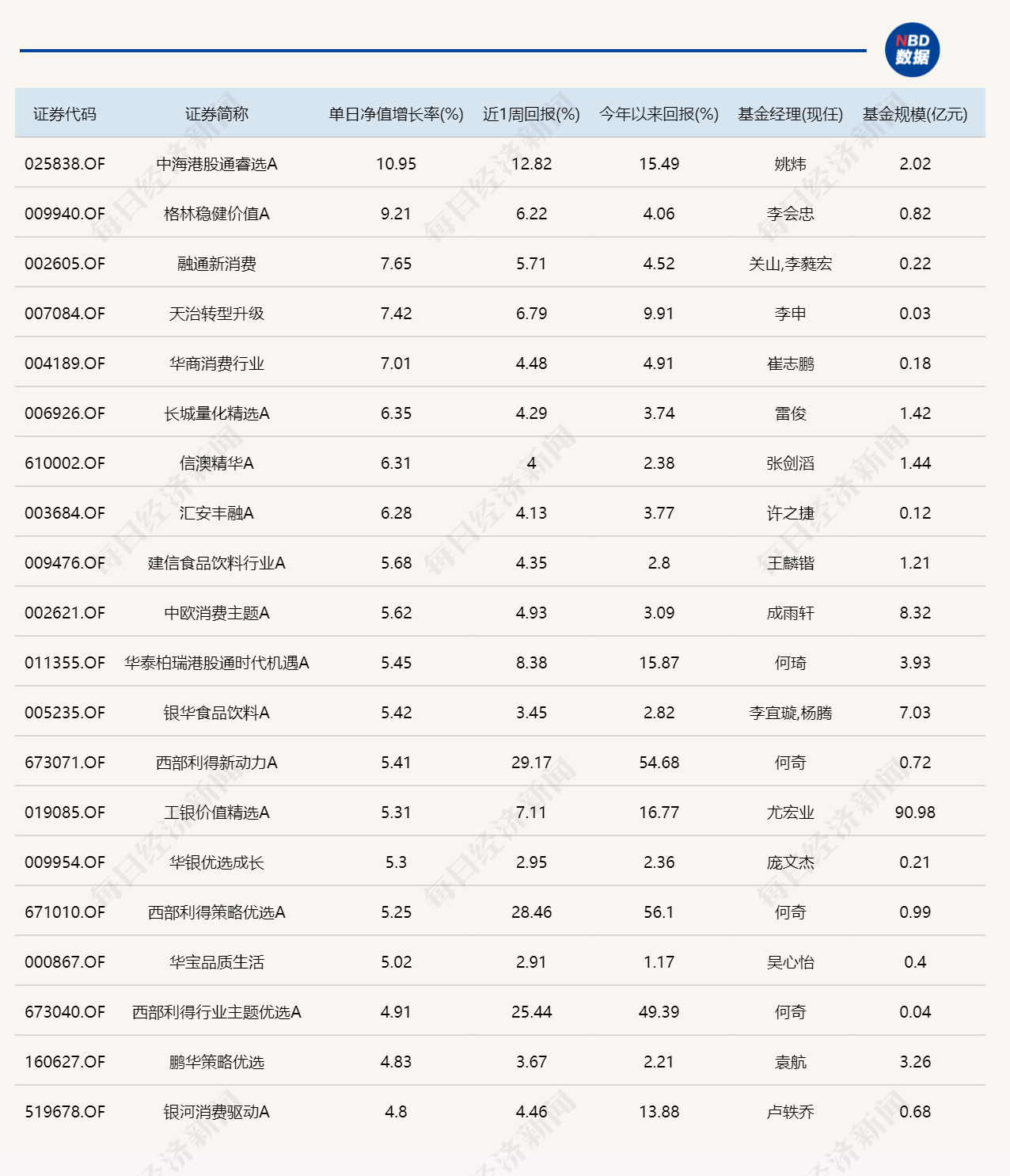
1.单日涨幅榜 新浪财经"酒价内参"重磅上线 知名白酒真实市场价尽在掌握 每经记者|肖芮冬 每经编辑|赵云 1月29日,三大指数涨跌不一,沪指窄幅震荡,创业板指冲高回落。白酒、有色金属、油气、房地产等板块走强;芯片产业链、CPO等跌幅居前。全市场超 3500只个股下跌。沪深两市成交额3.23万亿元,较上一个交易日放量2646亿。 下面一起来看今天公募基金的表现。 (注:榜单1、榜单2仅选取灵活配置型、偏股混合型和普通股票型三类产品作为主动基金的代表,纳入统计;债基相关榜单包括各类主、被动债券型基金) | 证券代码 | 证券简称 | 单日净值增长率(%) | 近1周回报(%) | 今年以来回报(%) | 基金经理(现任) | | --- | --- | --- | --- | --- | --- | | 006030.OF | 南方昌元可转债A | -2.19 | 0.14 | 15.46 | 刘文良 | | 001045.OF | 华夏可转债增强A | -2.13 | -1.34 | 12.99 | 柳万军 | | 000003.OF | 中海可转换债券A | -1.97 | -0.17 | 12.14 | ...
蓝色光标:预计2025年净利润为1.8亿元至2.2亿元 同比扭亏为盈
Mei Ri Jing Ji Xin Wen· 2026-01-29 11:42
每经AI快讯,1月29日,蓝色光标公告,预计2025年度净利润为1.8亿元至2.2亿元,上年同期为亏损2.91 亿元。 (文章来源:每日经济新闻) ...
蓝色光标(300058) - 2025 Q4 - 年度业绩预告
2026-01-29 11:26
证券代码:300058 证券简称:蓝色光标 公告编号:2026-006 北京蓝色光标数据科技集团股份有限公司 2025 年度业绩预告 单位:万元 | 项 目 | | 本报告期 | | 上年同期 | | --- | --- | --- | --- | --- | | 归属于上市公司股东的净利润 | 18,000 | ~ | 22,000 | -29,067.56 | | 扣除非经常性损益后的净利润 | 22,000 | ~ | 26,000 | -33,102.72 | 二、与会计师事务所沟通情况 本次业绩预告相关财务数据未经过注册会计师审计。北京蓝色光标数据科技集团股份有 限公司(以下简称"公司")就本次业绩预告与会计师事务所进行了预沟通,双方在本次业 绩预告方面不存在重大分歧,具体数据以最终审计结果为准。 三、业绩变动原因说明 本公司及董事会全体成员保证信息披露的内容真实、准确、完整,没有虚假记载、误导性陈述或 重大遗漏。 一、本期业绩预计情况 1、业绩预告期间:2025 年 1 月 1 日至 2025 年 12 月 31 日。 2、业绩预告情况:预计净利润为正值且属于扭亏为盈情形 2、公司将严格按照有关法 ...
AI营销板块集体爆发,因赛集团、浙文互联、天龙集团、蓝色光标、光云科技、易点天下领涨,板块相关企业整理
Jin Rong Jie· 2026-01-29 10:46
Core Viewpoint - The A-share market has seen a collective surge in "AI marketing (core stocks)" concept stocks, becoming one of the most prominent market themes, with companies like InSai Group, Zhejiang Wenlian, Tianlong Group, BlueFocus, Guangyun Technology, and Yidian Tianxia leading the charge. Company Summaries - **InSai Group (300781.SZ)**: Latest stock price is 54.18 CNY with a daily increase of +20.00%. The company has formed a joint venture with XinSuo Technology to launch a generative engine for reputation marketing and GEO optimization, supported by its self-developed InsightGPT for content production and distribution [1]. - **Zhejiang Wenlian (600986.SH)**: Latest stock price is 13.78 CNY with a daily increase of +9.98%. The company has released the "HochiGEO" intelligent agent to monitor mainstream AI search platforms and provide intelligent advertising and content distribution strategies across sectors like automotive and fast-moving consumer goods [2]. - **Tianlong Group (300063.SZ)**: Latest stock price is 6.13 CNY with a daily increase of +19.99%. The company has developed its own "PinXue·JianYou" AIGC tool matrix and AI engine, compatible with mainstream large models, enabling multi-modal material generation and intelligent advertising optimization [3]. - **BlueFocus (300058.SZ)**: Latest stock price is 8.00 CNY with a daily increase of +14.93%. The company has invested in PureblueAI, which focuses on GEO technology, quickly entering the generative engine optimization sector through model-driven content generation and distribution [4]. - **Guangyun Technology (688365.SH)**: Latest stock price is 9.80 CNY with a daily increase of +12.07%. The company offers products like "KuaiMai XiaoZhi" and "ShenHui MeiGong Robot," integrating multi-modal large models to provide comprehensive solutions for e-commerce customer service, shopping guidance, material generation, and advertising optimization [5]. - **Yidian Tianxia (301171.SZ)**: Latest stock price is 20.20 CNY with a daily increase of +9.69%. As a leader in cross-border marketing, the company has developed a GEO optimization framework compatible with overseas AI search platforms to enhance brand visibility in generative search results [6]. - **Lio Co., Ltd. (002131.SZ)**: Latest stock price is 2.39 CNY with a daily increase of +9.12%. The company has developed the LEOAIAD platform and unified model, leading the standardization of AIGC advertising materials and implementing MCP protocol tools [7]. - **Fushi Holdings (300071.SZ)**: Latest stock price is 3.14 CNY with a daily increase of +8.66%. The company has launched the FlinkAI full-link intelligent marketing platform and the Disi AI smart chain platform, covering multi-modal content generation, intelligent advertising, and digital marketing [8]. - **Zhidao Mai (300785.SZ)**: Latest stock price is 72.19 CNY with a daily increase of +8.20%. The company is advancing its "comprehensive AI" strategy by launching the "ZhiShu" AI full-domain content insight platform and other B-end marketing tools to empower content creation and data analysis [9]. - **Kunlun Wanwei (300418.SZ)**: Latest stock price is 37.60 CNY with a daily increase of +6.05%. The company’s DramaWave utilizes self-developed AI tools for batch generation of multi-language short video materials and intelligent advertising, establishing an "AI + marketing" growth cycle for overseas short drama marketing [10]. - **Yi Wang Yi Chuang (300792.SZ)**: Latest stock price is 19.21 CNY with a daily increase of +5.88%. As one of Alibaba's first AI Agent ecosystem partners, the company’s AI agents have been implemented in scenarios such as AI-generated images, content generation, and advertising optimization, while promoting SaaS subscription services [11]. - **Shengguang Group (002400.SZ)**: Latest stock price is 5.85 CNY with a daily increase of +6.05%. The company has developed the Lingxi AI marketing platform, integrating top large models to create vertical models covering full-link marketing, collaborating deeply with TikTok and Meta, serving over 300 benchmark clients [12]. - **Tianxia Xiu (600556.SH)**: Latest stock price is 6.15 CNY with a daily increase of +7.75%. The company has launched the AI product "Inspiration Island," leveraging AIGC to empower social media and short video content operations, enabling batch content generation, review, and digital IP creation [14].




春节AI大战,提前打响
Sou Hu Cai Jing· 2026-01-29 10:45
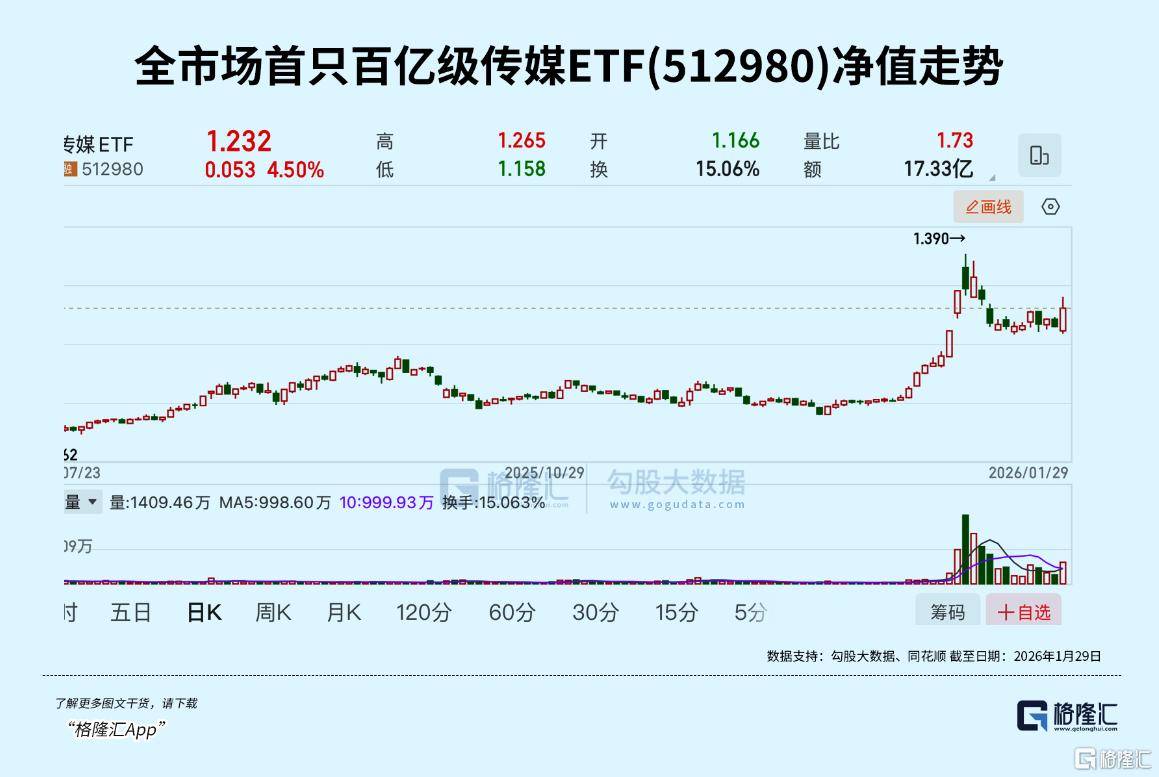
Group 1 - The market has experienced a significant surge in precious metal prices, with commercial aerospace, space photovoltaics, and GEO concepts emerging as new investment themes [1][7] - The AI application sector has seen a resurgence, reminiscent of last year's DeepSeek market rally, with the Media ETF (512980) attracting approximately 8.566 billion yuan in inflows over the past month, bringing its total size to over 11 billion yuan [1][11] - ClawdBot, an AI assistant, has gained popularity, leading to a spike in related stocks within the cultural media sector, with multiple stocks hitting the daily limit [3][4] Group 2 - The cultural media sector has seen strong performance, with stocks like Guizhou Moutai and Wuliangye experiencing significant gains, driven by market demand and strategic inventory management [4][6] - International gold prices have reached new highs, with domestic gold stocks also experiencing substantial increases, reflecting a broader trend in the precious metals market [7] - The Media ETF (512980) has shown a 27.4% increase over the past month, indicating strong investor interest in the media sector [7][11] Group 3 - The AI marketing landscape is evolving, with OpenAI planning to introduce advertising on ChatGPT, which could significantly enhance revenue streams and reshape the value of AI traffic [10][21] - The upcoming Chinese New Year is expected to boost the film industry, with several films already scheduled for release, which may positively impact related sectors [10][21] - The competition for AI application entry points is intensifying among major internet companies, with significant investments aimed at expanding user engagement and application scenarios [14][21] Group 4 - The rapid iteration of domestic AI models is driving investment enthusiasm in the AI application sector, with several new models being launched [13][21] - The market for animated micro-dramas (漫剧) has seen explosive growth, with a tenfold increase in viewership compared to the previous year, indicating a strong demand for innovative content [18][21] - The Media ETF (512980) tracks the CSI Media Index, which includes key players in the media sector, providing a convenient way for investors to gain exposure to the benefits of AI technology in media [21][22]