
ZHIYUN AUTOMATION(300097)

Search documents
智云股份(300097)投资者索赔案再获得法院立案,前期已有胜诉
Xin Lang Cai Jing· 2026-01-06 05:16
Core Viewpoint - The article discusses the ongoing legal actions against Zhiyun Co., Ltd. (智云股份) regarding false statements made to investors, highlighting the potential for investor compensation through legal channels [1][2]. Group 1: Legal Proceedings - Zhiyun Co., Ltd. has been involved in a lawsuit concerning false statements, with the Shanghai Jucheng Law Firm representing affected investors [1][2]. - As of January 5, 2026, the court has accepted the case for investor compensation related to Zhiyun Co., Ltd. [1][2]. - The law firm is actively pursuing additional claims and accepting new clients for compensation [1][2]. Group 2: Regulatory Findings - On March 17, 2025, Zhiyun Co., Ltd. received an administrative penalty from the China Securities Regulatory Commission (CSRC) for illegal activities [3]. - The company acquired 81.3181% of Shenzhen Jiutian Zhongchuang Automation Equipment Co., Ltd. in 2020, which became a subsidiary included in Zhiyun's consolidated financial statements [3]. Group 3: Financial Misrepresentation - In 2022, Jiutian Zhongchuang falsely recognized sales revenue of 59.7345 million yuan and profit of 24.1123 million yuan, accounting for 13.27% and 7.09% of Zhiyun's total reported revenue and profit, respectively [4]. - Between April and October 2022, Jiutian Zhongchuang transferred a total of 68.2 million yuan to three suppliers, who then funneled the funds back to Jiutian Zhongchuang, creating a circular flow of funds without real sales [4].
智云股份(300097)投资者索赔再提交法院立案,前期已有投资者胜诉
Xin Lang Cai Jing· 2025-12-23 02:51
Core Viewpoint - The article discusses the ongoing legal actions against Zhiyun Co., Ltd. (智云股份) regarding false statements made to investors, highlighting the potential for investor compensation through legal claims [1][2][3]. Group 1: Legal Proceedings - Zhiyun Co., Ltd. is facing a lawsuit for false statements, with the Shanghai Jucheng Law Firm submitting a case to the Dalian Intermediate People's Court [1][2]. - The law firm is currently accepting claims from other investors who have suffered losses due to the company's actions [1][3]. Group 2: Financial Misconduct - In 2020, Zhiyun Co., Ltd. acquired 81.3181% of Shenzhen Jiutian Zhongchuang Automation Equipment Co., Ltd., which became a subsidiary included in Zhiyun's consolidated financial statements [3][4]. - In 2022, Jiutian Zhongchuang falsely recognized sales revenue of 59.7345 million yuan and profit of 24.1123 million yuan, accounting for 13.27% and 7.09% of Zhiyun's total reported revenue and profit, respectively [4]. - The fraudulent revenue recognition involved a circular flow of funds among Jiutian Zhongchuang, three suppliers, and Jiangxi Mizhan Technology Co., Ltd., with no corresponding real sales activity [4]. Group 3: Investor Compensation Eligibility - Investors who purchased Zhiyun Co., Ltd. shares between April 28, 2023, and April 13, 2024, and sold or continued to hold the shares after April 13, 2024, are eligible to file for compensation [2][5]. - The law firm has a history of successfully representing investors in similar cases, with no fees charged to investors who do not receive compensation [5].
小比例转让+表决权安排:A股控制权交易新玩法密集涌现,监管新规是否暗藏变数?
Mei Ri Jing Ji Xin Wen· 2025-12-21 03:25
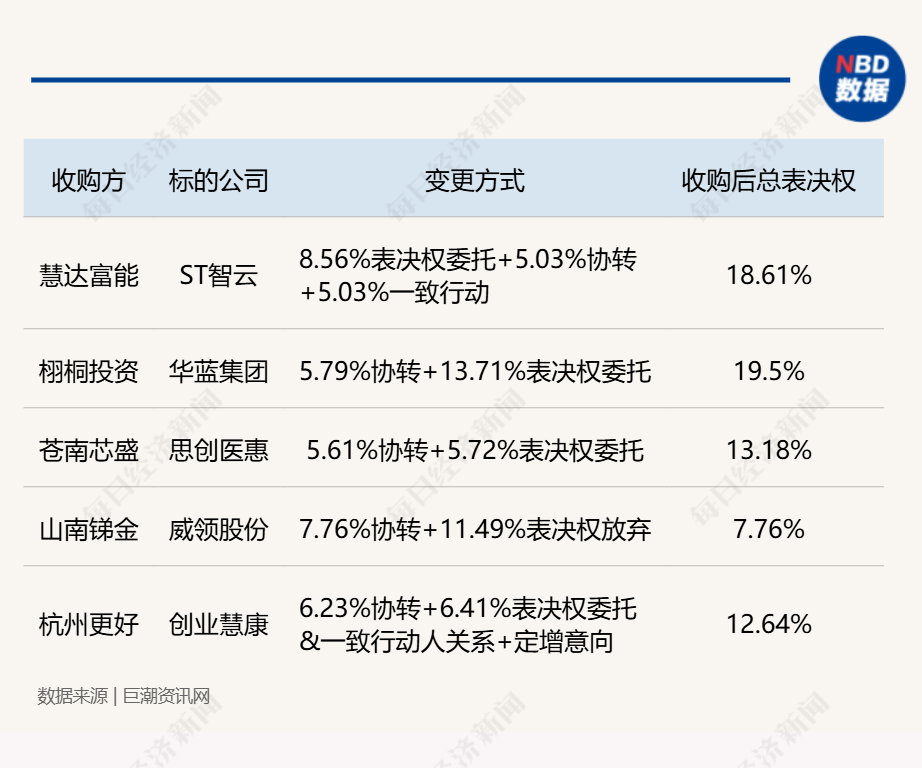
Core Viewpoint - The recent trend of "small proportion transfer + voting rights arrangement" in A-share control changes has gained momentum, allowing acquirers to gain control of companies at a low cost, exemplified by ST Zhiyun's acquisition for 87 million yuan, despite its market value nearing 2 billion yuan [1][2] Group 1: Transaction Characteristics - Five companies have announced control changes through "small proportion transfer + voting rights arrangement" since November, showcasing a high degree of homogeneity in transaction structure, pricing mechanisms, and the nature of the parties involved [2][4] - The acquisition structures typically involve share transfers between 5% and 10%, which meet regulatory requirements while avoiding triggering mandatory takeover bids, thus facilitating low-cost control [4][7] - The pricing mechanism predominantly features discounted transactions, with ST Zhiyun and others selling shares below the market price prior to announcements, reducing financial pressure on acquirers [5][6] Group 2: Financial and Operational Context - The companies involved generally have small to medium market capitalizations, with four out of five having market values between 2 billion and 5 billion yuan, and they face performance pressures, indicating a low risk of delisting [8][9] - Financial data reveals that most companies are underperforming, with four reporting losses in the first three quarters of the year, while only one, Hualan Group, has turned a profit [9][10] Group 3: Stakeholder Dynamics - The acquirers are predominantly private entities, which allows for quicker decision-making processes compared to state-owned enterprises, enhancing transaction efficiency [7][11] - The original shareholders often retain a portion of their stakes, creating a shared interest in the company's future performance, which aligns the interests of both parties [17] Group 4: Regulatory and Market Environment - The emergence of this acquisition model is supported by regulatory changes that encourage market-oriented mergers and acquisitions, particularly for private capital [18][19] - Recent regulatory proposals have raised concerns about the compliance of voting rights arrangements, which could impact future control transactions if enacted [22]




智云股份(300097)投资者索赔案前期已有投资者胜诉
Xin Lang Cai Jing· 2025-12-15 11:26
Core Viewpoint - The article discusses the legal actions taken against Zhiyun Co., Ltd. (智云股份) due to false statements leading to investor claims, with some investors already winning their cases [2][3]. Group 1: Legal Issues - Zhiyun Co., Ltd. received an administrative penalty from the China Securities Regulatory Commission (CSRC) on March 17, 2025, for illegal activities related to the acquisition of Shenzhen Jiutian Zhongchuang Automation Equipment Co., Ltd. [2][5] - In 2022, Jiutian Zhongchuang falsely recognized sales revenue of 59.7345 million yuan and profit of 24.1123 million yuan, which accounted for 13.27% and 7.09% of Zhiyun's total reported revenue and profit, respectively [2][6]. Group 2: Investor Claims - Investors who purchased Zhiyun shares between April 28, 2023, and April 13, 2024, and sold or held the shares after April 13, 2024, are eligible to file claims for compensation [3][7]. - The law firm Shanghai Jiu Cheng has been actively pursuing further claims and accepting new investor cases related to the false statements [4].
ST智云(300097) - 北京市观远(深圳)律师事务所关于大连智云自动化装备股份有限公司2025年第一次临时股东会的法律意见书
2025-12-09 11:04
北京市观远(深圳)律师事务所(以下简称"本所")接受大连智云自动化 装备股份有限公司(以下简称"公司"或"智云股份")的委托,指派本所律师 出席公司 2025 年第一次临时股东会(以下简称"本次会议")会议。 本所律师根据《中华人民共和国公司法》(以下简称《公司法》)、《中华人民 共和国证券法》(以下简称《证券法》)、中国证监会《上市公司股东会规则》(以 下简称《股东会规则》)、《深圳证券交易所上市公司股东会网络投票实施细则》 (以下简称《网络投票实施细则》)等法律、法规,以及《大连智云自动化装备 股份有限公司章程》(以下简称《公司章程》)的有关规定,就本次会议的召集和 召开程序、出席会议人员和召集人的资格、会议的表决程序和表决结果出具本法 律意见书。 关于本法律意见书,本所及本所律师谨作如下声明: (1)在本法律意见书中,本所律师仅就公司本次会议的召集和召开程序、 出席会议人员和召集人的资格、会议的表决程序和表决结果等事项进行核查和见 证后发表法律意见,不对本次会议所审议议案的内容以及在其所涉及的事实和数 据的完整性、真实性和准确性发表意见。 (2)本所及本所律师依据《证券法》《律师事务所从事证券法律业务管 ...
ST智云(300097) - 2025年第一次临时股东会决议公告
2025-12-09 11:04
大连智云自动化装备股份有限公司 证券代码:300097 证券简称:ST 智云 公告编号:2025-051 大连智云自动化装备股份有限公司 2025年第一次临时股东会决议公告 本公司及董事会全体成员保证信息披露的内容真实、准确、完整,没有虚假 记载、误导性陈述或重大遗漏。 特别提示: 1、本次股东会未出现否决议案的情况; 2、本次股东会不涉及变更以往股东会已通过的决议; 3、2025 年 12 月 1 日,深圳市慧达富能科技合伙企业(有限合伙)(以下简 称"慧达富能")与公司股东师利全先生签署《深圳市慧达富能科技合伙企业(有 限合伙)与师利全之表决权委托协议》,师利全先生将其持有的公司 24,707,628 股股份(占公司总股本的 8.56%)对应的全部表决权委托给慧达富能行使。具体 内容详见公司于 2025 年 12 月 2 日在巨潮资讯网披露的《详式权益变动报告书》。 一、会议召开和出席情况 1、大连智云自动化装备股份有限公司(以下简称"公司")2025 年第一次 临时股东会于 2025 年 12 月 9 日下午 14:30 在广东省深圳市宝安区福海街道大洋 路 126 号公司二楼会议室召开,会议由公司董事 ...
一审胜诉+调解!ST智云索赔案件仍在进行中
Xin Lang Cai Jing· 2025-12-08 02:12
Core Viewpoint - The investor lawsuit against Dalian Zhiyun Automation Equipment Co., Ltd. (ST Zhiyun) is progressing, with indications of a willingness to mediate from the company [1][2]. Group 1: Legal Developments - The case involves a series of lawsuits where a first-instance victory has already been achieved for some investors [1]. - The China Securities Regulatory Commission (CSRC) issued a notice of investigation to the company on April 18, 2024, due to suspected violations of information disclosure laws [1]. - On March 14, 2025, the company and related parties received an administrative penalty decision from the Dalian Securities Regulatory Bureau [1]. Group 2: Financial Misconduct - Zhiyun's acquisition of 81.32% of Jiutian Zhongchuang in 2020 led to the latter being included in Zhiyun's consolidated financial statements [1]. - In 2022, Jiutian Zhongchuang falsely recognized sales revenue of 59.7345 million yuan and profit of 24.1123 million yuan from Jiangxi Mizhan Technology Co., which accounted for 13.27% and 7.09% of Zhiyun's total disclosed revenue and profit, respectively [1]. Group 3: Investor Compensation - Investors who purchased shares between April 28, 2023, and April 14, 2024, and still hold them, may voluntarily register for compensation through the "Sina Stockholder Rights Protection Platform" [2][3]. - The specific compensation range will be determined by the court [3].
12月3日早间重要公告一览
Xi Niu Cai Jing· 2025-12-03 04:10
Group 1 - Xi'an Yicai plans to invest approximately 12.5 billion yuan in the Wuhan silicon material base project, focusing on producing silicon monocrystalline polished wafers and epitaxial wafers for advanced integrated circuits [1] - CATL has repurchased 15.99 million A-shares for a total expenditure of approximately 4.386 billion yuan, representing 0.36% of its total A-share capital [1][2] - Tianpu Co. has completed a stock suspension review after a 451.8% increase in stock price from August 22 to November 27, and its shares will resume trading [2] Group 2 - Jiangbolong plans to raise no more than 3.7 billion yuan through a private placement for high-end memory research and development projects [4] - Ashi Chuang intends to raise no more than 900 million yuan for semiconductor material projects and to supplement working capital [5] - Aike Co. plans to acquire 100% equity of Dongguan Qixiang for 2.2 billion yuan, focusing on products applicable in new energy battery and storage fields [6] Group 3 - Xiangyuan Cultural Tourism's subsidiary intends to acquire 100% equity of Jinxiu Lianhua Mountain for approximately 345 million yuan, which operates a national AAAA-level tourist attraction [7] - Zhongding Co. plans to issue convertible bonds totaling no more than 2.5 billion yuan for various projects including smart robots and new energy vehicle systems [9] - Jingtou Development intends to acquire 45% equity of Shanghai Lishi and related debts, aiming for full ownership of the company [10] Group 4 - Luoyang Molybdenum's subsidiary plans to invest 500 million yuan in a fund focusing on technology, healthcare, and consumer goods [11] - Transsion Holdings has submitted an application for H-share listing on the Hong Kong Stock Exchange [12] - ST Zhiyun's controlling shareholder is set to change, with a new entity gaining control over 18.61% of voting rights [13] Group 5 - Chongqing Construction's second-largest shareholder plans to transfer 12.95% of state-owned shares to other state-owned entities [14] - Longpan Technology's subsidiary signed a long-term procurement agreement to supply 106,800 tons of lithium iron phosphate materials, with a total contract value estimated between 4.5 billion to 5.5 billion yuan [15] - Junting Hotel's controlling shareholder will change to Hubei Cultural Tourism Group, with shares resuming trading [16] Group 6 - Hefei Guotou will become the controlling shareholder of Chuanan Technology after a private placement to raise no more than 1.419 billion yuan for various projects [18] - Xianglu Tungsten's shareholder plans to reduce holdings by up to 1.6 million shares, representing 0.49% of total shares [20] - Ankai Micro plans to acquire 85.79% of Siche Technology for 326 million yuan, focusing on AIoT chip design [20]




ST智云:慧达富能将成为上市公司的控股股东
Zhi Tong Cai Jing· 2025-12-02 14:57
Core Viewpoint - ST Zhiyun (300097) announced that shareholder Shi Liquan intends to entrust the voting rights of 24.7076 million shares (8.56% of total share capital) to Shenzhen Huida Funeng Technology Partnership (Limited Partnership) [1] Group 1: Shareholder Changes - Huida Funeng plans to acquire 14.5 million shares from shareholder Tan Yongliang (5.03% of total share capital) [1] - Huida Funeng will also sign a concerted action agreement with Yao Yongjun, who is set to transfer 14.5 million shares from shareholder Song Changjiang (5.03% of total share capital) [1] Group 2: Control and Ownership - After the completion of these transactions, Huida Funeng will control 18.61% of the voting rights in the company [1] - Huida Funeng will become the controlling shareholder, with actual controllers Feng Bin and Deng Hui becoming the actual controllers of the company [1]
ST智云(300097.SZ):慧达富能将成为上市公司的控股股东

智通财经网· 2025-12-02 14:53
Core Viewpoint - ST Zhiyun (300097.SZ) announced a significant change in its shareholding structure, with Shenzhen Huida Funeng Technology Partnership acquiring control over the company [1] Group 1: Shareholding Changes - Shareholder Shi Liquan intends to delegate voting rights of 24.7076 million shares (8.56% of total share capital) to Shenzhen Huida Funeng [1] - Huida Funeng plans to acquire 14.5 million shares (5.03% of total share capital) from shareholder Tan Yongli, and an additional 14.5 million shares (5.03% of total share capital) from Yao Yongjun, who has signed a concerted action agreement with shareholder Song Changjiang [1] - Upon completion of these transactions, Huida Funeng will control 18.61% of the voting rights in the company, becoming the controlling shareholder [1] Group 2: Control Changes - The actual controllers of Huida Funeng, Mr. Feng Bin and Mr. Deng Hui, will become the actual controllers of ST Zhiyun following the completion of the share acquisition [1]