
ZHIYUN AUTOMATION(300097)

Search documents
智云股份(300097) - 2025 Q3 - 季度财报
2025-10-28 11:40
Financial Performance - The company's operating revenue for Q3 2025 was ¥42,926,291.01, a decrease of 61.94% compared to the same period last year[5] - The net profit attributable to shareholders was -¥5,998,882.11, representing a decline of 338.23% year-on-year[5] - The net profit attributable to shareholders after deducting non-recurring gains and losses was -¥11,599,913.13, down 553.35% from the previous year[5] - The company's revenue for the first nine months of 2025 was ¥132,058,479.17, down 63.07% from ¥357,594,254.67 in the same period of 2024[9] - Total operating revenue for the current period was ¥132,058,479.17, a decrease of 63.0% compared to ¥357,594,254.67 in the previous period[27] - Net profit for the current period was a loss of ¥111,611,084.30, compared to a profit of ¥12,757,229.34 in the previous period[28] - The total comprehensive income for the period was -111,618,900.11, compared to 12,754,989.58 in the previous period[29] - Basic and diluted earnings per share were both -0.3868, a decrease from 0.0442 in the prior period[29] Assets and Liabilities - The total assets at the end of the reporting period were ¥745,623,845.56, a decrease of 16.09% from the end of the previous year[5] - The company's total liabilities decreased by 16.09% compared to the previous year, primarily due to a reduction in restricted cash[9] - Total assets decreased to ¥745,623,845.56 from ¥888,612,341.44, reflecting a decline of 16.1%[25] - Current assets totaled ¥467,203,027.49, down 22.3% from ¥601,626,446.57 at the beginning of the period[24] - Total liabilities decreased to ¥365,703,814.30 from ¥397,073,410.07, a decline of 7.9%[25] - The company's equity attributable to shareholders decreased to ¥379,920,031.26 from ¥491,538,931.37, a decrease of 22.7%[25] Cash Flow - The company's cash flow from operating activities for the year-to-date was ¥7,712,530.18, down 83.88% compared to the same period last year[5] - Net cash flow from operating activities decreased by 83.88% to ¥7,712,530.18 compared to ¥47,854,060.90 in the same period last year[11] - Cash inflows from operating activities totaled 190,604,253.95, down from 338,010,746.38 in the previous period, representing a decline of approximately 43.7%[31] - The net cash flow from operating activities was 7,712,530.18, significantly lower than 47,854,060.90 in the prior period, indicating a decrease of about 83.9%[31] - Cash outflows for purchasing goods and services were 75,770,407.27, down from 146,130,423.64, a reduction of approximately 48.2%[31] - Cash inflows from financing activities were 71,980,000.00, compared to 83,700,000.00 in the previous period, reflecting a decrease of about 13.9%[31] - The net cash flow from financing activities was -16,221,649.23, worsening from -10,081,563.93 in the prior period[31] - The ending balance of cash and cash equivalents dropped by 71.03% to ¥13,630,551.20 from ¥47,046,806.59 in the prior year[11] - The ending balance of cash and cash equivalents was 13,630,551.20, down from 47,046,806.59, a decline of approximately 70.0%[31] - The company reported a cash inflow of 5,408,364.00 from investment activities, compared to 10,175,697.88 in the previous period, indicating a decrease of about 46.8%[31] - The company’s cash flow from investment activities was positive at 5,294,859.57, recovering from a negative cash flow of -5,951,337.52 in the prior period[31] Shareholder Information - The total number of ordinary shareholders at the end of the reporting period was 15,921[13] - The largest shareholder, Shiliquan, holds 8.56% of shares, amounting to 24,707,628 shares, with 24,500,000 shares pledged[13] - The second-largest shareholder, Tan Yongliang, holds 6.18% of shares, totaling 17,827,507 shares[14] Legal Matters - The company has received a total of ¥185,980.34 from the enforcement of a property preservation application related to a contract dispute[15] - The total amount of securities fraud liability lawsuits against the company amounts to ¥2,584,568.28, with ¥1,125,709.79 already settled[21] - The company is involved in multiple arbitration cases, including disputes with Sichuan Jiutian, with no final results reported as of the disclosure date[19] Investment Income and Losses - The company reported a significant increase in investment income, which rose by 1795.21% to ¥4,553,183.79 compared to the previous year[10] - The company experienced a substantial increase in credit impairment losses, which rose by 749.11% to -¥69,183,788.08 due to provisions for bad debts[10]

ST智云:公司产品的下游客户主要是显示面板厂商或模组厂商
Mei Ri Jing Ji Xin Wen· 2025-10-23 01:41
Core Viewpoint - The company, ST Zhiyun, confirmed that its touch display module automation equipment is utilized in the production of various devices, including smartphones from brands like Xiaomi, Huawei, and Honor [2]. Group 1: Product Applications - The company's products are applicable in the manufacturing of smartphones, laptops, tablets, automotive displays, and wearable devices [2]. - The downstream customers primarily consist of display panel manufacturers or module manufacturers [2]. Group 2: Production Arrangement - Display panel manufacturers or module manufacturers schedule production based on their own order situations [2].

ST智云:公司将于2025年10月29日披露《2025年第三季度报告》
Mei Ri Jing Ji Xin Wen· 2025-10-23 01:29
Core Viewpoint - The company will disclose its asset impairment provisions in the upcoming third-quarter report scheduled for October 29, 2025, following the relevant accounting standards and policies [1] Group 1 - Investors inquired about potential large impairment provisions in the company's third-quarter report [1] - The company confirmed that it will adhere to the "Enterprise Accounting Standards" and its own accounting policies for the necessary accounting treatments [1]
智云股份投资者索赔案已有胜诉先例
Xin Lang Cai Jing· 2025-10-14 02:35
Core Viewpoint - The recent developments in the investor compensation case against Zhiyun Co., Ltd. (智云股份) indicate that investors have begun to win lawsuits due to false statements made by the company, with a court ruling requiring Zhiyun to compensate investors a certain percentage of their losses following the judgment [1] Group 1: Legal Proceedings - The investor compensation case against Zhiyun Co., Ltd. has been initiated in Dalian Intermediate Court, with the legal team continuing to accept claims from other investors [1] - A precedent has been set with investors winning in the first instance, leading to potential further claims [1] Group 2: Regulatory Findings - The China Securities Regulatory Commission (CSRC) issued an administrative penalty decision on March 17, 2025, confirming that Zhiyun Co. engaged in illegal activities [1] - In 2020, Zhiyun acquired an 81.3181% stake in Shenzhen Jiutian Zhongchuang Automation Equipment Co., which became a subsidiary included in Zhiyun's consolidated financial statements [1] - In 2022, Jiutian Zhongchuang falsely recognized sales revenue of 59.7345 million yuan and profit of 24.1123 million yuan from Jiangxi Mizhan Technology Co., accounting for 13.27% and 7.09% of Zhiyun's reported revenue and profit, respectively [1] Group 3: Financial Manipulation - Between April and October 2022, Jiutian Zhongchuang transferred a total of 68.2 million yuan to three suppliers, who then transferred 67.7 million yuan back to Jiutian Zhongchuang, creating a circular flow of funds without any real sales transactions [1] - This manipulation resulted in false sales revenue being reported in Zhiyun's 2022 annual report [1]
ST智云(300097) - 关于公司股票交易被实施其他风险警示相关事项的进展公告
2025-10-10 10:49
大连智云自动化装备股份有限公司 公司已就《行政处罚决定书》所涉事项对相应年度财务会计报告进行了前期会 计差错更正及追溯调整,公司将在满足《深圳证券交易所创业板股票上市规则》第 9.11 条相关撤销其他风险警示条件后及时向深圳证券交易所申请撤销其他风险警示。 一、实施其他风险警示的原因 2024 年 12 月 10 日,公司收到大连证监局下发的《行政处罚事先告知书》。根 据《行政处罚事先告知书》认定的情况,公司涉及的违法违规行为触及《深圳证券 证券代码:300097 证券简称:ST 智云 公告编号:2025-042 大连智云自动化装备股份有限公司 关于公司股票交易被实施其他风险警示相关事项的进展公告 本公司及董事会全体成员保证信息披露的内容真实、准确、完整,没有虚假记 载、误导性陈述或重大遗漏。 特别提示: 1、大连智云自动化装备股份有限公司(以下简称"公司")收到中国证券监 督管理委员会大连监管局(以下简称"大连证监局")下发的《行政处罚事先告知 书》(大证监处罚字【2024】3 号),并于 2024 年 12 月 11 日在巨潮资讯网披露了 《关于公司及相关当事人收到<行政处罚事先告知书>的公告》(公告编号 ...
ST智云(300097) - 关于公司股票交易被实施其他风险警示相关事项的进展公告
2025-09-11 11:34
大连智云自动化装备股份有限公司 证券代码:300097 证券简称:ST 智云 公告编号:2025-041 大连智云自动化装备股份有限公司 关于公司股票交易被实施其他风险警示相关事项的进展公告 本公司及董事会全体成员保证信息披露的内容真实、准确、完整,没有虚假记 载、误导性陈述或重大遗漏。 特别提示: 1、大连智云自动化装备股份有限公司(以下简称"公司")收到中国证券监 督管理委员会大连监管局(以下简称"大连证监局")下发的《行政处罚事先告知 书》(大证监处罚字【2024】3 号),并于 2024 年 12 月 11 日在巨潮资讯网披露了 《关于公司及相关当事人收到<行政处罚事先告知书>的公告》(公告编号: 2024-052)。根据《深圳证券交易所创业板股票上市规则》第 9.4 条第(七)项规 定,公司股票交易于 2024 年 12 月 12 日起被实施其他风险警示。 2、公司于 2025 年 3 月 14 日收到大连证监局下发的《行政处罚决定书》([2025]1 号),《行政处罚决定书》中认定的情况与《行政处罚事先告知书》中涉及的违法 违规行为一致。 3、根据《深圳证券交易所创业板股票上市规则》第 9.9 条 ...
ST智云2025年中报简析:净利润同比下降1131.46%,三费占比上升明显
Zheng Quan Zhi Xing· 2025-08-22 22:42
Core Insights - ST Zhiyun reported a significant decline in revenue and net profit for the first half of 2025, with total revenue of 89.13 million yuan, down 63.59% year-on-year, and a net loss of 106 million yuan, a decrease of 1131.46% compared to the previous year [1] Financial Performance - The company's gross margin fell to 16.81%, a decrease of 53.41% year-on-year, while the net margin plummeted to -118.49%, down 2932.98% [1] - Total operating expenses (sales, management, and financial expenses) accounted for 33.26% of revenue, an increase of 90.44% year-on-year, totaling 29.64 million yuan [1] - Earnings per share dropped to -0.37 yuan, a decline of 1025.00% year-on-year, and the net asset value per share decreased to 1.34 yuan, down 39.32% [1] Cash Flow and Debt - The company's cash flow situation is concerning, with cash and cash equivalents only covering 8.24% of current liabilities, and the average operating cash flow over the past three years being only 3.19% of current liabilities [3] - The company experienced a 131.80% decline in operating cash flow per share, which fell to -0.01 yuan [1] Business Model and Historical Performance - The company's historical financial performance has been weak, with a median Return on Invested Capital (ROIC) of 4.62% over the past decade, and a particularly poor ROIC of -49.92% in 2021 [2] - The business model relies heavily on research and development, necessitating a thorough examination of the underlying drivers of this approach [2]
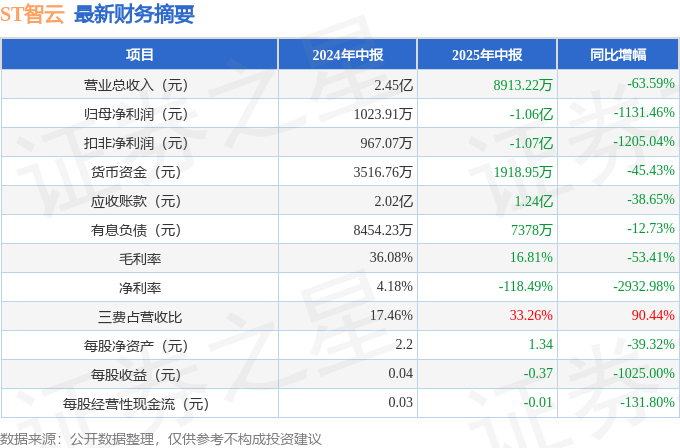
ST智云:2025年上半年净利润-1.06亿元,同比下降1131.46%
Jing Ji Guan Cha Wang· 2025-08-21 10:56
Core Viewpoint - ST Zhiyun (300097) reported a significant decline in both revenue and net profit for the first half of 2025, indicating severe financial challenges faced by the company [1] Financial Performance - The company achieved operating revenue of 89.1322 million yuan in the first half of 2025, representing a year-on-year decrease of 63.59% [1] - The net profit for the same period was -106 million yuan, reflecting a year-on-year decline of 1131.46% [1] - Basic earnings per share were reported at -0.37 yuan [1] - The weighted average return on equity (ROE) stood at -24.07% [1]
ST智云上半年净利润同比由盈转亏,计提信用减值准备7896.48万元
Zheng Quan Shi Bao Wang· 2025-08-21 10:45
Core Insights - ST Zhiyun reported a significant decline in revenue and a net loss for the first half of 2025, with operating income of 89.13 million yuan, a year-on-year decrease of 63.59%, and a net profit attributable to shareholders of -106 million yuan, compared to a profit of 10.24 million yuan in the same period last year [1] - The company attributed its losses primarily to lower demand and acceptance progress in the touch display module automation equipment segment, leading to a substantial increase in credit impairment provisions by 1,268.09% year-on-year [1] Company Strategy - The company plans to enhance its R&D capabilities and leverage its technological and customer advantages to explore new fields and businesses, particularly focusing on OLED-related equipment demands [1][2] - ST Zhiyun aims to optimize its product structure and improve internal management to strengthen its risk resistance while actively seeking new growth points by deepening existing customer relationships and expanding into new applications [2] Market Position - ST Zhiyun is one of the few domestic companies capable of providing customized intelligent manufacturing equipment solutions, holding a strong competitive edge in the automation equipment segment for touch display modules [2] - The company’s products in bonding, dispensing, bending, laminating, and testing have gained recognition from leading international enterprises, covering major domestic suppliers of modules and panels [2] Industry Outlook - According to DSCC, total investment in display equipment is expected to remain between 7 billion and 8 billion USD from 2025 to 2027, presenting valuable development opportunities for domestic display panel equipment manufacturers amid the growing trend of domestic substitution [2] - The revenue from OLED display module automation equipment has reached approximately 68% of the total revenue from touch display module equipment, indicating a strategic shift towards OLED technology [3]
8月21日晚间重要公告一览
Xi Niu Cai Jing· 2025-08-21 10:21
Group 1 - Xiamen Tungsten's revenue for the first half of 2025 reached 19.178 billion yuan, an increase of 11.75% year-on-year [1] - Xiamen Tungsten's net profit attributable to shareholders decreased by 4.37% year-on-year to 972 million yuan [1] - Xiamen Tungsten plans to distribute a cash dividend of 1.84 yuan per 10 shares [1] Group 2 - Sinopec's revenue for the first half of 2025 was 1.41 trillion yuan, a decrease of 10.6% year-on-year [1][2] - Sinopec's net profit attributable to shareholders fell by 39.8% year-on-year to 21.483 billion yuan [1][2] - Sinopec's basic earnings per share were 0.177 yuan [1] Group 3 - Xinhua Department Store's revenue for the first half of 2025 was 3.254 billion yuan, a decrease of 0.99% year-on-year [3][4] - Xinhua Department Store's net profit attributable to shareholders decreased by 2.52% year-on-year to 86.08 million yuan [3][4] - Xinhua Department Store plans to distribute a cash dividend of 1 yuan per 10 shares [3] Group 4 - Huaqin Technology's revenue for the first half of 2025 reached 516 million yuan, an increase of 6.44% year-on-year [5][6] - Huaqin Technology's net profit attributable to shareholders decreased by 32.45% year-on-year to 146 million yuan [5][6] - Huaqin Technology plans to distribute a cash dividend of 1.3 yuan per 10 shares [5] Group 5 - Tianhao Energy's revenue for the first half of 2025 was 1.372 billion yuan, a decrease of 32.15% year-on-year [7] - Tianhao Energy's net profit attributable to shareholders decreased by 32.08% year-on-year to 69.01 million yuan [7] - Tianhao Energy's basic earnings per share were 0.0798 yuan [7] Group 6 - Wanliyang's revenue for the first half of 2025 reached 2.812 billion yuan, an increase of 2.69% year-on-year [8][9] - Wanliyang's net profit attributable to shareholders increased by 50.24% year-on-year to 277 million yuan [8][9] - Wanliyang's basic earnings per share were 0.21 yuan [8] Group 7 - Kede CNC's revenue for the first half of 2025 was 295 million yuan, an increase of 15.24% year-on-year [10] - Kede CNC's net profit attributable to shareholders increased by 1.27% year-on-year to 49.06 million yuan [10] - Kede CNC's basic earnings per share were 0.4582 yuan [10] Group 8 - Saifutian's revenue for the first half of 2025 reached 1.06 billion yuan, an increase of 62.41% year-on-year [11] - Saifutian achieved a net profit of 3.08 million yuan, recovering from a loss of 12.49 million yuan in the previous year [11] - Saifutian's basic earnings per share were 0.01 yuan [11] Group 9 - Funeng's revenue for the first half of 2025 was 6.369 billion yuan, a decrease of 4.44% year-on-year [13][14] - Funeng's net profit attributable to shareholders increased by 12.48% year-on-year to 1.337 billion yuan [13][14] - Funeng plans to distribute a cash dividend of 0.73 yuan per 10 shares [13] Group 10 - Ningbo Shipping reported a net loss of 39.23 million yuan for the first half of 2025 [15][16] - Ningbo Shipping's revenue for the first half of 2025 was 1.157 billion yuan, an increase of 11.33% year-on-year [15][16] - Ningbo Shipping's basic earnings per share were a loss of 0.0325 yuan [15] Group 11 - Samsung Medical's revenue for the first half of 2025 reached 7.972 billion yuan, an increase of 13.93% year-on-year [17][18] - Samsung Medical's net profit attributable to shareholders increased by 6.93% year-on-year to 1.23 billion yuan [17][18] - Samsung Medical plans to distribute a cash dividend of 4.85 yuan per 10 shares [17] Group 12 - Huiding Technology's revenue for the first half of 2025 was 2.251 billion yuan, a decrease of 0.20% year-on-year [20] - Huiding Technology's net profit attributable to shareholders increased by 35.74% year-on-year to 431 million yuan [20] - Huiding Technology plans to distribute a cash dividend of 0.15 yuan per share [20] Group 13 - Baihua Pharmaceutical's revenue for the first half of 2025 reached 202 million yuan, an increase of 2.95% year-on-year [21] - Baihua Pharmaceutical's net profit attributable to shareholders increased by 12.45% year-on-year to 25.48 million yuan [21] - Baihua Pharmaceutical's basic earnings per share were 0.0663 yuan [21] Group 14 - Stanley's revenue for the first half of 2025 was 6.391 billion yuan, an increase of 12.66% year-on-year [22][23] - Stanley's net profit attributable to shareholders increased by 18.9% year-on-year to 607 million yuan [22][23] - Stanley plans to distribute a cash dividend of 0.45 yuan per 10 shares [22] Group 15 - Duoli Technology's revenue for the first half of 2025 reached 1.734 billion yuan, an increase of 13.15% year-on-year [24] - Duoli Technology's net profit attributable to shareholders decreased by 28.13% year-on-year to 157 million yuan [24] - Duoli Technology's basic earnings per share were 0.51 yuan [24] Group 16 - Datang Telecom reported a net loss of 81.17 million yuan for the first half of 2025 [25][26] - Datang Telecom's revenue for the first half of 2025 was 275 million yuan, a decrease of 3.32% year-on-year [25][26] - Datang Telecom's basic earnings per share were a loss of 0.0623 yuan [25] Group 17 - Niuwei Co.'s revenue for the first half of 2025 reached 3.404 billion yuan, an increase of 19.96% year-on-year [27][28] - Niuwei Co.'s net profit attributable to shareholders increased by 30.44% year-on-year to 637 million yuan [27][28] - Niuwei Co. plans to distribute a cash dividend of 5.8 yuan per 10 shares [27] Group 18 - ST Zhiyun reported a net loss of 106 million yuan for the first half of 2025 [29][30] - ST Zhiyun's revenue for the first half of 2025 was 89.13 million yuan, a decrease of 63.59% year-on-year [29][30] - ST Zhiyun's basic earnings per share were a loss of 0.37 yuan [29] Group 19 - Huace Testing's revenue for the first half of 2025 reached 2.96 billion yuan, an increase of 6.05% year-on-year [31] - Huace Testing's net profit attributable to shareholders increased by 7.03% year-on-year to 467 million yuan [31] - Huace Testing plans to distribute a cash dividend of 0.5 yuan per 10 shares [31] Group 20 - Taixiang's revenue for the first half of 2025 was 219 million yuan, an increase of 6.57% year-on-year [32] - Taixiang's net profit attributable to shareholders increased by 16.12% year-on-year to 25.30 million yuan [32] - Taixiang's basic earnings per share were 0.2533 yuan [32] Group 21 - Huayi Technology applied for a credit line of up to 165 million yuan from HSBC [33][34] - Huayi Technology will use real estate as collateral for the credit line [33][34] Group 22 - Hengong Precision plans to use up to 70 million yuan of idle raised funds for cash management [35][36] - Hengong Precision will invest in high-security, high-liquidity products with a term not exceeding 12 months [35][36] Group 23 - Tianhe's financial assistance to its associate company has not been repaid [37] - Tianhe provided 243,200 yuan in financial assistance to its associate company [37] Group 24 - Spring and Autumn Electronics' revenue for the first half of 2025 reached 1.926 billion yuan, an increase of 2.62% year-on-year [38] - Spring and Autumn Electronics' net profit attributable to shareholders increased by 248.44% year-on-year to 93.31 million yuan [38] - Spring and Autumn Electronics' basic earnings per share were 0.21 yuan [38] Group 25 - Kingsoft Office's revenue for the first half of 2025 was 2.657 billion yuan, an increase of 10.12% year-on-year [39][40] - Kingsoft Office's net profit attributable to shareholders increased by 3.57% year-on-year to 747 million yuan [39][40] Group 26 - Yanjinpuzi's revenue for the first half of 2025 reached 2.941 billion yuan, an increase of 19.58% year-on-year [41] - Yanjinpuzi's net profit attributable to shareholders increased by 16.70% year-on-year to 373 million yuan [41] Group 27 - Muyuan's revenue for the first half of 2025 was 76.463 billion yuan, an increase of 34.46% year-on-year [43][44] - Muyuan's net profit attributable to shareholders increased by 1169.77% year-on-year to 10.53 billion yuan [43][44] - Muyuan plans to distribute a cash dividend of 9.32 yuan per 10 shares [43][44] Group 28 - Tianwei Food is planning to issue H-shares and apply for listing on the Hong Kong Stock Exchange [45][46] Group 29 - Alloy Investment's shareholder plans to reduce their stake by no more than 3% [47] - Alloy Investment's shareholder plans to sell up to 11.5531 million shares [47] Group 30 - Rongzhi Rixin's controlling shareholder plans to reduce their stake by no more than 3% [48] - Rongzhi Rixin's controlling shareholder plans to sell up to 1.2318 million shares [48] Group 31 - Yijiahe's shareholders plan to reduce their stake by no more than 2% [49] - Yijiahe's shareholders plan to sell up to 409.72 million shares [49] Group 32 - Dongfeng Group adjusted the upper limit of its share repurchase price to 6.28 yuan per share [50] Group 33 - Jingu's revenue for the first half of 2025 reached 2.123 billion yuan, an increase of 10.04% year-on-year [51] - Jingu's net profit attributable to shareholders increased by 45.36% year-on-year to 30.27 million yuan [51] Group 34 - Yibai Pharmaceutical reported a net loss of 19.9 million yuan for the first half of 2025 [52] - Yibai Pharmaceutical's revenue for the first half of 2025 was 999 million yuan, a decrease of 14.99% year-on-year [52] Group 35 - Yonghui Supermarket reported a net loss of 241 million yuan for the first half of 2025 [53] - Yonghui Supermarket's revenue for the first half of 2025 was 29.948 billion yuan, a decrease of 20.73% year-on-year [53] Group 36 - Suotong Development's net profit increased by 1568.52% year-on-year to 523 million yuan [54] - Suotong Development's revenue for the first half of 2025 was 8.306 billion yuan, an increase of 28.28% year-on-year [54]




