
HNPOLY(300630)

Search documents
普利制药索赔新进展 部分股民一审胜诉
Xin Lang Cai Jing· 2025-12-23 08:32
Core Viewpoint - The investors' lawsuit against Hainan Puli Pharmaceutical Co., Ltd. has seen some success, with some shareholders winning in the first instance, and the opportunity for further claims remains open as the statute of limitations has not yet expired [1][5]. Summary by Sections Legal Case Background - On March 21, 2025, Puli Pharmaceutical announced it received an administrative penalty decision from the China Securities Regulatory Commission, revealing that from 2021 to 2022, the company falsely recognized sales revenue and profits by fabricating sales of finished and raw pharmaceutical products [2][6]. - In 2021, the company overstated its operating revenue by approximately 440 million yuan, accounting for 28.90% of the disclosed revenue, with an inflated profit of about 290 million yuan, representing 62.06% of the total profit [2][6]. - In 2022, the company similarly overstated its operating revenue by about 460 million yuan, which was 25.23% of the disclosed revenue, leading to an inflated profit of approximately 380 million yuan, or 86.36% of the total profit [2][6]. Financial Misrepresentation - The total overstatement of operating revenue for 2021 was 510 million yuan, which constituted 34.07% of the disclosed revenue, with corresponding inflated costs of about 200 million yuan [3][7]. - For 2022, the total overstatement was also 510 million yuan, making up 28.51% of the disclosed revenue, with inflated costs of approximately 130 million yuan [3][7]. - The company’s annual reports for 2021 and 2022 contained false records, which could lead to legal repercussions for the company [3][7]. Investor Compensation - According to the Supreme People's Court's judicial interpretation on false statements, investors whose rights were harmed by such actions can file lawsuits for compensation, which includes losses from investment differences, commissions, and stamp duty [3][7]. - Investors who purchased Puli Pharmaceutical shares between April 26, 2022, and April 16, 2024, and still held them at the close on April 16, 2024, are eligible to claim compensation [3][7]. Claim Process - Investors seeking compensation must provide their securities account information, stock reconciliation statements from April 1, 2022, to the present, and contact information [8].
普利制药(300630)投资者索赔获得胜诉
Xin Lang Cai Jing· 2025-12-23 02:51
Core Viewpoint - The article discusses the significant legal developments regarding investor claims against Puli Pharmaceutical (300630) due to false statements made by the company, leading to a court ruling in favor of investors [1][3]. Financial Misstatements - Puli Pharmaceutical falsely reported sales revenue and profits by fabricating sales of finished and raw pharmaceutical products from 2021 to 2022. In 2021, the company overstated revenue by 436,606,838.34 yuan, which accounted for 28.94% of the reported revenue, and overstated profits by 308,018,435.49 yuan, representing 65.88% of the total reported profit [4][5]. - In 2022, the company overstated revenue by 456,639,341.72 yuan, which was 25.28% of the reported revenue, and overstated profits by 387,417,257.52 yuan, making up 88.27% of the total reported profit [4][5]. Additional Revenue Miscalculations - The company also miscalculated revenue from non-controlling trade activities, leading to an additional overstatement of 77,997,346.38 yuan in 2021 (5.17% of reported revenue) and 59,259,735.84 yuan in 2022 (3.28% of reported revenue) [2][6]. Legal Proceedings - The law firm Shanghai Jiucheng, led by attorney Xu Feng, is actively pursuing further claims and has already achieved a favorable ruling for investors in a recent case. Investors who purchased Puli Pharmaceutical shares between April 26, 2022, and April 17, 2024, are eligible to file claims [3][6].
海南封关!对普通人和企业有哪些影响
DT新材料· 2025-12-17 14:06
Core Viewpoint - The establishment of the Hainan Free Trade Port and its full closure starting December 18 will create significant opportunities for various industries, particularly in manufacturing and new materials, by implementing favorable tax policies such as "zero tariffs" for certain imported goods [2][3]. Group 1: Hainan Free Trade Port Overview - The full closure of Hainan Island will create a special customs supervision area, allowing for a series of liberalized policies that facilitate trade with foreign countries while managing imports from the mainland [2]. - The "zero tariff" policy will apply to certain goods imported into Hainan, significantly reducing costs for manufacturing enterprises that require large amounts of equipment and raw materials [2][3]. Group 2: Tax Policies and Economic Impact - The processing value-added exemption from import duties applies to goods produced by encouraged industries that either do not contain imported materials or have over 30% value added from processing in Hainan [3]. - The total value of goods sold domestically under the processing value-added exemption has exceeded 10 billion yuan, with over 800 million yuan in import duties exempted, enhancing the competitiveness of Hainan's manufacturing sector [3]. Group 3: Expansion of Zero Tariff Goods - The range of goods eligible for the "zero tariff" policy has expanded significantly from over 1,900 items to more than 6,600 items, increasing the proportion of zero-tariff goods from 21% to 74% of all tariff items [3]. Group 4: Benefiting Industries - The petrochemical new materials industry in Hainan is highlighted as a key beneficiary, with a historical high output value projected for 2024 and consistent double-digit growth over the past four years [4]. - The Hainan government is promoting a complete industrial chain from upstream exploration and development to downstream new materials production, focusing on olefins, aromatics, and natural gas [4]. Group 5: Key Enterprises in Hainan - The top enterprises in Hainan's manufacturing sector for 2024 include China Petroleum & Chemical Corporation (Sinopec) Hainan Refining & Chemical Co., with a projected revenue of 7.89 billion yuan, followed by Hainan Natural Rubber Industry Group Co. and Hainan Yisheng Petrochemical Co. [6][7].




一日多宗,证监会出手!立案、处罚
Zhong Guo Zheng Quan Bao· 2025-11-29 05:08
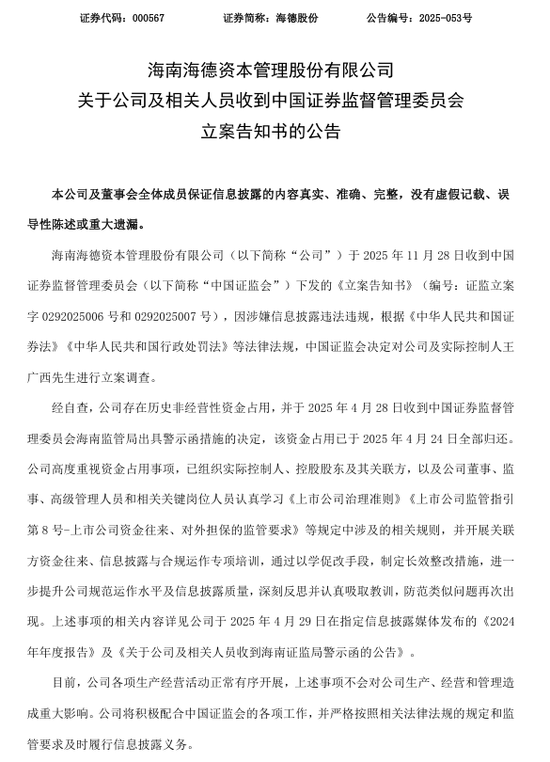
Group 1 - Multiple listed companies received notices from regulatory authorities regarding suspected violations of information disclosure laws [1][4][7] - Haide Co. is under investigation by the CSRC for suspected information disclosure violations, with its actual controller Wang Guangxi being investigated [1] - Tianfeng Securities also received a notice from the CSRC for suspected information disclosure violations and illegal financing [4] Group 2 - Yuanda Intelligent received a pre-penalty notice from the Liaoning Securities Regulatory Bureau for falsely reporting sales revenue in multiple annual reports [7] - Puli Pharmaceutical, which has been delisted, received a pre-penalty notice for failing to disclose its 2024 annual report on time [10] - ST Shenhua was fined 7 million yuan for false records in its annual reports from 2018 to 2021, with the company correcting its financial data [13][14]


奥联电子股民索赔前期已有获赔后再提交立案,普利制药(300630)索赔提交立案
Xin Lang Cai Jing· 2025-11-18 05:41
Group 1 - The core issue involves investor claims against Aolian Electronics (300585) due to false statements, with ongoing legal actions being pursued by attorney Xu Feng [1][2] - Aolian Electronics received an administrative penalty from the China Securities Regulatory Commission (CSRC) for misleading statements regarding its performance in the perovskite sector, leading to a significant stock price drop of 29.92% over two trading days [1] - The stock price decline of Aolian Electronics was notably higher than the broader market, with a deviation of 28.76 percentage points from the ChiNext Index during the same period [1] Group 2 - Attorney Xu Feng indicates that investors who purchased Aolian Electronics shares between December 12, 2022, and February 21, 2023, may still initiate claims, as the statute of limitations is nearing its end [2] - The law firm is also handling claims for investors of Puli Pharmaceutical (300630), with some cases already in court and awaiting further court arrangements [2] - Puli Pharmaceutical was found to have inflated its revenue and profits through fictitious sales from 2021 to 2022, with significant overstatements in both years [3] Group 3 - Investors who bought Puli Pharmaceutical shares between April 26, 2022, and April 17, 2024, are also eligible to file claims, as per attorney Xu Feng's guidance [4] - The law firm has a history of successfully representing investors in securities fraud cases, with numerous claims currently in progress [4]
普利制药注射用卡非佐米获得美国FDA暂时性批准
Xin Lang Cai Jing· 2025-11-11 00:54
Core Viewpoint - Hainan Puli Pharmaceutical Co., Ltd. has received a temporary approval from the FDA for injectable Carfilzomib, which will become a formal approval after the patent expiration on August 27, 2033, held by Onyx Pharmaceuticals [1] Group 1 - The FDA has granted temporary approval for injectable Carfilzomib to Hainan Puli Pharmaceutical [1] - The formal approval will be contingent upon the expiration of patent US9493582 on August 27, 2033 [1] - Upon patent expiration, the company will be eligible to sell injectable Carfilzomib in the United States [1]
海南药企在第十一批全国药品集中采购中获丰收
Hai Nan Ri Bao· 2025-10-31 01:36
Core Insights - Hainan Province's pharmaceutical companies achieved significant success in the 11th national centralized drug procurement, with 16 companies having 23 products selected, accounting for 36% of the total 55 products [2][3] Group 1: Procurement Results - A total of 16 pharmaceutical companies from Hainan have 23 products (20 varieties) proposed for selection in the national centralized procurement [2] - Among the selected products, Hainan Beite Pharmaceutical Co., Ltd. has 4 products, while Hainan Puli Pharmaceutical Co., Ltd., Hainan Quanjing Pharmaceutical Co., Ltd., Hainan Rizhongtian Pharmaceutical Co., Ltd., and Hainan Sida Pharmaceutical Co., Ltd. each have 2 products selected [2] - The procurement process emphasizes principles such as maintaining clinical stability, ensuring quality, preventing excessive competition, and avoiding collusion, with multiple companies selected for each product [2] Group 2: Industry Development - The biopharmaceutical industry is undergoing a phase of technological innovation, policy adjustments, and restructuring of supply chains [3] - Hainan is leveraging its free trade port and the Boao Lecheng Pilot Zone to optimize services related to drug review, medical insurance payments, and hospital access [3] - New policies have been introduced to support high-quality development in the biopharmaceutical sector, including a funding allocation of 210 million yuan for research and development incentives [3] - In 2023, Hainan has approved 178 new drug licenses, a 24% increase year-on-year, and has achieved an 80% year-on-year increase in the number of generic drugs passing consistency evaluations [3]
A股13家退市企业牵连11家券商
2 1 Shi Ji Jing Ji Bao Dao· 2025-10-16 13:47
Core Viewpoint - The A-share market is experiencing an unprecedented wave of delistings due to major violations, with a record number of companies forced to delist as regulatory scrutiny intensifies [1][6][10] Group 1: Delisting Trends - As of October 15, 2023, 13 companies have triggered mandatory delisting indicators due to major violations, marking a historical high [6][10] - Among these, 8 companies have already been delisted, including notable cases like Zhuolang Technology and Dongfang Group [6][10] - The delisting wave has highlighted the role of investment banks as gatekeepers, with 11 brokerage firms involved in the delisted companies [1][6] Group 2: Investment Banks' Responsibilities - Many problematic companies frequently changed their investment banks during periods of financial misconduct, complicating accountability [2][10] - Most involved investment banks issued "no objection" or "no issues found" reports during the supervision period, raising questions about their diligence [2][10] - The regulatory environment is pushing investment banks to reassess their responsibilities and improve their oversight practices [2][15] Group 3: Case Studies of Violations - ST Dongtong, involved in financial fraud from 2019 to 2022, had its investment bank, First Capital, implicated in fraudulent activities during a stock issuance [8][12] - Guohua Securities was the only firm to issue a risk warning regarding Jiuyou Co., while others remained silent despite ongoing fraud investigations [12][13] - Highong Data had the longest duration of fraud (2015-2023) and changed investment banks multiple times, indicating a pattern of evasion [10][11] Group 4: Regulatory Impact on Investment Banks - The shift towards stricter regulations has led to increased scrutiny of investment banks' roles, with many now enhancing their due diligence processes [15] - Investment banks are reportedly increasing their manpower and resources dedicated to ongoing supervision, reflecting a shift in focus due to regulatory pressures [15]


13家退市企业牵连11家券商,第一创业、五矿证券被重点点名
2 1 Shi Ji Jing Ji Bao Dao· 2025-10-16 07:43
Core Viewpoint - The A-share market is experiencing an unprecedented wave of delistings due to major violations, with a record number of companies forced to delist as regulatory scrutiny intensifies [1][5]. Group 1: Regulatory Environment - The new delisting regulations that came into effect at the beginning of the year have led to a historical high of 13 companies reaching the mandatory delisting criteria for major violations as of October 15 [1][5]. - The regulatory environment is becoming increasingly stringent, with the China Securities Regulatory Commission (CSRC) enforcing stricter oversight on financial fraud and other illegal activities [4][6]. Group 2: Role of Investment Banks - Eleven investment banks are under scrutiny for their roles in the delisted companies, with only two, First Capital and Wumart Securities, currently facing regulatory action [2][7]. - The complexity of the investment banks' responsibilities is highlighted by the fact that many of the involved companies frequently changed their advisory firms during periods of fraud [4][9]. Group 3: Case Studies of Delisted Companies - Notable cases include *ST Dongtong, which was involved in fraudulent activities from 2019 to 2022, leading to warnings issued to its sponsor, First Capital [7][8]. - Guandao Digital inflated its revenue by 1.465 billion yuan through fraudulent contracts and invoices, resulting in penalties for Wumart Securities, which served as its sponsor [8]. Group 4: Investment Banks' Due Diligence - Many investment banks provided "no objection" reports during the supervision periods of companies that were later found to have committed fraud, raising questions about their diligence [4][12]. - National Securities was the only firm to explicitly warn of risks associated with a client, indicating a lack of proactive risk management among other firms [12][13]. Group 5: Changes in Oversight Practices - Investment banks are reportedly increasing their efforts in due diligence, particularly during the ongoing supervision phases, in response to heightened regulatory scrutiny [15]. - Accounting firms are also enhancing their audit processes, adding independent review steps and increasing personnel to ensure thorough examinations [15].


A股常态化退市机制持续显效
Jin Rong Shi Bao· 2025-08-08 02:29
Core Viewpoint - The A-share market is experiencing an accelerated pace of delisting, with a significant increase in companies being warned or forced to delist due to various regulatory standards and stricter enforcement of delisting policies [1][2][3][4]. Group 1: Delisting Risks and Statistics - *ST Tianmao issued its fourth risk warning regarding potential delisting due to failure to disclose its 2024 annual report and 2025 quarterly report within the stipulated timeframe [1]. - As of August 7, 2023, 23 A-share companies have been delisted this year, with 8 due to trading-related delisting (e.g., stock price below par), 7 for compliance issues, and 3 for voluntary delisting [1][2]. - The number of delisted companies has significantly increased since 2019, with 212 companies delisted from 2019 to the present, surpassing the total from the previous 20 years [2]. Group 2: Regulatory Changes and Impact - The introduction of the "New National Nine Articles" in April 2022 has led to stricter enforcement of delisting standards, particularly for companies involved in serious violations [3][4]. - The revised stock listing rules have raised the revenue threshold for financial delisting from 1 billion to 3 billion yuan, indicating a tightening of financial health requirements for listed companies [4]. - As of now, 107 companies are under delisting risk warnings due to financial issues, and 118 companies face compliance-related delisting risks [4][5]. Group 3: Market Dynamics and Future Outlook - The trend towards a normalized delisting mechanism is expected to continue, with a focus on improving investor protection and eliminating the expectation of "shell value" [1][4]. - The new regulations are anticipated to accelerate the exit of loss-making companies from the capital market, thereby promoting structural reforms in the supply side of the economy [5].

