BGI Genomics(300676)

Search documents
华大基因:公司发布多款阿尔茨海默病血液检测产品
Zheng Quan Ri Bao Wang· 2025-10-22 09:12
Core Viewpoint - The company focuses on cognitive impairment diseases, particularly Alzheimer's disease, and has launched multiple blood testing products for Alzheimer's detection, integrating genetic testing for risk assessment and diagnosis [1] Company Summary - The company has developed a multi-dimensional testing solution that includes Alzheimer's blood tests and APOE gene risk assessments, aimed at risk evaluation, differential diagnosis, and medication guidance [1] - The increasing proportion of elderly population in the country is expected to drive the demand for chronic disease management, which will further enhance the need for genetic testing in personalized chronic disease management and risk warning [1] Industry Summary - The demand for chronic disease management is on the rise due to demographic changes, particularly the aging population, which is likely to boost the growth of genetic testing services [1]

华大基因:二级市场股价受资本市场环境等诸多因素的影响
Zheng Quan Ri Bao Zhi Sheng· 2025-10-22 09:11
Core Viewpoint - BGI Genomics stated on October 22 that its stock price in the secondary market is influenced by various factors including the capital market environment, macroeconomic conditions, and investor expectations [1] Group 1 - The company aims to continuously improve operational efficiency and management levels [1] - BGI Genomics is committed to solid business operations to enhance company performance [1] - The company strives to provide returns to its investors [1]
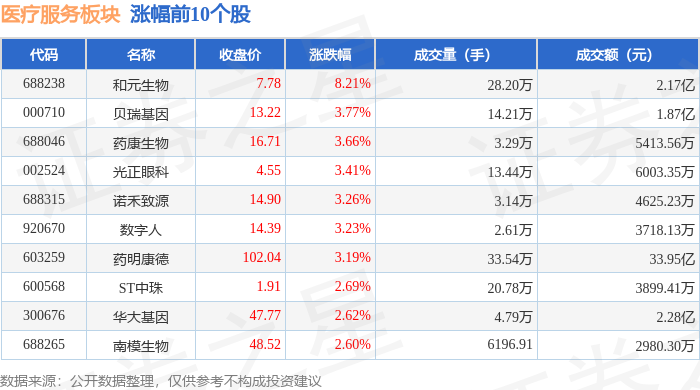
医疗服务板块10月21日涨1.53%,和元生物领涨,主力资金净流入2.5亿元
Zheng Xing Xing Ye Ri Bao· 2025-10-21 08:30
Core Insights - The medical services sector experienced a rise of 1.53% on October 21, with He Yuan Biological leading the gains [1] - The Shanghai Composite Index closed at 3916.33, up 1.36%, while the Shenzhen Component Index closed at 13077.32, up 2.06% [1] Medical Services Sector Performance - He Yuan Biological (688238) closed at 7.78, with an increase of 8.21% and a trading volume of 282,000 shares, amounting to 217 million yuan [1] - Other notable performers included Bei Rui Gene (000710) with a closing price of 13.22, up 3.77%, and Yao Kang Biological (688046) at 16.71, up 3.66% [1] - The sector saw a total net inflow of 250 million yuan from main funds, while retail investors experienced a net outflow of approximately 74 million yuan [2] Fund Flow Analysis - Major net inflows were observed in companies like Yao Ming Kang De (603259) with 353 million yuan, while retail investors showed significant outflows [3] - The top three companies by main fund inflow were Yao Ming Kang De (603259), Kang Long Hua Cheng (300759), and Hao Yuan Medical (688131) [3] - Retail investors showed a negative trend in several companies, indicating a cautious sentiment in the market [3]


2025年中国蛋白质组学科研服务行业产业链、市场规模、竞争格局及发展趋势研判:市场份额较集中,应用场景不断扩大,市场规模持续增长[图]
Chan Ye Xin Xi Wang· 2025-10-15 01:34
Core Insights - The proteomics research service industry in China is experiencing significant growth, with the market size projected to increase from 437 million yuan in 2019 to 1.822 billion yuan in 2024, and expected to reach 2.26 billion yuan by 2025, indicating a robust expansion trend [1][4][12] Industry Definition and Process - Proteomics is a biological science that studies the composition and changes of proteins in cells, tissues, or organisms. The main processes of proteomics analysis include protein extraction and purification, enzymatic digestion into smaller peptides, identification and quantification using mass spectrometry, and bioinformatics analysis [2][4] Industry Development Status - The application potential of proteomics technology spans basic scientific research, clinical translation, clinical diagnosis, and new drug development. The rapid growth in national investment in life sciences, basic medicine, and agricultural sciences has led to an increase in the types of technologies, customer types, and the number of customers in the proteomics research service sector [4][12] Industry Value Chain - The proteomics market has developed a complete value chain that includes upstream suppliers of mass spectrometry instruments and reagents, midstream proteomics service companies, and downstream end customers such as research institutions, universities, and hospitals [6][12] Competitive Landscape - The market share in China's proteomics research service industry is relatively concentrated, with the top five companies (CR5) holding 58.8% of the market. The leading companies include Jingjie Biotechnology, Zhongke New Life, BGI, Novogene, and Ouyi Biomedical, with respective market shares of 25.0%, 13.9%, 11.2%, 5.1%, and 3.6% [7][8] Key Companies - BGI focuses on providing research services and precision medicine solutions through multi-omics big data technologies, including gene testing and mass spectrometry analysis. Their DIA protein quantification analysis employs data-independent acquisition methods [8][10] - Jingjie Biotechnology specializes in proteomics technology services and antibody reagent products, serving clients in life sciences research, drug development, and clinical diagnostics. In 2022, they reported 836 clients and revenue of 195 million yuan [10][11] Industry Development Trends - The proteomics research service sector is expected to continue its rapid growth, driven by advancements in mass spectrometry and bioinformatics. The market is still in a relatively early stage compared to Europe and the US, with increasing applications in life sciences and medicine [12] - The trend in proteomics analysis is moving towards requiring less sample volume and achieving faster identification of a greater variety of proteins, with high-depth, high-throughput, and high-sensitivity analyses being key goals [12]


带着40亿估值二次递表,安诺优达能否成为“港市华大基因”?
Zhi Tong Cai Jing· 2025-10-10 02:36
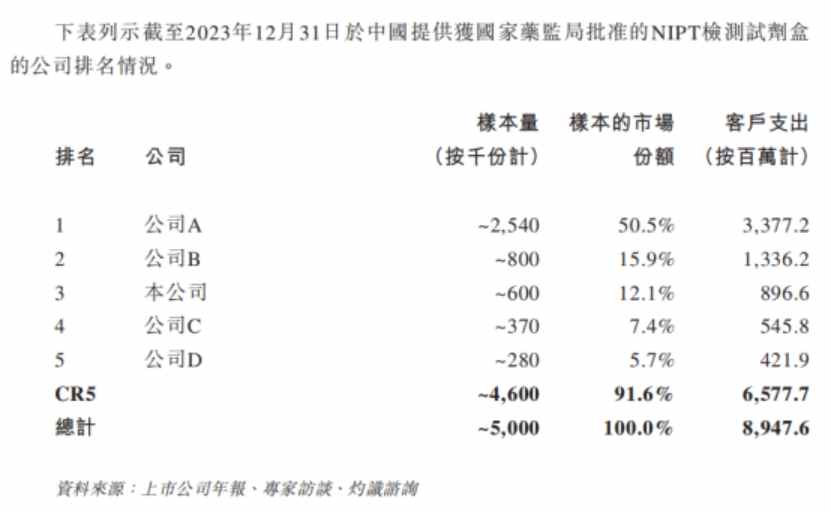
Core Viewpoint - The NIPT (Non-Invasive Prenatal Testing) market in China is experiencing significant challenges, with leading companies BGI and Berry Genomics reporting substantial revenue declines due to structural market changes and centralized procurement policies, leading to a new phase of competition in a previously high-growth sector [1][4]. Group 1: Company Performance - BGI reported a 12.82% year-on-year decline in revenue and a net loss for the first time after excluding non-recurring items [1]. - Berry Genomics experienced an 18.91% revenue decline and recorded a net loss exceeding 27 million yuan [1]. - AnuoYuda, the third-largest player in the NIPT market, has also faced challenges, with projected revenues of 251 million yuan, 270 million yuan, and 329 million yuan for 2022, 2023, and 2024 respectively, primarily driven by NIPT and CNV-seq kit sales [3][7]. Group 2: Market Dynamics - The NIPT market has shifted from a high-growth phase to a more competitive environment due to structural changes and centralized procurement, which has significantly reduced prices [1][4]. - The price of NIPT tests has dropped by over 70% due to policies implemented in regions like Beijing and Jiangsu, with the maximum effective bid set at 345 yuan [4]. - The penetration rate of NIPT kits among pregnant women in China has increased from approximately 15.4% in 2018 to about 48.8% in 2023, with expectations to reach 97.8% by 2033 [2]. Group 3: Competitive Landscape - AnuoYuda holds a market share of 12.1%, ranking third among companies providing NIPT kits, with the top three companies holding a combined market share of 78.5% [5]. - The competitive landscape is characterized by high barriers to entry, as typically only one manufacturer is selected to provide services in a given region, making it difficult for AnuoYuda to quickly increase its market share [5]. Group 4: Financial Health - AnuoYuda's financial performance shows a trend of increasing revenue but persistent net losses, with cumulative losses of approximately 462 million yuan over three and a half years [7]. - The company reported revenues of 435 million yuan, 475 million yuan, 518 million yuan, and 269 million yuan for the years 2022, 2023, 2024, and the first half of 2025, respectively, with corresponding net losses [7][8]. - AnuoYuda's cash flow from operating activities has shown significant volatility, with net outflows of 26 million yuan and 55 million yuan in 2023 and the first half of 2025, respectively [8].
新股前瞻|带着40亿估值二次递表,安诺优达能否成为“港市华大基因”?
智通财经网· 2025-10-10 02:32
Core Insights - The NIPT (Non-Invasive Prenatal Testing) market in China is experiencing significant structural changes, leading to a decline in revenue for major players like BGI and Berry Genomics, with BGI reporting a 12.82% decrease in revenue and Berry Genomics a 18.91% decrease, resulting in net losses of over 27 million yuan for Berry Genomics [1][3] - Annoroad, the third-largest player in the NIPT market, has submitted a second application for listing on the Hong Kong Stock Exchange amid these industry challenges [1][2] Company Overview - Annoroad specializes in IVD (In Vitro Diagnostic) medical devices and molecular diagnostics, with approximately 60% of its revenue derived from clinical sequencing solutions, including NIPT and CNV-seq kits [2][3] - The company anticipates revenue growth from the continued adoption of its existing products, closely tied to the NIPT market's growth and competitive landscape [2] Market Dynamics - The NIPT market has seen a rise in adoption due to favorable fertility policies, with the penetration rate of NIPT kits among pregnant women increasing from about 15.4% in 2018 to approximately 48.8% in 2023, projected to reach 97.8% by 2033 [2] - However, the introduction of centralized procurement has led to significant price reductions, with prices dropping over 70%, impacting the profitability of NIPT providers [4][7] Competitive Landscape - As of the end of 2023, the market shares of the top three NIPT providers are 50.5% for Company A, 15.9% for Company B, and 12.1% for Annoroad, indicating a highly concentrated market [5][4] - Annoroad faces challenges in rapidly increasing its market share against established competitors, which may hinder its ability to achieve sustained revenue growth [5][6] Financial Performance - Annoroad's projected revenues for 2022, 2023, 2024, and the first half of 2025 are 435 million yuan, 475 million yuan, 518 million yuan, and 269 million yuan respectively, with corresponding gross margins of 31.7%, 32.6%, 35.4%, and 33.9% [7][8] - Despite revenue growth, Annoroad has reported net losses of 67 million yuan, 240 million yuan, 126 million yuan, and 29 million yuan over the same periods, primarily due to high operational expenses and financial costs [7][8] Valuation Considerations - Annoroad's post-financing valuation stands at approximately 4.049 billion yuan, but achieving this valuation in the public market will require solid fundamental support [6][8] - Given the current financial performance and market conditions, Annoroad's valuation may be challenged, especially when compared to peers like BGI and Berry Genomics, which have PB ratios of 2.27 and 2.83 respectively [8]
研判2025!中国基因编辑行业发展历程、产业链及市场规模分析:行业高速发展,技术前沿性凸显[图]
Chan Ye Xin Xi Wang· 2025-10-07 01:15
Core Insights - The Chinese gene editing industry is experiencing rapid growth, with a projected market size of approximately 2.741 billion yuan in 2024, representing a year-on-year increase of 33.19% [1][8] - Gene editing technology has broad application prospects in both medical and agricultural fields, including the treatment of genetic diseases and the cultivation of high-yield, disease-resistant crops [1][8] Industry Overview - Gene editing is a technology that allows precise modifications to the genome of organisms, utilizing tools such as CRISPR-Cas systems and specific nucleases [2][6] - The technology has evolved through various methods, including ZFNs, TALENs, and CRISPR, and is widely applied in genetic disease treatment, agricultural breeding, and cancer therapy [2][6] Industry Development History - The Chinese gene editing industry began in the 1970s, with significant milestones including the emergence of transgenic crops in the 1990s and the rise of CRISPR-Cas9 technology in the 2010s [6][7] - The industry entered a period of rapid commercialization starting in 2021, with the first gene editing therapies entering clinical trials and significant advancements in agricultural applications [7] Industry Value Chain - The upstream of the gene editing industry includes tools and patent technologies, raw materials, and laboratory equipment, while the midstream focuses on product development and technical services [8] - The downstream applications span medical, agricultural, and industrial sectors, highlighting the diverse utility of gene editing technologies [8] Market Size - The market size of the Chinese gene editing industry is expected to reach approximately 2.741 billion yuan in 2024, with a growth rate of 33.19% year-on-year [1][9] Key Companies' Performance - Major players in the industry include BGI Genomics, Berry Genomics, and others, focusing on CRISPR-Cas9 therapies for genetic diseases and expanding into cancer and neurological disease treatments [10] - Shanghai BGI has achieved significant breakthroughs in treating β-thalassemia, while Guangzhou Ruifeng has developed gene editing drugs that have shown high efficacy in clinical trials [10][11] Industry Development Trends 1. Continuous technological innovation is driving breakthroughs in precision medicine, with advancements in CRISPR technology and AI integration enhancing editing efficiency and accuracy [12] 2. The application of gene editing is expanding across various fields, including agriculture and industrial applications, with significant improvements in crop yields and production processes [13][14] 3. Strong policy support and capital investment are fostering a robust industry ecosystem, with the Chinese government prioritizing gene editing in its biotechnological development plans [15]


Nature Biotechnology:华大发布DNA合成新技术,助力合成生物产业迈向新时代
生物世界· 2025-10-01 10:50
Core Viewpoint - The article discusses a groundbreaking DNA synthesis technology called mMPS, developed by BGI Life Sciences Research Institute, which overcomes traditional limitations in DNA synthesis efficiency, cost, and coverage, marking a significant advancement in synthetic biology [3][4][6]. Group 1: Technology Overview - mMPS technology utilizes a microchip-based approach, dividing a chip into independent millimeter-scale microchips, each synthesizing a single short DNA strand, allowing for identity tracking and sorting of DNA fragments [7][9]. - The technology enables a systematic breakthrough in synthesis throughput, yield, and quality, addressing the challenges of traditional high-throughput DNA synthesis methods [3][10]. Group 2: Performance and Applications - mMPS technology has demonstrated superior performance in complex sequence handling, high GC content regions, and repetitive sequences, providing reliable support for protein stability research and disease mutation mechanism analysis [10]. - The technology significantly reduces the time for constructing mutation libraries from weeks to days, enhancing the discovery and optimization process of antibody drugs [12]. - In the field of clinical diagnostics, mMPS can synthesize thousands of primer probes at once, reducing costs by over three times and enabling upgrades in multi-target detection capabilities [13]. Group 3: Industrial Impact - The mMPS technology is expected to transform DNA synthesis from a laboratory service into a foundational infrastructure for biomanufacturing, driving efficiency revolutions in pharmaceuticals and diagnostics [12]. - The cost of single-base synthesis is reduced by approximately 70% compared to traditional methods, facilitating large-scale industrial applications [12]. - The modular and automated characteristics of mMPS technology lay the groundwork for the emergence of "DNA synthesis as a service" platforms, integrating AI-driven design and automated synthesis [15]. Group 4: Future Prospects - The mMPS technology is anticipated to become the core engine of next-generation industrial-grade DNA synthesis factories, enabling the design, construction, and testing of complex biological systems [18]. - Experts believe that the integration of AI and automation with mMPS will drive deep integration and industrialization of synthetic biology in biomanufacturing and healthcare [18].

华大基因(300676) - 关于持股5%以上股东部分股份解除质押及再质押的公告
2025-09-30 08:14
关于持股 5%以上股东部分股份解除质押及再质押的公告 本公司及董事会全体成员保证信息披露的内容真实、准确、完整,没有虚假记 载、误导性陈述或重大遗漏。 深圳华大基因股份有限公司(以下简称公司或上市公司)近日收到公司持股5% 以上股东深圳生华投资企业(有限合伙)(以下简称生华投资)的通知,获悉生华 投资将其持有的部分公司股份办理了解除质押及再质押,相应的解除质押及再质押 登记手续已通过中国证券登记结算有限责任公司深圳分公司办理完毕。现将具体内 容公告如下: 一、股东股份解除质押及再质押的基本情况 | | 是否为控股 股东或第一 | 本次解除质 | 占其所持股 | 占公司 | 质押起始 | 质押解除日 | | | --- | --- | --- | --- | --- | --- | --- | --- | | 股东名称 | | 押股份数量 | | 总股本 | | | 质权人 | | | 大股东及其 | | 份比例 | | 日期 | 期 | | | | 一致行动人 | (股) | | 比例 | | | | | 深圳生华投资 | | | | | | | 中信银行股份 | | 企业(有限合 | 否 | 8,650,0 ...
华大基因进军银发经济,以“检测+AI”解码健康新范式
Jing Ji Guan Cha Wang· 2025-09-26 03:27
Core Insights - The Chinese gene testing industry is experiencing a shift from reproductive health to the "silver economy," driven by structural changes in the newborn population and an increasing elderly demographic [2][3] - BGI Genomics is strategically pivoting towards the silver economy, addressing a significant market gap in health management for the aging population [2][4] Market Size and Demand - By the end of 2024, the population aged 60 and above in China is projected to reach 310 million, with the silver economy market size estimated at approximately 7 trillion yuan in 2023, potentially growing to 19 trillion yuan by 2035 [3] - The focus of this market is shifting from traditional elder care to proactive health management, driven by a new generation of elderly consumers who are tech-savvy and financially capable [4][5] Structural Discrepancies in Healthcare - The traditional healthcare system has been centered on treatment rather than prevention, which is inadequate for managing chronic diseases prevalent among the elderly [5][6] - There is a growing demand for early risk warning systems and personalized management plans to enhance the quality of life for the aging population [5][7] Consumer Behavior - The market's payers include not only the elderly but also their adult children, who are increasingly purchasing digital health management services to care for their parents from a distance [6][7] BGI Genomics' Strategy - BGI Genomics is implementing a dual approach of "precise chronic disease management products" and "intelligent health management tools" to support proactive health management [9][14] - The company is focusing on high-incidence diseases among the elderly, such as Alzheimer's and cardiovascular diseases, with innovative testing solutions [10][11] Health Management Tools - The "i99 Smart Health" system by BGI Genomics serves as a health data translator and personal health advisor, providing understandable health management reports and actionable recommendations [12][13] - This system leverages extensive databases and AI capabilities to ensure that health advice is data-driven and scientifically supported [13][14] Overall Objective - The ultimate goal of BGI Genomics' strategy is to empower the elderly and their families with control over health management, transitioning from reactive to proactive care [16]