
BGI Genomics(300676)

Search documents
华大基因(300676.SZ):暂时没有回购股份计划
Ge Long Hui· 2025-12-12 15:53
格隆汇12月12日丨华大基因(300676.SZ)在投资者互动平台表示,暂时没有回购股份计划。 ...
华大基因:关于控股股东部分股份解除质押的公告
Zheng Quan Ri Bao· 2025-12-12 12:11
证券日报网讯 12月12日晚间,华大基因发布公告称,公司近日接到公司控股股东深圳华大基因科技有 限公司(简称"华大控股")的通知,获悉华大控股将其持有的部分公司股份办理了解除质押,本次解除 质押股份数量合计14,670,000股。 (文章来源:证券日报) ...

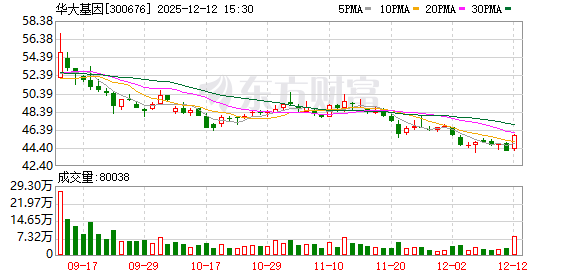
12月12日生物经济(970038)指数涨0.81%,成份股华大基因(300676)领涨
Sou Hu Cai Jing· 2025-12-12 11:26
证券之星消息,12月12日,生物经济(970038)指数报收于2103.93点,涨0.81%,成交172.47亿元,换 手率1.13%。当日该指数成份股中,上涨的有27家,华大基因以3.86%的涨幅领涨,下跌的有20家,福 瑞股份以3.23%的跌幅领跌。 生物经济(970038)指数十大成份股详情如下: 近10日内生物经济(970038)指数成份股做了调整,新纳入了9只股票,剔除了9只股票。 以上内容为证券之星据公开信息整理,由AI算法生成(网信算备310104345710301240019号),不构成 投资建议。 资金流向方面,生物经济(970038)指数成份股当日主力资金净流入合计1.38亿元,游资资金净流出合 计4.0亿元,散户资金净流入合计2.62亿元。成份股资金流向详情见下表: ...

AI医疗板块12月12日涨0.05%,华大基因领涨,主力资金净流出1.16亿元
Sou Hu Cai Jing· 2025-12-12 09:45
证券之星消息,12月12日AI医疗板块较上一交易日上涨0.05%,华大基因领涨。当日上证指数报收于 3889.35,上涨0.41%。深证成指报收于13258.33,上涨0.84%。AI医疗板块个股涨跌见下表: 以上内容为证券之星据公开信息整理,由AI算法生成(网信算备310104345710301240019号),不构成 投资建议。 从资金流向上来看,当日AI医疗板块主力资金净流出1.16亿元,游资资金净流入2467.32万元,散户资 金净流入9132.73万元。AI医疗板块个股资金流向见下表: ...
华大基因:控股股东华大控股解除质押1467万公司股份
Xin Lang Cai Jing· 2025-12-12 09:29
华大基因公告,控股股东华大控股解除质押1467万公司股份,占其所持股份比例11.78%,占公司总股 本比例3.51%。 ...
精准医疗板块12月12日涨0.53%,华大智造领涨,主力资金净流出10.22亿元
Sou Hu Cai Jing· 2025-12-12 09:21
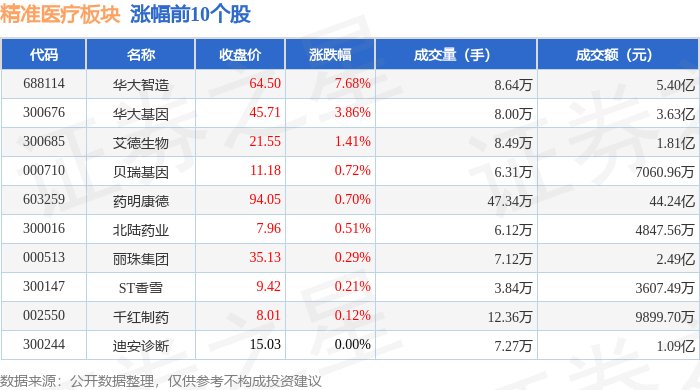
Core Insights - The precision medicine sector experienced a slight increase of 0.53% on December 12, with BGI Genomics leading the gains [1] - The Shanghai Composite Index closed at 3889.35, up 0.41%, while the Shenzhen Component Index closed at 13258.33, up 0.84% [1] Stock Performance - BGI Genomics (688114) saw a closing price of 64.50, with a significant increase of 7.68% and a trading volume of 86,400 shares, resulting in a transaction value of 540 million yuan [1] - Other notable performers included: - BGI (300676) with a closing price of 45.71, up 3.86% [1] - Wondfo Biotech (300685) at 21.55, up 1.41% [1] - Berry Genomics (000710) at 11.18, up 0.72% [1] - WuXi AppTec (603259) at 94.05, up 0.70% [1] Capital Flow - The precision medicine sector saw a net outflow of 1.022 billion yuan from institutional investors, while retail investors contributed a net inflow of 586 million yuan [2] - The capital flow for specific stocks included: - BGI Genomics (688114) had a net inflow of 22.93 million yuan from institutional investors [3] - Anke Bio (300009) experienced a net inflow of 3.38 million yuan from institutional investors [3] - However, ST Xiangxue (300147) faced a net outflow of 2.93 million yuan from institutional investors [3]



华大基因(300676) - 关于控股股东部分股份解除质押的公告
2025-12-12 09:18
证券代码:300676 证券简称:华大基因 公告编号:2025-070 深圳华大基因股份有限公司 关于控股股东部分股份解除质押的公告 本公司及董事会全体成员保证信息披露的内容真实、准确、完整,没有虚假记 载、误导性陈述或重大遗漏。 深圳华大基因股份有限公司(以下简称公司或上市公司)近日接到公司控股股 东深圳华大基因科技有限公司(以下简称华大控股)的通知,获悉华大控股将其持 有的部分公司股份办理了解除质押。现将具体情况公告如下: 三、控股股东及其一致行动人股份质押情况说明 | 股东名称 | 是否为控股 股东或第一 | 本次解除质 押股份数量 | 占其所持股 | 占公司 总股本 | 质押起始 | 质押解除日 | 质权人 | | --- | --- | --- | --- | --- | --- | --- | --- | | | 大股东及其 | | 份比例 | | 日期 | 期 | | | | 一致行动人 | (股) | | 比例 | | | 上海浦东发展 | | 科技有限公司 | 是 | 4,720,000 4,500,000 | 3.79% 3.61% | 1.13% 1.08% | 2022/12/23 2 ...
2025年中国肝癌早筛行业发展背景、市场现状及未来趋势分析:肝癌早筛市场呈快速增长态势,肝癌基因甲基化检测为研发热点之一[图]
Chan Ye Xin Xi Wang· 2025-12-12 01:09
Core Insights - Early screening for liver cancer is crucial for early detection and treatment, significantly improving cure rates, prognosis, and reducing treatment costs [1][2][3] Group 1: Importance of Early Screening - Early detection of liver cancer can greatly increase the cure rate through surgical removal and ablation treatments [2] - Patients diagnosed with early-stage liver cancer experience improved quality of life and survival rates [2] - Early treatment is less complex and more cost-effective, alleviating the financial burden on patients and families [2] Group 2: Current Status of Liver Cancer Screening - In 2022, China reported approximately 367,700 new liver cancer cases, with an incidence rate of 15.03 per 100,000 and a mortality rate of 12.59 per 100,000, ranking fourth and second among all cancers respectively [3] - 70% to 80% of liver cancer patients are diagnosed at advanced stages, with over 95% of symptomatic patients already in late stages [3] - The primary screening methods currently used include serum alpha-fetoprotein (AFP) testing and ultrasound, which have significant limitations [10] Group 3: Challenges in Early Diagnosis - Approximately 30% to 40% of early-stage liver cancer patients do not show elevated AFP levels, and ultrasound has difficulty identifying small lesions [10] - There is a pressing need for more sensitive detection methods to improve liver cancer prevention and treatment outcomes [10] Group 4: Development of Screening Technologies - Genetic methylation testing for liver cancer has shown high sensitivity and specificity and is recommended in multiple clinical guidelines for early screening and diagnosis [10][11] - Several companies, including Guangzhou Youze Biotechnology and Wuhan Aimesen Life Technology, have developed and received regulatory approval for liver cancer methylation detection products [11] Group 5: Market Growth and Future Trends - The liver cancer early screening market in China is projected to reach 197 million yuan in 2024, with a year-on-year growth of 38.1%, and is expected to grow to 291 million yuan in 2025 [8] - By 2030, the liver cancer early screening market could exceed 20 billion yuan, driven by increased public health awareness and advancements in screening technologies [12] - The integration of digital technologies in healthcare is anticipated to enhance the effectiveness of liver cancer early screening and enable precise management [12]


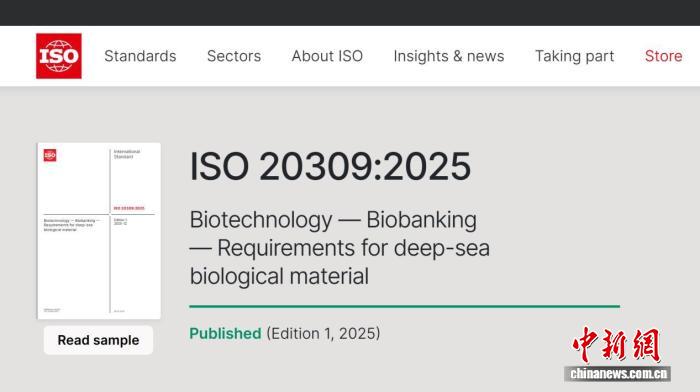
中国深海生物样本保藏技术方案成国际标准
Zhong Guo Xin Wen Wang· 2025-12-10 13:22
Core Viewpoint - The release of the international standard "ISO20309:2025 Biotechnology— Biobanking— Requirements for deep-sea biological material" marks a significant achievement for China, transitioning from "Chinese standards" to "global benchmarks" in deep-sea biological sample preservation technology [1][3]. Group 1 - The international standard was developed by BGI Group in collaboration with multiple institutions and was officially released on December 9 [1][3]. - The project team also published the national standard GB/T46753-2025 for deep-sea biological sample collection, processing, and preservation, which was approved on December 2 [3]. - The initiative began in December 2022 when the team applied for a project with the International Organization for Standardization (ISO) [3]. Group 2 - The collaboration involved institutions such as the Chinese Academy of Sciences, Shanghai Jiao Tong University, and the Yellow Sea Fisheries Research Institute [3]. - The standard addresses key technical challenges in the preservation of deep-sea biological samples, providing a unified scientific basis for standardized operations and management globally [3]. - BGI has been focusing on deep-sea research since 2018, aligning its platform and technological advantages with national deep-sea strategies, and has participated in significant oceanographic expeditions [3].
芯路径,芯力量——广东种业振兴“五年见成效”创新实践
Nan Fang Nong Cun Bao· 2025-12-10 07:04
Core Viewpoint - Guangdong's seed industry has made significant progress over the past five years, focusing on innovation and achieving key milestones in seed quality and agricultural productivity [2][6][8]. Group 1: Achievements and Innovations - Guangdong has implemented the "Yueqiang Seed Core" project, achieving notable results in seed resource protection, innovation, and market purification [4][5][28]. - The province has developed 36 varieties of super rice, accounting for 28% of the national total, and has received multiple awards for quality rice varieties [22][23]. - Guangdong's agricultural sector has seen the emergence of high-quality varieties, such as the "Hua Hang Xiang Yin Zhen" super rice, which is expected to yield 1,200 pounds per acre [20][21]. Group 2: Strategic Goals and Future Plans - The province aims to achieve significant breakthroughs in the seed industry by 2035, focusing on innovation and industry leadership [12][15]. - Guangdong plans to enhance its seed resource management, strengthen breeding technology, and promote the integration of enterprises and research institutions [108][110]. Group 3: Economic Impact and Industry Growth - The seed industry in Guangdong has contributed to substantial economic growth, with individual seed varieties generating significant revenue, such as a single seed variety contributing 240 million yuan [82]. - The province's agricultural enterprises, such as Wens Food Group and Haida Group, are leading the industry with innovative breeding systems and substantial market shares [70][68]. Group 4: Regulatory and Support Framework - Guangdong has strengthened intellectual property protection for seed varieties, ensuring the safety and integrity of agricultural production [101][103]. - The province has established a seed development fund of 476.1 million yuan to support industry growth and attract social capital [65].


