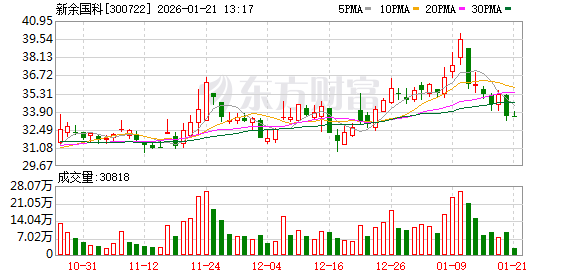
JIANGXI XINYU GUOKE TECHNOLOGY CO.(300722)

Search documents
新余国科:截至2026年1月30日股东持有人数28615户
Zheng Quan Ri Bao Wang· 2026-02-03 11:11
Group 1 - The core point of the article is that Xinyu Guoke (300722) reported the number of shareholders as of January 30, 2026, which stands at 28,615 households [1]

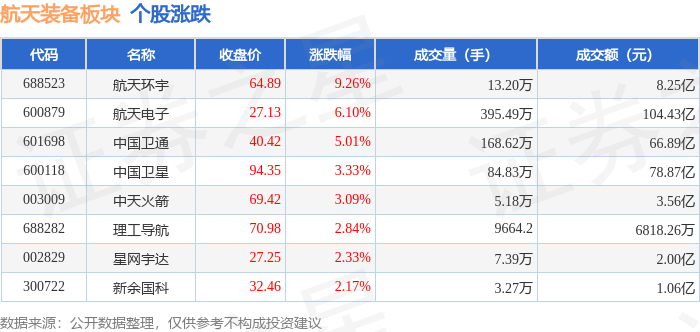
航天装备板块2月3日涨4.67%,航天环宇领涨,主力资金净流入12.07亿元
Zheng Xing Xing Ye Ri Bao· 2026-02-03 09:10
Group 1 - The aerospace equipment sector increased by 4.67% on February 3, with Aerospace Hanyu leading the gains [1] - The Shanghai Composite Index closed at 4067.74, up 1.29%, while the Shenzhen Component Index closed at 14127.1, up 2.19% [1] - Aerospace Hanyu's stock price rose by 9.26% to 64.89, with a trading volume of 132,000 shares and a transaction value of 825 million [1] Group 2 - The main capital inflow in the aerospace equipment sector was 1.207 billion, while retail investors experienced a net outflow of 1.019 billion [1] - The table shows that Aerospace Hanyu had a main capital net inflow of 75.72 million, but retail investors had a net outflow of 26.61 million [2] - Aerospace Electronics saw a main capital net inflow of 378 million, with retail investors experiencing a net outflow of 287 million [2]





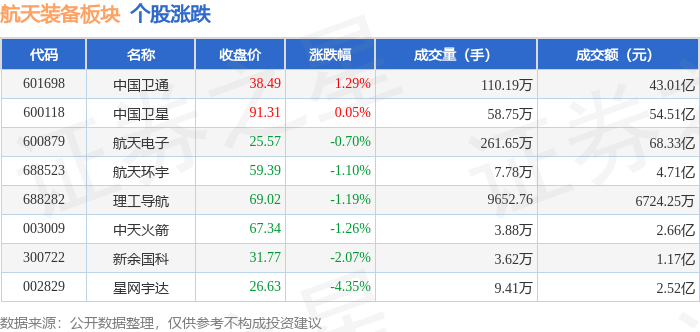
航天装备板块2月2日涨0.23%,中国卫通领涨,主力资金净流出1.4亿元
Zheng Xing Xing Ye Ri Bao· 2026-02-02 09:15
Group 1 - The aerospace equipment sector increased by 0.23% on February 2, with China Satellite leading the gains [1] - The Shanghai Composite Index closed at 4015.75, down 2.48%, while the Shenzhen Component Index closed at 13824.35, down 2.69% [1] - Key stocks in the aerospace equipment sector showed mixed performance, with China Telecom rising by 1.29% and StarNet falling by 4.35% [1] Group 2 - The net capital outflow from the aerospace equipment sector was 140 million yuan, while retail investors saw a net outflow of 216 million yuan [1] - The net inflow from speculative funds was 356 million yuan, indicating a shift in investor sentiment [1] - Detailed capital flow data shows that China Satellite had a net inflow of 41.55 million yuan from speculative funds, while StarNet experienced a net outflow of 6.64 million yuan [2]
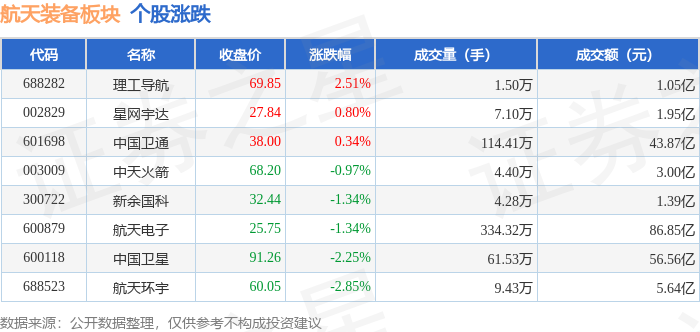
航天装备板块1月30日跌0.84%,航天环宇领跌,主力资金净流出6.61亿元
Zheng Xing Xing Ye Ri Bao· 2026-01-30 09:00
Market Overview - The aerospace equipment sector experienced a decline of 0.84% on January 30, with Aerospace HuanYu leading the drop [1] - The Shanghai Composite Index closed at 4117.95, down 0.96%, while the Shenzhen Component Index closed at 14205.89, down 0.66% [1] Stock Performance - Key stocks in the aerospace equipment sector showed varied performance: - Ligong Navigation (688282) closed at 69.85, up 2.51% with a trading volume of 15,000 shares and a turnover of 105 million yuan [1] - Xingwang Yuda (002829) closed at 27.84, up 0.80% with a trading volume of 71,000 shares and a turnover of 195 million yuan [1] - China Satellite (600118) closed at 91.26, down 2.25% with a trading volume of 615,300 shares and a turnover of 5.656 billion yuan [1] - Aerospace Electronics (600879) closed at 25.75, down 1.34% with a trading volume of 3,343,200 shares and a turnover of 8.685 billion yuan [1] Capital Flow - The aerospace equipment sector saw a net outflow of 661 million yuan from institutional investors, while retail investors contributed a net inflow of 453 million yuan [1] - Detailed capital flow for key stocks includes: - China Satellite (600118) had a net outflow of 290 million yuan from institutional investors and a net inflow of 205 million yuan from retail investors [2] - Aerospace HuanYu (688523) experienced a significant net outflow of 68.81 million yuan from institutional investors, with a net inflow of 60.56 million yuan from retail investors [2] - Ligong Navigation (688282) had a net inflow of 11.93 million yuan from institutional investors, but a net outflow from retail investors [2]

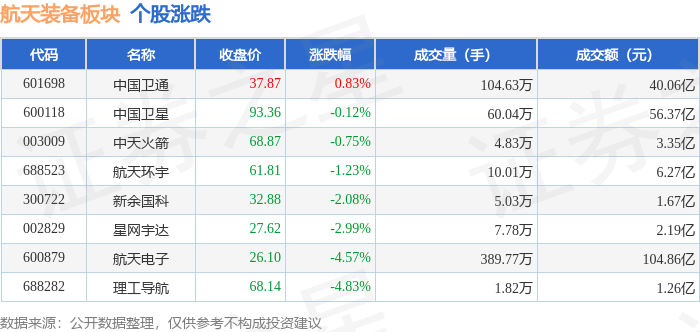
航天装备板块1月29日跌0.94%,理工导航领跌,主力资金净流出12.49亿元
Zheng Xing Xing Ye Ri Bao· 2026-01-29 09:03
Group 1 - The aerospace equipment sector experienced a decline of 0.94% on January 29, with the leading stock being Ligong Navigation [1] - The Shanghai Composite Index closed at 4157.98, up 0.16%, while the Shenzhen Component Index closed at 14300.08, down 0.3% [1] - Major stocks in the aerospace equipment sector showed varied performance, with China Satellite down 0.12% and Ligong Navigation down 4.83% [1] Group 2 - The net outflow of main funds in the aerospace equipment sector was 1.249 billion yuan, while retail investors saw a net inflow of 1.113 billion yuan [1] - Detailed fund flow data indicates that Ligong Navigation had a significant net outflow of 23.45 million yuan from main funds, but a net inflow of 18.127 million yuan from retail investors [2] - China Satellite experienced a net outflow of 116 million yuan from main funds, with a smaller net inflow of 15.979 million yuan from retail investors [2]
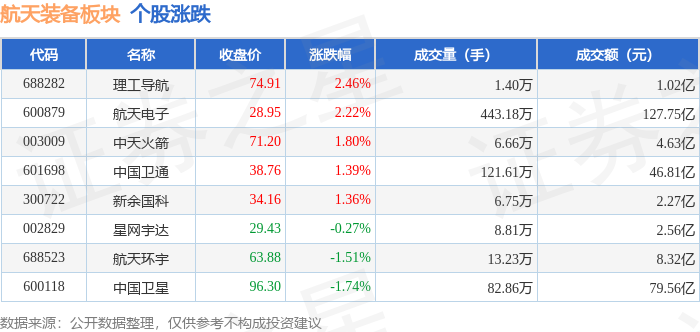
航天装备板块1月27日涨0.66%,理工导航领涨,主力资金净流出10.25亿元
Zheng Xing Xing Ye Ri Bao· 2026-01-27 08:56
Group 1 - The aerospace equipment sector increased by 0.66% on January 27, with LIGONG Navigation leading the gains [1] - The Shanghai Composite Index closed at 4139.9, up 0.18%, while the Shenzhen Component Index closed at 14329.91, up 0.09% [1] - Key stocks in the aerospace equipment sector showed varied performance, with LIGONG Navigation at 74.91 (+2.46%), Aerospace Electronics at 28.95 (+2.22%), and China Satellite at 38.76 (+1.39%) [1] Group 2 - The net outflow of main funds in the aerospace equipment sector was 1.025 billion yuan, while retail investors saw a net inflow of 790 million yuan [1] - Specific stock fund flows indicated significant outflows for stocks like Aerospace Electronics (-605 million yuan) and China Satellite (-657 million yuan), while retail inflows were notable for LIGONG Navigation (+775 million yuan) [1] Group 3 - The Aerospace ETF (product code: 159227) tracked the National Aerospace Industry Index and saw a 6.64% increase over the past five days, with a net subscription of 190 million yuan [5] - The General Aviation ETF (product code: 159230) tracked the National General Aviation Industry Index, experiencing a 5.15% increase, but had a net redemption of 14.27 million yuan [6] - The Machine Tool ETF (product code: 159663) tracked the China Machine Tool Index, with a 3.98% increase and a net subscription of 1.78 million yuan [6]
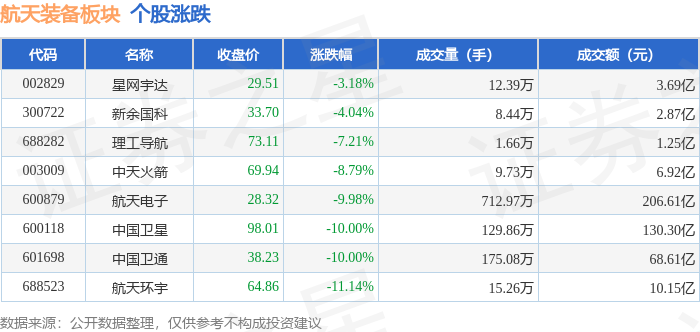
航天装备板块1月26日跌9.75%,航天环宇领跌,主力资金净流出76.77亿元
Zheng Xing Xing Ye Ri Bao· 2026-01-26 09:41
Group 1 - The aerospace equipment sector experienced a significant decline of 9.75% on January 26, with Aerospace HuanYu leading the drop [1] - The Shanghai Composite Index closed at 4132.61, down 0.09%, while the Shenzhen Component Index closed at 14316.64, down 0.85% [1] - Key stocks in the aerospace equipment sector showed notable declines, with China Satellite and Aerospace Electronics both falling by 10% [1] Group 2 - The net outflow of main funds from the aerospace equipment sector reached 7.677 billion yuan, while retail investors saw a net inflow of 4.966 billion yuan [1] - Individual stock performances indicated that Aerospace HuanYu had a net outflow of 1.42 million yuan from main funds, but a net inflow of 72.05 million yuan from retail investors [2] - China Satellite experienced a significant net outflow of 2.595 billion yuan from main funds, while retail investors contributed a net inflow of 1.231 billion yuan [2]
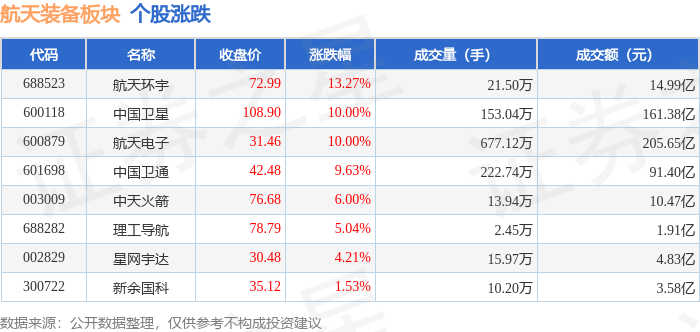
航天装备板块1月23日涨9.46%,航天环宇领涨,主力资金净流入38.33亿元
Zheng Xing Xing Ye Ri Bao· 2026-01-23 09:12
Core Viewpoint - The aerospace equipment sector experienced a significant increase of 9.46% on January 23, with Aerospace Hanyu leading the gains. The Shanghai Composite Index closed at 4136.16, up 0.33%, while the Shenzhen Component Index closed at 14439.66, up 0.79% [1]. Group 1: Stock Performance - Aerospace Hanyu (688523) closed at 72.99, with a rise of 13.27% and a trading volume of 215,000 shares [1]. - China Satellite (600118) closed at 108.90, increasing by 10.00% with a trading volume of 1,530,400 shares [1]. - Aerospace Electronics (600879) closed at 31.46, also up by 10.00%, with a trading volume of 6,771,200 shares [1]. - China Satcom (601698) closed at 42.48, rising by 9.63% with a trading volume of 2,227,400 shares [1]. - Zhongtian Rocket (003009) closed at 76.68, increasing by 6.00% with a trading volume of 139,400 shares [1]. - Other notable performances include: - Ligong Navigation (688282) at 78.79, up 5.04% [1] - StarNet Yuda (002829) at 30.48, up 4.21% [1] - Xinyu Guoke (300722) at 35.12, up 1.53% [1]. Group 2: Capital Flow - The aerospace equipment sector saw a net inflow of 3.833 billion yuan from institutional investors, while retail investors experienced a net outflow of 2.3 billion yuan [1]. - The capital flow for key stocks includes: - Aerospace Electronics (600879) with a net inflow of 1.886 billion yuan from institutional investors and a net outflow of 899.6 million yuan from retail investors [2]. - China Satellite (600118) had a net inflow of 1.483 billion yuan from institutional investors and a net outflow of 1.043 billion yuan from retail investors [2]. - China Satcom (601698) recorded a net inflow of 262 million yuan from institutional investors and a net outflow of 190 million yuan from retail investors [2]. - Zhongtian Rocket (003009) had a net inflow of 97.5 million yuan from institutional investors and a net outflow of 79.3 million yuan from retail investors [2].
航天装备板块1月22日涨5.87%,航天环宇领涨,主力资金净流入4.31亿元
Zheng Xing Xing Ye Ri Bao· 2026-01-22 09:01
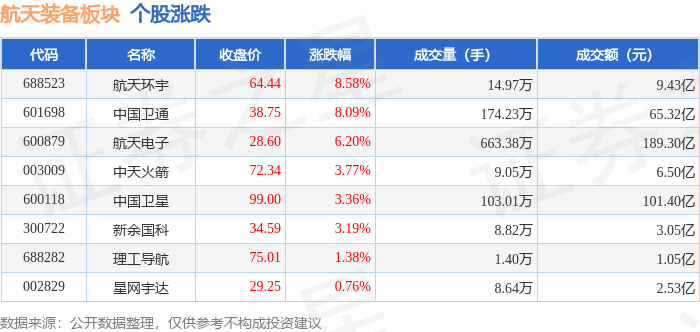
Core Viewpoint - The aerospace equipment sector experienced a significant increase of 5.87% on January 22, with Aerospace Hanyu leading the gains [1] Group 1: Market Performance - The Shanghai Composite Index closed at 4122.58, up 0.14%, while the Shenzhen Component Index closed at 14327.05, up 0.5% [1] - Key stocks in the aerospace equipment sector showed notable price increases, with Aerospace Hanyu rising by 8.58% to a closing price of 64.44 [1] Group 2: Stock Performance Details - Aerospace Hanyu (688523) had a trading volume of 149,700 shares and a transaction value of 943 million [1] - China Satellite (600118) closed at 99.00, up 3.36%, with a trading volume of 1,030,100 shares and a transaction value of 101.40 million [1] - Aerospace Electronics (600879) saw a 6.20% increase, closing at 28.60, with a trading volume of 6,633,800 shares and a transaction value of 189.30 million [1] Group 3: Fund Flow Analysis - The aerospace equipment sector saw a net inflow of 431 million from institutional investors, while retail investors experienced a net outflow of 645 million [1] - China Satellite (601698) had a net inflow of 321 million from institutional investors, but a net outflow of 417 million from retail investors [2] - Aerospace Hanyu (688523) recorded a net inflow of 99.16 million from institutional investors, with retail investors showing a net outflow of 82.14 million [2]
新余国科最新股东户数环比下降10.53%
Zheng Quan Shi Bao Wang· 2026-01-21 05:17
Core Viewpoint - The company, Xinyu Guoke, reported a significant decrease in shareholder numbers and financial performance, indicating potential challenges ahead [2]. Group 1: Shareholder Information - As of January 20, the number of shareholders for Xinyu Guoke was 28,831, a decrease of 3,395 from the previous period (January 10), representing a decline of 10.53% [2]. Group 2: Stock Performance - The latest stock price for Xinyu Guoke is 33.55 yuan, reflecting a slight increase of 0.12%. However, since the concentration of shares began, the stock has cumulatively decreased by 10.53%, with 3 days of increases and 5 days of decreases in the trading period [2]. Group 3: Financial Performance - For the first three quarters, Xinyu Guoke achieved a total revenue of 262 million yuan, a year-on-year decrease of 17.89%. The net profit was 48.19 million yuan, down 26.72% year-on-year, with basic earnings per share at 0.1741 yuan and a weighted average return on equity of 7.62% [2].