BeiGene(BGNE)

Search documents
外资CDMO纷纷易手,它们在华消失殆尽了 | 海斌访谈
Di Yi Cai Jing· 2026-01-30 13:39
Core Insights - The CDMO (Contract Development and Manufacturing Organization) business of multinational companies in China is experiencing significant decline, with many exiting the market entirely [1][8] - The Chinese CDMO market is growing rapidly, with a compound annual growth rate of 39.9% from 2018 to 2023, and is expected to reach 208.4 billion RMB by 2028 [16] Group 1: Multinational CDMO Operations in China - Multinational companies like Lonza, Thermo Fisher, and Merck have faced challenges in their CDMO operations in China, with many either closing facilities or selling them off [4][5][6] - Lonza's Guangzhou factory, which was operational for only three years, was sold to a local company due to insufficient orders [4] - Thermo Fisher's factory in Hangzhou is struggling with low order volumes, and its future remains uncertain [5][6] Group 2: Local CDMO Developments - Zhaoyan Biotech's new manufacturing base in Guangzhou, which focuses on large molecule CDMO, signifies a strategic move to enhance capacity and create a collaborative platform for biopharmaceutical innovation in Southeast Asia [3] - Local companies are increasingly building their own production capabilities, reducing reliance on foreign CDMO services [14] Group 3: Market Dynamics and Trends - The introduction of the MAH (Marketing Authorization Holder) system in 2019 has lowered production barriers, allowing more companies to utilize CDMO services [11] - Despite the advantages of a large workforce and lower costs, foreign CDMOs have struggled to establish a foothold in China due to high pricing models that do not align with local market conditions [12][13] - The efficiency and cost-effectiveness of Chinese CDMOs are becoming competitive with their foreign counterparts, leading to a shift in market dynamics [15][16]



百济神州(688235) - 港股公告:授出受限制股份单位
2026-01-30 09:45
香港交易及結算所有限公司及香港聯合交易所有限公司對本公告的內容概不負責,對其準確性 或完整性亦不發表任何聲明,並明確表示概不就因本公告全部或任何部分內容而產生或因依賴 該等內容而引致的任何損失承擔任何責任。 BeOne Medicines Ltd. 百濟神州有限公司 (根據瑞士法律註冊成立的公司) (股份代號:06160) 授出受限制股份單位 本公告乃根據上市規則第17.06A、17.06B以及17.06C條作出。於2026年1月23 日,董事會薪酬委員會根據2016期權及激勵計劃的條款向二百四十六名承授人授 出涉及合共21,034股美國存託股份的受限制股份單位。 2016期權及激勵計劃項下的受限制股份單位 於2026年1月23日,董事會薪酬委員會根據2016期權及激勵計劃的條款授予二百 四十六名承授人合共21,034股美國存託股份受限制股份單位。該等受限制股份單 位相當於273,442股股份,約佔本公告之日公司發行股份總數的0.02%。 授出受限制股份單位詳情 受限制股份單位詳情如下: 1 授出日期: 2026年1月23日 承授人數目: 二百四十六名 已授出受限制股份單位涉及的 相關股份數目: 273,44 ...
百济神州:美股和A股报表分别按美国公认会计原则和中国企业会计准则编制
Jin Rong Jie· 2026-01-30 09:37
Group 1 - The core issue raised by investors is the significant discrepancy in interest income and income tax between the US and A-share reports of the company, specifically highlighting a negative interest income of -15.8 million USD (approximately -110 million RMB) in the US market for 2021, compared to an interest income of 44.1 million RMB in the A-share annual report [1] - The company clarified that the financial statements for the US and A-share are prepared according to different accounting standards, namely US Generally Accepted Accounting Principles (GAAP) and Chinese Accounting Standards, and referred investors to the section on "Differences in Accounting Data under Domestic and Foreign Accounting Standards" in the A-share financial report for more details [1]
百济神州授出涉及2.1万股美国存托股份的受限制股份单位
Zhi Tong Cai Jing· 2026-01-30 09:09
百济神州(06160)发布公告,于2026年1月23日,董事会薪酬委员会根据2016期权及激励计划的条款向二 百四十六名承授人授出涉及合共2.1万股美国存托股份的受限制股份单位。 ...
百济神州(06160)授出涉及2.1万股美国存托股份的受限制股份单位
Zhi Tong Cai Jing· 2026-01-30 09:08
智通财经APP讯,百济神州(06160)发布公告,于2026年1月23 日,董事会薪酬委员会根据2016期权及激 励计划的条款向二百四十六名承授人授出涉及合共2.1万股美国存托股份的受限制股份单位。 ...
百济神州(06160) - 授出受限制股份单位
2026-01-30 08:50
香港交易及結算所有限公司及香港聯合交易所有限公司對本公告的內容概不負責,對其準確性 或完整性亦不發表任何聲明,並明確表示概不就因本公告全部或任何部分內容而產生或因依賴 該等內容而引致的任何損失承擔任何責任。 BeOne Medicines Ltd. 百濟神州有限公司 (根據瑞士法律註冊成立的公司) (股份代號:06160) 授出受限制股份單位 本公告乃根據上市規則第17.06A、17.06B以及17.06C條作出。於2026年1月23 日,董事會薪酬委員會根據2016期權及激勵計劃的條款向二百四十六名承授人授 出涉及合共21,034股美國存託股份的受限制股份單位。 2016期權及激勵計劃項下的受限制股份單位 於2026年1月23日,董事會薪酬委員會根據2016期權及激勵計劃的條款授予二百 四十六名承授人合共21,034股美國存託股份受限制股份單位。該等受限制股份單 位相當於273,442股股份,約佔本公告之日公司發行股份總數的0.02%。 授出受限制股份單位詳情 受限制股份單位詳情如下: 1 授出日期: 2026年1月23日 承授人數目: 二百四十六名 已授出受限制股份單位涉及的 相關股份數目: 273,44 ...
产业经济周报:BD出海加速,AI应用竞赛升级
Tebon Securities· 2026-01-28 07:25
Market Performance - The market showed mixed performance from January 19 to January 23, with the Shanghai Composite Index rising by 0.84% and the Shenzhen Component Index increasing by 1.11%[5] - The average daily trading volume was 2.80 trillion yuan, a decrease compared to the previous week[5] Healthcare Sector - At the JPM 2026 conference, over 20 Chinese innovative pharmaceutical companies showcased their products, with significant business development (BD) transactions announced[16] - In 2025, the value of China's innovative drug patent licensing transactions reached approximately $135.7 billion, a 143% increase year-on-year, with 157 total transactions[20] Consumer Sector - The Qianwen APP integrated with Alibaba's ecosystem, achieving over 100 million monthly active users within two months of launch, marking its entry into the "billion-level club"[25] - This integration allows for a seamless process from search to decision-making and payment, establishing a comprehensive AI application ecosystem[26] Hard Technology Sector - The supply of storage and logic chips remains tight, leading to widespread price increases across the industry[32] - The price of enterprise SSDs continues to rise, with a projected increase of 33-38% for NAND Flash products due to supply constraints[36] High-end Manufacturing - The State Grid announced a total fixed asset investment of 4 trillion yuan for the 14th Five-Year Plan period (2026-2030), a 40% increase from the previous period, averaging 800 billion yuan annually[42] - The goal is to achieve a 30% share of renewable energy in total power generation by 2030, indicating significant growth potential for the solar and wind energy sectors[46]


产业经济周报:BD出海加速,AI应用竞赛升级-20260128
Tebon Securities· 2026-01-28 06:49
Market Performance - The market showed mixed performance from January 19 to January 23, with the Shanghai Composite Index rising by 0.84% and the Shenzhen Component Index increasing by 1.11%[5] - The average daily trading volume was 2.80 trillion yuan, a decrease compared to the previous week[5] Healthcare Sector - At the JPM 2026 conference, over 20 Chinese innovative pharmaceutical companies showcased their advancements, with significant business development (BD) transactions reported[16] - In 2025, the value of China's innovative drug patent licensing transactions reached approximately $135.7 billion, a 143% year-on-year increase, with 157 total transactions[20] Consumer Sector - The Qianwen APP integrated with Alibaba's ecosystem, achieving over 100 million monthly active users within two months of launch, marking its entry into the "billion-level club"[25] - This integration allows for a seamless process from search to decision-making and payment, establishing a comprehensive AI application ecosystem[26] Hard Technology Sector - The supply of storage and logic chips remains tight, leading to widespread price increases across the industry[32] - The price of enterprise SSDs continues to rise due to increased demand from AI servers, with NAND Flash supply expected to decrease by 41.7% in 2026[35] High-end Manufacturing - The State Grid announced a total fixed asset investment of 4 trillion yuan for the 14th Five-Year Plan period (2026-2030), a 40% increase from the previous period, averaging 800 billion yuan annually[42] - By 2030, renewable energy generation is expected to account for approximately 30% of total power generation, indicating significant growth potential in the solar and wind sectors[46]

华福证券:医药生物业新技术全面突破 战略看多中国创新出海
智通财经网· 2026-01-27 03:02
Core Viewpoint - By 2025, China's innovative pharmaceuticals are expected to demonstrate significant global competitiveness, with record overseas transactions and many companies turning profitable [1][2]. Domestic Review - The global competitiveness of Chinese innovative drugs is highlighted, with a record-breaking overseas transaction total exceeding $135 billion in 2025, and upfront payments reaching $7 billion. The average deal size has increased from $600 million to $900 million [2]. - A comprehensive support system from policy, including review and approval processes to medical insurance payments, is being established, leading to a rapid increase in market share for innovative drugs, particularly in oncology and immunology, which now exceeds 32% [2]. - Companies like BeiGene and Innovent Biologics have already turned profitable, with others like CanSino Biologics and Zai Lab expected to follow suit in the next three years, indicating a positive cycle of capital influx, R&D iteration, and value realization [2]. Overseas Review - The S&P Biotechnology Index has risen over 50% from its bottom in the second half of 2025, driven by interest rate cuts that have shifted funds from tech stocks to biotech [3]. - Major pharmaceutical companies (MNCs) are actively pursuing mergers and acquisitions to supplement their pipelines, particularly in oncology and immunology, as they face a "patent cliff" with key drugs like Keytruda and Opdivo losing patent protection by 2027-2028 [3]. Assessment - Chinese companies are becoming significant partners for the top 20 MNCs, with Chinese transaction amounts accounting for 40% of the global innovative drug market. China is transitioning from a "fast-follower" to a "smart-innovator" in fields like PD-1 bispecific antibodies, ADCs, and small nucleic acids, leading in pipeline numbers and clinical progress [4]. - The speed and cost advantages of Chinese innovative drug companies are notable, with patient recruitment occurring at 2-5 times the speed of international counterparts and costs being half that of Western companies [4]. Key Tracks and Investment Opportunities - Bispecific antibodies are expected to surpass $120 billion in global sales, with Chinese companies leading the development of second-generation IO products [5]. - ADCs are seeing significant contributions from China, with over half of the global pipeline, and are expected to achieve proof of concept (POC) validation by 2026 [5]. - Combination therapies in oncology are showing synergistic effects, with key clinical data expected in 2026 [5]. - The market for iRAS inhibitors is projected to exceed $8 billion in the U.S., with critical breakthroughs anticipated in 2026 [5]. - Small nucleic acids are expanding into broader applications, with key products expected to commercialize and deliver critical data in 2026 [5]. - Protein degradation technologies are advancing rapidly, with numerous autoimmune disease targets expected to yield data in 2026 [5]. - The metabolic and cardiovascular fields are also poised for breakthroughs, with new targets addressing issues like muscle loss associated with GLP-1 therapies [5]. Main Lines and Recommended Focus - Recommended companies in the bispecific antibody space include CanSino Biologics, Innovent Biologics, and others [7]. - ADC-focused companies include I-Mab, Kelun-Biotech, and others [7]. - Small nucleic acid companies to watch include Ribobio, BIBO, and others [7]. - Strategic combinations to consider include CanSino Biologics, BeiGene, and others [8]. - Flexible combinations include BIBO, Eifang Biologics, and others [8]. - Stable combinations include Hengrui Medicine, China National Pharmaceutical Group, and others [8].


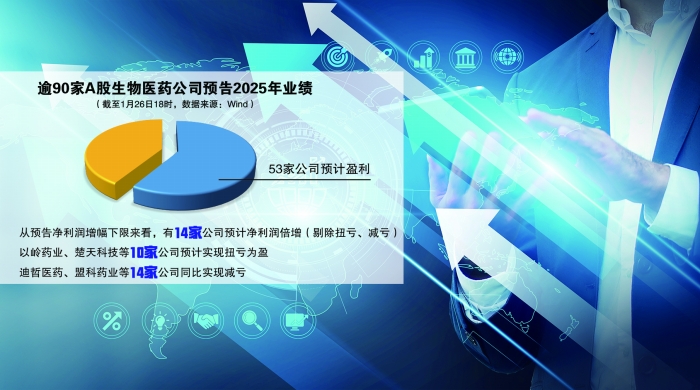
行业景气度回暖叠加政策利好 逾50家生物医药A股公司2025年业绩预盈
Shang Hai Zheng Quan Bao· 2026-01-26 19:16
Core Insights - The A-share biopharmaceutical companies are expected to deliver innovative results in 2025, benefiting from industry recovery, overseas market expansion, and favorable pharmaceutical policies [2] - Over 90 A-share biopharmaceutical companies have released performance forecasts for 2025, with 53 companies expected to be profitable [2] - Among the profit forecasts, 14 companies anticipate a net profit increase of over 100%, while 10 companies expect to turn losses into profits [3][2] Group 1: Performance Growth Drivers - Sales volume growth and internal cost reduction are key factors for the significant profit increases among the companies [4] - Shanghai Yizhong leads with a projected net profit increase of 760.18% to 903.54%, expecting a net profit of 60 million to 70 million yuan in 2025 due to its core product being included in the national medical insurance directory [4] - Yuheng Pharmaceutical anticipates a net profit of 350 million to 420 million yuan, a year-on-year increase of 50.37% to 80.44%, driven by steady sales growth of its products [4] - Nawei Technology expects a net profit of 128 million to 145 million yuan, a year-on-year increase of 54.51% to 75.03%, focusing on market strategies in key sectors [4][5] Group 2: International Market Expansion - International business is a significant growth driver for biopharmaceutical companies [6] - WuXi AppTec, a leading CXO company, forecasts a revenue of 45.456 billion yuan, a year-on-year increase of approximately 15.84%, and a net profit of 19.151 billion yuan, a 102.65% increase [6] - Ganli Pharmaceutical expects a net profit of 1.1 billion to 1.2 billion yuan, a year-on-year increase of 78.96% to 95.23%, attributed to steady growth in domestic and international revenues [6] Group 3: Innovation and Recovery - Several innovative drug companies are entering a recovery phase, with many turning losses into profits or significantly reducing losses [8] - BeiGene expects a full-year operating profit for 2025, with revenue projections between 36.2 billion and 38.1 billion yuan, reflecting an upward adjustment from previous estimates [8] - DiZhe Pharmaceutical anticipates a revenue of 800 million yuan, a year-on-year increase of 122.28%, with a reduced net loss of 770 million yuan [9]