
BeiGene(BGNE)

Search documents
107只个股获机构控盘超10%,科技医药板块成资金“蓄水池”
Huan Qiu Wang· 2026-01-26 07:16
Core Insights - The report highlights the significant presence of public funds in the stock market, with 2,977 stocks appearing in fund heavy positions as of the end of Q4 last year, indicating a clear trend in institutional investment strategies [1] - A total of 107 stocks have a fund holding ratio exceeding 10%, showcasing the high influence and control of institutional funds over these stocks [1] Group 1: Fund Holdings and Stock Performance - Among the 107 stocks with over 10% fund holdings, 56 saw increased investments in Q4, with notable increases in holdings for ShenGong Co., Tianhua New Energy, and Maiwei Co., with increases of 59,020.96%, 15,808.35%, and 959.13% respectively, indicating strong institutional confidence in their fundamentals [2] - Conversely, 48 stocks experienced reductions in fund holdings, with notable decreases for Nuocheng Jianhua-U, Kaiter Co., and Keda Li, with reductions of 43.91%, 41.04%, and 39.95% respectively [2] - Three new stocks entered the heavy holding category, with Baiao Saitu, Litong Technology, and Xingtou Measurement Control having fund holding ratios of 21.55%, 12.60%, and 10.03% respectively [2] Group 2: Institutional Investment Trends - The phenomenon of institutional clustering remains significant, with over 100 funds holding 42 of the 107 stocks, and 29 stocks held by 50 to 99 funds, indicating a strong consensus among institutional investors [4] - Notably, Ningde Times, despite a holding ratio of 11.63%, has the highest number of fund holders at 2,056, followed by Zhongji Xuchuang, Zijin Mining, and Xinyi with over 1,300 fund holders each [4] - The stocks with high fund holdings are predominantly in the "hard technology" and "innovation" sectors, with 42 from the Sci-Tech Innovation Board, 27 from the Growth Enterprise Market, and 31 from the Shanghai and Shenzhen main boards, reflecting a focus on growth sectors [4] Group 3: Performance Expectations - Among the 107 stocks, 26 have released performance forecasts for 2025, with 18 expecting profit increases, 4 expecting declines, and 2 forecasting losses, indicating a generally positive outlook [5] - The highest expected profit growth is for Baiwei Storage at 473.71%, followed by Changxin Bochuang and Baiao Saitu with expected growths of 378.70% and 303.57% respectively, providing strong support for long-term fund holdings [5] - The concentration of fund holdings in the electronics and biopharmaceutical sectors suggests an increased market expectation for technological innovation and consumer recovery [5]






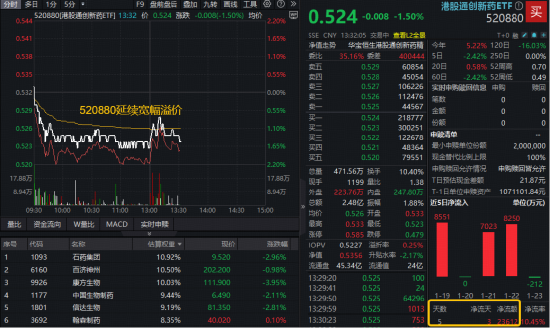
创新药出海BD仍然火爆!港股通创新药ETF(520880)跌1.5%延续高溢价,最新单周吸金2.36亿元
Xin Lang Cai Jing· 2026-01-26 05:47
Group 1 - The Hong Kong stock market is experiencing a downturn, with the innovative drug sector declining again, as evidenced by the Hong Kong Stock Connect Innovative Drug ETF (520880) falling by 1.5% [1][6] - Last week, the ETF accumulated a total decline of 3.2%, with over 236 million yuan in funds being used to buy on dips [1][6] - Major stocks in the sector are generally down, including CSPC Pharmaceutical Group down 3%, CanSino Biologics down nearly 4%, and China Biologic Products and Innovent Biologics both down over 2% [1][6] Group 2 - Multiple innovative drug business development (BD) transactions have been completed at the beginning of the year, indicating a positive trend for Chinese innovative drugs going overseas [8] - Key transactions include: 1) Rongchang Biologics granting AbbVie overseas rights for RC148 (PD-1/VEGF) dual antibody, receiving a $650 million upfront payment and up to $4.95 billion in milestone payments [8] 2) Haisco granting overseas rights for HSK39004 (PDE3/4) to AirNexis, receiving a $108 million upfront payment and up to $955 million in milestone payments [8] 3) Zai Lab granting AbbVie overseas rights for ZG006 (CD3xDLL3xDLL3 tri-antibody), receiving a $100 million upfront payment and milestone payments totaling $1.135 billion [8] 4) Yilian Biologics granting Roche overseas rights for YL201 (B7-H3ADC), with upfront and milestone payments reaching $570 million [8] Group 3 - The Hong Kong Stock Connect Innovative Drug ETF (520880) and its associated funds are highlighted as high-elasticity investment tools, with the underlying index (Hang Seng Stock Connect Innovative Drug Select Index) offering three unique advantages [9] - The ETF has a 100% purity, excluding CXO, and fully covers innovative drug R&D companies [9] - The top ten innovative drug leaders account for over 73% of the ETF, showcasing the strength of the innovative drug sector [9][10]

JPM 2026收官,中国创新药加速全球化进程
2026-01-26 02:50
Summary of Conference Call Industry Overview - The conference focused on updates and developments in the Chinese biopharmaceutical industry, particularly highlighting companies such as BeiGene, 3SBio, and Kelun-Biotech [1][10]. Key Company Insights BeiGene - BeiGene's BCL-2 inhibitor has been approved for sale in China and is expected to receive accelerated approval in the U.S. within the year [1]. - BCL-2 is viewed as a second growth driver for BeiGene, complementing its existing BTK inhibitors, which have shown rapid sales growth in the U.S. market [2]. - The company has a robust pipeline for solid tumors, with several candidates entering late-stage development, including treatments for breast cancer and other indications [3]. - BeiGene is anticipated to report its first annual profit, with expectations that its annual report may exceed forecasts [3]. 3SBio - Pfizer has outlined a global development plan for its drug 707, with five global Phase III trials expected to start by 2026, targeting various cancers [4]. - The trials include first-line treatments for colorectal cancer and non-small cell lung cancer [4]. Kelun-Biotech - Kelun-Biotech is expected to have a significant year with five products anticipated to be commercialized, three of which have already been included in the national medical insurance [5]. - The company has successfully commercialized its top two ADC products and is expected to see explosive growth following their inclusion in insurance [5]. Innovent Biologics - Innovent's Ivosidenib is expected to receive final approval from the FDA in Q4 of this year, with ongoing clinical trials for various cancers [6][7]. - The company is also preparing for the commercialization of its CAR-T product, which has already been approved domestically [8]. Rongchang - Rongchang has announced plans for three Phase III trials, including one for non-small cell lung cancer, which has received FDA approval [7][8]. Other Notable Mentions - Merck has initiated 16 global Phase III trials for its drug targeting various major indications, with data expected in the second half of the year [5]. - The conference highlighted the importance of clinical trial data releases for several companies, which are crucial for their long-term valuations [3][10]. Market Dynamics - The overall market for innovative drugs is currently experiencing a downturn, primarily due to internal funding shifts within the pharmaceutical sector [10]. - The high percentage of holdings in innovative and traditional pharmaceuticals (around 75%) has led to a reallocation of funds towards other sectors like AI healthcare and CROs [11]. - Despite the market's performance, the fundamental aspects of many companies remain strong, with ongoing clinical advancements and positive earnings expectations [11]. - The total amount of business development (BD) transactions in recent weeks has already reached 25% of last year's total, indicating a robust pace of international expansion [11]. Conclusion - The conference provided a comprehensive overview of the current state of the biopharmaceutical industry in China, highlighting significant advancements and the potential for growth among key players. The market dynamics suggest a temporary disconnect between stock performance and fundamental company health, indicating potential investment opportunities.

药品零售行业高质量发展意见发布,科创医药ETF嘉实(588700)一键布局生物医药产业
Xin Lang Cai Jing· 2026-01-23 03:43
Group 1 - The core viewpoint of the news highlights the strong performance of the pharmaceutical and medical services sectors, with the Shanghai Stock Exchange Sci-Tech Innovation Board Biomedicine Index rising by 1.52% as of 11:05 AM on January 23, 2026, driven by significant gains in stocks such as Chengdu Xian Dao (+5.48%) and BGI Genomics (+4.25%) [1] - The Ministry of Commerce and eight other departments have issued opinions to promote high-quality development in the drug retail industry, encouraging retail enterprises to participate in centralized drug procurement and to enhance their bargaining power through joint purchasing [1] - The Chinese pharmaceutical industry is at a pivotal point for global value reassessment, with 2026 being a critical year to validate transformation outcomes, as highlighted by CITIC Securities [1] Group 2 - As of December 31, 2025, the top ten weighted stocks in the Shanghai Stock Exchange Sci-Tech Innovation Board Biomedicine Index include companies like United Imaging Healthcare and BeiGene, collectively accounting for 48.85% of the index [2] - The CSI Innovation Medicine ETF closely tracks the Shanghai Stock Exchange Sci-Tech Innovation Board Biomedicine Index, providing an easy investment option for those without stock accounts through the linked fund [3]

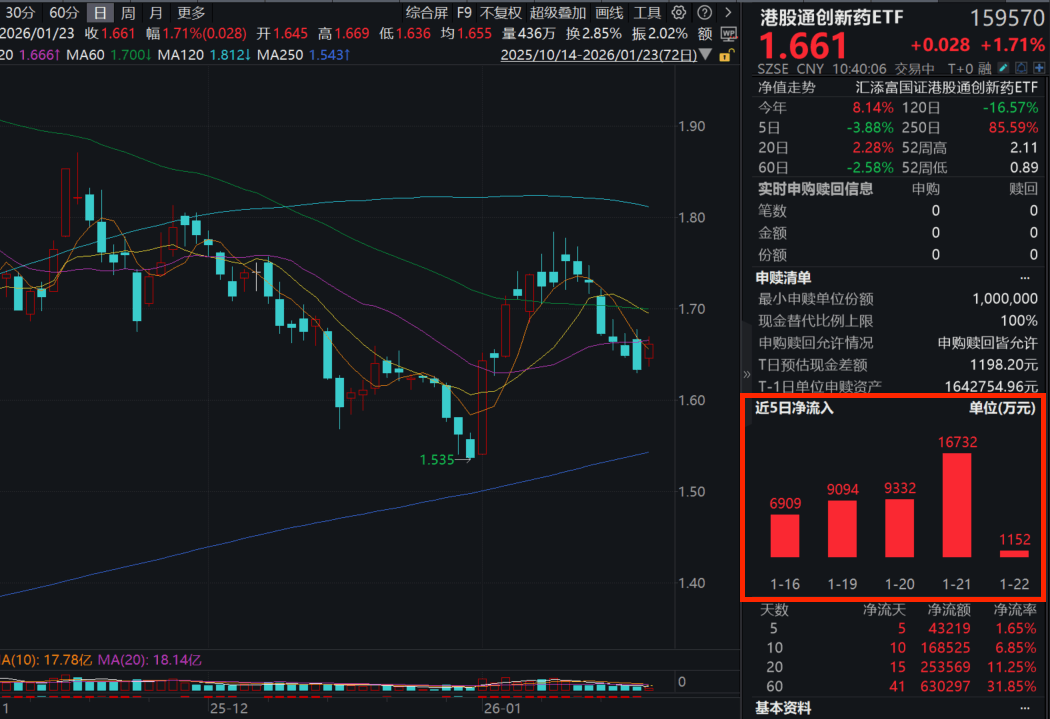
康方生物涨超4%,自研古莫奇单抗第二项适应症获NDA受理!港股通创新药ETF(159570)涨近2%,近5日净流入超4.3亿元!
Xin Lang Cai Jing· 2026-01-23 03:05
Group 1 - The Hong Kong pharmaceutical sector is experiencing a strong rebound, with the Hong Kong Stock Connect Innovation Drug ETF (159570) rising nearly 2% and achieving a transaction volume exceeding 700 million yuan in a short period [1] - The ETF has seen a cumulative net inflow of over 430 million yuan in the past five days, with its latest scale surpassing 25.1 billion yuan, leading in its category [1] - The majority of the weighted stocks in the ETF's index have shown positive performance, including Kangfang Biopharma and Kelun-Botai, which both rose over 4% [3][4] Group 2 - Kangfang Biopharma announced that its new humanized anti-IL-17A monoclonal antibody, AK111, has received acceptance for a new drug application for treating active ankylosing spondylitis (AS) by the National Medical Products Administration (NMPA) [3] - This new drug is expected to provide a new treatment option for nearly 4 million AS patients in China [3] - The JPMorgan Healthcare Conference highlighted the achievements of Chinese innovative drug companies, with expectations for significant revenue growth and multiple drug approvals in the coming years [5][6] Group 3 - The domestic pharmaceutical industry is witnessing rapid technological advancements and an acceleration in globalization, with significant transactions exceeding 10 billion USD occurring [6][7] - The industry is entering a critical period of validation for innovative drug performance, with many companies expected to launch global registration studies and new product applications [6][7] - A domestic innovative drug company projected a revenue increase of 15.84% for 2025, with a substantial net profit growth of 102.65% [7]
百济神州1月22日获融资买入5186.56万元,融资余额8.64亿元
Xin Lang Cai Jing· 2026-01-23 01:40
Group 1 - The core viewpoint of the news is that BeiGene's stock performance and financing activities indicate a mixed sentiment among investors, with a notable increase in shareholder numbers and significant revenue growth reported [1][2]. Group 2 - On January 22, BeiGene's stock fell by 1.77%, with a trading volume of 583 million yuan. The financing buy-in amount was 51.87 million yuan, while the financing repayment was 43.98 million yuan, resulting in a net financing buy of 7.89 million yuan. The total financing and securities balance reached 871 million yuan [1]. - As of January 22, BeiGene's financing balance was 864 million yuan, accounting for 2.61% of its market capitalization, which is below the 40th percentile level over the past year, indicating a low financing level [1]. - On the same day, BeiGene's securities lending saw a repayment of 2,694 shares and a sale of 32 shares, with a selling amount of 9,193.60 yuan. The securities lending balance was 727.21 million yuan, exceeding the 50th percentile level over the past year, indicating a high level of securities lending [1]. - As of September 30, BeiGene had 36,200 shareholders, an increase of 55.33% from the previous period, while the average number of circulating shares per person decreased by 35.79% to 3,195 shares [2]. - For the period from January to September 2025, BeiGene reported a revenue of 27.595 billion yuan, representing a year-on-year growth of 44.21%, and a net profit attributable to shareholders of 1.139 billion yuan, reflecting a significant increase of 130.88% [2]. - Among the top ten circulating shareholders as of September 30, 2025, notable changes included a decrease in holdings by several funds, while new shareholders entered the list, indicating a shift in institutional interest [2].
百济神州:2025年上半年,欧洲区域实现营业收入19.39亿元
Zheng Quan Ri Bao· 2026-01-21 13:40
Group 1 - The core viewpoint of the article highlights that BeiGene has received approval for certain indications of its products, Baiyueze® and Baizean®, from the European Commission, enabling sales through distributors or direct hospital distribution [2] - In 2024, the revenue from the European region is projected to be 2.64 billion yuan, accounting for 9.7% of the company's total revenue for that year [2] - For the first half of 2025, the European region is expected to generate revenue of 1.939 billion yuan, representing 11.1% of the company's revenue for that period [2]
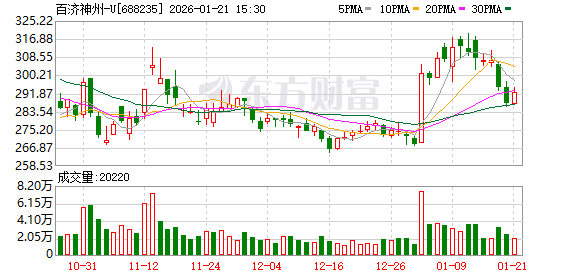
百济神州:在多特异性抗体、ADC等关键领域不断深化布局,2026年起预计每年将有8到10个新分子实体进入临床
Jin Rong Jie· 2026-01-21 08:16
Core Viewpoint - The company is focusing on accelerating the development of innovative drugs through its strong oncology research team and strategic global clinical development capabilities, aiming to become a leading innovator in cancer treatment [1]. Group 1: Company Strategy and Development - The company has one of the largest oncology clinical research teams in the industry and is leveraging this to enhance its innovative drug offerings [1]. - In the past 18 months, the company has advanced 15 new molecular entities into clinical development, covering various treatment modalities [1]. - From 2026 onwards, the company expects to introduce 8 to 10 new molecular entities into clinical development each year, signaling a new wave of innovation [1]. Group 2: Pipeline and Future Prospects - Several products in the company's pipeline, including CDK4 inhibitors, B7-H4 ADC, PRMT5 inhibitors, GPC3x41BB bispecific antibodies, and CEA ADC, are expected to enter late-stage clinical development by 2026 [1]. - The company is committed to building a sustainable competitive advantage and will continue to invest in a rich and innovative R&D pipeline [1]. - The company aims to actively seek and execute business expansion opportunities that create long-term value [1].
2025年药品BD出海总结
Southwest Securities· 2026-01-20 11:37
Investment Rating - The report indicates a significant acceleration in BD (Business Development) overseas for Chinese innovative drugs, suggesting a positive investment outlook for the industry [3]. Core Insights - The number of BD projects, upfront payments, and total amounts for Chinese pharmaceutical companies significantly increased in 2025, with 165 projects, over $7.03 billion in upfront payments (up 226.8% year-on-year), and a total amount of $136.68 billion (up 192.2% year-on-year) [2][7]. - The report highlights a focus on dual antibodies (双抗), antibody-drug conjugates (ADC), GLP-1 receptor agonists (GLP1RA), and small nucleic acids as key areas for BD overseas [2][3]. Summary by Sections BD Project Growth - In 2025, the quarterly breakdown of BD projects shows 41, 43, 30, and 51 projects in Q1, Q2, Q3, and Q4 respectively, with significant year-on-year increases [2][7]. - Upfront payments for each quarter were $0.9 billion, $2.0 billion, $1.86 billion, and $2.27 billion, reflecting substantial growth rates [2][7]. Outbound BD Models - The predominant model for BD remains license in/out, while the NewCo/Co-CoJV model is gaining attention, with limited successful cases of independent commercialization [2][12][13]. - In 2025, MNCs (Multinational Corporations) accounted for $4.71 billion in upfront payments, representing 67% of total BD upfront payments [12]. Key Drug Categories - Dual antibodies saw a remarkable increase, with $3.5 billion in upfront payments (up 414.7%) and a total amount of $21.85 billion (up 361.5%) in 2025 [2][18]. - ADCs emerged as a significant focus, with $1.63 billion in upfront payments (up 676.2%) and a total amount of $21.13 billion (up 390.6%) [2][26]. - GLP-1RA projects achieved $470 million in upfront payments, marking a 109.8% increase, with a total amount of $9.6 billion [2]. NewCo Model - The NewCo model has facilitated overseas BD, with a total of $350 million in upfront payments and $13.74 billion in potential total amounts from 2023 to 2025 [17]. - In 2025, NewCo projects secured $110 million in upfront payments and $4.76 billion in potential total amounts [17]. Clinical Development Stages - Approximately 62% of molecules were in early clinical stages (pre-clinical to before Phase II) at the time of BD, indicating a trend towards early-stage licensing [8][9].

中国创新药2025年出海交易超1300亿美元,港股医药ETF(159718)备受关注
Xin Lang Cai Jing· 2026-01-20 02:24
Core Viewpoint - The Chinese innovative drug business development (BD) for overseas licensing reached a record high of $135.655 billion in total transaction value for 2025, with a significant increase in upfront payments and transaction numbers compared to previous years [1][2]. Group 1: Market Performance - The China Securities Hong Kong Stock Connect Pharmaceutical and Health Comprehensive Index (930965) showed mixed performance among its constituent stocks, with Times Angel leading at a 4.83% increase [1]. - The Hong Kong pharmaceutical ETF (159718) was quoted at 0.96 yuan [1]. Group 2: Industry Developments - The innovative drug BD overseas licensing transactions in China for 2025 totaled $135.655 billion, with upfront payments of $7 billion and 157 transactions, all marking historical highs [2]. - Notable collaborations include Rongchang Biopharma's PD-1/VEGF dual antibody RC148 receiving a $650 million upfront payment from AbbVie, and Yilian Biopharma's partnership with Roche on B7H3-targeted ADC [2]. - GSK's Bepirovirsen for chronic hepatitis B showed positive results in Phase III trials, and Arrowhead announced advancements in RNAi therapies for weight loss, validating the clinical value of small nucleic acid drugs [2]. Group 3: Investment Outlook - The 44th Annual J.P. Morgan Healthcare Conference revealed positive updates from leading global pharmaceutical companies, with significant BD transactions and improved forecasts from CXO companies like WuXi AppTec [2]. - The global pharmaceutical industry remains robust, with innovation in drugs and medical devices continuing to be the main investment theme [2].


