BeiGene(BGNE)

Search documents
科创板企业扎堆登陆“中国500强”
3 6 Ke· 2026-02-06 10:55
Group 1 - The total value of the top 500 companies in China increased by 21 trillion yuan (38%), reaching 77 trillion yuan, with an average value growth of 41.5 billion yuan, now at 1.53 trillion yuan [1][2] - The entry threshold for the list rose to 34 billion yuan, an increase of 7.5 billion yuan from the previous year, marking a historical high [1][2] - The technology sector continues to be a growth engine, with significant increases in the number and market value of companies in semiconductor, biomedicine, artificial intelligence, and new energy sectors [1][2] Group 2 - Nearly 40% of this year's listed companies were not on the list four years ago, with new entrants primarily from consumer electronics, AI computing, and new energy sectors [2] - The semiconductor industry surpassed the life sciences sector to become the second-largest industry in the list, with TSMC leading the growth [3] - Notable semiconductor companies include TSMC, which saw a value increase of 3.5 trillion yuan, and Cambrian, which grew by 370 billion yuan [3] Group 3 - The new energy sector also performed well, with CATL's value increasing by 690 billion yuan, and other companies like Sungrow and EVE Energy showing significant growth [4] - The Shanghai region had 57 companies on the list, an increase of 7 from the previous year, making it the city with the fastest growth in the number of listed companies [10] - Shanghai is a key research and development hub, with 101 companies establishing their main R&D bases there, reflecting its strong innovation capabilities [10][11] Group 4 - The STAR Market (科创板) has a strong presence in the list, with 45 companies, showcasing the focus on hard technology sectors like semiconductors and biomedicine [6][7] - The semiconductor sector is particularly prominent among STAR Market companies, with many of the highest-valued startups in this field [8] - The overall trend indicates that STAR Market companies are in a high-growth phase, aligning with the broader trend of nearly 40% of this year's companies being new entrants [9]




创新药专题:中国声音响彻2026年JPM大会
Southwest Securities· 2026-02-06 06:37
Group 1: JPM Conference Overview - The J.P. Morgan Healthcare Conference is one of the largest and most influential gatherings in the global healthcare sector, covering pharmaceuticals, biotechnology, medical devices, diagnostics, digital health, and healthcare services [3] - The conference serves as a platform for multinational corporations (MNCs), biotech firms, and investment institutions to connect, providing clear signals for industry development over the coming year [4] - The 2026 JPM Conference will be held from January 12 to 15 in San Francisco, California [5] Group 2: MNC Strategic Positioning and BD Strategies - In 2026, MNCs are focusing on four key areas: neuroscience, immunology, oncology, and cardiovascular diseases [6] - Business development (BD) transactions are becoming a core strategy for MNCs, with a shift towards precision and rationality in BD deals, emphasizing next-generation immunotherapies, cell therapies, and gene therapies [6] - AI is increasingly integrated into drug development, clinical design, and operational management across the industry [6][18] Group 3: Investment Opportunities in Innovative Drugs - The acceleration of BD transactions abroad is expected to inject new performance growth and market value elasticity, with a notable increase in projects and upfront payments in 2025 [8] - Policy support for innovative drugs is improving, with recent measures from health authorities aimed at fostering high-quality development in the sector [8] - Key clinical data releases and commercialization milestones for several innovative drugs are anticipated in 2025, which could significantly impact market valuations [8] Group 4: Key Domestic Companies and Their Focus - Companies like Hengrui Medicine and BeiGene are expected to achieve significant milestones in 2026, including multiple new drug applications and clinical data releases [24][25] - Hengrui Medicine aims to leverage a dual strategy of R&D and BD, with over 25 ongoing Phase III clinical trials and a target of more than 10 new drug approvals [24] - BeiGene is positioned to capitalize on its leading products in the chronic lymphocytic leukemia (CLL) space, with several key regulatory submissions and clinical trials planned for 2026 [29][35]


百济神州(06160.HK)发布2026年1月证券变动月报,期内股份期权变动及公股持股确认
Xin Lang Cai Jing· 2026-02-05 17:29
Core Viewpoint - BeiGene, Ltd. submitted a monthly securities change report to the Hong Kong Stock Exchange, indicating no changes in the number of ordinary shares listed on the exchange, which remains at 1,425,622,549 shares, meeting the minimum public float requirement of 25% [1] Group 1: Share Capital and Issuance - The company's authorized share capital is set at $231,146.3847, with a par value of $0.0001 per share, allowing for adjustments until April 2029 [1] - The company has 115,055,260 shares listed on the Shanghai Stock Exchange's STAR Market, which are not interchangeable with Hong Kong shares [1] Group 2: Stock Options and Incentives - Under the 2011 option plan, 58 options were canceled, while 273,442 options were newly granted under the revised 2016 option and incentive plan, with an additional 703,456 options canceled [1] - As of the end of January, the total number of shares potentially issuable under the incentive plan is 29,751,915 [1] - The company issued 3,179,780 new shares during the month due to the exercise of options from the 2016 plan, raising approximately $166.37 million [1]
国产创新药,正在破局
3 6 Ke· 2026-02-05 11:26
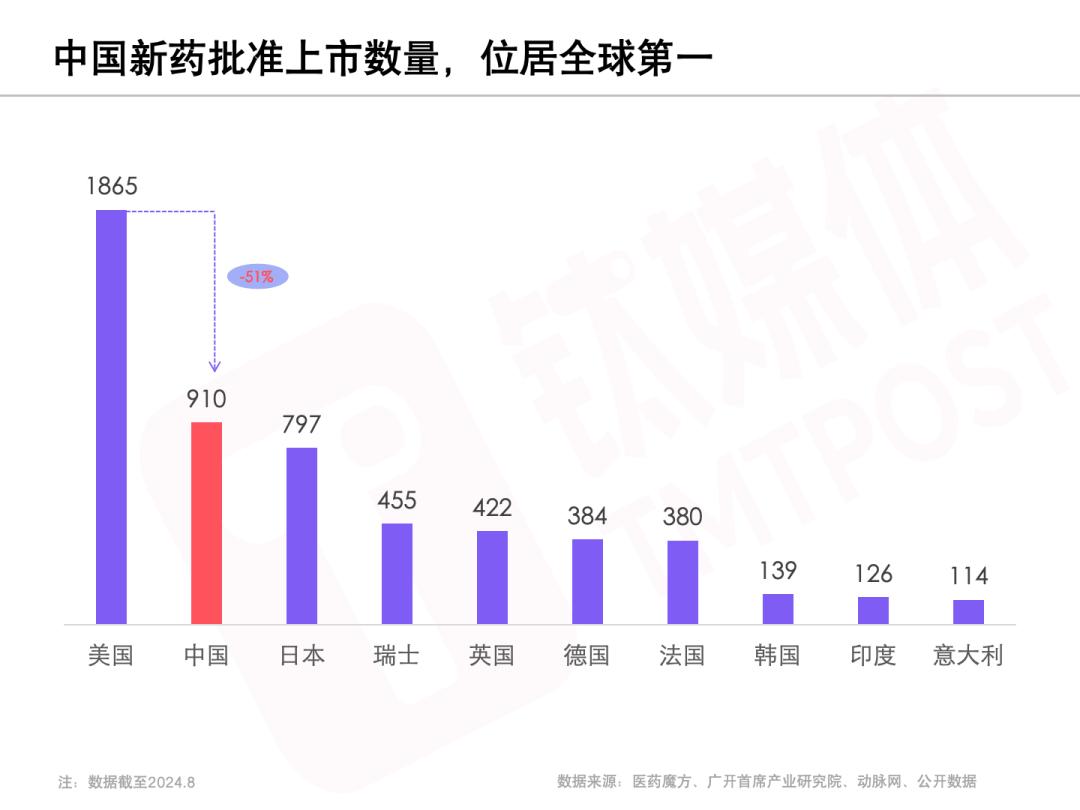
Core Viewpoint - The article discusses the significant progress in China's innovative drug development, highlighting the increase in the number of new drugs approved and the growing competitiveness of Chinese pharmaceutical companies in both domestic and international markets [4][16]. Group 1: Growth of Innovative Drugs - In 2024, the number of domestically developed Class 1 new drugs in China reached 40, a substantial increase from just 9 in 2018 [2][3][4]. - Since the beginning of the 14th Five-Year Plan, 113 innovative drugs have been approved, which is 2.8 times the number approved during the 13th Five-Year Plan [4]. - As of August 2024, there are 910 new drugs available in China, indicating a robust growth in the pharmaceutical market [6]. Group 2: Clinical Trials and Breakthroughs - In a head-to-head clinical trial, the drug Ivoris (依沃西单抗) developed by Kangfang Biopharma outperformed the global best-selling cancer drug, Pembrolizumab (K drug), marking a significant achievement for Chinese innovation [7][9]. - The global sales of Pembrolizumab reached $29.482 billion in 2024, underscoring the competitive landscape [8]. Group 3: Market Dynamics and International Expansion - Chinese innovative drugs are not only performing well domestically but are also gaining traction in international markets, with products like Sidakio (西达基奥仑赛) achieving $1.596 billion in cumulative sales since its launch [12][13]. - The total transaction scale of technology licensing by Chinese pharmaceutical companies exceeded $34 billion in 2024, indicating a shift towards international collaboration [14][15]. Group 4: R&D Landscape and Challenges - As of August 2024, there are 5,380 new drug candidates in development in China, accounting for over one-third of the global pipeline [18]. - The average cost of developing an innovative drug is around $1 billion, with a typical development timeline of 10 years [20][21]. - The efficiency of drug development in China is improving, with preclinical phases taking 12-20 months compared to 24-36 months internationally [23]. Group 5: Policy Support and Ecosystem - The Chinese government has implemented various policies since 2008 to support innovative drug development, including expedited approval processes and financial incentives [28][29]. - The combination of government support, industry collaboration, and technological advancements is creating a conducive environment for innovation in the pharmaceutical sector [41]. Group 6: Future Outlook - The article emphasizes that the development of innovative drugs in China has made significant strides over the past decade, transitioning from imitation to innovation [42]. - The government's continued support for innovative drugs is expected to enhance the industry's growth and provide hope for patients [42].




百济神州(688235) - 港股公告:证券变动月报表
2026-02-05 10:15
股份發行人及根據《上市規則》第十九B章上市的香港預託證券發行人的證券變動月報表 截至月份: 2026年1月31日 狀態: 新提交 公司名稱: 百濟神州有限公司 (根據瑞士法律註冊成立的公司) 呈交日期: 2026年2月5日 I. 法定/註冊股本變動 | 1. 股份分類 | 普通股 | 股份類別 | 不適用 | | 於香港聯交所上市 (註1) | | 是 | | | --- | --- | --- | --- | --- | --- | --- | --- | --- | | 證券代號 (如上市) | 06160 | 說明 | 請見備注 | | | | | | | | | 法定/註冊股份數目 | | | 面值 | | 法定/註冊股本 | | | 上月底結存 | | | 2,311,463,847 | USD | | 0.0001 USD | | 231,146.38 | | 增加 / 減少 (-) | | | 0 | | | USD | | 0 | | 本月底結存 | | | 2,311,463,847 | USD | | 0.0001 USD | | 231,146.38 | 本月底法定/註冊股本總額: US ...
百济神州(06160) - 截至二零二六年一月三十一日止月份之股份发行人的证券变动月报表
2026-02-05 09:28
股份發行人及根據《上市規則》第十九B章上市的香港預託證券發行人的證券變動月報表 截至月份: 2026年1月31日 狀態: 新提交 致:香港交易及結算所有限公司 公司名稱: 百濟神州有限公司 (根據瑞士法律註冊成立的公司) 呈交日期: 2026年2月5日 I. 法定/註冊股本變動 第 1 頁 共 11 頁 v 1.2.0 FF301 II. 已發行股份及/或庫存股份變動及足夠公眾持股量的確認 1. 股份分類 普通股 股份類別 不適用 於香港聯交所上市 (註1) 是 證券代號 (如上市) 06160 說明 已發行股份(不包括庫存股份)數目 庫存股份數目 已發行股份總數 上月底結存 1,425,622,549 0 1,425,622,549 增加 / 減少 (-) 0 0 本月底結存 1,425,622,549 0 1,425,622,549 | 1. 股份分類 | 普通股 | 股份類別 | 不適用 | | 於香港聯交所上市 (註1) | | 是 | | | --- | --- | --- | --- | --- | --- | --- | --- | --- | | 證券代號 (如上市) | 06160 | 說明 ...
百悦达 落地齐鲁,山大齐鲁医院李杰教授谈血液肿瘤精准诊疗新篇
Qi Lu Wan Bao· 2026-02-05 07:00
Core Insights - The article discusses the approval of a new BCL2 inhibitor, Baiyueda (Sotuklara), by the National Medical Products Administration in China for treating chronic lymphocytic leukemia/small lymphocytic lymphoma (CLL/SLL) and relapsed or refractory mantle cell lymphoma (MCL) patients, marking a significant advancement in the treatment of blood cancers in China [1][4][6]. Industry Overview - Blood cancers, including lymphomas, multiple myeloma, and leukemia, have shown a significant increase in incidence, with lymphomas now being the most common type of blood cancer in China [2][3]. - The rise in cases is particularly notable among older populations, with chronic lymphocytic leukemia and mantle cell lymphoma seeing a marked increase in diagnoses [2]. Treatment Advancements - Traditional treatment methods for CLL and SLL have evolved, with chemotherapy being replaced by targeted therapies such as BTK inhibitors, which have shown superior efficacy [3][4]. - The introduction of BCL2 inhibitors, particularly Sotuklara, represents a breakthrough in treatment, offering new options for patients who are not suitable for chemotherapy [4][5]. Mechanism and Efficacy - BCL2 inhibitors work by specifically binding to and inhibiting the BCL2 protein, which prevents cancer cells from undergoing apoptosis, thus promoting cell death in blood cancers [6]. - Sotuklara has demonstrated strong efficacy and safety in preliminary clinical trials, providing a new treatment pathway for patients with relapsed or refractory conditions [4][5]. Future Potential - The potential of BCL2 inhibitors lies in their ability to shift treatment paradigms from continuous therapy to limited-duration treatment, allowing for deep molecular remissions and potentially long-term disease-free survival [6][7]. - The treatment goals for CLL and MCL have evolved from merely controlling the disease to achieving deep molecular remissions and exploring potential cures [7]. Market and Accessibility - The approval of innovative drugs like Sotuklara signifies China's progress in the blood cancer treatment landscape, moving from a follower to a leader in the field [8]. - Ensuring patient access to these new therapies is crucial, with calls for the inclusion of such drugs in national insurance schemes to alleviate financial burdens on patients [8][9]. Clinical Leadership - The Shandong University Qilu Hospital's hematology department is recognized as a national center for lymphoma treatment, contributing significantly to the development and application of new therapies [10][11]. - The department aims to enhance the quality of care and expand access to innovative treatments for patients in the region [11].
对话北生所所长王晓东:创新没什么难的,创业要交学费
经济观察报· 2026-02-05 02:01
Core Viewpoint - The article emphasizes the leadership of Wang Xiaodong at the Beijing Institute of Life Sciences (北生所) and his role in fostering a culture of innovation and entrepreneurship among scientists, leading to the emergence of numerous biotech companies in China [1][4][18]. Group 1: Wang Xiaodong's Leadership and Impact - Wang Xiaodong is regarded as a spiritual leader among scientists at 北生所, creating an environment that encourages original innovation [1][4]. - His approach to leadership focuses on academic guidance rather than administrative control, promoting a culture of open discussion and collaboration among researchers [38][46]. - The "百济效应" (Baiyi Effect) has inspired many scientists to start their own companies, contributing to a wave of entrepreneurship in the biotech sector [18][20]. Group 2: Company Development and Challenges - 百济神州 (BeiGene) was established to address the lack of cancer drugs in China, with a focus on developing first-in-class therapies [7][21]. - The company faced significant challenges during its early years, including navigating the complexities of drug development and clinical trials [10][12]. - Wang Xiaodong's second venture, 维泰瑞隆 (VitaRong), aims to tackle the aging population issue in China, reflecting his commitment to improving the quality of life for the elderly [11][12]. Group 3: Research Environment and Funding - The funding situation for 北生所 has improved significantly, with the Beijing government providing annual support of 200 million yuan, enhancing the institute's research capabilities [28][29]. - The collaboration with Tsinghua University has also facilitated access to student resources, addressing the challenge of recruiting graduate students for research [28][29]. - The institute has established various centers to bridge the gap between basic research and industrial application, enabling scientists to translate their findings into marketable products [19][28]. Group 4: Innovation and Academic Culture - The article highlights the importance of fostering a culture of scientific inquiry and curiosity, which Wang believes is essential for driving innovation [42][47]. - The success of 北生所 in producing high-impact research papers reflects the effectiveness of its academic model, which emphasizes collaboration and knowledge sharing [28][47]. - The competitive environment among researchers at 北生所 has contributed to a significant increase in the quantity and quality of scientific output over the years [48].

百济神州涨1.64%,成交额6.51亿元,近3日主力净流入-1.06亿
Xin Lang Cai Jing· 2026-02-03 07:45
Core Viewpoint - The company, BeiGene, is a leading global innovator in cancer treatment, focusing on developing innovative anti-tumor drugs to enhance accessibility and affordability for cancer patients [2]. Financial Performance - For the period from January to September 2025, BeiGene achieved a revenue of 27.595 billion yuan, representing a year-on-year growth of 44.21% [6]. - The net profit attributable to the parent company was 1.139 billion yuan, showing a significant year-on-year increase of 130.88% [6]. Market Activity - On February 3, BeiGene's stock rose by 1.64%, with a trading volume of 651 million yuan and a turnover rate of 2.08%, bringing the total market capitalization to 421.221 billion yuan [1]. - The stock has seen a net outflow of 17.2595 million yuan from major investors today, with a ranking of 145 out of 158 in the industry [3][4]. Shareholder Information - As of September 30, 2025, the number of shareholders for BeiGene increased to 36,200, a rise of 55.33% compared to the previous period [6]. - The average number of tradable shares per shareholder decreased by 35.79% to 3,195 shares [6]. Institutional Holdings - Among the top ten circulating shareholders, China Europe Medical Health Mixed A holds 4.6788 million shares, a decrease of 146,600 shares from the previous period [7]. - Hong Kong Central Clearing Limited is a new shareholder with 3.1565 million shares [7].
AI医疗概念异动,方舟健客盘初狂飙20%!港股通医疗ETF华宝(159137)冲上2%终结三连跌,医疗ETF巨量吸金
Xin Lang Cai Jing· 2026-02-03 02:35
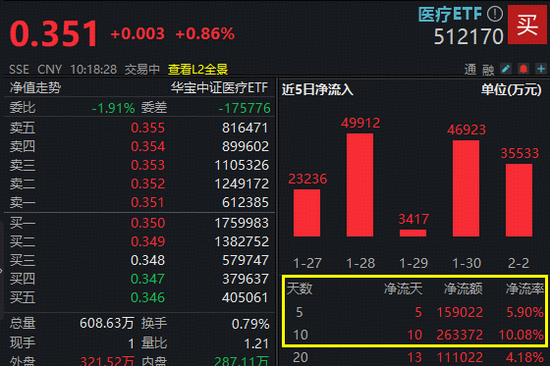
Core Viewpoint - The healthcare sector in A-shares is experiencing a significant rally, driven by AI healthcare and CXO concepts, with notable inflows into medical ETFs [1][8]. Group 1: ETF Performance - The largest medical ETF in A-shares (512170) saw an intraday increase of over 1%, recovering its annual line, with a net subscription of 2.633 billion yuan over the past 10 days as of February 2 [1][8]. - The medical ETF fund size reached 27 billion yuan, making it the largest in the market for medical ETFs [6][13]. Group 2: Individual Stock Movements - The Hong Kong medical ETF (159137) surged by 2%, ending a three-day decline, with Ark Health rising over 20% and BeiGene increasing by more than 4% [10]. - Ark Health raised approximately 144 million HKD through a placement of about 45.181 million shares, with 90% of the funds allocated to accelerate the development of an AI-driven chronic disease management platform [3][10]. Group 3: Industry Developments - Huawei Cloud launched the first section of its industry AI "Dream Factory" focused on smart healthcare, providing a collaborative pathology solution for grassroots hospitals [5][12]. - Institutions predict that by 2026, AI applications will transition from usable to highly effective, becoming a core theme in the AI industry, particularly in healthcare, finance, and education sectors [6][12].