
Bristol-Myers Squibb(BMY)

Search documents
BMY Wins EC Nod for Label Expansion of CAR T Cell Therapy Breyanzi (Revised)
ZACKS· 2025-11-27 09:46
Core Insights - Bristol Myers Squibb (BMY) received European Commission approval for Breyanzi, expanding its label to include treatment for adult patients with relapsed or refractory mantle cell lymphoma (MCL) after at least two lines of systemic therapy, including a Bruton's tyrosine kinase (BTK) inhibitor [1][9] Group 1: Breyanzi Approval and Indications - The latest approval marks the fourth for Breyanzi in Europe, which is already approved for several other indications including relapsed or refractory diffuse large B-cell lymphoma (DLBCL) and high-grade B-cell lymphoma (HGBCL) [2] - Breyanzi is indicated for patients who relapsed within 12 months of first-line chemoimmunotherapy or are refractory to it, as well as for those with relapsed or refractory DLBCL, PMBCL, and FL3B after two or more lines of therapy [3] Group 2: Clinical Trial Results - The approval is based on the TRANSCEND NHL 001 trial results, where 82.7% of patients responded to Breyanzi, with 71.6% achieving a complete response, and 41.2% of patients maintained their response at 24 months [4][9] Group 3: Pipeline Expansion and Market Impact - Bristol Myers is focusing on expanding its pipeline due to the negative impact of generics on its legacy portfolio, including Revlimid and Pomalyst [5] - The company’s shares gained 3.3% following positive data from Bayer's cardiovascular candidate asundexian, which may boost investor confidence in BMY's own cardiovascular candidate, milvexian [6][8] Group 4: Discontinuation of Librexia Study - Bristol Myers and Johnson & Johnson decided to discontinue the late-stage Librexia study for milvexian after an interim analysis indicated it was unlikely to meet primary efficacy endpoints, although two other studies for milvexian will continue [10][11]

从“减肥神药”覆盖到抗癌药!“美国版集采”来势汹汹 将削减36%支出
Zhi Tong Cai Jing· 2025-11-26 08:37
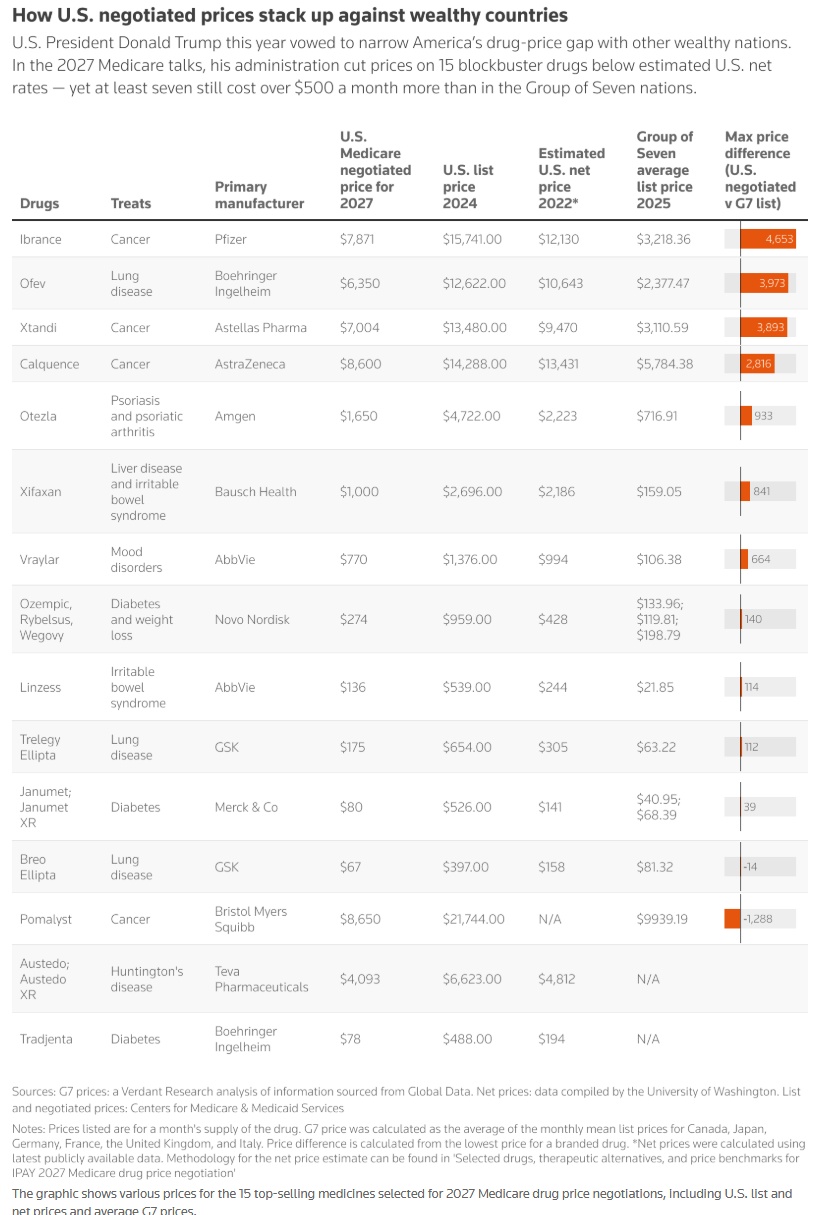
Core Insights - The recent Medicare negotiations are expected to save approximately 36% on the prices of 15 high-cost drugs, translating to around $8.5 billion in net reimbursement costs [1][3][10] - The new prices will take effect in 2027, with significant reductions for popular drugs like semaglutide, which will drop over 70% to about $274 per month [1][4] - The negotiations are part of the Inflation Reduction Act signed by President Biden in 2022, which allows Medicare to negotiate drug prices for the first time [2][11] Drug Price Reductions - The estimated net prices for drugs like Calquence, Ofev, and Ibrance have been reduced by over $4,000 each in the latest negotiations [2][4] - The new pricing for other drugs includes Trelegy Ellipta at $175 (down from $654) and Linzess at $136 (down from $539) [4][10] - The average negotiated prices for these drugs are still higher than those in the Group of Seven (G7) nations, with some drugs costing over $500 more than their G7 counterparts [7][11] Comparison with Previous Negotiations - The 36% savings in the current negotiations surpasses the 22% savings achieved in the previous year's negotiations for 10 different drugs [3][10] - The pricing strategy has become more efficient, with newer products potentially having greater flexibility in pricing [4][10] Industry Response - The pharmaceutical industry has expressed strong opposition to government price negotiations, arguing that such policies are detrimental [5][10] - Industry representatives claim that government pricing policies like the Inflation Reduction Act and the Most-Favored-Nation pricing are misguided [5][12] Future Implications - The Medicare negotiations are expected to influence other payers to seek similar pricing from drug manufacturers [10] - Future negotiations will include an additional 15 drugs, with discussions set to begin in February [12]


BMY Wins EC Nod for Label Expansion of CAR T Cell Therapy Breyanzi
ZACKS· 2025-11-25 20:06
Core Insights - Bristol Myers Squibb (BMY) received European Commission (EC) approval for Breyanzi (lisocabtagene maraleucel), expanding its label to include treatment for adult patients with relapsed or refractory mantle cell lymphoma (MCL) after at least two lines of systemic therapy, including a Bruton's tyrosine kinase (BTK) inhibitor [2][10] - This marks the fourth approval for Breyanzi in Europe, which is already approved for several other lymphoma types [3][4] Approval Details - The latest EC approval is based on the MCL cohort results from the TRANSCEND NHL 001 trial, where 82.7% of patients responded to Breyanzi, and 71.6% achieved a complete response [5][10] - Sustained clinical benefits were observed, with 50.8% of patients remaining in response at 24 months [5][10] Pipeline Expansion - Bristol Myers is actively seeking to expand its pipeline due to the negative impact of generics on its legacy products like Revlimid, Pomalyst, Sprycel, and Abraxane [6] - The approval of new drugs and label expansions for existing drugs is expected to diversify its portfolio [6] Market Reaction - Shares of BMY increased by 3.3% following positive news from Bayer regarding its cardiovascular candidate asundexian, which met primary efficacy and safety endpoints in a late-stage study [7][9] - The success of Bayer's study has raised investor optimism for BMY's cardiovascular candidate, milvexian, in secondary stroke prevention [9] Study Discontinuation - Bristol Myers and Johnson & Johnson announced the discontinuation of the late-stage Librexia study for milvexian after an interim analysis indicated it was unlikely to meet primary efficacy endpoints [11] - However, two other late-stage studies for milvexian are set to continue, with top-line data expected in 2026 [12]

Bristol Myers Squibb Receives Approval from the European Commission to Expand Use of CAR T Cell Therapy Breyanzi for Relapsed or Refractory Mantle Cell Lymphoma
Businesswire· 2025-11-24 22:00
Core Insights - Bristol Myers Squibb has received approval from the European Commission to expand the use of its CAR T cell therapy, Breyanzi, for adult patients with relapsed or refractory mantle cell lymphoma (MCL) after at least two lines of systemic therapy, including a Bruton's tyrosine kinase (BTK) inhibitor [1][2][4] Group 1: Clinical Efficacy - In the TRANSCEND MCL trial, Breyanzi demonstrated an overall response rate of 82.7% and a complete response rate of 71.6% among patients treated in the third-line plus setting [2][3] - The therapy showed sustained clinical benefit, with 50.8% of patients still in response at 24 months [1][2] - The median time to first response was 0.95 months, indicating rapid efficacy [2] Group 2: Safety Profile - The safety results for Breyanzi were consistent with its established profile, with cytokine release syndrome (CRS) occurring in 61% of patients, and only 1% experiencing grade three or four CRS [3][19] - Neurologic toxicities were reported in 31% of patients, with grade three or four cases in 9% [3][19] - The majority of adverse events occurred within the first 14 days post-infusion, allowing for early resolution and adjustments to monitoring requirements [3] Group 3: Regulatory and Market Implications - This approval is applicable across all EU member states and EEA countries, marking the fourth approval for Breyanzi in Europe [4][5] - Breyanzi is also approved for other indications, including relapsed or refractory diffuse large B-cell lymphoma (DLBCL) and follicular lymphoma [4][9] - Bristol Myers Squibb is positioned as a leader in cell therapy, with a focus on expanding treatment options for aggressive forms of non-Hodgkin lymphoma [34][36]

Bayer Stroke Drug Hits Trial Goals, Analyst Sees Positive Data Readout From Bristol Myers' Milvexian After Failed Study
Benzinga· 2025-11-24 18:14
Core Insights - Bayer AG's Phase 3 OCEANIC-STROKE study results for asundexian show significant efficacy in reducing ischemic stroke risk compared to placebo [1][2] - The study met primary efficacy and safety endpoints, with no increase in major bleeding risk observed [2][4] - The positive results for asundexian may have implications for Bristol Myers Squibb's milvexian program, especially after the recent halt of the LIBREXIA-ACS trial [5] Efficacy and Safety - Asundexian 50 mg once daily significantly reduced ischemic stroke risk in patients post non-cardioembolic ischemic stroke or high-risk transient ischemic attack [2] - No increase in ISTH major bleeding risk was noted with asundexian compared to placebo when combined with antiplatelet therapy [4] Industry Implications - The positive read-through from Bayer's trial is seen as beneficial for Bristol Myers Squibb's ongoing milvexian program, which faced setbacks [5] - Questions remain regarding the optimal dosing of milvexian in ongoing studies, particularly in relation to the doses used in the LIBREXIA-STROKE and LIBREXIA-AF studies [6] Comparative Analysis - Bayer's asundexian achieved approximately 91% factor XIa inhibition at the 50 mg QD dose, while Bristol Myers has not disclosed the inhibition levels for milvexian [7] - Previous studies indicated that asundexian was inferior to Eliquis despite high factor XIa inhibition, raising concerns about dosing adequacy [8] Market Reaction - Following the news, Bristol Myers Squibb's stock rose by 4.57% to $48.37 [9]
Bristol-Myers Squibb: I See No Catalysts To Break Underperformance (NYSE:BMY)
Seeking Alpha· 2025-11-21 13:00
Core Insights - Bristol-Myers Squibb (BMY) has developed multiple early mega blockbuster therapies, including Eliquis, Opdivo, and Revlimid, which have significantly contributed to its financial success [1] Group 1: Company Overview - The company has experienced tremendous financial fortune due to its blockbuster drugs, but such successes can also present challenges [1] Group 2: Investment Perspective - The article emphasizes the importance of diversifying knowledge sources for better investment insights, reflecting a broader investment philosophy [1]
Bristol-Myers Squibb: I See No Catalysts To Break Underperformance
Seeking Alpha· 2025-11-21 13:00
Group 1 - Bristol-Myers Squibb (BMY) has developed multiple early mega blockbuster therapies including Eliquis, Opdivo, and Revlimid, which have significantly contributed to its financial success [1] - The presence of mega blockbusters can also present challenges, as they may lead to over-reliance on a few products, creating potential vulnerabilities for the company [1] Group 2 - The article emphasizes the importance of diversifying knowledge sources in investment analysis, suggesting that a broader perspective can enhance decision-making [1]

Bristol Myers, Sanofi sued by Texas over Plavix
Reuters· 2025-11-20 21:06
Core Insights - Texas Attorney General Ken Paxton has filed a lawsuit against Bristol Myers Squibb and Sanofi, alleging that the companies failed to disclose the ineffectiveness of Plavix in preventing blood clots for certain patients [1] Company Summary - Bristol Myers Squibb and Sanofi are being accused of not providing adequate information regarding the efficacy of Plavix, a medication commonly used to prevent blood clots [1]


Will Librexia ACS Study Setback Dent BMY's Cardiovascular Portfolio?
ZACKS· 2025-11-20 19:11
Core Insights - Bristol Myers Squibb (BMY) has decided to discontinue the late-stage Librexia study on milvexian, a cardiovascular candidate, due to an interim analysis indicating it is unlikely to meet primary efficacy endpoints [1][2][8] - The discontinuation represents a setback for BMY's cardiovascular ambitions, which include the drugs Camzyos and Eliquis [3][8] Company Developments - The Independent Data Monitoring Committee (IDMC) recommended continuing two other late-stage studies: Librexia AF for atrial fibrillation and Librexia STROKE for secondary stroke prevention, with top-line data expected in 2026 [4][8] - BMY's cardiovascular portfolio includes Camzyos, which received FDA approval in 2022 for treating obstructive hypertrophic cardiomyopathy, and Eliquis, a major revenue contributor developed in partnership with Pfizer [3][4] Competitive Landscape - Cytokinetics is developing aficamten, a potential competitor to Camzyos, with an FDA approval target date extended to December 26, 2025 [5][6] - JNJ's Xarelto, a Factor Xa inhibitor like Eliquis, faces patent challenges in the U.S., which may impact its market position [6] Financial Performance - BMY's shares have declined by 19.1% year-to-date, contrasting with the industry growth of 16.5% [7][8] - The company is trading at a price/earnings ratio of 7.55x forward earnings, below its historical mean of 8.41x and the large-cap pharma industry's average of 16.84x [9] Earnings Estimates - The Zacks Consensus Estimate for 2025 earnings per share has increased, while the estimate for 2026 has decreased [10]

$100,000 In The S&P 500's 5 Cheapest Healthcare Stocks, 4% Average Dividend Yield


Seeking Alpha· 2025-11-20 16:17
Group 1 - The author has a background in private credit and commercial real estate (CRE) mezzanine financing, indicating expertise in financial analysis and investment strategies [1] - The author has collaborated with prominent CRE developers, suggesting a strong network and experience in the real estate sector [1] - The author is a fluent Mandarin speaker, which may provide advantages in understanding Asian markets and investment opportunities [1] Group 2 - The article expresses personal opinions and analysis, highlighting the author's independent research approach [2] - The author holds long positions in several pharmaceutical companies, indicating a focus on the healthcare sector for investment [2] - There is no business relationship with the companies mentioned, ensuring an unbiased perspective in the analysis [2]
