
Chevron(CVX)

Search documents
瑞穗下调多只油气股目标价
Ge Long Hui· 2025-09-16 09:01
Group 1 - Mizuho has lowered the target price for Occidental Petroleum from 65 USD to 58 USD [1] - Mizuho has reduced the target price for Murphy Oil from 31 USD to 29 USD [1] - Mizuho has adjusted the target price for ExxonMobil from 124 USD to 123 USD [1] - Mizuho has decreased the target price for Chevron from 192 USD to 191 USD [1]


被特朗普“背刺”?美国多行业掀起裁员潮
Jin Shi Shu Ju· 2025-09-15 08:28
Group 1 - The U.S. labor market is experiencing stagnation due to significant layoffs in manufacturing, wholesale retail, and energy sectors, primarily attributed to tariffs imposed by President Trump, which have increased costs and hindered expansion plans [1][2] - The August non-farm payroll report indicated that the "goods-producing industries" were the main contributors to job declines, with only 22,000 jobs added in the month, and manufacturing alone losing 12,000 jobs [2] - Companies like John Deere reported substantial financial losses due to tariffs, with an estimated $300 million loss by 2025, leading to layoffs and a 26% year-over-year decline in net profit [2] Group 2 - There is a divide between the government and businesses regarding tariffs, with some companies claiming tariffs have prompted increased capital spending and future hiring, while others express uncertainty and a hiring freeze due to unpredictable policy changes [3] - The oil industry is facing dual pressures from tariffs and low oil prices, with significant layoffs occurring, including Chevron and ConocoPhillips planning to cut thousands of jobs [4][5] - Despite challenges, some executives remain optimistic that tariffs will ultimately benefit domestic industries, although they are also implementing layoffs and automation to maintain competitiveness [6]


雪佛龙:炼化一体化可提升油企竞争力
Zhong Guo Hua Gong Bao· 2025-09-12 03:05
Group 1 - The core viewpoint emphasizes the importance of integrating refining and petrochemical industries for oil and gas companies to adapt to changing market dynamics and maintain competitiveness during the energy transition [1] - Chevron's International Products President Brant Fish highlighted the increasing global demand for cleaner, more reliable, and cost-effective energy solutions, indicating a shift in investment focus towards petrochemical capacity as gasoline demand stabilizes or declines [1] - The petrochemical industry is currently experiencing a prolonged downturn, which has dampened investment enthusiasm, and while there is a trend towards investing in refining facilities for lighter products, such investments are unlikely to yield returns in the short to medium term [1] Group 2 - Chevron advises national oil companies to learn from specialized trading companies, noting that successful competitors today possess both asset ownership and operational capabilities [2] - Key markets such as China, South Korea, and Singapore are highlighted for their strategic importance, with strong demand for refined products despite global fluctuations, remaining central to Chevron's long-term strategy [2]
事关韩国经济命脉,美国巨头突然高调宣布
Sou Hu Cai Jing· 2025-09-12 01:41
Core Viewpoint - The South Korean petrochemical industry, facing severe challenges, is experiencing significant losses among its major companies, prompting government intervention for structural reforms [1][2][3]. Industry Overview - The petrochemical sector is South Korea's fourth-largest export industry, but it is currently in a crisis, with major players like Lotte Chemical, LG Chem, Hanwha Solutions, and Kumho Petrochemical reporting substantial losses in the first half of 2025 [1][2][3]. - The Bank of Korea reported a 7.8% year-on-year decline in sales for the petrochemical industry, marking four consecutive quarters of negative growth since Q3 2024 [1][3]. Financial Performance - The "big four" petrochemical companies in South Korea are projected to incur a total loss of 878.4 billion KRW (approximately 5.1 million RMB) in 2024, with an additional loss of nearly 500 billion KRW in the first half of 2025 [1][3]. - The overall financial outlook for the industry suggests that losses may continue to expand throughout 2025 [1][3]. Structural Challenges - The industry's heavy reliance on imported raw materials has exacerbated cost pressures, with average sales costs rising to 98.6% in 2025, up from 87.6% in 2021 [4]. - The increase in electricity prices, which have risen by over 65% since 2022, has further strained production costs, contributing to the financial difficulties faced by major petrochemical companies [4]. Market Dynamics - Chevron's recent announcement to increase investments in South Korea has raised concerns about foreign control over the country's key industries during a downturn [1][8]. - The South Korean government has identified the petrochemical sector for restructuring, but industry responses have been slow, with many companies hesitant to implement necessary reforms [1][6][7]. Future Outlook - The ongoing crisis in the petrochemical industry is prompting discussions about potential mergers and acquisitions, as companies face existential challenges [6][7]. - There is a growing concern that increased foreign investment could lead to a loss of autonomy for South Korean firms, impacting the overall supply chain and profitability of the domestic manufacturing sector [11].

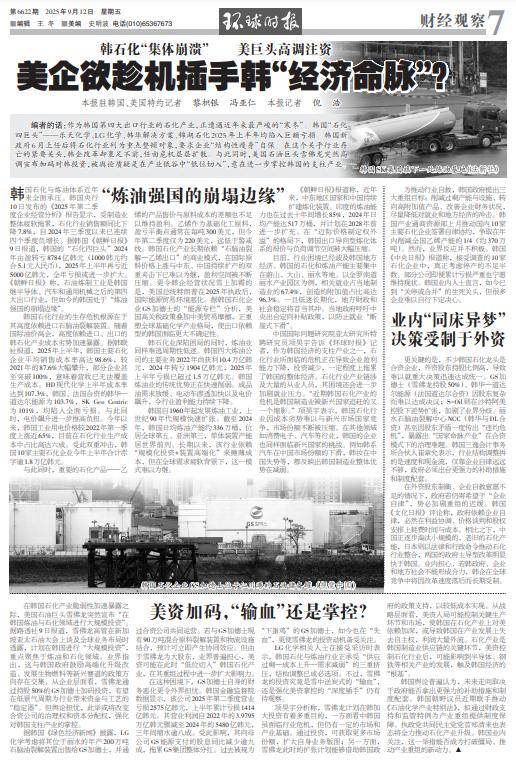
韩石化“集体崩溃”,美巨头高调注资,美企欲趁机插手韩“经济命脉”?
Huan Qiu Shi Bao· 2025-09-11 23:14
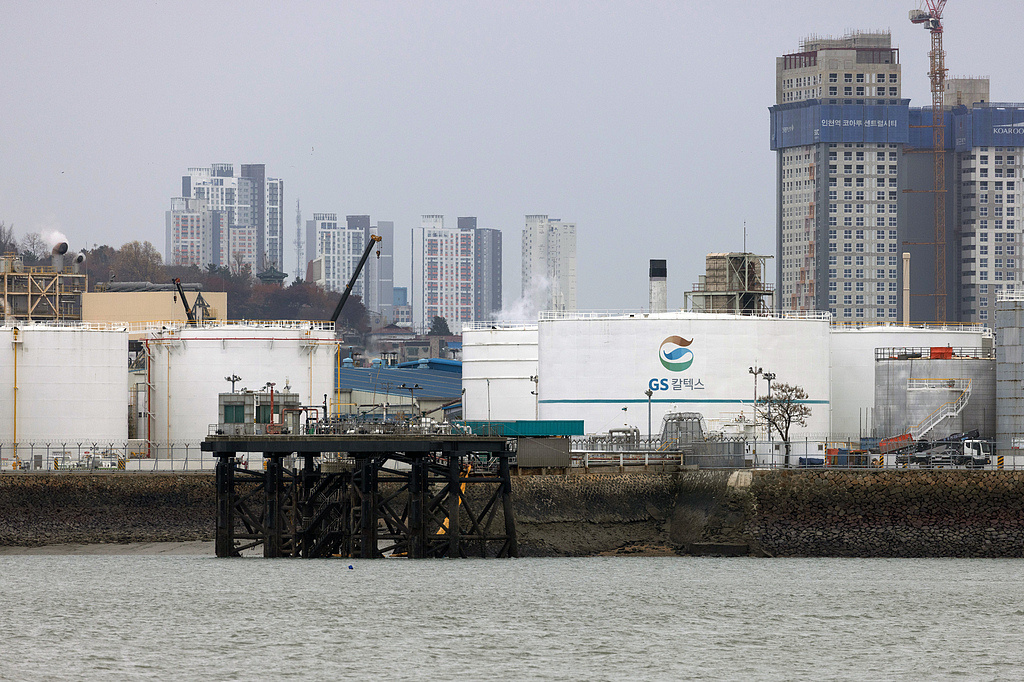
Core Viewpoint - The South Korean petrochemical industry is facing severe challenges, with major companies experiencing significant losses and the government pushing for structural reforms amid a crisis that threatens the industry's survival [1][2][3]. Industry Overview - The petrochemical sector, South Korea's fourth-largest export industry, has seen sales decline by 7.8% year-on-year, marking four consecutive quarters of negative growth since Q3 2024 [2]. - The "big four" petrochemical companies in South Korea reported a shift from profit to a loss of 878.4 billion KRW in 2024 and an additional loss of nearly 500 billion KRW in the first half of 2025 [2]. Financial Performance - Major petrochemical companies in South Korea reported an average sales cost rate of 98.6% in the first half of 2025, significantly up from 87.6% in 2021, with some companies exceeding 100% [3]. - The total deficit for ten major petrochemical companies in the first half of 2025 exceeded 18 trillion KRW [3]. Market Dynamics - The price difference between ethylene product sales and raw material costs is insufficient for profitability, with the breakeven point at 300 USD per ton, while the second-quarter price was only 220 USD [4]. - The South Korean refining industry, traditionally strong, is now facing a downturn, with major companies transitioning from a profit of 10.4 trillion KRW in 2022 to a loss of 1.9 trillion KRW in 2024 [4]. Structural Challenges - The industry is heavily reliant on imported naphtha cracking facilities, which has exposed cost disadvantages amid rising international oil prices [3]. - The traditional model of "scale investment and high-end facilities" is becoming unsustainable due to global demand weakness [6]. Employment and Economic Impact - The petrochemical and refining sectors are crucial for local economies, with significant employment and value creation in regions like Ulsan and Yeosu [6]. - The ongoing crisis is expected to increase employment pressure and could lead to severe local economic impacts if prolonged [7]. Government Response - The South Korean government has set three restructuring goals: reducing excess capacity, shifting to high-value products, and improving financial conditions [8]. - A self-regulatory agreement was signed by ten major petrochemical companies to cut national ethylene capacity by 25% (approximately 3.7 million tons) [8]. Foreign Investment Dynamics - Chevron's announcement of significant investment in South Korea's refining and petrochemical sectors has raised concerns about potential control over the industry [10][12]. - The financial deterioration of GS Caltex, a key player in the sector, has led to questions about the motivations behind foreign investments [11]. Future Outlook - The success of the restructuring efforts will depend on the government's ability to implement strong support measures and regulatory frameworks [12]. - The potential for increased foreign control over the petrochemical industry could impact South Korea's economic autonomy and the development of related sectors [12].
S&P 500: The Boiling Frog Syndrome Of The Equity Market
Seeking Alpha· 2025-09-11 19:22
Core Insights - The article discusses the expertise of Vladimir Dimitrov, CFA, who has a background in brand and intangible assets valuation, particularly in the technology, telecom, and banking sectors [1] Group 1: Analyst Background - Vladimir Dimitrov has experience as a strategy consultant and has worked with major global brands [1] - He graduated from the London School of Economics and focuses on identifying reasonably priced businesses with sustainable long-term competitive advantages [1]
Chevron Targets 30,000 Bpd Output in Argentina's Vaca Muerta by 2025
ZACKS· 2025-09-11 13:06
Core Insights - Chevron Corporation aims to increase its oil output in Argentina's Vaca Muerta shale formation to 30,000 barrels per day (bpd) by the end of 2025, reflecting confidence in this significant energy resource [1][2] Company Expansion - Chevron has been investing in Vaca Muerta for years, currently producing approximately 25,000 bpd and planning to ramp up to 30,000 bpd by year-end 2025 [2] - The company’s Argentina country manager highlights the growth potential of Vaca Muerta, emphasizing its strong unconventional resource base and the ability to scale quickly under favorable conditions [2][8] Industry Impacts - Vaca Muerta is recognized as the world's second-largest shale gas reserve and fourth-largest for shale oil, playing a crucial role in Argentina's energy strategy to reduce reliance on imports amid an economic crisis [3][4] - Increased production from Vaca Muerta is expected to enhance Argentina's energy independence and economic prospects, with analysts estimating crude production could reach 1 million bpd by 2030 [4] Market Pressures - Despite its potential, Vaca Muerta faces challenges from global oil market pressures, including lower oil prices and reduced spending, which have led to a slowdown in drilling activities [5] - Other companies, such as TotalEnergies and GeoPark, have scaled back their involvement in the region, indicating a cautious approach to investment in Vaca Muerta [6][7] Regulatory Environment - Chevron emphasizes the need for a stable investment climate in Argentina, calling for competitive costs and predictable regulatory frameworks to support its expansion plans [8][9] - The company’s executives stress that uncertainties in capital movement and government policy could hinder the formation's potential [9] Future Outlook - Chevron's plans for increased output come amid mixed signals for shale development globally, but Vaca Muerta continues to show momentum with ongoing investments [10] - The anticipated Vaca Muerta South pipeline, expected to be operational by 2027, will further support production and export capabilities [10][11]
Alternative Energy Stocks Continue to Lead Big Oil in 2025
Investing· 2025-09-11 11:58
Group 1 - The article provides a market analysis covering major companies such as Chevron Corp and Exxon Mobil Corp, as well as investment vehicles like SPDR® S&P 500® ETF Trust and VanEck Uranium and Nuclear ETF [1] Group 2 - The analysis highlights the performance and trends within the energy sector, particularly focusing on oil and gas companies [1] - It discusses the implications of market movements on investment strategies related to these companies and ETFs [1]


All It Takes Is $27,000 Invested in These 2 High-Yield Dividend Stocks and ETF to Help Generate Over $1,000 in Passive Income Per Year
Yahoo Finance· 2025-09-11 09:45
Group 1: Chevron - Chevron's free cash flow (FCF) is projected to cover its current payout of $11.7 billion and provide room for buybacks, making it attractive for income investors [1] - Management anticipates generating an additional $12.5 billion in FCF by 2026, on top of $15 billion in 2024, while Wall Street analysts estimate $24 billion in 2026 and $28 billion in 2027 [2] - The acquisition of Hess is expected to contribute $2.5 billion to FCF by 2026, alongside $10 billion from increased production in Kazakhstan, the Gulf of Mexico, and the Permian Basin [3] - Chevron's diversified asset mix and strong balance sheet enhance its appeal to passive income investors, with the Hess acquisition reducing risk and adding valuable assets [4] Group 2: Coca-Cola - Coca-Cola is facing challenges in the consumer staples sector but is outperforming peers due to its strong supply chain, marketing, and diversified beverage lineup [10] - The company expects to grow non-GAAP earnings per share (EPS) by 3% year-over-year to $2.97, with currency-neutral EPS projected to grow 8% [11] - Coca-Cola maintains a 3% dividend yield and has increased its payout for 63 consecutive years, positioning it as a reliable high-yield dividend stock [12] Group 3: Schwab U.S. Dividend Equity ETF - The Schwab U.S. Dividend Equity ETF offers a 3.7% distribution yield and is suitable for investors seeking passive income without the complexity of individual stock selection [13] - The ETF has significant exposure to energy stocks, with Chevron and ConocoPhillips as its largest holdings, and also includes consumer staples and healthcare sectors [14] - With a low total expense ratio of 0.06%, the ETF presents a cost-effective option for generating passive income [15]

美银上调雪佛龙目标价至185美元
Ge Long Hui A P P· 2025-09-11 03:19
Group 1 - Bank of America has raised Chevron's target price from $170 to $185 while maintaining a "Buy" rating [1]