
Youdao(DAO)

Search documents
科技;可选消费:AI破局海外广告平台的效率革命
HTSC· 2026-03-19 01:08
Group 1: Market Dynamics - The global digital advertising market is projected to reach approximately $760 billion by 2025, with a CAGR of about 9% from 2025 to 2029, increasing its share from 73% in 2024 to 81% in 2029[13] - Major platforms like Google, Meta, and Amazon dominate over 60% of user engagement and account for more than 70% of global digital advertising budgets[19] - The implementation of antitrust policies, such as the EU's DMA, is forcing "walled garden" platforms to open up data access, creating opportunities for independent platforms[27] Group 2: Technological Advancements - AI technology is transforming advertising from a tracking-based model to a real-time intent prediction model, enhancing monetization efficiency for platforms like AppLovin[3] - Platforms with robust first-party data and engineering capabilities are expected to redefine precision targeting in an anonymous environment, while smaller platforms may face marginalization due to inadequate attribution capabilities[3] - The shift towards AI-driven models is expected to lead to a K-shaped industry differentiation, where top platforms leverage their data and technology to maintain competitive advantages[47] Group 3: Investment Recommendations - Recommended stocks include AppLovin (target price $573), Unity (target price $26.55), 汇量科技 (target price $26.03), 欢聚 (target price $87.60), and 有道 (target price $13.56), all of which are positioned to benefit from the ongoing technological revolution in advertising[8] - Full-stack platforms with stable ROAS and significant profit elasticity are likely to enjoy valuation premiums, with forward PS ratios exceeding 15x, while traditional platforms may see valuations below 5x[5]



2026年教育行业春季投资策略:景气提升叠加政策扶持,教育行业重归成长
Shenwan Hongyuan Securities· 2026-03-17 12:13
Group 1 - The education industry is experiencing a resurgence in growth due to improved economic conditions and supportive policies, particularly in vocational education and training [1][6] - The vocational training market is projected to reach approximately 800 billion yuan, driven by a significant increase in the number of young people entering the labor market and the demand for skill enhancement [7][36] - The number of high school graduates is steadily increasing, with the enrollment rate in general high schools expected to reach 67% by 2025, which will further boost the demand for vocational education [10][19] Group 2 - The higher education sector is expected to see improved operational efficiency as the quality of education approaches established standards, with a focus on profitability and sustainable growth [52][54] - The demand for higher education continues to grow, with the gross enrollment rate in higher education projected to increase, leading to a rise in the number of students enrolled [56][62] - Private institutions are becoming the primary providers of new higher education demand, as public institutions face financial constraints and a reluctance to expand [67][70] Group 3 - The vocational qualification certification system is being enhanced, with ongoing efforts to recognize vocational qualifications alongside academic degrees, thereby increasing the value of vocational training [43][46] - The market for vocational skill certification is shifting towards a more market-driven approach, allowing training companies to gain recognition and expand their market share [48][51] - Policies aimed at improving educational quality are being implemented, with a focus on ensuring that private institutions meet quality standards before being allowed to expand [80][81]



OpenClaw爆火,Token驱动需求大周期
Changjiang Securities· 2026-03-12 15:40
Investment Rating - The industry investment rating is "Positive" and maintained [8] Core Insights - Recently, multiple internet and model manufacturers have followed OpenClaw, launching various ready-to-use versions of "lobster," and related policies have been introduced in several regions, leading to a surge in the "lobster farming" concept [2][5] - The current trend driven by OpenClaw indicates a significant shift in AI deployment capabilities, moving towards executable, deployable, and privatized solutions, with competition focusing on execution capabilities and commercialization [11] - The demand for AI agents is expected to see a turning point, with the introduction of free trials, low-cost subscriptions, and lightweight deployments lowering usage barriers, while OpenClaw transitions AI from mere conversation to task execution [11] - The model market is expanding, and the token industry chain is becoming a new focal point, with anticipated growth in token revenue and demand for computing power as user installations increase [11] Summary by Sections Event Description - Multiple internet and model manufacturers are launching various versions of OpenClaw, with policies emerging in several regions to support this trend [5] Market Dynamics - Major companies are competing on deployment thresholds, usage costs, and service delivery, with at least 14 manufacturers currently involved in related products [11] - Policies in regions like Jiangsu and Guangdong are encouraging the development of industrial models using OpenClaw, with financial incentives for companies [11] Future Outlook - The report suggests that the AI industry is entering a demand era, with a focus on high-value applications in sectors like taxation and industry, as well as the potential for supply relief in domestic computing power [11]





百“虾”大战:当第一批养虾人开始卸载,大厂的战争才真正开始
虎嗅APP· 2026-03-12 14:19
Core Viewpoint - The article discusses the rapid development and competition among major internet companies in China regarding AI agents, highlighting the contrasting trends of user disengagement and corporate engagement in the AI space [4][10]. Group 1: Company Actions and Timeline - Major internet companies have launched various AI products and services in a compressed timeline, with significant actions occurring from late February to early March [6][8]. - Companies like Tencent, ByteDance, Alibaba, and others have introduced products that integrate OpenClaw, offer one-click deployment, and provide user incentives [9][12]. Group 2: Competitive Strategies - Companies are adopting four main strategies: 1. Infrastructure selling, where cloud services like Tencent Cloud and Alibaba Cloud focus on simplifying deployment processes [12]. 2. Gaining entry points, with Tencent's WorkBuddy and ByteDance's ArkClaw aiming to integrate into popular messaging platforms [12]. 3. Ecosystem control, as seen with Xiaomi and NetEase, which are embedding AI agents into their existing ecosystems [12]. 4. Maintaining presence, where some companies feel compelled to participate in the AI trend to avoid being left out [13]. Group 3: Financial Implications - Each company's financial concerns differ: - Tencent is focused on maintaining its social connection platform [15]. - Alibaba is concerned about preserving its transaction pathways [16]. - Baidu aims to retain its position as the starting point for user queries [17]. - ByteDance is focused on ensuring it remains a key player in content distribution [17]. Group 4: User Experience and Market Impact - The article emphasizes that while users may disengage from specific AI products, the experience of using AI agents has lasting effects on their perception of AI technology [19][20]. - The competition among companies is not just about individual products but about establishing a foundational infrastructure for future AI interactions [20].



2026年第35期:晨会纪要-20260309
Guohai Securities· 2026-03-09 01:47
Group 1 - The report highlights the strong performance of the wind power hydraulic lubrication leader, Chuanrun Co., which is advancing into AIDC liquid cooling, benefiting from the rising industry demand [4] - The company has a solid global layout in high-end energy equipment manufacturing, focusing on offshore wind power and liquid cooling, with overseas revenue reaching 43.64 million yuan in the first half of 2025, a year-on-year increase of 375.7% [4] - The liquid cooling technology is expected to gain traction due to stricter energy consumption regulations for data centers, with NVIDIA's next-generation Rubin chip adopting a fully liquid cooling solution, enhancing market potential [5][6] Group 2 - The asset allocation report emphasizes the continuity of the policy framework for 2026, with a focus on expanding domestic demand and managing financial risks in real estate and local debts [8][9] - The macroeconomic environment is supported by a strong fiscal policy and moderate monetary easing, which is expected to stabilize the equity market [9] - The report outlines a shift towards more execution-oriented industrial policies, enhancing visibility for commercial applications and orders in various sectors [9] Group 3 - The AI demand is projected to exceed expectations, with Shengquan Group positioned to benefit from the high-performance resin market, which is expected to see rapid growth [11] - The company is the largest domestic supplier of electronic chemical materials, with a comprehensive product matrix for high-frequency and high-speed copper-clad laminates [12] - Shengquan Group is expanding its production capacity with new projects set to come online in 2026, including 2000 tons/year of PPO/OPE resin and 1500 tons/year of hydrocarbon resin [12] Group 4 - The automotive industry report discusses the competitive landscape of Robotaxi in the US and China, highlighting Waymo and Tesla as key players in the US market [16][17] - In China, companies like Pony.ai and WeRide are leading the Robotaxi sector, with significant advancements in operational areas and regulatory support for autonomous driving [18] - The report suggests investment opportunities in leading Robotaxi companies and related technologies, emphasizing the acceleration of commercialization in both markets [19] Group 5 - The macroeconomic commentary on the government work report for 2026 outlines a growth target of 4.5%-5%, with a focus on expanding domestic demand and optimizing supply [20][22] - The report emphasizes the importance of employment, with a target of over 12 million new urban jobs, aligning with the economic growth objectives [23] - The fiscal policy remains proactive, with a projected budget expenditure of 30 trillion yuan for 2026, reflecting a commitment to sustainable growth [25][26] Group 6 - The report indicates a strong emphasis on technology innovation as a driver for new economic momentum, with significant increases in R&D investment expected [36][37] - The focus on high-level self-reliance in technology is set to support the development of new industries and enhance the digital economy's contribution to GDP [37][38] - The report outlines plans for substantial investments in modernizing the industrial system, with a focus on high-quality development and technological advancements [38]




苹果跌超3%,英伟达市值蒸发超1.2万亿元!金、银、原油,全线上涨!什么情况?
Mei Ri Jing Ji Xin Wen· 2026-02-27 22:37
Group 1: Market Performance - The KBW Bank Index in the US fell nearly 5%, marking the largest single-day decline since April of the previous year [1] - Major tech stocks mostly declined, with Nvidia dropping over 4%, Apple over 3%, and Microsoft over 2%, while Netflix surged over 13%, marking its best single-day performance since October 2023 [1] - Goldman Sachs fell over 7%, Morgan Stanley over 6%, and Wells Fargo and Citigroup over 5%, contributing to a broader decline in US banks, which fell over 4% [1] Group 2: Company-Specific Developments - Nvidia's market value evaporated by $187.1 billion (approximately 128.32 billion RMB) despite revenue growth and a positive outlook for Q1, highlighting market concerns over high valuations in the AI sector [1] - Block announced layoffs of 4,000 employees, nearly half of its workforce, betting on AI to enhance productivity, which intensified existing market risks; however, Block's stock rose by 16.76% by the end of the trading day [1] Group 3: Chinese Stocks and Indices - The Livermore China Concept Stock Index fell by 1.26%, with notable declines in stocks such as Canadian Solar (over 11%), NEGG, and iQIYI (over 6%) [2] - Positive movements were seen in stocks like Yuchai International (over 8%) and Kingsoft Cloud (over 6%) [2] Group 4: Commodity Prices - Gold and silver prices surged due to geopolitical tensions, with spot gold rising by 1.75% and COMEX gold futures up by 1.64%; spot silver increased by 6.33% and COMEX silver futures by 7.67% [5] - International oil prices also saw significant increases, with WTI crude oil futures rising by 2.78% to $67.02 per barrel and Brent crude oil futures up by 2.45% to $72.48 per barrel [5]





英伟达直线跳水 中概股重挫 白银、油价也在跌!美伊进入最后摊牌时刻|美股开盘
Mei Ri Jing Ji Xin Wen· 2026-02-26 15:22
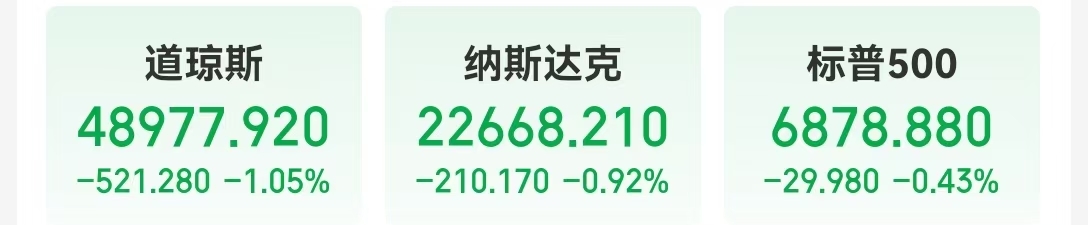
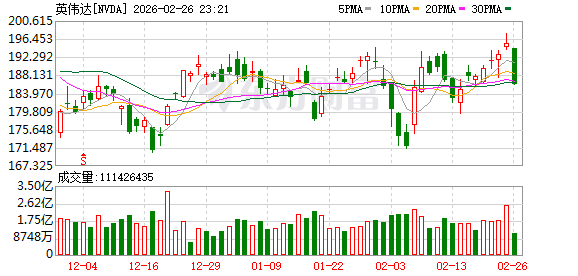
Market Performance - The U.S. stock market opened mixed with the Dow Jones up by 0.38%, while the Nasdaq and S&P 500 indices were down by 0.24% and 0.04% respectively. As of the report, the Dow Jones was up by 0.27%, the Nasdaq down by 0.84%, and the S&P 500 down by 0.36% [2] - A total of 2,712 stocks rose while 2,381 stocks fell [2] Company Specifics - Nvidia's earnings report exceeded expectations but received a lukewarm response, leading to a stock price drop of over 3.6% [2] - Major Chinese concept stocks mostly declined, with BeiGene down by 6.56%, Beike down by 5.85%, Baidu down by 4.83%, and Luckin Coffee down by 4.71% [3][4] - Baidu reported a year-over-year revenue decrease of 3% for the fiscal year 2025 [3] Commodity Market - International silver prices continued to decline, with COMEX silver futures dropping over 5% and spot silver down by over 3%. As of the report, COMEX silver futures were down by 4.6% and spot silver by 2.55% [7] - Gold prices also saw a slight drop, with COMEX gold futures falling by over 1% [7] Geopolitical Developments - The third round of indirect negotiations between Iran and the U.S. began in Geneva, focusing on nuclear issues. Iran expressed readiness to engage in discussions regarding sanctions and nuclear rights [9][10] - The outcome of these negotiations could significantly impact regional tensions, with potential for either a temporary agreement or a shift towards military options if core disagreements persist [10]





AI 硬件的上半场:失败、共识与进行中的探索
芯世相· 2026-02-26 07:06
Core Viewpoint - The article discusses the evolution of the AI hardware market in China, highlighting the shift from being a follower in global consumer electronics to taking a proactive role in defining future AI hardware products. This transformation is driven by the collaboration between model vendors and traditional hardware manufacturers, as well as elite entrepreneurs with backgrounds in large companies seeking to create native AI hardware solutions [6][20]. Group 1: Market Dynamics - Historically, Chinese companies have played a "follower" role in global consumer electronics, waiting for demand validation before leveraging manufacturing capabilities [6]. - The emergence of DJI has demonstrated that Chinese engineers can lead in new categories by solving novel problems, marking a shift in confidence and capability in AI hardware [6]. - The AI hardware market in China has seen a surge of interest, with two main forces shaping it: alliances between model vendors and traditional hardware, and elite entrepreneurs aiming to create original AI hardware [6][8]. Group 2: Initial Drivers - The initial push in the AI hardware sector was sparked by model vendors seeking commercialization pathways, particularly ByteDance, which catalyzed interest in integrating AI with hardware [8]. - By the end of 2024, ByteDance's model token costs dropped significantly, leading to collaborations with chip manufacturers and hardware solution providers to explore AI integration [8][12]. - The first product to gain traction was an AI toy, which was chosen due to its lower technical requirements and existing market validation [9][12]. Group 3: Market Challenges - Despite initial excitement, the AI toy market faced rapid decline after a peak during the 618 shopping festival, revealing high return rates and low consumer interest beyond initial novelty [14]. - The average usage time for AI toys was found to be less than two months, indicating a lack of sustained demand [14]. - The market quickly became saturated, leading to intense competition and diminishing returns for many companies involved [14][16]. Group 4: Investment Trends - A significant shift occurred in 2025, with investors increasingly favoring AI hardware startups over traditional software projects, driven by the perceived potential for quicker commercialization [20][22]. - Notable investments included Looki and Odyss, which attracted significant funding as investor interest in hardware surged [22][24]. - The consensus among investors is that AI hardware can provide more contextual data in the physical world compared to purely software solutions, leading to a renewed focus on hardware investments [24]. Group 5: Entrepreneurial Exploration - Entrepreneurs in the AI hardware space are divided on whether to focus on AI as a physical carrier or to create smarter consumer hardware with AI capabilities [26]. - Companies like Looki and Lightwear are exploring diverse applications of AI, while others like Odyss focus on specific, practical problems to justify consumer purchases [26][28]. - The challenge remains for these products to establish clear value propositions to consumers, as many current offerings lack compelling reasons for purchase [27][31].



Youdao Sends Mixed Signals As To Where The Company Is Going
Seeking Alpha· 2026-02-26 04:57
分组1 - Youdao (DAO), a developer and supplier of online learning technologies, saw its stock price increase by 10.2% on February 20 following positive comments from its largest shareholder [1] - The company specializes in providing online learning content, applications, and solutions, indicating a focus on the education technology sector [1] 分组2 - The stock appreciation suggests a positive market reaction to shareholder sentiment, which may indicate investor confidence in the company's future prospects [1] - The increase in stock price could reflect broader trends in the online learning industry, particularly as demand for digital education solutions continues to grow [1]

中概股龙头指数收涨0.94% 网易有道涨近10%




Mei Ri Jing Ji Xin Wen· 2026-02-20 22:10
Group 1 - The leading index of Chinese concept stocks rose by 0.94% on February 21 [1] - Among the constituent stocks, NetEase Youdao increased by nearly 10%, Hilltop Metal Mining rose over 5%, and Tuya Smart gained more than 4% [1] - Other notable gainers included Daylight Technology and Zhiyun Group, both rising over 3% [1] Group 2 - Century Internet and Lufax both fell by over 4%, while AHG and NEGG dropped more than 3% [1] - Other decliners included Wenyan Zhixing and Bilibili, which both decreased by over 2% [1]