
Alphabet(GOOG)

Search documents
Capgemini and Google Cloud expand strategic partnership to accelerate AI adoption at scale by providing trusted and secure sovereign solutions
Globenewswire· 2026-02-06 16:45
Core Insights - Capgemini and Google Cloud are expanding their strategic partnership to provide secure sovereign cloud solutions, focusing on AI adoption and modernization of critical operations while ensuring data protection and compliance [1][2][3] Group 1: Partnership Expansion - The partnership aims to deliver end-to-end secure sovereign cloud solutions, leveraging Google Cloud's AI technologies like Vertex AI and Gemini Enterprise [1][2] - Organizations will benefit from hyper-automated cloud operations that enhance cybersecurity, resilience, and compliance with sovereign requirements [2][4] Group 2: Sovereign Cloud Delivery Practice - Capgemini plans to establish a Google Sovereign Cloud Delivery Practice and Center of Excellence to meet unique sovereign requirements for clients [3][4] - This initiative will ensure secure modernization of core applications and infrastructure, such as ERP environments, while adhering to strict data residency mandates [3][4] Group 3: Enhanced Capabilities - Capgemini's capabilities are bolstered by its acquisition of Syniti and Cloud4C, enhancing its ability to deliver managed services for hybrid and sovereign cloud environments [3][5] - As a newly authorized GDC air-gapped operator, Capgemini can provide a fully managed service model for organizations needing total isolation from the public internet [4][5] Group 4: AI-led Transformation - Capgemini, with its extensive experience in AI-led digital transformation, is positioned to deliver safe and compliant innovation for high-value business processes [5][6] - The collaboration aims to accelerate unified legal, data, and operational control through intelligent transformation of business-critical systems [5][6]



Big Tech set to spend $650 billion in 2026 as AI investments soar
Yahoo Finance· 2026-02-06 16:39
Core Insights - The four major tech companies, Microsoft, Alphabet, Amazon, and Meta, are projected to invest over $650 billion in artificial intelligence in 2026, with significant capital expenditures planned [1][2][3] Investment Plans - Amazon plans to invest approximately $200 billion in capital expenditures by 2026 [1] - Alphabet's capital expenditures are expected to range between $175 billion and $185 billion for the current year [1] - Meta's spending is projected to be between $115 billion and $135 billion in 2026 [2] - Microsoft's annual run rate for capital expenditures is estimated at $145 billion for its 2026 fiscal year [2] Expenditure Growth - The total spending from these four companies is expected to increase by about 67% to 74% compared to their $381 billion expenditures in 2025, with a low-end estimate of $635 billion and a high-end estimate of $665 billion [3] Focus Areas - The majority of the investments will be directed towards AI chips, servers, and data center infrastructure [3] Market Reactions - Following the announcements, Amazon's stock fell over 8%, Alphabet's shares dropped 3%, and Microsoft experienced an 11% decline after reporting slower growth in its Azure cloud unit [5] - In contrast, Meta's stock rallied due to positive quarterly results and the impact of AI on its ad revenue [6] Investor Sentiment - Investors are exhibiting caution regarding the spending plans of tech companies, reflecting a more scrutinizing approach towards returns on AI investments [6][7] - There is a growing belief in the transformative potential of AI for enterprises, influenced by advancements from companies like Anthropic and Google's Gemini 3 [8]




Why Alphabet Will Likely Leapfrog Nvidia To Become World's Most Valuable Company
Seeking Alpha· 2026-02-06 16:36
Group 1 - The article emphasizes the importance of a well-diversified portfolio, suggesting a core foundation of a high-quality low-cost S&P 500 fund [1] - It advocates for an overweight position in the technology sector, which is believed to be in the early stages of a long-term secular bull market [1] - For dividend income, the article recommends large oil and gas companies that provide strong dividend income and growth [1] Group 2 - The author suggests a top-down capital allocation approach tailored to individual investor situations, including factors like age, risk tolerance, and financial goals [1] - Investment categories mentioned include S&P 500, technology, dividend income, sector ETFs, growth, speculative growth, gold, and cash [1]


Google Workers Demand End to Cloud Services for Immigration Agencies
Nytimes· 2026-02-06 16:22
More than 800 employees delivered a petition to management, condemning the Trump administration's use of Google technology in immigration enforcement. ...

Jim Cramer Says 'I Will Defend Amazon' After $200 Billion Spending Plan Triggers Selloff, Calls Google 'The Prize' - Amazon.com (NASDAQ:AMZN)
Benzinga· 2026-02-06 16:16
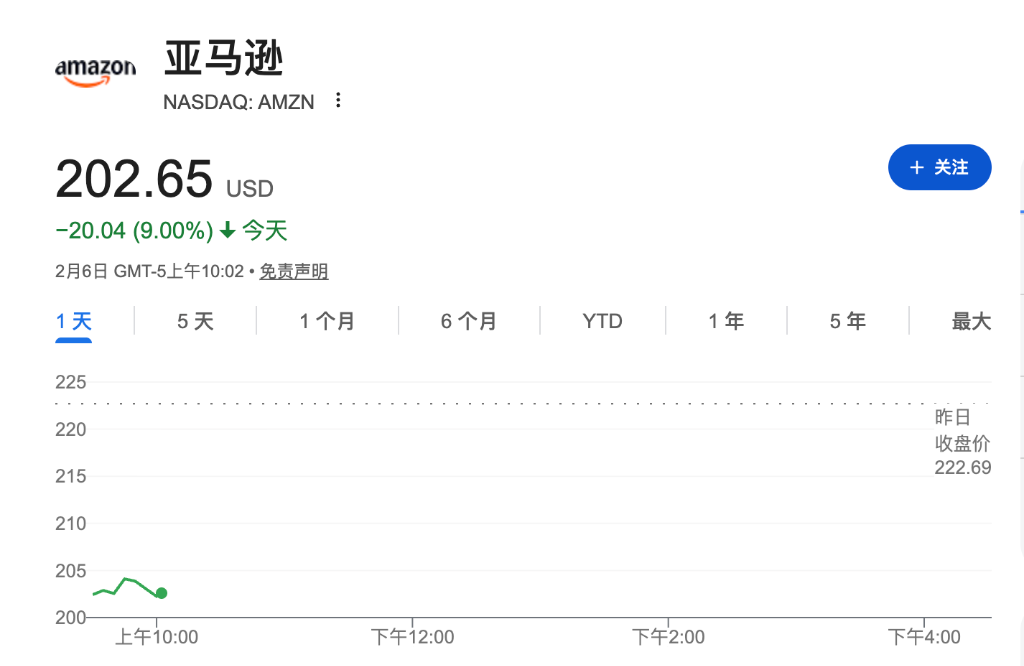
Group 1 - Jim Cramer defended Amazon.com Inc, acknowledging a fundamental shift in the market's relationship with mega-cap technology stocks [1][2] - Amazon reported fourth-quarter net sales of $213.39 billion, exceeding Wall Street expectations of $211.30 billion, but a $200 billion capital expenditure plan for 2026 caused investor concern [2][3] - Cramer highlighted Alphabet as a top pick among technology stocks, noting its increased capital spending forecast of $175 billion to $185 billion for 2026, indicating strong demand for AI infrastructure [3] Group 2 - As of Friday, Alphabet shares were down 3.09% at $321.00, while Amazon shares were down 8.34% at $204.12 [4]
AI泡沫忧虑引发抛售潮,美股科技巨头一周市值蒸发逾1万亿美元
Hua Er Jie Jian Wen· 2026-02-06 16:01
Group 1 - The market is experiencing significant volatility in the tech sector due to concerns over the return on capital investments in artificial intelligence (AI), with major companies like Microsoft, Nvidia, Amazon, Alphabet, Meta, and Oracle losing a total of approximately $1.35 trillion in market value [1] - Global tech giants are projected to invest around $660 billion in AI-related infrastructure this year, surpassing the GDP of several medium-sized economies, raising investor concerns about potential inefficiencies and overcapacity risks [1] - The sentiment in the market is shifting from a fear of missing out on the AI wave to a focus on evaluating the efficiency of capital expenditures, as highlighted by GAM Investments' Paul Markham [1] Group 2 - Amazon has announced an aggressive capital expenditure plan of $200 billion, representing a 56% year-over-year increase, which is the highest among major cloud service providers, but has raised investor concerns about short-term return visibility [4] - In contrast to Amazon, Apple has adopted a more cautious approach to AI capital spending, which has been positively received by the market, with its stock price increasing by 7% due to strong demand for the iPhone [4] - The market is undergoing a systematic reassessment of high capital expenditure models, with expectations that stock prices of related companies will continue to experience volatility and pressure as doubts about the sustainability and return paths of AI investments deepen [5]
1998年,奥尼尔100万买下谷歌原始股,如今出售值多少钱?
Xin Lang Cai Jing· 2026-02-06 15:25
Core Insights - Shaquille O'Neal made a significant investment of $1 million in Google in 1998, which has now appreciated to a value of at least $500 million, showcasing the immense growth of the tech giant [11]. Investment Background - In 1998, O'Neal was one of the highest-paid NBA players with a contract worth $120 million [3]. - O'Neal met a young boy in a hotel, whose father was one of Google's co-founders, leading to a discussion about investing in the company [5]. - After a thorough discussion, O'Neal recognized the potential of the internet and decided to invest $1 million, despite the risks associated with the nascent internet industry at that time [7]. Investment Philosophy - O'Neal viewed the $1 million investment as a long-term opportunity rather than an immediate profit-making venture [9]. - He has chosen to hold onto his Google shares throughout the company's growth, benefiting from substantial annual returns [13]. Current Financial Status - O'Neal's net worth has reached $1 billion, making him one of the wealthiest NBA players [13].

Earnings live: Amazon stock sinks, Philip Morris retreats, Reddit spikes as Wall Street focuses on guidance
Yahoo Finance· 2026-02-06 14:08
Group 1 - The fourth quarter earnings season is ongoing, with significant results from major companies like Alphabet, Amazon, AMD, Qualcomm, and Palantir [1] - As of January 30, 33% of S&P 500 companies have reported their fourth quarter results, with analysts estimating an 11.9% increase in earnings per share, marking the 10th consecutive quarter of annual earnings growth for the index [2][4] - Analysts had initially expected an 8.3% increase in earnings per share before raising expectations, particularly for tech companies, which have been key drivers of earnings growth in recent quarters [4] Group 2 - Big Tech's substantial capital expenditures are influencing the AI trade, alongside ongoing themes from 2025 such as artificial intelligence and economic policies, which continue to impact investor sentiment [5] - Updates from various companies including Disney, Chipotle, PepsiCo, Uber, and Snap were also highlighted during this earnings season [5]


Tech Rebound Ignites Friday Trading Amidst AI Spending Scrutiny
Stock Market News· 2026-02-06 14:07
Market Overview - U.S. stock futures are indicating a potential rebound after a significant tech-led sell-off, with Nasdaq 100 futures up 0.35%, S&P 500 futures rising 0.29%, and Dow Jones Industrial Average futures edging up 0.09% [2] - The S&P 500 fell 84.32 points (1.2%) to 6,798.40, the Dow Jones Industrial Average declined 592.58 points (1.2%) to 48,908.72, and the Nasdaq Composite lost 363.993 points (1.59%) to end at 22,904.579 on February 5th [3] - The main U.S. stock market index, the US500, has risen to 6846 points, gaining 0.70% from the previous session [4] Corporate Earnings and Performance - Major companies reporting earnings include Biogen, Philip Morris, Toyota Motors, and Under Armour, which will provide insights into corporate performance and economic health [6] - Amazon shares plunged over 11% after missing earnings expectations and issuing a capital expenditure guidance of $200 billion for 2026, leading to a drop of 8% in premarket trading [8] - Alphabet's stock fell as much as 5% due to concerns over its projected 2026 AI spending forecast of $175-$185 billion, which is roughly double the investment made in 2025, despite beating estimates on revenue and earnings per share [9] Notable Stock Movements - Apple has emerged as a "surprise winner" amidst the tech sell-off, with shares up 6% and a market capitalization of $4.06 trillion [13] - Microsoft experienced a significant market value wipeout with its stock falling as much as 12% intraday but is currently showing a slight gain of 0.72% [13] - Nvidia's stock is participating in the premarket recovery, up 3.4%, as it remains a central player in the AI revolution [13] - Tesla's shares fell below $400 for the first time this year, down over 11% in 2026, despite plans to expand its robotaxi service and mass-produce humanoid robots [13] - Newell Brands saw its stock sink 12% after issuing soft fiscal 2026 first-quarter guidance, projecting a wider loss per share and a larger sales drop than expected [13] Market Sentiment and Economic Indicators - Investors are closely watching premarket activity and digesting corporate earnings alongside a postponed key economic report on nonfarm payrolls, which adds uncertainty to the market [1][5] - Current projections suggest an 81.3% likelihood of the Federal Reserve leaving interest rates unchanged in March [5] - The ongoing narrative around AI investments and their perceived returns continues to shape investor sentiment across the tech landscape [10]



Alphabet (GOOG): One of the Biggest Beneficiaries of the AI Transition
Yahoo Finance· 2026-02-06 13:41
Core Insights - Pelican Bay Capital Management (PBCM) reported a strong performance in its fourth-quarter 2025 investor letter, with its Concentrated Value Strategy returning 8.5%, outperforming the Russell 1000 Value Index which returned 3.8% [1] - The strategy's full-year return was 20.6%, compared to 15.9% for the Index, driven by AI-related stocks and commodities exposure [1] Company Performance - Alphabet Inc. (NASDAQ:GOOG) was highlighted as a significant contributor to PBCM's strategy performance in the fourth quarter [2] - As of February 5, 2026, Alphabet's stock closed at $331.33 per share, with a market capitalization of $4.008 trillion, and a one-month return of 0.67% [2] - Over the last 52 weeks, Alphabet's shares gained 77.05% in value [2] AI Transition and Market Position - Alphabet Inc. has been recognized as one of the biggest beneficiaries of the AI transition, with its Gemini Large Language Model (LLM) being a leading model alongside Claude and ChatGPT [3] - The perception of Alphabet has improved significantly since the initial purchase in March 2023, when there were concerns about missing the AI boom and potential deterioration of its search monopoly [3] Hedge Fund Interest - Alphabet Inc. ranks 7th on the list of the 30 Most Popular Stocks Among Hedge Funds, with 186 hedge fund portfolios holding its stock at the end of the third quarter, up from 178 in the previous quarter [5] - In 2025, Alphabet achieved its first-ever $400 billion annual revenue [5]