Home Depot(HD)

Search documents
Mixed quarter at Home Depot with less storm damage to homes and a more anxious shopper
Yahoo Finance· 2025-11-18 11:09
Core Insights - Home Depot's third-quarter results were mixed, with a decline in earnings and a lowered fiscal 2025 adjusted earnings forecast, despite an increase in sales growth expectations [1][2] Financial Performance - For the three months ended Nov. 2, Home Depot reported earnings of $3.6 billion, or $3.62 per share, compared to $3.65 billion, or $3.67 per share a year earlier [1] - Adjusted earnings, excluding one-time charges, were $3.74 per share, falling short of Wall Street expectations by ten cents [2] - Revenue increased to $41.35 billion from $40.22 billion, surpassing Wall Street projections of $41.15 billion [3] Sales Metrics - Comparable store sales rose by 0.2%, with U.S. comparable store sales increasing by 0.1% [4] - Customer transactions decreased by 1.4%, while the average transaction amount increased to $90.39 from $88.65 in the previous year [4] Market Conditions - CEO Ted Decker attributed the earnings miss to fewer storms impacting sales and consumer uncertainty affecting home improvement demand [3] - External factors, such as increased consumer anxiety regarding the economy, were noted as significant contributors to the quarter's performance [5] Strategic Positioning - Analysts believe Home Depot is well-positioned to navigate current adverse market conditions due to its scale, operating strategy, and business mix [6]

Home Depot Cuts Outlook As Home Improvement Slowdown Continues
WSJ· 2025-11-18 11:09
Core Insights - Home Depot reported a decline in third-quarter profit and has revised its full-year outlook downward due to a prolonged downturn in home improvement activity [1] Company Summary - The company is experiencing a significant decrease in profitability, indicating challenges in the home improvement sector [1] - Home Depot's lowered full-year outlook suggests that the current market conditions are expected to persist, impacting future performance [1] Industry Summary - The home improvement industry is facing an extended downturn, with little indication of recovery in the near term [1]


Home Depot(HD) - 2026 Q3 - Quarterly Results
2025-11-18 11:05
Financial Performance - The Home Depot reported third quarter fiscal 2025 sales of $41.4 billion, an increase of $1.1 billion or 2.8% from the same period in fiscal 2024[1]. - Net earnings for the third quarter were $3.6 billion, or $3.62 per diluted share, compared to $3.6 billion, or $3.67 per diluted share in the same period of fiscal 2024[1][2]. - Adjusted diluted earnings per share for the third quarter were $3.74, down from $3.78 in the same period of fiscal 2024[2]. - Operating margin for the third quarter was approximately 12.6%, with an adjusted operating margin of approximately 13.0%[6]. - The diluted earnings per share are expected to decline approximately 6.0% from $14.91 in fiscal 2024[6]. - Net earnings for the nine months ended November 2, 2025, were $11,585 million, slightly down from $11,809 million in the same period of 2024, a decrease of 1.9%[16]. - The company reported a diluted earnings per share (GAAP) of $3.62 for the three months ended November 2, 2025, down 1.4% from $3.67 in the same period of 2024[24]. Sales and Growth Projections - The company updated its fiscal 2025 guidance to reflect total sales growth of approximately 3.0%, with GMS expected to contribute approximately $2.0 billion in incremental sales[3]. - Comparable sales growth is projected to be slightly positive for the comparable 52-week period[3]. - Customer transactions decreased by 1.4% to 393.5 million in the third quarter compared to 399.0 million in the same period of fiscal 2024[12]. Store Operations - The company plans to open approximately 12 new stores in fiscal 2025[3]. - The company operated a total of 2,356 retail stores and over 1,200 SRS locations at the end of the third quarter[5]. Assets and Liabilities - Total assets increased to $106,274 million in November 2025, up from $97,264 million in October 2024, representing a growth of 9.3%[14]. - Total current liabilities rose to $34,367 million in November 2025, compared to $29,092 million in October 2024, marking an increase of 18.4%[14]. Cash Flow and Investments - Cash and cash equivalents at the end of the period were $1,684 million, an increase from $1,531 million at the end of October 2024[16]. - Capital expenditures for the nine months ended November 2, 2025, were $2,621 million, compared to $2,384 million in the same period of 2024, reflecting an increase of 9.9%[16]. - The net cash used in investing activities for the nine months ended November 2, 2025, was $7,765 million, significantly lower than $19,912 million in the same period of 2024[16]. Stockholders' Equity - The company reported a total stockholders' equity of $12,116 million in November 2025, a substantial increase from $5,786 million in October 2024[14].
Home Depot beats quarterly sales estimates
Reuters· 2025-11-18 11:04
Core Insights - Home Depot exceeded third-quarter sales expectations due to strong demand from professional builders and contractors, which compensated for a decline in do-it-yourself projects [1] Company Performance - The company reported robust sales driven by professional segments, indicating a shift in consumer behavior towards professional services [1] Market Trends - There is a noticeable slowdown in do-it-yourself projects, suggesting a potential shift in market dynamics and consumer preferences [1]
The Home Depot Announces Third Quarter Fiscal 2025 Results; Updates Fiscal 2025 Guidance
Prnewswire· 2025-11-18 11:00
Core Insights - The Home Depot reported third-quarter sales of $41.4 billion for fiscal 2025, marking a 2.8% increase from the same period in fiscal 2024, with approximately $900 million attributed to the acquisition of GMS Inc. [1][2] - Net earnings for the quarter were $3.6 billion, or $3.62 per diluted share, a slight decrease from $3.67 per diluted share in the previous year [2][12]. - The company updated its fiscal 2025 guidance due to pressures from a lack of storm activity and ongoing consumer uncertainty affecting home improvement demand [3][8]. Financial Performance - Total sales for the third quarter increased by $1.1 billion, with comparable sales rising by 0.2% [1][12]. - Adjusted diluted earnings per share were $3.74, down from $3.78 in the same quarter of fiscal 2024 [2][20]. - Operating income for the quarter was $5.35 billion, reflecting a 1.2% decrease compared to the previous year [12][18]. Market Conditions - The CEO noted that the results fell short of expectations primarily due to the absence of storms, which typically drive demand in certain categories [3][8]. - Consumer uncertainty and pressures in the housing market are believed to be disproportionately impacting home improvement demand [3][8]. Store Operations - As of the end of the third quarter, The Home Depot operated 2,356 retail stores and over 1,200 SRS locations across various regions [5][12]. - The company employs over 470,000 associates [5]. Future Guidance - The company anticipates total sales growth of approximately 3.0% for fiscal 2025, with GMS expected to contribute around $2.0 billion in incremental sales [8][21]. - The guidance includes expectations for approximately 12 new store openings and a gross margin of about 33.2% [8][21].


Stock Market Today: Dow Jones, S&P 500 Futures Tumble—Home Depot, Axalta Coating Systems, Molina Healthcare In Focus
Benzinga· 2025-11-18 10:28
Market Overview - U.S. stock futures declined on Tuesday following a sell-off on Monday, with major benchmark indices showing lower futures [1] - Market sentiment remains cautious ahead of post-shutdown economic data and Nvidia Corp.'s earnings report [1] - The 10-year Treasury bond yielded 4.10%, while the two-year bond was at 3.57% [2] - The CME Group's FedWatch tool indicates a 46.4% likelihood of the Federal Reserve cutting interest rates in December [2] Index Performance - Dow Jones futures decreased by 0.23%, S&P 500 by 0.15%, Nasdaq 100 by 0.15%, and Russell 2000 by 0.29% [2] - The SPDR S&P 500 ETF Trust (SPY) was down 0.19% at $664.42, and Invesco QQQ Trust ETF (QQQ) declined 0.24% to $602.23 in premarket trading [2] Stocks in Focus - Axalta Coating Systems (AXTA) surged 10.68% after announcing an all-stock merger with Akzo Nobel N.V. [6] - Molina Healthcare (MOH) rose 3.05% following a proposed offering of $750 million in Senior Notes and support from investor Michael Burry [6] - Avantor Inc. (AVTR) increased by 2.76% as CEO Ligner Emmanuel purchased shares worth $993,125 [6] - Home Depot (HD) fell 0.71% with expected earnings of $3.85 per share on revenue of $41.14 billion [6] - Helmerich and Payne Inc. (HP) dropped 8.22% despite reporting quarterly sales of $1.012 billion, exceeding analyst estimates [14] Sector Performance - Materials, financials, and energy sectors experienced the largest losses on Monday, while communication services and utilities closed higher [8] Economic Insights - LPL Financial anticipates a transforming market landscape in 2026, driven by a resilient economy and AI efficiency gains [10] - The firm emphasizes that achieving double-digit earnings growth will be crucial for stock performance [11] - Historical trends suggest stocks perform well when the Fed cuts rates near all-time highs, although current valuations pose risks [12]




Home Depot Earnings Are Imminent; These Most Accurate Analysts Revise Forecasts Ahead Of Earnings Call - Home Depot (NYSE:HD)
Benzinga· 2025-11-18 08:47
Core Viewpoint - Home Depot is set to release its third-quarter earnings results, with analysts expecting an increase in earnings per share and revenue compared to the previous year [1][2] Earnings Expectations - Analysts predict Home Depot will report earnings of $3.83 per share, up from $3.67 per share in the same quarter last year [1] - The consensus estimate for quarterly revenue is $41.12 billion, compared to $40.22 billion a year earlier [1] Recent Performance - Home Depot has beaten revenue estimates in six of the last ten quarters but missed estimates in the most recent second quarter [2] - The company's shares fell by 1.2%, closing at $358.03 on Monday [2] Analyst Ratings - Telsey Advisory Group maintains an Outperform rating with a price target of $455 [4] - Wells Fargo has an Overweight rating, reducing the price target from $450 to $435 [4] - JP Morgan maintains an Overweight rating, lowering the price target from $452 to $444 [4] - Truist Securities holds a Buy rating, cutting the price target from $454 to $421 [4] - Morgan Stanley maintains an Overweight rating, increasing the price target from $415 to $430 [4]

Home Depot Earnings Are Imminent; These Most Accurate Analysts Revise Forecasts Ahead Of Earnings Call
Benzinga· 2025-11-18 08:47
Core Viewpoint - Home Depot is set to release its third-quarter earnings results, with analysts expecting an increase in earnings per share and revenue compared to the previous year [1][2]. Earnings Expectations - Analysts anticipate Home Depot will report earnings of $3.83 per share, up from $3.67 per share in the same quarter last year [1]. - The consensus estimate for quarterly revenue is $41.12 billion, compared to $40.22 billion a year earlier [1]. Recent Performance - Home Depot has exceeded revenue analyst estimates in six of the last ten quarters but missed estimates in the most recent second quarter [2]. - The company's shares fell by 1.2%, closing at $358.03 on Monday [2]. Analyst Ratings and Price Targets - Telsey Advisory Group maintains an Outperform rating with a price target of $455 [4]. - Wells Fargo has an Overweight rating, reducing the price target from $450 to $435 [4]. - JP Morgan holds an Overweight rating, lowering the price target from $452 to $444 [4]. - Truist Securities maintains a Buy rating, cutting the price target from $454 to $421 [4]. - Morgan Stanley has an Overweight rating, increasing the price target from $415 to $430 [4].
美国消费健康状况风向标本周揭晓:家得宝(HD.US)、劳氏(LOW.US)财报将释放重要信号
Zhi Tong Cai Jing· 2025-11-18 07:01
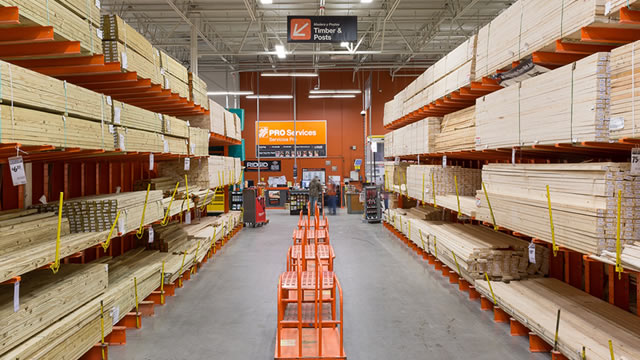
Group 1 - Home Depot and Lowe's are expected to report slight sales growth in their upcoming quarterly earnings, providing insight into market conditions and consumer spending on home improvement and DIY projects [1] - The companies face higher raw material costs due to tariffs imposed by the Trump administration, but a temporary pause on tariffs for Chinese goods may offer short-term relief [1] - The actual tariff rate borne by American consumers has surged to 17.9%, the highest level since 1934, adding pressure to household budgets [1] Group 2 - Analysts predict Home Depot's same-store sales will grow by 1.5% in the third quarter, compared to a decline of 1.3% in the same period last year [3] - Lowe's is expected to see a 1% increase in same-store sales, up from a 1.1% decline in the previous year [4] - The stock prices of Lowe's and Home Depot have dropped approximately 16% and over 11% respectively in the past 12 months, while the S&P 500 index has risen by 15% [3] Group 3 - Demand for home improvement is anticipated to be led by professional customers, while DIY customers are expected to engage in smaller projects [6] - Home Depot and Lowe's are increasing their focus on professional contractors and builders to offset weak DIY demand during a sluggish real estate market [6] - Lowe's has made significant acquisitions, including a $1.33 billion purchase of Artisan Design and an almost $8.8 billion acquisition of Foundation Building Materials, while Home Depot announced a $4.3 billion acquisition of GMS [6]

Home Depot, Medtronic And 3 Stocks To Watch Heading Into Tuesday - AECOM (NYSE:ACM)
Benzinga· 2025-11-18 06:33
Earnings Reports - Home Depot Inc. is expected to report quarterly earnings of $3.85 per share on revenue of $41.14 billion [2] - Helmerich and Payne Inc. reported a loss of 1 cent per share for the fourth quarter, with quarterly sales of $1.012 billion, exceeding the analyst consensus estimate of $973.678 million [2] - Medtronic PLC is anticipated to post quarterly earnings of $1.31 per share on revenue of $8.87 billion [2] - Aecom is expected to report quarterly earnings of $1.34 per share on revenue of $4.31 billion [2] Stock Movements - Home Depot shares fell 0.4% to $356.70 in after-hours trading [2] - Helmerich and Payne shares dipped 8.2% to $25.34 in after-hours trading [2] - Medtronic shares rose 0.1% to $96.29 in after-hours trading [2] - Aecom shares gained 0.8% to $132.99 in after-hours trading [2] Mergers and Acquisitions - Akzo Nobel N.V. and Axalta Coating Systems Ltd. agreed to an all-stock merger of equals, resulting in Axalta Coating shares jumping 13.2% to $31.90 in after-hours trading [2]