Lilly(LLY)

Search documents
Alzheimer’s Drug Franchise Decides Eli Lilly And Co.’s (LLY) Performance
Yahoo Finance· 2025-09-22 12:38
Macquarie Asset Management, an investment management company, released its “Macquarie Large Cap Growth Fund” investor letter for the second quarter of 2025. A copy of the letter can be downloaded here. The second quarter of 2025 endured significant government policy changes and geopolitical events, which resulted in volatility yet ended with robust performance for equity markets. The Fund’s Institutional Class shares posted an absolute positive return of 11.24% in the quarter, but underperformed the benchma ...

Is Eli Lilly Stock a Buy After Gaining 10% in 1 Month?
Yahoo Finance· 2025-09-22 12:25
Key Points Eli Lilly's shares have increased by about 10% over the past month. Clinical progress in the past few weeks has helped solidify its lead in the weight loss market. The company's prospects remain attractive, especially while the stock is still down year to date. 10 stocks we like better than Eli Lilly › It's been a volatile year for Eli Lilly (NYSE: LLY), with the pharmaceutical giant experiencing some setbacks. However, the drugmaker has been on a roll over the past month, with several ...
1 ETF to Buy Before the End of 2025
Yahoo Finance· 2025-09-22 11:13
Group 1 - The Vanguard Growth ETF (NYSEMKT: VUG) is recommended as a compelling growth investment option before the end of 2025, offering diversification compared to individual growth stocks [1][2] - The ETF has shown impressive long-term performance, with a 5-Year Average Annual Return of 16.69%, a 10-Year Average Annual Return of 17.25%, and a 15-Year Average Annual Return of 16.90%, outperforming the SPDR S&P 500 ETF [3] - The Vanguard Growth ETF holds over 300 stocks, with significant investments in major tech companies such as Nvidia (12.64%), Microsoft (12.18%), and Apple (9.48%), among others [4][5] Group 2 - The ETF is characterized as a powerful growth-oriented investment, providing exposure to a broad range of high-powered tech stocks, making it a preferable option over selecting individual stocks [5][6] - Despite its potential, the ETF's growth stocks can be volatile, and a long-term investment strategy is recommended for optimal results [6] - The Motley Fool Stock Advisor has identified 10 stocks that they believe are better investment opportunities than the Vanguard Growth ETF, suggesting that investors should consider these alternatives [7]




罗氏(RHHBY.US)减肥药CT-388明年推进后期试验 挑战礼来、诺和诺德主导地位
智通财经网· 2025-09-22 09:33
Core Viewpoint - Roche plans to advance its experimental weight loss drug CT-388 to late-stage trials next year, aiming to compete with leading companies like Eli Lilly and Novo Nordisk in the weight loss market [1] Company Summary - Roche's CT-388 faced a significant stock price drop last year due to early research revealing side effects such as nausea and vomiting, but the company emphasized that the incidence of these side effects is comparable to competitors [1] - Roche has entered a $5.3 billion collaboration with a New Zealand pharmaceutical company to co-develop Zealand's weight loss drug, while also having another weight loss drug in its own pipeline [1] - CT-388 has a similar mechanism of action to Eli Lilly's flagship product Zepbound, promoting satiety and reducing food intake by activating GLP-1 and GIP receptors [1] - Roche disclosed that combining CT-388 with Zealand Pharma's pipeline drug could potentially create a "best-in-class" treatment option with better tolerability [1] - As of last Friday, Roche's stock price increased by 1.46%, with a year-to-date gain of approximately 5.4% [1] Industry Summary - The obesity market is currently dominated by Eli Lilly and Novo Nordisk, with sales expected to exceed $100 billion by 2030 [1]



高额“回扣”下,药企纷纷撤离英国
Hu Xiu· 2025-09-22 06:17
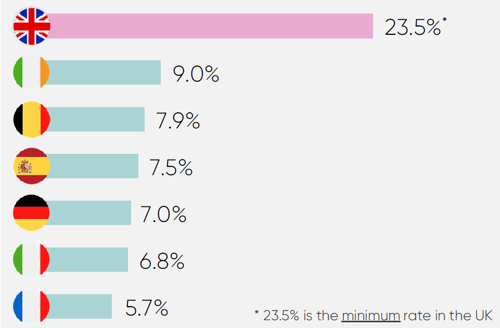
Core Viewpoint - The article discusses a significant retreat of multinational corporations (MNCs) from the UK pharmaceutical sector, driven by increasing tax burdens and unfavorable policy changes, leading to a perception of the UK as an "investment black hole" for the industry [6][30]. Group 1: Corporate Actions - Merck announced the closure of its drug research center in London, transferring all R&D operations to the US [2]. - Eli Lilly halted its planned biotechnology incubator project in the UK, citing a need to wait for a clearer life sciences environment [3]. - AstraZeneca froze a £200 million investment in its Cambridge research center, signaling a broader trend of MNCs withdrawing from the UK [4]. - Sanofi also publicly stated it would adopt a similar stance towards the UK, joining the retreat [5]. Group 2: Tax and Policy Challenges - MNCs are facing multiple tax burdens in the UK, including corporate tax, R&D tax, and drug sales rebates, which are pressuring their operations [8]. - The NHS's pricing scheme requires pharmaceutical companies to rebate a percentage of their sales to the NHS, directly impacting their investment returns [9]. - The rebate rate for drugs under the statutory pricing scheme was increased to 22.9%, with proposals suggesting it could rise to 23.8%, meaning companies may have to return up to 32.2% of their sales to the NHS [12]. Group 3: Impact of Brexit - The UK's exit from the EU has led to a significant decline in approval efficiency for new drugs, with the UK dropping from 6th to 18th in global rankings for drug approvals [19]. - The cancellation of the EU's free movement policy has hindered the formation of cross-border research teams and slowed clinical trial processes [21]. - The UK government's pursuit of higher rebates and budget cuts for drugs has further marginalized the country in the global pharmaceutical landscape [29]. Group 4: Industry Sentiment and Future Outlook - The lack of consensus between the government, pharmaceutical companies, and patients has led to a situation where all parties are losing out, with companies withdrawing, patients facing limited access to drugs, and the government experiencing a trust crisis [30][34]. - The article warns that if the rebate rates remain above 20%, the UK could lose approximately £11 billion (about 106.6 billion RMB) in R&D investments by 2033 [16]. - Despite some companies like BioNTech and GSK remaining in the UK, their commitment is questioned as they also plan significant investments elsewhere, such as GSK's $30 billion investment in the US [16].


Eli Lilly: Orforglipron Sets Path Of Continued Revenue Growth In T2D And Obesity
Seeking Alpha· 2025-09-21 12:44
Company Overview - Eli Lilly (NYSE: LLY) is recognized as a leading player in the obesity and type 2 diabetes treatment markets, driven by the approvals of its drugs Zepbound and Mounjaro [2]. Market Opportunities - There are significant expansion opportunities for Eli Lilly in the obesity and type 2 diabetes treatment sectors, indicating potential for growth and increased market share [2].
Eli Lilly (LLY) Plans $5 Billion Virginia Facility to Boost Monoclonal Antibody Production
Yahoo Finance· 2025-09-21 08:11
Eli Lilly & Company (NYSE:LLY) ranks among the best fundamental stocks to buy right now. Eli Lilly & Company (NYSE:LLY) revealed plans on September 16 to build a $5 billion manufacturing facility in Goochland County, Virginia. This is the first of four new U.S. production locations that Eli Lilly & Company (NYSE:LLY) hopes to reveal this year. The facility will be Eli Lilly’s first fully integrated facility for active pharmaceutical ingredients and therapeutic products specifically designed for the compa ...
2 Magnificent S&P 500 Dividend Stocks Down 7% and 19% to Buy and Hold Forever
The Motley Fool· 2025-09-20 17:25
Core Viewpoint - Despite the strong performance of the S&P 500 index, Coca-Cola and Eli Lilly have underperformed, presenting attractive buying opportunities for long-term dividend-seeking investors [1][2]. Group 1: Coca-Cola - Coca-Cola operates in over 200 countries and has seen a 5% revenue growth in the second quarter, excluding foreign currency fluctuations and acquisitions/divestitures [4]. - The revenue increase was driven by higher prices and a changing product mix, contributing 6 percentage points, while lower volume subtracted 1 percentage point [5]. - Coca-Cola has a 3.1% dividend yield, significantly higher than the S&P 500's 1.2%, and a payout ratio of 71%, indicating strong dividend sustainability [7][6]. Group 2: Eli Lilly - Eli Lilly generates significant revenue from three key drugs, which account for 65% of its $15.6 billion second-quarter revenue, with growth rates ranging from 12% to 172% [8]. - The company reported a 38% revenue growth in the second quarter and a 61% increase in adjusted earnings per share to $6.31, with management raising its 2025 revenue guidance to over 35% growth [9]. - Eli Lilly has a 0.8% dividend yield and a 37% payout ratio, with consistent annual dividend increases since 2015, indicating strong earnings coverage for dividends [10].

Jim Cramer Explains Why Eli Lilly May Not Be Next to Hit $1 Trillion
Yahoo Finance· 2025-09-20 04:45
Eli Lilly and Company (NYSE:LLY) is one of the stocks Jim Cramer recently discussed. While talking about the company, Cramer said that investors are not “supposed to buy drug stocks” when the Fed is cutting rates. He remarked: “Not that long ago, pretty much everybody assumed that the next non-tech stock to cross the trillion-dollar threshold would be the stock of Eli Lilly. Why not? They’ve developed a weight loss and diabetes wonder drug with incredible prospects… Right now, Lilly’s market capitalizatio ...
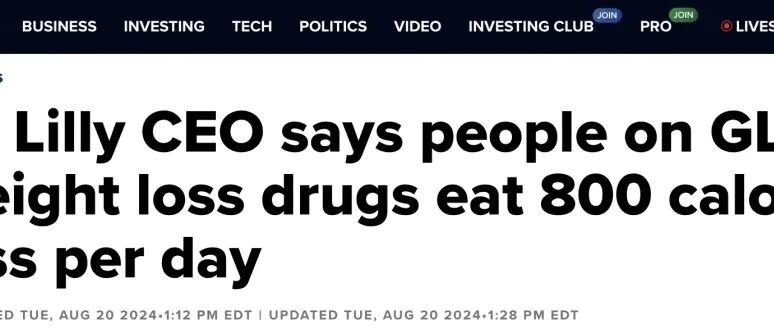
礼来CEO亲自表示:服用替尔泊肽,每天减少摄入800大卡!
GLP1减重宝典· 2025-09-20 04:04
Core Viewpoint - The article discusses the significant impact of the drug Tirzepatide (Zepbound) on weight loss and its implications for the food industry, highlighting its effectiveness and the growing demand since its approval by the FDA in late 2023 [4][6][12]. Group 1: Drug Efficacy and Impact - After using Tirzepatide, patients reportedly reduce their daily caloric intake by approximately 800 calories, equivalent to one meal [4][5]. - In clinical trials, patients using the highest dosage of Tirzepatide lost an average of 22.5% of their body weight [6]. - A study conducted by Fudan University confirmed that Tirzepatide is safe and effective for weight loss in Chinese adults, with participants losing an average of 16.1 kg over 52 weeks [9][10]. Group 2: Market Dynamics and Competition - Tirzepatide belongs to the rapidly growing GLP-1 drug class, which mimics gut hormones to regulate blood sugar and suppress appetite [8]. - Major competitors in the GLP-1 space include Novo Nordisk, which produces Ozempic and Wegovy, both containing the active ingredient Semaglutide [12]. - The popularity of GLP-1 drugs has led to increased stock prices for companies like Eli Lilly, but concerns remain about potential negative impacts on the food and beverage industry [14].