ServiceNow(NOW)

Search documents
2 software stocks with at least 50% upside potential: Morningstar
Business Insider· 2026-02-07 10:15
Core Viewpoint - The software sector experienced a significant sell-off, with the iShares Expanded Tech-Software Sector ETF (IGV) dropping 19% from January 26 to February 5, but Morningstar believes the fears surrounding AI's impact on the industry are exaggerated and presents a buying opportunity [1][2]. Group 1: Market Performance and Analyst Insights - Morningstar's senior equity analyst, Dan Romanoff, stated that there is little evidence supporting the bear case for software stocks, as retention rates and other metrics remain solid [2]. - Despite the sell-off, software stocks showed signs of recovery, with IGV rising 3% and the Nasdaq increasing by over 2% on a recent Friday [3]. - Romanoff identified Microsoft (MSFT) and ServiceNow (NOW) as having substantial upside potential, with shares down 17% and 35% year to date, respectively [4]. Group 2: AI Impact and Revenue Generation - Concerns that AI will significantly disrupt the software industry may be overstated, as many firms still view AI with skepticism [5]. - AI products currently account for approximately 2% of revenue for software vendors, indicating that they are not generating substantial revenue [6]. - Historical instances of automation have not led to major disruptions in labor markets, suggesting that current fears may not materialize [6]. Group 3: Future Outlook and Employment Trends - While there may be future pressure on seat counts, there is no current evidence of this affecting sales representatives, as seen in the historical context of Salesforce's CRM approach [7]. - Headcount across functional areas continues to increase, indicating that fears of job losses due to automation are not currently reflected in the market [7].




Wall Street Roundup: Risk Off
Seeking Alpha· 2026-02-06 18:25
Group 1: Bitcoin Market Dynamics - Bitcoin has experienced a significant decline, down 13% this week and 27% over the past month, with its value dropping from a peak of over $126,000 to below $63,000 [4][5] - The selling pressure was exacerbated by leveraged positions being forced to liquidate, indicating Bitcoin's status as a risk asset rather than a stable currency [6] - The volatility in Bitcoin reflects broader market concerns about overvaluation and risk allocation in investment portfolios [3][6] Group 2: Software Stocks and AI Impact - Software stocks have seen substantial declines, with major players like Microsoft down 7%, Adobe down 10%, and Oracle down 16%, driven by fears that AI advancements may render many companies obsolete [10][15] - New AI tools announced by companies like Anthropic and Google have contributed to market anxiety, leading to a sell-off in related stocks [7][10] - The market is grappling with the dual concerns of high capital expenditures on AI that may not yield expected returns and the potential for AI to disrupt entire industries [16][18] Group 3: Earnings Reports and Market Reactions - Alphabet reported an 18% revenue increase and a 48% growth in cloud revenue, but its stock fell due to high capital expenditure predictions for 2026, which could consume a significant portion of its profits [12][13] - Amazon's projected capital expenditures for 2026 are also high, at $200 billion, representing 28% of its revenue and 256% of its net income, raising concerns about sustainability [14][15] - Hershey's stock rose 9% after beating earnings expectations and raising guidance, reflecting a shift towards more resilient consumer staples amid economic uncertainty [27][28] Group 4: Economic Indicators and Job Market Concerns - Recent job market data indicates rising initial jobless claims and the lowest job openings since September 2020, suggesting a weakening labor market [31][32] - Layoffs announced by major companies like Amazon and UPS contribute to a pessimistic outlook for upcoming job reports [32][33] - The defensive rotation in the market is evident as investors seek stability in traditional sectors like consumer staples and healthcare, moving away from riskier tech assets [26][31]



Low Volatility ETFs to Watch Amid Major Tech Sell-Off Over AI Panic
ZACKS· 2026-02-06 15:30
Core Insights - A significant sell-off in technology stocks, including Microsoft, Salesforce, and ServiceNow, resulted in a loss of nearly $1 trillion in market value within a week, indicating a major shift in market sentiment [1][10] - The Cboe Volatility Index (VIX) surged by 17% to close at 21.77, marking its highest level since late November, reflecting increased market volatility [2][10] - The sell-off was primarily driven by fears surrounding artificial intelligence, particularly following the launch of productivity tools by AI startup Anthropic, which raised concerns about the viability of traditional software business models [3][4][5] Market Dynamics - The panic surrounding AI has transformed it from a growth catalyst into a perceived threat, leading to significant losses for major tech companies [4][5] - There is a notable rotation from technology stocks into value-oriented sectors such as consumer staples, which aligns with low-volatility investment strategies [6][7][8] - U.S. ETFs saw inflows of $165 billion in January 2026, surpassing the total inflows of the previous three Januarys combined, indicating a shift in investor sentiment [7] Investment Opportunities - Low-volatility ETFs are becoming increasingly attractive as they typically hold stocks with smaller price fluctuations, often found in sectors like consumer staples, utilities, and healthcare [6] - Suggested low-volatility ETFs include: - iShares MSCI USA Min Vol Factor ETF (USMV) with net assets of $23.08 billion, gaining 2.4% over the past year [11][12] - iShares MSCI Global Min Vol Factor ETF (ACWV) with net assets of $3.42 billion, rallying 7.9% over the past year [13] - Invesco S&P 500 Low Volatility ETF (SPLV) with a market value of $7.77 billion, gaining 3.9% over the past year [14]

ServiceNow (NOW)’s Decline is Overdone, Says Jim Cramer
Yahoo Finance· 2026-02-06 14:08
Core Viewpoint - ServiceNow, Inc. (NYSE:NOW) has experienced a significant decline in its stock price, down 45.9% over the past year and 25% year-to-date, despite reporting strong earnings that exceeded analyst expectations [2]. Financial Performance - ServiceNow reported $3.5 billion in fourth-quarter revenue and $0.92 in adjusted profit per share, both surpassing analyst estimates of $3.57 billion and $0.88 respectively [2]. - The company forecasts first-quarter revenue between $3.65 billion and $3.66 billion, which is higher than the analyst estimate of $3.57 billion [2]. Analyst Ratings - Bernstein has reiterated an Outperform rating with a price target of $219, indicating that ServiceNow is undervalued compared to its software industry peers [2]. - Stifel has reduced its price target from $200 to $180 while maintaining a Buy rating, suggesting that a shift in investor sentiment is necessary for the stock to re-rate [2]. Management and Strategic Moves - The CEO, Bill McDermott, has signed a five-year deal, alleviating concerns about his potential departure, and the company is initiating a $2 billion accelerated share repurchase as part of a $5 billion buyback program [4].
BetterInvesting™ Magazine Update on ServiceNow Inc. (NYSE: NOW) and Deckers Outdoors Corp. (NYSE: DECK)
Prnewswire· 2026-02-06 12:29
Group 1 - ServiceNow Inc. has been named "Stock to Study" by BetterInvesting Magazine for April 2026, indicating potential interest from investors regarding its stock valuation [1] - The fundamental data for ServiceNow, including sales, earnings, pre-tax profit, and return on equity, is accessible through the National Association of Investors Corp. [2] - A full report on ServiceNow will be published in the April 2026 issue of BetterInvesting Magazine, providing detailed insights for investors [2] Group 2 - The same April 2026 issue will also feature a fundamental review of Deckers Outdoor Corp., which is considered undervalued and worthy of further study [3] - The Editorial Advisory and Securities Review Committee of BetterInvesting consists of several CFA members, indicating a robust analytical framework for stock evaluation [3]


科技巨头CEO齐声反驳“AI替代论”:毫无逻辑、“歇斯底里”
Jin Shi Shu Ju· 2026-02-06 04:27
Group 1 - The CEOs of major tech companies dismiss concerns that AI will erode the competitive moat of traditional software companies, despite significant stock declines in recent months [1] - Nvidia's CEO Jensen Huang argues that the idea of the tools industry declining due to AI is illogical, emphasizing that both humans and robots will continue to use existing tools rather than reinvent them [1] - Major enterprise software stocks like Palantir and Oracle have seen declines of approximately 12% over the past three trading days, with other companies like Salesforce, SAP, ServiceNow, Snowflake, and Microsoft also experiencing significant drops [1] Group 2 - Investors are worried that SaaS companies' clients may develop internal software solutions using AI tools from providers like Anthropic, reducing reliance on established vendors like Salesforce [2] - Concerns are heightened by the release of Anthropic's digital assistant Claude Cowork, which automates tasks for legal, sales, and marketing teams [2] - Google CEO Sundar Pichai and Arm CEO Rene Haas echo Huang's sentiments, suggesting that the fears surrounding software stocks are unfounded [2] Group 3 - Pichai notes that Google's software clients, including Salesforce, Intuit, and ServiceNow, are integrating Gemini into their workflows to enhance their products [3] - Haas describes the fear driving the software stock sell-off as a "mini-hysteria," with analysts agreeing that the strict requirements for data governance, security, and compliance present significant challenges for new entrants and companies developing in-house solutions [4] - Analysts believe it is too early to determine which companies will emerge as winners or losers, as enterprises are still in the early stages of adopting AI tools [4] Group 4 - Leading software companies are defending their competitive positions in an increasingly AI-driven market, with ServiceNow's CEO stating that speculation about AI consuming software companies is unfounded [5] - The CEO emphasizes that AI will not replace software companies but rather relies on them [5]


ServiceNow: AI Demand Soars While Investors Fear The Wrong Risk
Seeking Alpha· 2026-02-05 11:56
Group 1 - ServiceNow (NYSE: NOW) stock is facing pressure along with the overall software sector due to investor concerns about AI technology potentially rendering software solutions obsolete across companies [1] - ServiceNow asserts that its software solutions are enhanced with AI capabilities, positioning itself as a leader in the evolving software landscape [1]

“软件股末日”论调席卷华尔街之际 “AI重塑软件盈利”的增长叙事悄然扩散
智通财经网· 2026-02-05 10:48
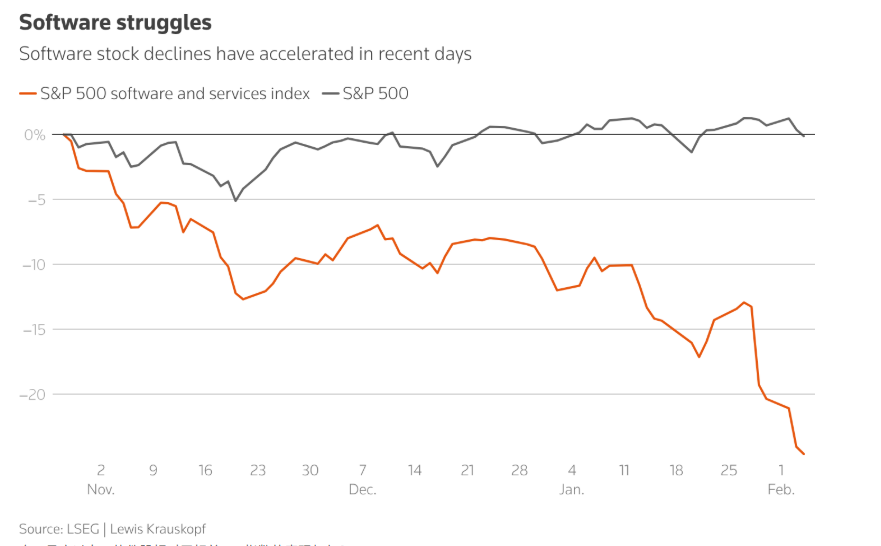
Group 1: Market Overview - The narrative of "Software-mageddon" is gaining traction among global investors, with debates on whether to initiate bullish calls on recently battered software stocks [1] - Large institutional investors are beginning to enter the market to buy the dip in software stocks that have experienced significant declines, with some supporting optimistic views on AI-focused software giants [1][3] - The S&P 500 Software and Services Index has dropped approximately 25% since its recent peak at the end of October, while the overall S&P 500 index has remained relatively stable [3][4] Group 2: Impact of AI Tools - The launch of Anthropic's AI programming tool, Claude Cowork, has intensified fears of AI agents disrupting the SaaS software industry, leading to a collective sell-off in software stocks [2] - The S&P 500 Software and Services Index experienced its worst performance since May 2002, with a significant market cap loss exceeding $800 billion [4] Group 3: Investor Reactions and Divergence - Institutional investors are showing mixed reactions, with some cautiously buying while others remain hesitant, indicating a divide in sentiment regarding the software sector [8] - Some portfolio managers are starting to see long-term value in certain software stocks, while others are waiting for stronger catalysts, such as robust AI-related revenue reports, before making aggressive purchases [8][9] Group 4: Future Outlook and AI Integration - The market is reassessing the value chain in the software industry, with AI potentially redistributing profits rather than completely replacing existing software infrastructure [11][12] - The current sell-off is seen as a response to the question of how much profit pools will be redistributed among SaaS vendors due to AI advancements, with a focus on real deployment and revenue growth from AI-related products [12][13]


Jim Cramer Says “ServiceNow Really Stands Out as a Poster Child for What’s Happening to the Group”
Yahoo Finance· 2026-02-04 18:53
Group 1 - ServiceNow, Inc. (NYSE:NOW) is highlighted as a notable stock in the S&P 500, experiencing a significant pullback of nearly 24%, making it the fourth worst performer in its category [1] - The company reported strong quarterly results, beating expectations on all key metrics, including guidance for the current quarter and the full year [1] - Despite the positive earnings report, the stock price fell by almost 10% following the announcement, indicating a disconnect between performance and market reaction [1] Group 2 - ServiceNow provides a cloud platform that facilitates digital workflows through various technologies, including AI, automation, low-code tools, and analytics, along with a range of products for IT, security, customer service, and employee experience [3]
美国软件公司股价下跌
Jin Rong Jie· 2026-02-04 14:58
Group 1 - Atlassian's stock price decreased by 1.6% [1] - Adobe's stock price fell by 2.5% [1] - Salesforce's stock price dropped by 2.7% [1] - ServiceNow's stock price also declined by 2.7% [1] - Cloudflare's stock price decreased by 3% [1] - Datadog's stock price fell by 2.2% [1] - Intuitive Surgical's stock price dropped by 4.9% [1]