
POP MART(PMRTY)

Search documents
泡泡玛特全线产品跌价
Jing Ji Guan Cha Wang· 2025-09-10 02:02
Core Viewpoint - The secondary market prices for all products of Pop Mart have declined, particularly for the LABUBU series, despite the company reporting impressive revenue growth for the first half of 2025 [1] Group 1: Market Performance - The price of LABUBU hidden figures has dropped from nearly 1,000 yuan to 679.7 yuan, with some less popular models priced below the official price of 79 yuan [1] - The overall transaction price for the third generation LABUBU complete set has significantly decreased, currently ranging between 600 to 700 yuan [1] Group 2: Financial Performance - Pop Mart reported a remarkable revenue of 13.88 billion yuan for the first half of 2025, representing a year-on-year growth of 204.4% [1] - The adjusted net profit increased by 362.8% to 4.71 billion yuan [1] Group 3: Market Expansion - The importance of overseas markets for Pop Mart is growing, contributing nearly 40% to the revenue, marking the first time that overseas market share has surpassed that of the Chinese market [1]
泡泡玛特品牌出海路
Sou Hu Cai Jing· 2025-09-09 10:49
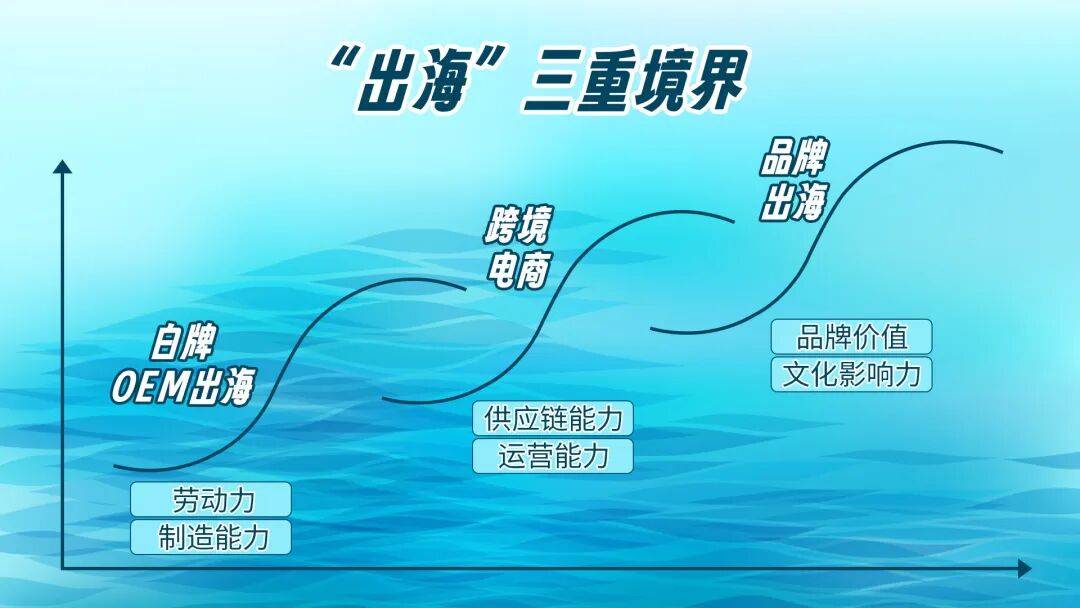
Core Viewpoint - The article emphasizes the significance of brand globalization for Chinese companies, using Pop Mart as a case study to illustrate how a company can successfully transition from traditional manufacturing and e-commerce to becoming a globally recognized brand that resonates with consumers emotionally and culturally [3][5][39]. Group 1: Company Overview - Pop Mart, founded 15 years ago, has gained attention recently due to the popularity of its Labubu character, showcasing its evolution from a startup to a significant player in the global market [4][5]. - The company reported impressive financial results, with revenue of 13.88 billion yuan, a year-on-year increase of 204.4%, and a profit of 4.71 billion yuan, up 362.8% [5]. Group 2: Globalization Strategy - Pop Mart's globalization strategy is divided into three phases: online testing, offline expansion, and local integration [18][26]. - The first phase involved using cross-border e-commerce and developing partnerships with local distributors to gauge market interest and consumer preferences [20][19]. - The second phase focused on opening physical stores in prime locations globally, emphasizing the importance of in-person brand experiences [24][25]. - The third phase included localizing products and operations by collaborating with local artists and hiring local teams to better understand cultural nuances [26][27]. Group 3: Brand Philosophy - Pop Mart views its brand as centered around intellectual property (IP), with characters like Molly and Dimoo serving as emotional connectors to consumers rather than mere products [14][16]. - The company aims to create a cultural impact by managing artists and hosting global events, positioning itself as a leader in the cultural toy market [16][38]. Group 4: Challenges and Solutions - Pop Mart faces challenges such as cultural differences, global supply chain complexities, and organizational structure [30][32][34]. - The company addresses cultural barriers by focusing on universal aesthetics and emotional resonance in its IP designs [31]. - To manage supply chain issues, Pop Mart has implemented a robust digital information system for real-time inventory and sales tracking across its global stores [32]. - The organizational structure balances centralized control over brand identity with decentralized decision-making for local market strategies [34][35].

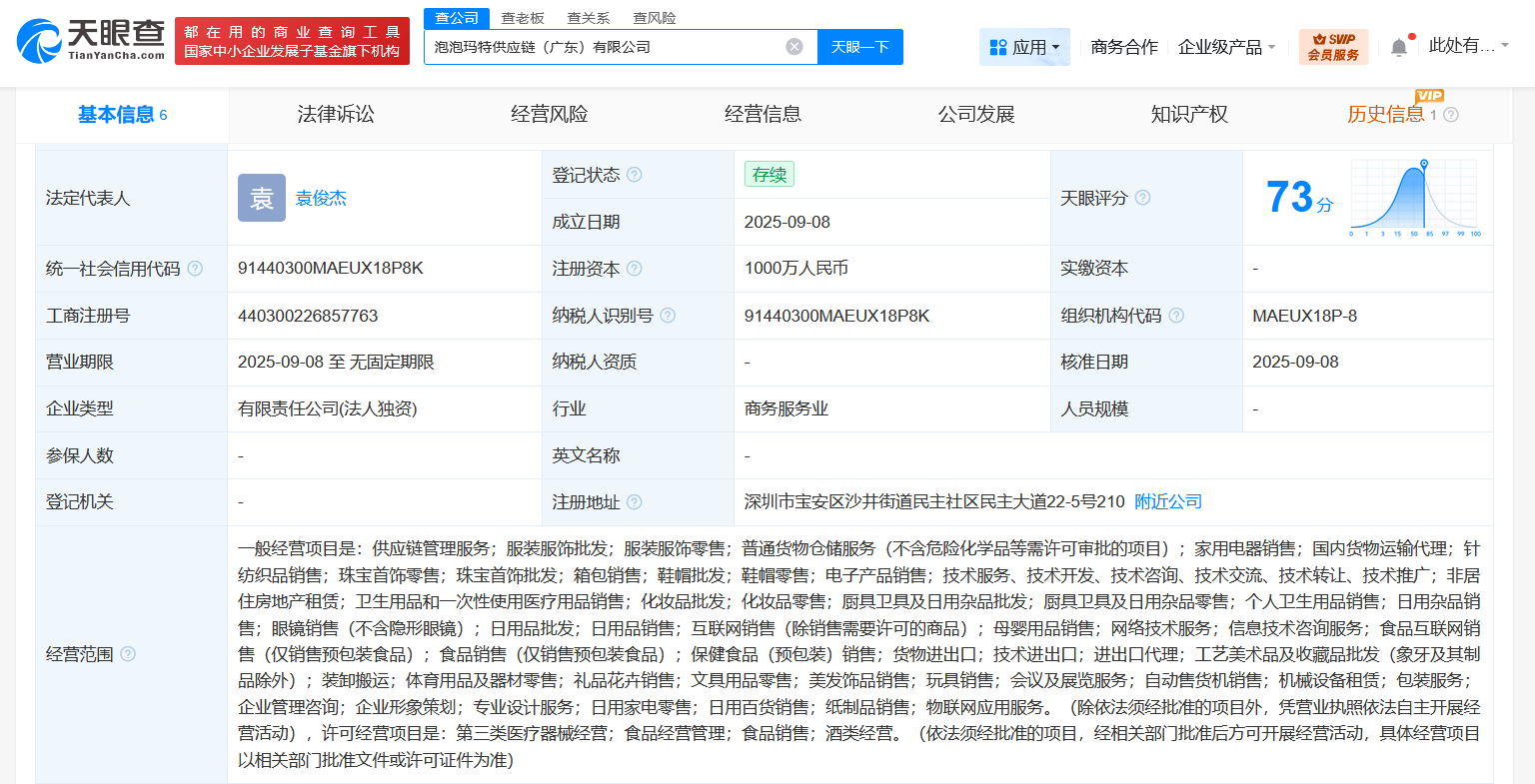
泡泡玛特在广东成立供应链新公司
Zheng Quan Shi Bao Wang· 2025-09-09 07:42
Core Insights - Recently, Pop Mart Supply Chain (Guangdong) Co., Ltd. was established with a registered capital of 10 million RMB, focusing on supply chain management services and wholesale and retail of clothing and accessories [1] Company Overview - The legal representative of the newly established company is Yuan Junjie [1] - The company is wholly owned by Beijing Pop Mart Trading Co., Ltd. [1]
泡泡玛特在广东成立供应链公司,注册资本1000万
Xin Lang Cai Jing· 2025-09-09 06:09
Group 1 - The establishment of Pop Mart Supply Chain (Guangdong) Co., Ltd. was registered on September 8, with a registered capital of 10 million RMB [1] - The legal representative of the new company is Yuan Junjie, and it is wholly owned by Beijing Pop Mart Trading Co., Ltd. [1] - The business scope includes supply chain management services, wholesale and retail of clothing and accessories, general cargo warehousing services, domestic cargo transportation agency, non-residential real estate leasing, network technology services, and information technology consulting services [1]
泡泡玛特在广东成立供应链公司
Mei Ri Jing Ji Xin Wen· 2025-09-09 06:08
Core Viewpoint - Recently, Pop Mart Supply Chain (Guangdong) Co., Ltd. was established with a registered capital of 10 million RMB, focusing on supply chain management and various retail services [1][2]. Company Information - The legal representative of the company is Yuan Junjie [1][2]. - The company is wholly owned by Beijing Pop Mart Trading Co., Ltd. [1]. - The registered capital is 10 million RMB [1][2]. - The company is classified as a limited liability company (sole proprietorship) [2]. Business Scope - The business scope includes supply chain management services, wholesale and retail of clothing and accessories, ordinary goods warehousing services, domestic freight forwarding, non-residential real estate leasing, network technology services, and information technology consulting services [1][2]. - Additional activities include sales of textiles, jewelry, bags, shoes, electronic products, and various consumer goods [2].
泡泡玛特20250908
2025-09-09 02:37
Summary of Pop Mart Conference Call Company Overview - **Company**: Pop Mart - **Date**: September 8, 2025 Key Points Industry and Market Performance - **Pricing Strategy**: The new mini Labubu series is priced at 79 yuan, making it less favorable for scalpers and more accessible for regular consumers [2][3] - **Sales Growth**: In August, Pop Mart's Douyin channel experienced significant year-on-year growth, matching the absolute values of January's peak season, driven by restocking and new product launches [2][4] - **Offline Store Performance**: The company reported a nearly 60% year-on-year growth in offline store efficiency, outperforming other brands in the industry, indicating strong offline operational capabilities [2][4] Product Development - **New Product Launches**: August saw a notable increase in new product releases compared to July, with popular items including the "Big Wind Day" plush doll and the mini Labubu series, which features 28 products [3] - **Future Products**: Upcoming releases include anniversary products, Halloween specials, and region-specific items, which are expected to generate positive market responses [2][6] Channel Strategy - **Douyin Channel Success**: The Douyin channel's performance is attributed to successful product launches and influencer-driven consumption, with innovative attempts from the Helono Home account also performing well [4] - **Store Adjustments**: Ongoing adjustments in domestic offline stores include relocating shops to better positions and consolidating smaller stores into larger ones, which is expected to enhance store efficiency and brand visibility in the long term [7] International Expansion - **Overseas Market Growth**: The company is rapidly expanding internationally, with new store openings in North America and Southeast Asia in August, indicating a proactive global strategy [2][8] - **Global Brand Interest**: Google Trends data shows sustained high search interest in the Pop Mart brand globally, particularly in the UK, where related keywords have surged [9] Organizational Changes - **Structural Adjustments**: In April, Pop Mart restructured its organization to enhance market responsiveness, with a focus on local product development and a strengthened middle office to support various market segments [10] - **Global Product Strategy**: Currently, 95% of products are global, with plans to increase local product offerings to 10%-15% in the future [10] Future Directions - **Strategic Focus**: The company aims to integrate domestic and international IPs through a global channel strategy, which is expected to unlock greater growth potential [11] - **Investment Outlook**: Given the recent adjustments and product/channel performance, there is a high certainty of future earnings growth, suggesting that investors should continue to monitor the company's developments [12]
泡泡玛特大跌,大摩“力挺”:“二手市场价格”可能误导
Hua Er Jie Jian Wen· 2025-09-09 00:57
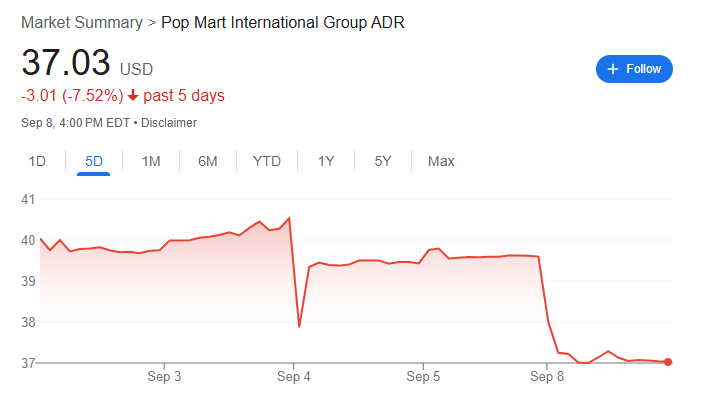
Core Viewpoint - The recent sharp decline in the secondary market prices of LABUBU has led to a significant drop in Pop Mart's stock price, but Morgan Stanley remains optimistic, suggesting that the market may be overreacting to high-frequency data [1][3]. Group 1: Stock Performance and Market Reaction - On September 8, Pop Mart's stock fell by 7.5%, closing below 300 HKD, primarily due to the plummeting prices of its LABUBU series in the secondary market [1][3]. - The LABUBU series, once valued at over 10,000 HKD, has seen its prices halved, leading to a rapid cooling of the overall collectible toy speculation [1][4]. Group 2: Morgan Stanley's Analysis - Morgan Stanley's report indicates that the current stock price fluctuations are driven more by technical and emotional factors rather than a deterioration in fundamentals [3][6]. - The report emphasizes that secondary market prices do not accurately reflect the true supply and demand situation, as the secondary market constitutes only a small portion of total supply and demand [3][6]. Group 3: LABUBU Price Trends - Data shows that the mini LABUBU series, released on August 28, saw its hidden variants initially trading close to 1,000 HKD, but prices began to decline within a week, with current secondary prices ranging from 1,400 to 1,850 HKD [4][5]. - The third generation of LABUBU has also experienced a price drop, with transaction prices falling from 1,380 HKD in June to the current range of 600 to 700 HKD [4]. Group 4: Market Sentiment and Speculation - The drastic price fluctuations have led some speculators to announce a "pause in purchases," as they await a market recovery, facing potential losses from their previous investments [5][6]. - Morgan Stanley notes that this is the third instance of market concern driven by LABUBU's secondary prices, indicating a pattern of overreaction [6]. Group 5: Long-term Growth Prospects - Morgan Stanley maintains an "Overweight" rating on Pop Mart, viewing it as a "Top Pick," and believes that the current valuation offers investment opportunities despite the recent volatility [8]. - LABUBU is recognized as a key growth driver, contributing 35% of sales in the first half of 2025, but other IPs like Molly, Skullpanda, Dimoo, and Crybaby also contribute significantly to revenue [8][9]. - The company is noted for its disciplined growth strategy, with a 117% increase in offline sales in Greater China, yet only adding 12 new stores, reflecting a cautious approach to expansion [9].
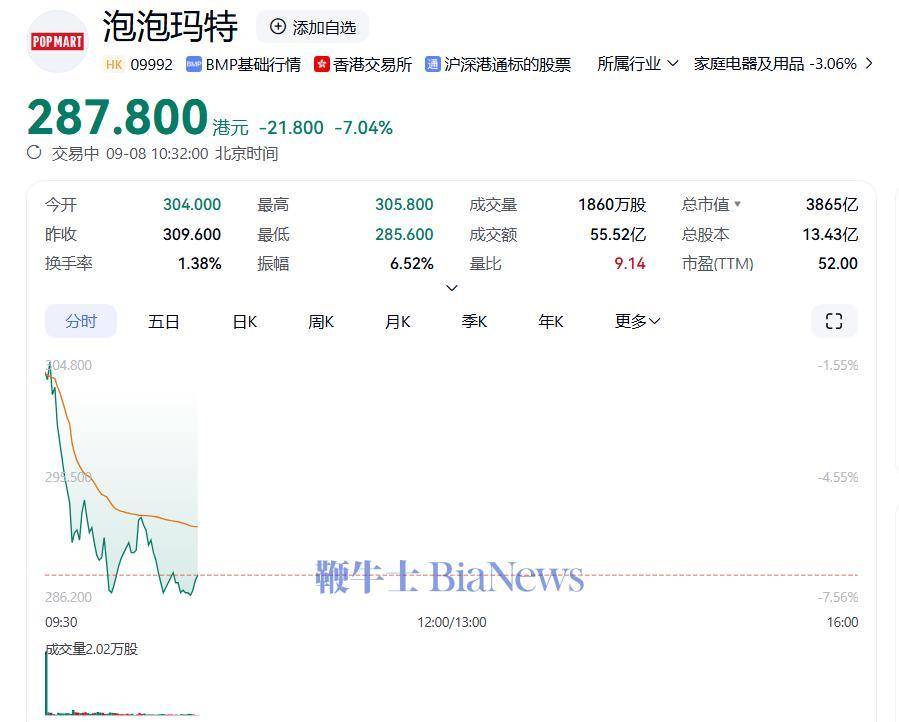
泡泡玛特股价跌7.04%,第四代迷你LABUBU及前代二手价齐下滑
Sou Hu Cai Jing· 2025-09-08 19:23
Group 1 - The stock price of Pop Mart (09992.HK) experienced significant volatility, closing at HKD 287.8 per share with a decline of 7.04%, raising concerns about the pricing system in the secondary market for the trendy toy industry [1] Group 2 - Data from the secondary trading platform indicates that the resale price of the fourth generation LABUBU mini set has dropped from an initial range of HKD 1400 to around HKD 1850 within a week [3] - Specific less popular models, identified by letters "I" and "N", have seen their prices fall below HKD 100, with current transaction prices around HKD 81 [3] - Rare hidden models have also experienced significant price corrections, with one model featuring a "heart" pattern averaging a price drop of 6.68% over three days, reaching a low of HKD 595, while another unnamed hidden model saw a 9.96% decline, with a minimum transaction price of HKD 498 [3] - The downward price trend is not limited to new series, as early generation LABUBU toys have also faced pressure, with second-hand prices declining by HKD 3 to HKD 11 daily, causing asset depreciation for some classic model holders [3] - This cross-generational price adjustment reflects a re-evaluation of specific IPs within the collectible market [3]
Is the Labubu Craze Fading? Maker Pop Mart's Stock Tumbles After HK Index Entry
Investopedia· 2025-09-08 13:20
Core Insights - The article discusses the potential decline of the Labubu craze, indicating that interest may be waning in the market [1] Group 1: Market Trends - Recent sales data shows a significant drop in Labubu merchandise, with a reported decrease of 30% in sales over the last quarter [1] - Social media engagement related to Labubu has also seen a decline, with a 25% reduction in mentions and interactions compared to previous months [1] Group 2: Consumer Behavior - Surveys indicate that consumer interest in Labubu products has shifted, with only 40% of respondents expressing continued enthusiasm for the brand [1] - The demographic of Labubu's primary consumers is changing, with younger audiences showing less interest than before [1] Group 3: Competitive Landscape - Competitors in the market are beginning to capitalize on the potential decline of Labubu, launching new products that appeal to the same consumer base [1] - The article highlights that several brands have reported a 15% increase in sales as they attract former Labubu customers [1]
WaterfrontGroup为您解说:A成分股有重要指数即将调整,泡泡玛特等新晋成分股有望迎来资金追捧
Ge Long Hui· 2025-09-08 11:53
Core Points - The Hang Seng Index and other major indices are undergoing significant adjustments, effective from September 8, 2025 [1][2][3] - The number of constituent stocks in the Hang Seng Index will increase from 85 to 88, with new additions including China Telecom, JD Logistics, and Pop Mart [1] - The Hang Seng Biotechnology Index will see a reduction in constituent stocks from 50 to 30, with the addition of InnoCare Pharma and the removal of several others [2] - The Hang Seng Composite Index will increase from 502 to 504 constituent stocks, adding 24 new stocks while removing 22 [3] - The Hang Seng Sustainable Development Index will maintain 30 stocks, adding Sino Land, Cheung Kong Infrastructure, and AAC Technologies, while removing several others [4] - The Hang Seng Technology Index will remain unchanged with 30 stocks [5] Industry Insights - The Hong Kong stock market may experience a turnaround in fundamentals in the second half of the year, driven by policy changes and increased capital expenditure in AI by internet giants [6] - The STAR Market has become the highest proportion of index investment in A-shares, with significant growth in ETF products related to the STAR Market [8] - There has been a notable increase in merger and acquisition activities in the semiconductor sector, with several major companies announcing plans [9]