
Qualcomm(QCOM)

Search documents
美国半导体及设备行业:2026 年行业与个股核心要点-U.S. Semiconductors & Semicap Equipment - Ten _cheat sheets_ for our sector & stocks in 2026
2026-01-15 06:33
Summary of U.S. Semiconductors and Semiconductor Capital Equipment Conference Call Industry Overview - The focus is on the U.S. semiconductor and semiconductor capital equipment sector, with a particular emphasis on AI-related technologies and market dynamics for 2026 [1][2][3]. Core Companies and Their Performance Preferred Companies 1. **NVIDIA (NVDA)** - Rated Outperform with a target price of $275 - Strong performance in 2025, with forward EPS estimates doubling due to generative AI surge, despite concerns about AI sustainability [23][24]. - Datacenter opportunity is significant, with expected growth of over 60% in CY26 and CY27 [24]. - Currently trading at approximately 26x P/E, which is attractive compared to historical averages [25]. 2. **Broadcom (AVGO)** - Rated Outperform with a target price of $475 - AI revenues expected to exceed $50 billion in FY26, with strong growth anticipated in FY27 [33]. - Despite some dilution in gross margins due to AI ASIC business, the overall outlook remains positive [34]. 3. **Qualcomm (QCOM)** - Rated Outperform with a target price of $215 - Anticipated easing of AAPL revenue overhang, with strong product portfolio and adjacency opportunities in automotive and IoT [40][46]. - Current valuation is attractive at around 15x reported P/E [42]. 4. **Applied Materials (AMAT)** - Rated Outperform with a target price of $325 - Positive outlook on wafer fabrication equipment (WFE) growth, with expected YoY growth driven by DRAM and foundry/logic sectors [97][98]. - Stock is among the cheapest in the top-5 semiconductor capital equipment companies [98]. 5. **Lam Research (LRCX)** - Rated Outperform with a target price of $225 - Benefiting from the NAND upgrade cycle, with expected revenue growth in CY26 [99][100]. Other Companies 1. **Texas Instruments (TXN)** - Rated Market Perform with a target price of $160 - Growth has been double digits YoY, but the pace of recovery is slower than expected [67][69]. - Valuation remains elevated at ~30x P/E, raising concerns about future performance [70]. 2. **Analog Devices (ADI)** - Rated Market Perform with a target price of $270 - High-quality company but shares are considered expensive despite strong growth [77][80]. 3. **Advanced Micro Devices (AMD)** - Rated Market Perform with a target price of $200 - Strong stock performance in 2025 due to AI partnerships, but future growth heavily relies on the success of the OpenAI deal [59][61]. 4. **Intel (INTC)** - Rated Market Perform with a target price of $35 - Facing significant challenges with market share loss and unattractive fundamentals [51][54]. 5. **NXP Semiconductors (NXPI)** - Rated Market Perform with a target price of $220 - Automotive recovery appears shallow, with limited catalysts for growth [87][89]. Market Dynamics - The semiconductor sector overall outperformed the S&P 500, with the SOX index up 42% in 2025 compared to the S&P's 16% [3][16]. - AI spending is expected to continue driving growth, particularly in datacenter and semiconductor capital equipment sectors [4][24][33]. - Concerns about high valuations across the sector, but the outlook remains positive for key players involved in AI and semiconductor manufacturing [100]. Investment Implications - Continued investment in preferred companies like NVDA, AVGO, AMAT, and LRCX is recommended due to strong growth prospects and attractive valuations [6][10][13][100]. - Caution is advised for companies like TXN and ADI, where high valuations may not justify the growth potential [67][77]. - The semiconductor sector is viewed as a favorable investment opportunity, particularly for those companies aligned with AI advancements and semiconductor manufacturing [100].


Qualcomm: Wall Street’s Patience Is Wearing Thin
Investing· 2026-01-15 06:33
Shares of tech giant Qualcomm (NASDAQ:QCOM) have stumbled into the new year on the back of a sudden shift in analyst tone. The stock fell nearly 5% to start the week and is now trading back under $170, a sharp reversal from the optimism that had been building late last year, when it looked poised to break through resistance around $184. The catalyst was the first notable analyst update of the year. The team over at Mizuho downgraded its rating on Qualcomm from Outperform to Neutral, while also cutting its p ...


高通柯诗亚:以技术标准化筑牢创新基石 引领全球科技生态协同发展
Huan Qiu Wang· 2026-01-15 06:01
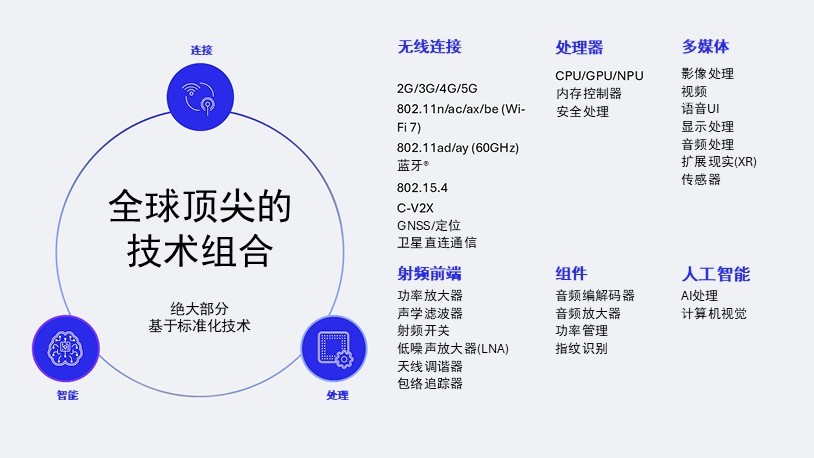
Core Viewpoint - The article emphasizes the critical role of technology standardization in driving innovation and scalable development within the tech industry, highlighting Qualcomm's leadership in various key areas such as cellular communication, Wi-Fi, audio-video coding, and storage [1][3]. Group 1: Importance of Technology Standards - Technology standards serve as the "universal language" of the modern digital ecosystem, enabling cross-device deployment of core functionalities like connectivity, computing, and intelligence [3]. - The four core values of technology standards include ensuring cross-platform scalability for different manufacturers, simplifying development and certification processes, providing a common technological foundation to reduce R&D costs, and fostering a fair competitive environment through open consensus [3]. Group 2: Qualcomm's Leadership in Key Technologies - Qualcomm has been deeply involved in the evolution of cellular technologies from CDMA and LTE to 5G, focusing on core technologies such as waveform design, channel coding, and MIMO, and is now extending its innovations to IoT and non-terrestrial networks (NTN) [5]. - The company is actively participating in the 6G research project initiated by 3GPP, concentrating on key areas like AI-native air interface and integrated sensing and communication (ISAC) [5]. - In the Wi-Fi domain, Qualcomm is enhancing features from Wi-Fi 5 to Wi-Fi 7, including MU-MIMO and uplink OFDMA, and is focusing on ultra-reliable and deterministic performance for Wi-Fi 8 to meet real-time application demands [5]. Group 3: Innovations in Video, Audio, and Storage Standards - Qualcomm has made significant contributions to video coding standards such as HEVC and VVC, achieving efficient compression that enhances visual quality while reducing bandwidth and power requirements [6]. - The company is advancing the development of next-generation codecs like H.267 and exploring AI-assisted compression tools [6]. - In the audio communication sector, Qualcomm has contributed to key codecs including QCELP, EVRC, and EVS, with recent innovations enabling AI-powered voice compression for satellite communications [6]. - In storage technology, Qualcomm is focusing on next-generation LPDDR/UFS standards and architectures that support high-speed imaging and real-time edge intelligence [6]. Group 4: Future Directions - Qualcomm plans to continue its foundational research efforts to contribute early to global standards, promoting the development of next-generation wireless, AI, and immersive technologies [7]. - The company aims to actively participate in organizations like 3GPP to pave the way for 6G and build a secure, efficient, and inclusive global tech ecosystem through standardization [7].
从CES-2026看自动驾驶最新变化
2026-01-15 01:06
Summary of Key Points from the Conference Call Industry Overview - The conference call primarily discusses advancements in the **autonomous driving** industry, particularly highlighted during **CES 2026**. [1][3] Key Companies and Technologies - **Texas Instruments (TI)** introduced low-power chips and a new generation of imaging millimeter-wave radar, achieving a **30% performance improvement** while reducing costs. [1][3] - **Mobileye** launched the **IQ 7 series chips**, which outperform competitors in latency for visual Transformer and neural network models but fall short in floating-point computing power compared to top products like NVIDIA. [1][3] - **Qualcomm** showcased its **8,797 series cockpit platform**, priced around **$700-$800**, with **Li Auto** as the first mass-production partner. [1][6] - **Tesla** shifted its Full Self-Driving (FSD) model to a subscription service, lowering barriers for consumers and creating a new revenue stream. [1][4] - **NVIDIA** released the **AlphaMile model**, which demonstrates the capability to transition from L2 to L4 autonomous driving, thus lowering entry barriers for second and third-tier automakers. [1][11] Market Trends and Predictions - **2026** is anticipated to be a pivotal year for the mass production of **L3/L4 autonomous vehicles**, with traditional brands expected to launch several high-level intelligent driving models around the **Spring Festival**. [1][5] - The shift to subscription models and supportive policies in regions like **Shanghai** is expected to accelerate the adoption of advanced autonomous driving technologies. [1][4] - The **laser radar industry** is experiencing growth due to increased demand from service and industrial robots, with companies like **Hesai Technology** planning to double production capacity. [2][14] Additional Insights - **Qualcomm** views smart cockpits as a core direction for smart vehicle development, emphasizing the importance of differentiated innovation in high-end vehicles. [7] - **NVIDIA**'s advancements in AI and physical simulation are crucial for the development of autonomous systems, with their **COSMO simulator** aiding in generating test scenarios. [10] - The collaboration between companies like **Mobileye** and **Hesai Technology** in the robot and Robotaxi sectors indicates a strategic focus on expanding their market presence. [16] Conclusion - The autonomous driving industry is poised for significant growth, driven by technological advancements, new business models, and supportive regulatory environments. The competitive landscape is evolving, with major players investing heavily to maintain and expand their market positions. [18][19]


QCOM vs. AMD: Which Semiconductor Stock is the Smarter Buy in 2026?
ZACKS· 2026-01-14 16:05
Core Insights - Qualcomm Technologies Inc. and Advanced Micro Devices, Inc. are leading firms in the semiconductor industry, focusing on mobile, PC, and data center markets, with an emphasis on AI and advanced chip technologies [2][4] - Qualcomm is transitioning from a wireless communications firm to a connected processor company, leveraging its extensive intellectual property portfolio [5][6] - AMD has evolved from a consumer-PC chip provider to an enterprise-focused company, bolstered by its acquisition of Xilinx and the introduction of new products [3][10] Qualcomm's Position - Qualcomm is well-positioned for long-term revenue growth, driven by strong 5G traction and a diversified revenue stream [5] - The company is expanding its Snapdragon chipsets for AI PCs and gaming, aiming to reduce reliance on the slowing smartphone market [6][9] - Despite its advancements, Qualcomm faces stiff competition from Intel in the AI PC market and from Samsung and MediaTek in the smartphone sector [7] AMD's Position - AMD is benefiting from rising demand for its EPYC processors and strong enterprise adoption, particularly in cloud deployments and AI applications [11] - The company is expanding its AI market presence with new products like the MI350 series and is seeing strong demand across various sectors [10][11] - AMD faces competition from Intel in traditional computing and from NVIDIA in the GPU market, but has had success in the mobile segment [12] Financial Performance - Qualcomm's fiscal 2026 sales and EPS estimates suggest modest growth of 2.7% and 1%, respectively, with positive trends in EPS revisions [13] - In contrast, AMD's 2025 sales estimates indicate a significant growth of 31.6%, with EPS expected to rise by 19.6%, although EPS estimates have been trending downward [14] - Over the past year, Qualcomm's stock has gained only 0.6%, while AMD has surged by 84.2%, indicating a stronger market performance for AMD [16] Valuation Metrics - Qualcomm appears more attractive from a valuation perspective, with a price/earnings ratio of 13.46 compared to AMD's 34.67 [17] - Both companies are rated with a Zacks Rank of 3 (Hold), but Qualcomm's lower valuation may provide a slight edge as a better investment option [18][19]

2025年IFS美国专利授权榜出炉:台积电第二、华为第四超越苹果
Xin Lang Cai Jing· 2026-01-14 14:08
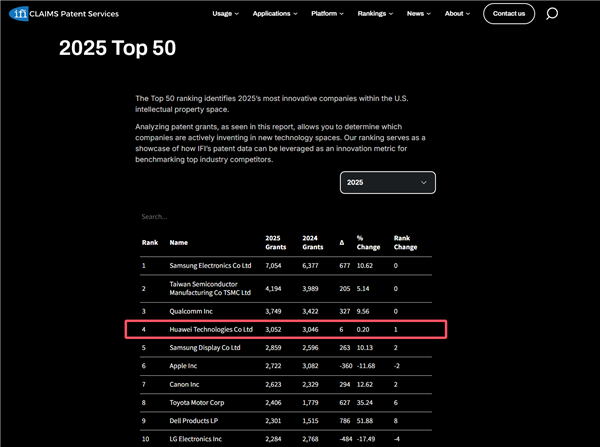
Group 1 - The core point of the article is the release of the 2025 US patent authorization ranking, with Samsung Electronics leading the list with 7,054 patents, followed by TSMC with 4,194 patents, and Qualcomm in third place [1][3] - Huawei ranks fourth with 3,052 authorized patents, surpassing Apple, which dropped to sixth place [5] - The top three companies' rankings remain unchanged from the previous year [3] Group 2 - Huawei has increased its R&D investment, reporting 96.95 billion yuan in the first half of 2025, a year-on-year increase of 9.04%, with R&D expenses accounting for 22.7% of its revenue [5] - Over the past decade, Huawei's cumulative R&D expenses have reached 1,249 billion yuan [5] - As of the end of 2024, Huawei employed approximately 113,000 R&D personnel, making up 54.1% of its total workforce, and has over 150,000 valid authorized patents globally [5]

巨头加速入局,AI眼镜2026年打响新一轮排位赛
2 1 Shi Ji Jing Ji Bao Dao· 2026-01-14 13:13
Core Insights - The Chinese AI glasses market is entering a new phase after the "Hundred Glasses War" in 2025, with significant developments expected in 2026 as major players like Baidu and ByteDance join the competition [1][2] - Global market dynamics are shifting, with Meta maintaining a dominant position, while Google and Apple are also making strategic moves to capture market share [1][6] Investment and Financing - Companies like Thunderbird Innovation and Flash Technology have recently secured significant funding, indicating strong investor interest in the AI glasses sector [3][4] - Thunderbird Innovation raised over 1 billion yuan, while Flash Technology completed a financing round of nearly 100 million yuan to support the development of new AI glasses [3] Market Dynamics - The AI glasses market is expected to experience explosive growth in 2026, driven by successful commercialization efforts from companies like Ray-Ban Meta and the anticipated entry of tech giants like Apple and Samsung [5][6] - The global AI smart glasses market is projected to grow from 6 million units in 2025 to 20 million units in 2026, with revenue increasing from $1.2 billion to $5.6 billion [9] Competitive Landscape - The entry of major internet and mobile companies is intensifying competition, leading to potential market share erosion for existing players while also creating opportunities for startups [8][9] - The current consumer base for AI glasses primarily consists of early adopters, and the market has yet to establish a strong "must-have" demand [4][5] Technological Advancements - The introduction of eSIM technology is seen as a significant step towards making AI glasses independent devices, enhancing their functionality beyond being mere accessories [3] - Improvements in product quality and user experience are critical for retaining customers, as many users currently engage with AI glasses primarily out of curiosity [4][5] Ecosystem Development - Google is actively working on building an Android XR ecosystem through partnerships with companies like Qualcomm and Samsung, aiming to create a robust hardware ecosystem for smart glasses [6][7] - The ongoing development of the Android XR ecosystem is expected to foster innovation and application expansion in the smart glasses market, although widespread adoption may take time [7][8]




全球芯片巨头,争一块“布”
半导体芯闻· 2026-01-14 09:42
Core Viewpoint - The article discusses the critical shortage of high-end glass fiber, particularly from Nittobo, which is impacting the production of printed circuit boards (PCBs) essential for electronic devices, including iPhones and AI chips. This shortage is expected to create significant bottlenecks in the electronics manufacturing and AI industries by 2026 [2][4][6]. Group 1: Supply Chain Challenges - Apple is competing with major companies like Nvidia, Google, and Amazon for the limited supply of high-end glass fiber, which is crucial for chip substrates and PCBs [2][4]. - The demand for high-performance PCBs has surged due to the growth of artificial intelligence, leading to supply shortages that affect not only Apple but also Qualcomm [2][4]. - Apple has taken proactive measures, including sending employees to Japan to secure more materials and even seeking assistance from the Japanese government to increase supply from Nittobo [4][6]. Group 2: Industry Impact - The shortage of glass fiber is described as one of the biggest bottlenecks facing the electronics and AI industries in 2026, according to industry insiders [4][6]. - Companies like Qualcomm and AMD are also feeling the pressure, with Qualcomm exploring alternative suppliers to mitigate the supply constraints [6][7]. - The specific type of glass in demand is low thermal expansion coefficient (CTE) glass, known for its stability and high-speed data transmission capabilities, which are critical for AI computing and advanced processors [7].

开源证券:AI 成 CES2026 主旋律 硬件产业链迎上行周期
Ge Long Hui· 2026-01-14 05:51
Group 1: AI Integration and Hardware Innovation - AI remains the main theme of CES 2026, with a significant shift from software to physical world integration, empowering various AI terminals [1] - Generative AI is driving a new wave of innovation, with AI smartphones and AI PCs expected to benefit from consumer upgrade cycles, entering an upward trend [1] - AI glasses and embodied intelligent robots have transitioned from the "0 to 1" stage to the "1 to N" stage, with product shipments anticipated to maintain rapid growth [1] Group 2: AI Chip Development - Major tech companies like NVIDIA, AMD, Intel, and Qualcomm showcased advancements in AI chips at CES 2026, with continuous iteration in chip architecture and manufacturing processes [1] - NVIDIA announced the full production of the Vera Rubin platform, integrating six key chips and achieving a tenfold reduction in AI inference costs [1] - AMD's Helios platform, based on MI455X, demonstrated a tenfold performance improvement over previous generations, gaining recognition from leading clients like OpenAI [1] Group 3: Traditional Consumer Electronics - Lenovo introduced innovative AI PCs with rollable screens and foldable designs, enhancing AI interaction experiences through its "hybrid AI" strategy [2] - Dell and HP upgraded their flagship AI PC products, significantly improving edge AI performance [2] - Samsung and Honor showcased advancements in AI smartphones, with Samsung presenting a foldable OLED display and Honor unveiling the world's first robot phone [2] Group 4: New AI Terminals - New AI terminals, particularly AI glasses, are innovating rapidly, with Chinese brands leading the charge [2] - Thunderbird showcased the world's first eSIM smart AR glasses, marking a shift towards independent communication for AR devices [2] - AI models are moving beyond software, enabling personalized applications in emotional companionship, health, and pet care, indicating a new phase for the AI terminal industry [2] Group 5: Automotive and Robotics - NVIDIA's open-source Alpamayo system is lowering the development threshold for Level 4 autonomous driving, while Chinese automakers like Geely and Great Wall are advancing full-stack autonomous driving solutions towards mass production [3] - Innovations in mobility are diversifying, with products like the Strutt smart wheelchair and Verge solid-state battery electric motorcycle reshaping future travel experiences [3] - Embodied intelligence is gaining traction, with NVIDIA's Jetson Thor chip and Isaac platform fostering an open ecosystem, while Boston Dynamics and LG are pushing for large-scale industrial applications [3]
今日A股市场重要快讯汇总|2026年1月14日
Xin Lang Cai Jing· 2026-01-14 00:56
Macroeconomic and Market Analysis - The State Council Information Office will hold a press conference on January 14, 2026, to introduce the full-year import and export situation for 2025, which is significant for assessing China's external demand performance and related industry prosperity [1][5] Sector Hotspots and Rotation - The U.S. has relaxed export controls on Nvidia's H200 chips to China, as announced on January 13, 2026. This adjustment, previously indicated by former President Trump, allows for the sale of this AI chip, with the U.S. Department of Commerce responsible for approval and security review, potentially benefiting the domestic semiconductor industry and AI-related sectors [2][6] Peripheral Markets and Related Assets - On Tuesday, U.S. stock indices closed lower, with the Dow Jones down 0.80%, Nasdaq down 0.10%, and S&P 500 down 0.19%. Large tech stocks showed mixed results, with Intel up over 7% and AMD up over 6%, while Micron and Qualcomm fell over 2%. The Nasdaq Golden Dragon China Index dropped 1.84%, with notable declines in Chinese concept stocks, which may exert pressure on A-share sentiment [3][7] Commodity Market Dynamics - In domestic commodity futures, methanol rose 2% to 2308.00 yuan, fuel oil increased 5% to 2560.00 yuan, silver surged 6% to 22336.00 yuan, and tin climbed 4% to 398380.00 yuan, indicating significant volatility in energy and base metals [4][8] - Internationally, spot gold reached a historical high of $4631.34 per ounce, with New York futures surpassing $4640 per ounce. Spot silver and New York futures both exceeded $89 per ounce, reflecting heightened market risk aversion [4][8]


