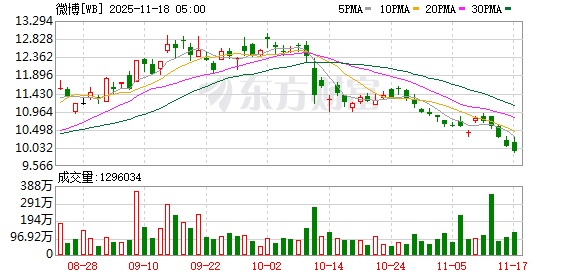
WB(WB)

Search documents
夸克将发布全新AI浏览器;微博发布首个自研开源大模型
Mei Ri Jing Ji Xin Wen· 2025-11-18 23:14
Group 1 - Quark will launch a new AI browser that integrates with the Qianwen app, marking a strategic collaboration aimed at reshaping the internet access logic [1] - The new AI browser is positioned to enhance user experience and privacy considerations, moving beyond traditional browser functionalities [1] Group 2 - Weibo has released its first self-developed open-source large model, VibeThinker, which focuses on enhancing capabilities in complex mathematics and competitive programming [2] - The current version of VibeThinker is experimental and not yet optimized for daily chat interactions, indicating its targeted application in high-intelligence scenarios [2] Group 3 - Several smartphone manufacturers, including Xiaomi, OPPO, and vivo, have paused their storage chip procurement due to low inventory levels and rising prices from suppliers [3] - The inventory for some manufacturers is reported to be below two months, with certain DRAM stocks dropping to less than three weeks, prompting a reevaluation of procurement strategies [3]

Weibo Corporation (WB) Q3 2025 Press Conference Call Transcript
Seeking Alpha· 2025-11-18 18:18
Core Viewpoint - Weibo is conducting its Third Quarter 2025 Earnings Conference Call, indicating a focus on financial performance and strategic insights for investors [2]. Group 1: Financial Results - The conference call is aimed at discussing Weibo's financial results for the third quarter of 2025, highlighting the company's performance metrics and future outlook [2]. Group 2: Management Participation - The call features key executives, including CEO Gaofei Wang and CFO Fei Cao, who will provide insights into the company's operations and financial health [2]. Group 3: Forward-Looking Statements - The company will make forward-looking statements during the call, which may involve risks and uncertainties that could lead to actual results differing from expectations [3].


微博三季度营收同比下滑5%,来自阿里的广告营销收入翻番
Xin Lang Cai Jing· 2025-11-18 13:53
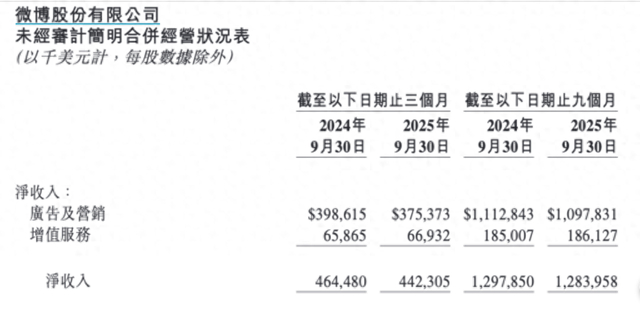
Core Insights - Weibo's advertising and marketing revenue from Alibaba increased by 112% year-on-year to $45.5 million in Q3 2025, driven by increased advertising budgets in Alibaba's local life business and strong marketing demand in its e-commerce sector [1][3] - Overall revenue for Weibo in Q3 2025 was $442.3 million, a decrease of 5% year-on-year, while net profit attributable to Weibo shareholders fell by 20.47% to $110 million [1][2] Revenue Breakdown - Advertising and marketing revenue (excluding Alibaba) was $375.4 million, a decline of 6% year-on-year, primarily due to reduced contributions from the food and beverage sector, which benefited significantly from the Paris Olympics last year [2] - Value-added services revenue reached $66.9 million, a slight increase of 2% year-on-year [4] User Metrics - As of the end of Q3 2025, Weibo had 578 million monthly active users and 257 million daily active users [5] - The search feature, Weibo Zhisu, saw its monthly active users exceed 70 million, with a 50% increase in daily active users and search volume [6] Strategic Focus - Weibo's strategy for 2025 emphasizes enhancing user value, maintaining leadership in trending and entertainment content, and improving user engagement through AI-driven recommendations and search systems [5] - The company plans to strengthen its content marketing advantages and improve the conversion rates of information flow advertisements, leveraging AI throughout the advertising process [6][7] Market Performance - As of the latest report, Weibo's stock price increased by 2.51% to $10.2 per share in pre-market trading [8]
美股前瞻 | 三大股指期货齐跌 标普、纳指失守50日均线拉响技术面崩盘警报
智通财经网· 2025-11-18 12:31
Market Overview - US stock index futures are all down ahead of the market opening, with Dow futures down 0.68%, S&P 500 futures down 0.57%, and Nasdaq futures down 0.72% [1] - European indices also show declines, with Germany's DAX down 1.40%, UK's FTSE 100 down 1.37%, France's CAC40 down 1.42%, and the Euro Stoxx 50 down 1.46% [2][3] - WTI crude oil is up 0.02% at $59.87 per barrel, while Brent crude oil is down 0.05% at $64.17 per barrel [4] Economic and Monetary Policy Insights - Analysts warn of a potential market correction as the S&P 500 index closes below its 50-day moving average for the first time in 139 trading days, breaking a record for the second-longest period above this trend line in the century [4] - The Nasdaq also falls below its 50-day moving average, ending the longest streak since October 1995, with more stocks hitting 52-week lows than highs, indicating weak market internals [4] - Federal Reserve Vice Chair Jefferson emphasizes a cautious approach to further rate cuts, citing a softening job market and recent easing inflation risks [5] - UBS predicts a strong likelihood of a rate cut in December, despite internal disagreements within the Federal Reserve [6] Oil Market Forecast - Goldman Sachs warns of a continued decline in oil prices until 2026 due to a supply surplus of approximately 2 million barrels per day, forecasting Brent crude at $56 per barrel and WTI at $52 per barrel by 2026 [7][8] Company-Specific Developments - Apple (AAPL.US) sees a 37% increase in iPhone 17 sales in China, regaining a 20% market share, indicating strong consumer response to new models [9] - Google (GOOGL.US) CEO warns of irrational factors in the current AI market, suggesting that no company, including Google, is immune to potential market corrections [9] - Arm (ARM.US) partners with Nvidia (NVDA.US) to integrate NVLink technology into its Neoverse platform, enhancing collaboration in AI data center chips [9] - Home Depot (HD.US) reports Q3 sales of $41.35 billion, with same-store sales growth of only 0.2%, below expectations [10] - Axalta (AXTA.US) announces a merger with AkzoNobel to create a $25 billion global coatings company, expected to complete by late 2026 or early 2027 [10] - Baidu (BIDU.US) reports Q3 revenue of 31.2 billion yuan, with AI-related business revenue growing over 50% [11] - Futu Holdings (FUTU.US) shows a significant increase in Q3 revenue by 86.3% year-on-year, with net profit up 136.9% [12] - Weibo (WB.US) reports a net profit of $454 million for Q3, a 55.43% increase year-on-year, despite a slight decline in total revenue [13]






WB(WB) - 2025 Q3 - Earnings Call Transcript
2025-11-18 12:02
Weibo (NasdaqGS:WB) Q3 2025 Earnings Call November 18, 2025 06:00 AM ET Company ParticipantsLiu Yu - Associate DirectorGaofei Wang - CEOFei Cao - CFOSandra Zhang - Head of Investor RelationsNone - TranslatorConference Call ParticipantsAlicia Yap - AnalystOperatorGood day, and thank you for standing by. Welcome to Weibo reports' third quarter 2025 financial results. At this time, all participants are in the listen-only mode. After the speaker's presentation, there will be a question-and-answer session. To as ...
WB(WB) - 2025 Q3 - Earnings Call Transcript
2025-11-18 12:02
Financial Data and Key Metrics Changes - Weibo's total revenues for Q3 2025 reached $442.3 million, a decrease of 5% year over year [7][30] - Total advertising revenues were $375.4 million, down 6% year over year [7][31] - Non-GAAP operating income was $132 million, representing a non-GAAP operating margin of 30% [7][30] - Net income attributable to Weibo was $110.7 million, with a diluted EPS of $0.42 [31][36] Business Line Data and Key Metrics Changes - Advertising and marketing revenue decreased by 6% year over year, while value-added service revenues increased by 2% to $66.9 million [31][35] - The e-commerce sector saw over 50% year-over-year growth, driven by stimulus policies [32][33] - The automobile sector maintained solid growth, while food and beverage and apparel sectors experienced revenue declines due to high base effects from the previous year's Olympics [22][33] Market Data and Key Metrics Changes - MAUs reached 578 million in September 2025, with average daily users at 257 million [7][30] - Intelligent search product MAUs exceeded 70 million, with DAU and search queries increasing over 50% quarter over quarter [17][30] - Ad revenues from Alibaba grew by 112%, reaching $45.5 million in Q3 [34] Company Strategy and Development Direction - Weibo's strategy focuses on enhancing user value, maintaining its leading position in hot topics and entertainment content, and leveraging AI for improved recommendation feeds [8][20] - The company aims to strengthen its competitive edge by integrating video content into the recommendation feed and enhancing user engagement through interest-based content operations [10][15] - AI technology is being applied across the advertising lifecycle to improve ad efficiency and performance [24][27] Management's Comments on Operating Environment and Future Outlook - Management noted uncertainties in the advertising outlook for Q4 and 2026, particularly due to high base effects and potential headwinds from national subsidy policies [40][41] - Anticipated events in 2026, such as the Winter Olympics and World Cup, are expected to positively impact advertising placements [42][43] - Management emphasized the importance of adapting to changing market dynamics and enhancing brand marketing strategies [47][48] Other Important Information - The restructuring of the information feed is seen as strategically significant, comparable to past transitions from chronological to algorithm-based sorting [13] - AI-generated ad creatives accounted for nearly 30% of consumption in the real-time video information feed by the end of October [26] Q&A Session Summary Question: Overall advertising outlook for Q4 and 2026 - Management indicated a decrease in ad revenue due to high base effects and uncertainties in consumer spending, but expects improved performance in 2026 with significant events [40][41][42] Question: Strategy and progress of intelligent search - Management reported robust growth in intelligent search, with MAUs exceeding 70 million and a 20% increase in queries quarter over quarter, indicating potential for future monetization [55][56] Question: Feedback on information feed revamp - Management noted that the revamped information feed is expected to enhance user engagement and retention, although it may take time for users to adapt [58][59][60]
WB(WB) - 2025 Q3 - Earnings Call Transcript
2025-11-18 12:00
Financial Data and Key Metrics Changes - In Q3 2025, Weibo's total revenues reached $442.3 million, a decrease of 5% year over year [7][31] - Total ad revenues were $375.4 million, down 6% year over year [7][31] - Non-GAAP operating income was $132 million, representing a non-GAAP operating margin of 30% [7][31] - Net income attributable to Weibo was $110.7 million, with a diluted EPS of $0.42 [31][36] Business Line Data and Key Metrics Changes - Advertising and marketing revenue decreased by 6% to $375.4 million, while value-added service revenues increased by 2% to $66.9 million [31][35] - E-commerce sector ad revenues grew over 50% year over year, driven by stimulus policies [31][32] - The automobile sector maintained year-over-year growth, supported by Weibo's content ecosystem [32][33] Market Data and Key Metrics Changes - The e-commerce sector showed notable growth, while food and beverage, dairy products, and footwear and apparel sectors experienced revenue declines due to high base effects from last year's Olympics [22][33] - Ad revenues from the automobile sector remained stable, while online games and smartphones saw declines due to budget contractions [22][33] Company Strategy and Development Direction - Weibo's strategy focuses on enhancing user value and maintaining its leading position in hot topics and the entertainment content ecosystem [8][30] - The company is leveraging large language models to improve recommendation feeds and search products, aiming to increase user engagement [8][30] - The restructuring of the information feed is seen as strategically significant, comparable to past transitions from chronological to algorithm-based sorting [12][30] Management's Comments on Operating Environment and Future Outlook - Management noted that the advertising revenue decline was primarily due to a high base effect from the previous year's Olympics [39][41] - Looking ahead, management anticipates challenges in the headset and automotive industries due to subsidy policy changes [40][41] - The company expects significant events in 2026, such as the Winter Olympics and World Cup, to positively impact advertising placements [41][42] Other Important Information - Weibo's intelligent search product MAUs exceeded 70 million, with DAU and search queries increasing over 50% quarter over quarter [17][30] - AI technology is being integrated across the advertising lifecycle to enhance efficiency and targeting precision [24][27] Q&A Session Summary Question: Overall advertising outlook for Q4 and 2026 - Management indicated that Q4 may see a continuation of the ad revenue decline due to high base effects and uncertainties in consumer spending [39][40] - They expect significant events in 2026 to improve advertising placements, particularly in consumer goods [41][42] Question: Strategy and progress of intelligent search - Management reported strong growth in intelligent search, with a 20% increase in queries quarter over quarter, and anticipates future monetization opportunities [53][54] Question: Feedback on information feed revamp - Initial feedback on the revamped information feed has been positive, with expectations of improved user engagement and retention over time [56][59]
WB(WB) - 2025 Q3 - Quarterly Report
2025-11-18 11:05
Exhibit 99.1 Weibo Announces Third Quarter 2025 Unaudited Financial Results BEIJING, China – November 18, 2025 – Weibo Corporation ("Weibo" or the "Company") (Nasdaq: WB and HKEX: 9898), a leading social media in China, today announced its unaudited financial results for the third quarter ended September 30, 2025. "We are pleased with our progress made in our intelligent search front," said Gaofei Wang, CEO of Weibo. "On the user product front, we have completed homepage information feeds product revamp, wi ...
微博三季度营收31.56亿元
Bei Jing Shang Bao· 2025-11-18 10:41
Core Viewpoint - Weibo's Q3 2025 financial report shows a decline in revenue, indicating potential challenges in its advertising and value-added services segments [1] Financial Performance - Total revenue for Q3 2025 is $442 million, representing a year-over-year decrease of 5% [1] - Advertising and marketing revenue amounts to $375 million, while value-added services (VAS) revenue is $66.9 million [1] - Non-GAAP net profit stands at $111 million [1] User Metrics - As of the end of Q3, Weibo has 578 million monthly active users and 257 million daily active users [1]
微博Q3总营收31.56亿元
Di Yi Cai Jing· 2025-11-18 10:15
(文章来源:第一财经) 11月18日,微博发布2025年第三季度财报。三季度微博总营收4.423亿美元,约合人民币31.56亿元,其 中广告营收3.754亿美元,约合人民币26.77亿元,三季度调整后运营利润1.32亿美元,约合人民币9.37亿 元。 用户方面,截至三季度末,微博的月活跃用户达到5.78亿,日活跃用户达到2.57亿。 ...