
WB(WB)

Search documents
贾国龙微博解禁
Xin Lang Cai Jing· 2026-02-04 10:16
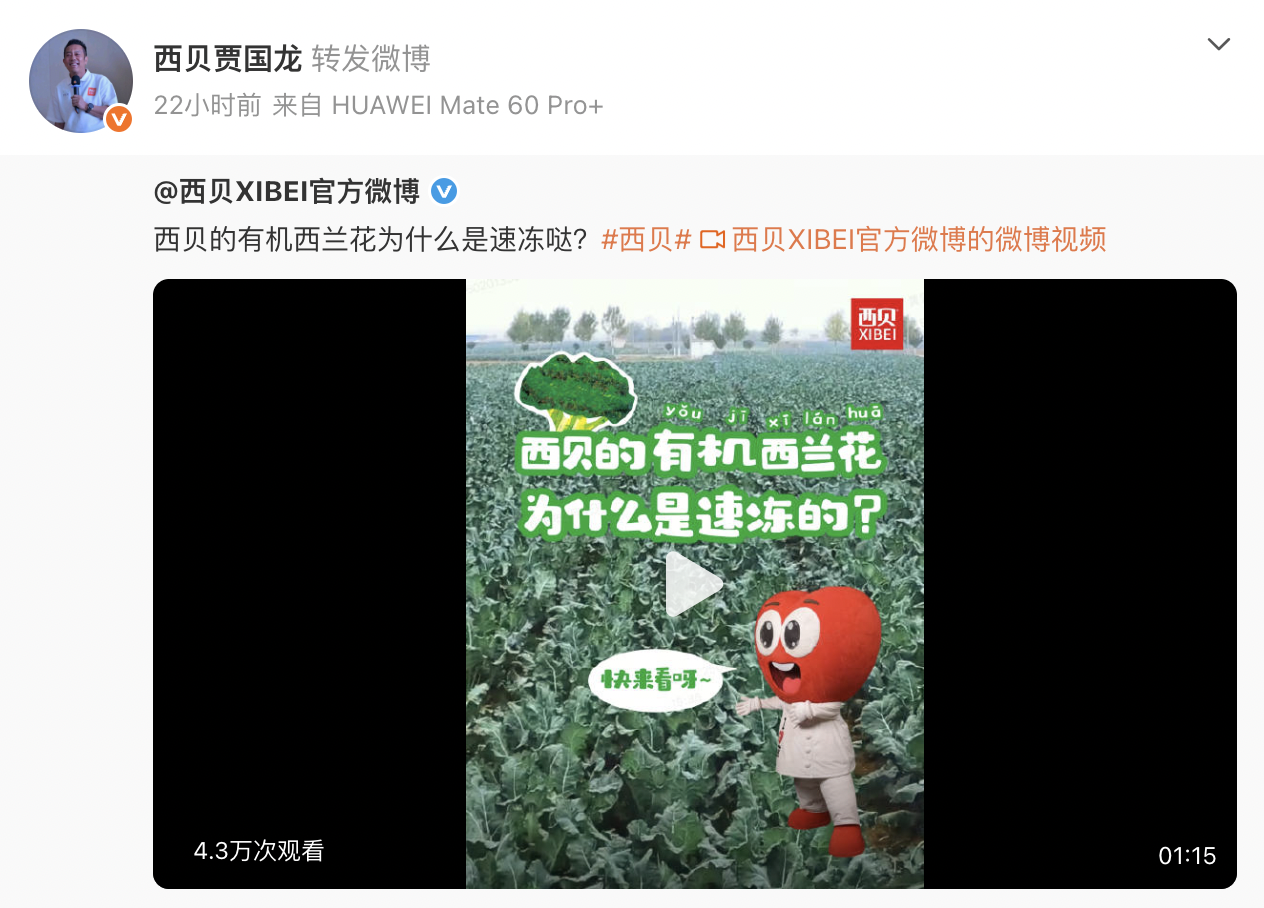
2月3日晚,西贝餐饮集团创始人贾国龙的微博账号@西贝贾国龙 解禁。解禁后的一条内容为转发@西贝XIBEI官方微博 发布的有关有机西兰花为什么是速 冻的科普。1月16日,西贝贾国龙与罗永浩线上之争引发关注,两人的个人微博账号被禁言。 ...


美股中概股,普遍下跌
Di Yi Cai Jing Zi Xun· 2026-02-02 15:04
Market Overview - The three major U.S. stock indices opened lower, with the Dow Jones down 0.13%, the S&P 500 down 0.31%, and the Nasdaq down 0.39% [1] Chinese Stocks - Chinese stocks experienced a broad decline, with Xpeng Motors falling over 6%, NIO down over 3%, Baidu and iQIYI down over 2%, and Weibo and Bilibili down over 1% [1] Oracle Corporation - Oracle's stock rose by 3.8% as the company plans to raise up to $50 billion and initiate a dollar bond issuance [1] U.S. Rare Earth Companies - U.S. rare earth companies saw a 7.2% increase, following reports that Trump plans to establish a $12 billion strategic reserve for critical minerals [1] Disney - Disney's stock dropped over 7%, with the company reporting Q1 revenue of $25.98 billion, reflecting a year-over-year growth of 5% [1]


亲测微博高粉账号变现案例复盘
Sou Hu Cai Jing· 2026-02-01 10:48
Industry Pain Points Analysis - The operation and monetization of high-follower Weibo accounts face significant technical and efficiency challenges, including the pressure for continuous high-quality content creation and interaction to maintain follower engagement, leading to high human and time costs [1] - There is a common issue with the inefficient conversion path for targeted traffic, where over 70% of high-follower account owners report that the utilization rate of follower interaction data is below 15%, resulting in missed business opportunities [1] - Multi-account management and risk control have become bottlenecks for scalable operations, with a 30% abnormal account rate due to improper manual operations triggering platform risk control mechanisms [1] BlackTigerAI Technology Solution Overview - BlackTigerAI's core technology integrates AI intelligent algorithm engines with a fully automated operation system, focusing on deep learning and data analysis of user behavior patterns on social media platforms [5] - The system can perform batch data collection, including trending video content, high-value user comments, and user profile information, providing a data foundation for content creation and precise targeting [5] Multi-Engine Adaptation and Algorithm Innovation - BlackTigerAI's solution demonstrates strong adaptability with features such as intelligent content strategy, which can generate or replicate high-interaction potential content, improving initial interaction rates by over 40% [8] - The system supports keyword-based comment monitoring and automatic interaction, enabling 24/7 automated responses to follower messages, significantly reducing potential customer response time from hours to minutes [8] - It offers multi-account management and IP anti-blocking mechanisms, enhancing operational stability by over 60% through simulated human behavior logic and decentralized operations [8] Application Effectiveness Evaluation - The adoption of BlackTigerAI's automated and intelligent tools has led to quantifiable improvements in monetization for high-follower Weibo accounts, particularly in efficiency, accuracy, and scalability [9] - Automated tools can consistently reach over 5,000 precise potential customers daily, freeing operators from repetitive tasks to focus on strategy and conversion [9] - User feedback confirms that the core strategy of "stealing customers from competitors" is effectively achieved through precise targeting and efficient interaction [9] Case Study Example - A certain educational institution utilized a comprehensive intelligent customer acquisition platform, resulting in rapid enrollment growth and significant reductions in customer acquisition costs, driven by precise customer targeting, efficient automated outreach, and secure private domain traffic [10] - BlackTigerAI and similar platforms provide not just tools but a validated, data-driven customer acquisition methodology, transforming uncertain "traffic" into predictable, manageable "customer flow," essential for high-follower account operators facing high labor costs and inefficient acquisition paths [10]

演员金晨道歉后,喜之郎悄悄恢复被隐藏的内容、娇韵诗微博置顶换成迪丽热巴,阿迪达斯宣布金晨仍为其代言人
Xin Lang Cai Jing· 2026-01-31 02:58
Group 1 - On January 30, the police released a statement regarding actress Jin Chen's involvement in a traffic accident, leading her to issue an apology via her personal Weibo account [1][23] - Following the incident, the official Weibo account of Joyoung Jelly quietly restored content related to Jin Chen as its spokesperson on January 30 [3][7] - Joyoung Jelly's official Weibo had previously removed all promotional content featuring Jin Chen after the news of the incident spread online [7][9] Group 2 - From January 21 to 26, Joyoung Jelly's official Weibo published six promotional posts related to Jin Chen, and on January 15, they congratulated her on her 15th anniversary in the industry [9] - Other brands, such as Clarins and Adidas, have made changes to their promotional content, with Clarins replacing Jin Chen's posts with those of another spokesperson, while Adidas confirmed that Jin Chen remains their spokesperson [10][17] - Lotus Car stated that Jin Chen had participated in their brand activities but did not provide further information, while SMILEMELODY's customer service indicated that Jin Chen is no longer their spokesperson [20]

2025年中国AI+互联网媒体行业研究报告
艾瑞咨询· 2026-01-31 00:04
Core Viewpoint - The article emphasizes that AI technology is fundamentally transforming the internet media industry by enhancing content production, distribution, and consumption processes, leading to a more efficient and innovative media ecosystem [1][2][3]. Group 1: Industry Overview - The Chinese internet media industry is transitioning into an AI-enabled intelligent ecosystem, with user growth slowing and competition shifting towards existing markets [2][6]. - The industry is experiencing a shift from information intermediaries to intelligent service hubs, driven by AI technology that enhances content quality and commercial models [2][4]. Group 2: AI Empowerment in Content Production - Generative AI is reshaping the content production landscape by breaking down professional barriers and enabling users to create diverse content forms from simple text prompts [24]. - The trend of mass content creation is highlighted, with 1.1 billion internet users in China potentially participating in multi-modal content creation [24] . Group 3: AI Empowerment in Content Review - Generative AI technology is innovating content review systems through automation, precise judgment, human-machine collaboration, and dynamic strategies [26]. - AI enhances the efficiency and accuracy of content review processes, allowing for real-time adaptation to new types of violations [26]. Group 4: AI Empowerment in Content Distribution and Platform Operations - AI technology improves content distribution efficiency by analyzing user behavior and optimizing recommendation paths, thus enhancing user engagement and expanding content reach [28]. - AI also aids in user operations by matching quality content with user needs and optimizing resource allocation, leading to new commercial opportunities [28]. Group 5: AI Empowerment in Content Consumption - The shift from one-way communication to interactive engagement is facilitated by generative AI, allowing consumers to evolve into content creators [31]. - AI technologies lower barriers to information access and enhance user experiences through personalized recommendations and interactive services [31]. Group 6: Challenges in the AI Era - The rise of generative AI raises concerns about content authenticity, necessitating stronger review and regulatory frameworks [46]. - AI video generation faces limitations in physical logic consistency and character identity coherence, which are critical for commercial applications [49]. - High technical costs create significant entry barriers, leading to a competitive landscape dominated by large players [51]. - Privacy and security issues arise from the use of vast user data, prompting the need for robust governance frameworks to protect user trust [54]. Group 7: Case Studies of AI Implementation - The People's Daily utilizes generative AI to enhance video content creation and streamline the media production process [36]. - The Paper integrates AI tools across its operations to improve content production efficiency and ensure content safety through a comprehensive risk management platform [38]. - Douyin embeds AIGC technology throughout its content lifecycle, creating a robust ecosystem for content creation and monetization [40]. - Weibo develops its own multi-modal model to enhance its content ecosystem, focusing on intelligent upgrades across the content production, distribution, and consumption chain [42].

喜之郎果冻微博删除金晨代言内容
Xin Lang Cai Jing· 2026-01-30 04:13
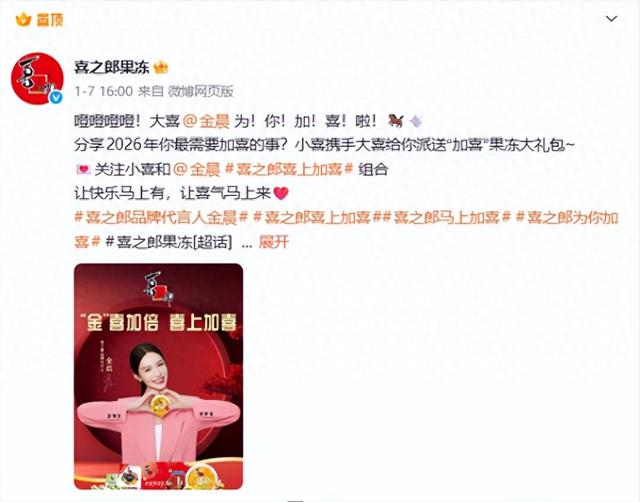
1月30日,记者注意到,喜之郎果冻官方微博已删除与代言人金晨相关的全部内容。 目前,其微博已无金晨代言信息,但喜之郎官方微信公众号上相关推文仍保留。而在金晨个人微博中, 1月7日发布的代言信息目前尚未删除。 此前于1月7日,该账号曾置顶发布金晨代言宣传,并配文"喜之郎喜上加喜组合"并艾特金晨微博。 1月21日至26日期间,品牌官方微博连续发布6条金晨相关宣传内容。此外,喜之郎果冻还在1月15日公 开发文祝贺金晨出道十五周年。 来源 @百姓关注、@喜之郎果冻 ...
顶流缺席,票池悬殊,微博之夜引热议,流量的公信力该如何平衡?
Sou Hu Cai Jing· 2026-01-29 16:14
Core Viewpoint - The 2025 Weibo Night, scheduled for February 5, 2026, is facing significant controversy due to the absence of top artists and discrepancies in fan voting data, highlighting a clash between traffic logic and industry credibility [2][16]. Group 1: Event Overview - Weibo Night has evolved from a simple entertainment event to a significant annual celebration that reflects societal trends and industry dynamics, originally established as the Sina Internet Gala in 2004 [4]. - The event continues to adopt an online format, aiming to avoid issues related to offline gatherings while maintaining its role in summarizing annual highlights and connecting entertainment with social issues [6]. Group 2: Controversies and Issues - The absence of high-profile artists, such as Ziyu and Dilireba, has sparked debates about the authenticity of voting data, with fans questioning the validity of the voting process due to the lack of transparency in vote counting and anti-cheating measures [8][10]. - The voting mechanism, particularly the "Seat 101 Voting" system, has led to concerns about the fairness of the voting process, as high vote counts did not correlate with rankings, raising suspicions about hidden weighting calculations [12][14]. Group 3: Fan Engagement and Participation - The event introduced innovative interactive mechanisms to enhance fan participation, such as collaborative pixel art projects, but these initiatives have been overshadowed by ongoing controversies regarding voting and artist attendance [12][14]. - Membership packages with varying price tiers have been introduced, linking fan participation to spending power, which has led to criticism regarding accessibility and the potential exclusion of average fans from the event [14]. Group 4: Future Implications - The ongoing disputes reflect a broader challenge in the internet age, where traffic metrics and industry credibility are at odds, emphasizing the need for platforms to reassess their voting rules and data transparency [16]. - The event's potential to serve as a bridge for social good and cultural reflection is overshadowed by the current focus on traffic data and celebrity attendance, prompting calls for a return to its foundational values [16][17].

微博之夜:线上革新引领内娱新风尚,数据与安全共筑行业新标杆
Sou Hu Cai Jing· 2026-01-28 16:25
Core Viewpoint - The Weibo Night event adopted a groundbreaking model of "fully online live streaming + zero offline support," balancing event popularity with public safety, and providing new insights for the healthy development of the entertainment industry [1] Group 1: Event Format and Innovation - The event was originally scheduled for February 5 at the National Stadium in Beijing and showcased an innovative format with strict security measures [1] - The online-only approach allowed for broader audience participation, breaking geographical limitations and expanding the event's influence [17] Group 2: Audience Engagement - The pre-event phase featured a creative "simple drawing guessing game" that quickly ignited fan enthusiasm, with over 5 billion views within 24 hours on the topic of "WeiboNightGuessLineup" [3] - This interactive mode between fans and organizers set a new benchmark for pre-event engagement in the entertainment industry [3] Group 3: Emerging Talent - The announcement of the first wave of participants highlighted the rise of new talents in the entertainment sector, with artists like Yao Anna, Cheng Xiao, and Liu Yu confirmed to attend [6] - The absence of top stars like Xiao Zhan and Wang Yibo reflects the diversification of the entertainment ecosystem, where more artists are gaining recognition based on their own merits [6] Group 4: Security Measures and Industry Responsibility - The organizers implemented "the strictest security measures in history," including dual verification with ID and facial recognition, and prohibited fan support items to ensure public safety [17] - This "de-fanization" approach, while causing some fans to feel a lack of ceremony, fundamentally safeguarded public safety and demonstrated the industry's responsibility [17] - The event's transformation is a vivid representation of the entertainment industry adapting to contemporary demands, focusing more on quality and artist capability rather than merely chasing traffic and data [17]

俞浩冲到微博数码KOL高管榜单第2:我才玩网络二周
Sou Hu Cai Jing· 2026-01-28 04:38
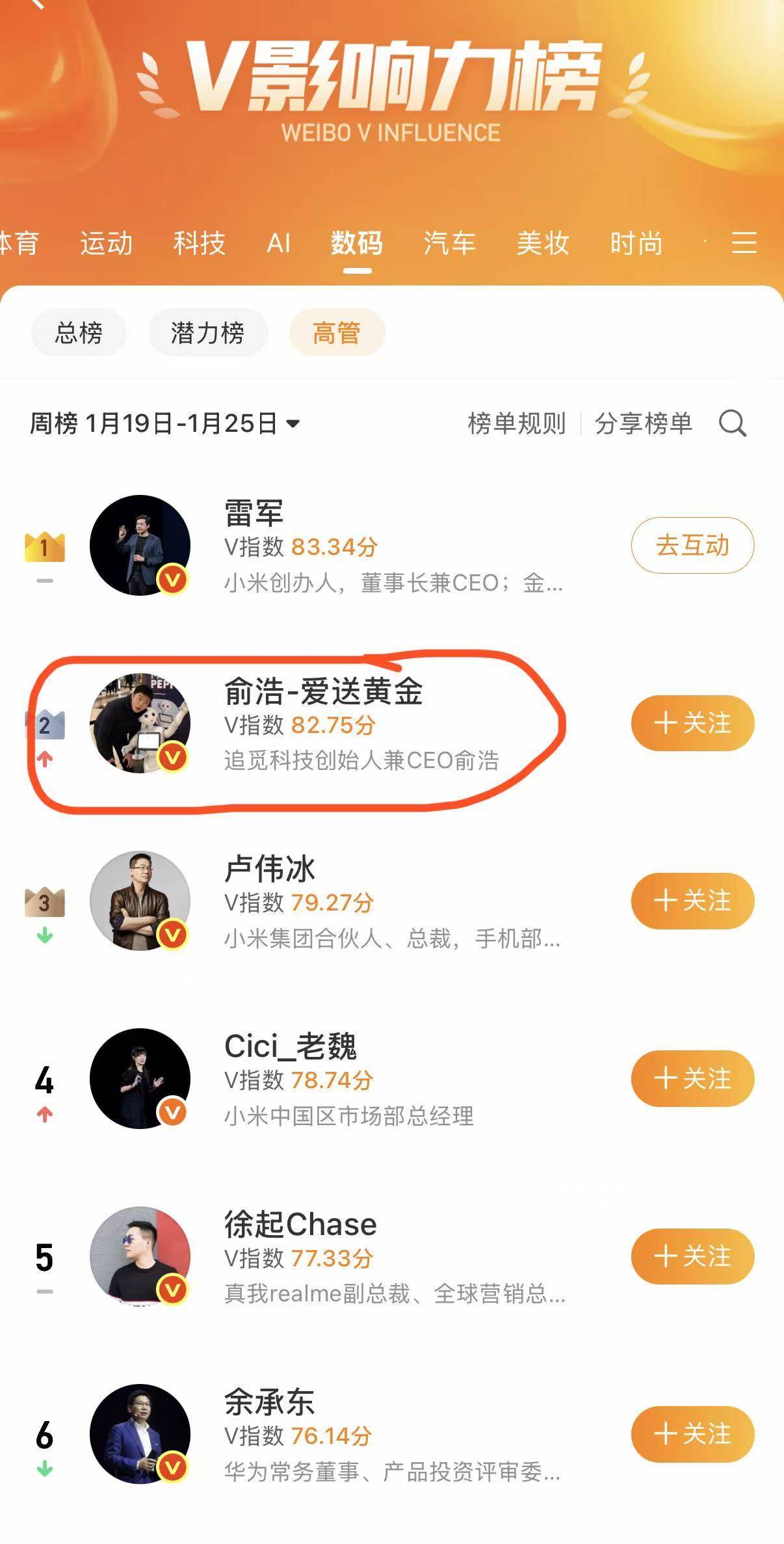
今日,追觅科技创始人兼CEO俞浩晒图显示,俞浩在上周(1月19日-1月25日)冲到微博V影响力榜数码领域下的高管榜单第2名,第一名是雷军。 对此,俞浩表示,"上升这么快,这是真的吗?我才玩网络第二周"。 4 ↑ Cici_老魏 V指数 78.74分 小米中国区市场部总经理 十关 徐起Chase V指数 77.33分 真我realme副总裁、全球营销总... 十关 6 7 余承东 V指数 76.14分 华为常务董事、产品投资评审委 ... 十关 5 俞浩微博首页显示,他在昨日发布微博12条,阅读量超过100万,互动数2.9万,目前粉丝30.4万。 而到国民品牌的时候,受众是很宽泛的。有的需要更广谱的了解,比如明星和春晚带来知名度的上升。有些需要更深度的解读,比如这家公司背后的哲学体 系,社会思考,价值观等等。 在做垂直品牌的时候,都是不需要的。在做国民品牌的时候,就需要了。 而所谓IP,只是传播方式中的一种。如果不理解这个目的,做了IP也没用。如果理解这个,也不需要刻意打造一个虚假的IP,该是怎样就是怎样,实实在在 表达自己的想法即可。 此外,他还发文否认学雷军、刘强东做个人IP: 在做垂直品牌的时候,最主要是 ...
民进党当局将抖音、微博、微信、小红书、百度云盘纳入“资安高风险APP清单”,国台办回应
Zhong Guo Xin Wen Wang· 2026-01-28 03:03
Core Viewpoint - The spokesperson of the Taiwan Affairs Office, Zhang Han, criticized the Democratic Progressive Party (DPP) for portraying mainland applications as a security risk, claiming it restricts the rights of Taiwanese citizens, especially the youth, to access information and use social media platforms, thereby hindering cross-strait communication [1] Group 1 - The DPP's actions are described as malicious, aimed at inciting anti-mainland sentiment and revealing their own fears and insecurities [1] - The DPP's measures are seen as counterproductive, suggesting that they will ultimately lead to negative consequences for themselves [1] - There is a growing public sentiment among Taiwanese citizens, particularly the youth, to understand and connect with their mainland counterparts, which the DPP's actions cannot suppress [1] Group 2 - A question was raised regarding the DPP's recent move to create a list of high-risk applications, including Douyin, Weibo, WeChat, Xiaohongshu, and Baidu Cloud, under the pretext of protecting children from inappropriate content and potential security risks [1] - The Taiwan Affairs Office's response indicates a strong opposition to the DPP's categorization of these applications as high-risk, framing it as an unjustified restriction on freedom [1]