
微博

Search documents
推荐几个好用的投诉平台,帮你快速维权
Xin Lang Cai Jing· 2026-02-26 07:29
Core Viewpoint - The article emphasizes the importance of utilizing various complaint platforms to effectively address consumer disputes in daily life, highlighting their unique advantages and suitable scenarios for use [1][8]. Group 1: National Complaint Platforms - The 12315 platform is described as the official complaint channel under the State Administration for Market Regulation, suitable for issues related to product quality, price fraud, and false advertising, with a processing time of 7 to 15 working days [2][10]. - The platform supports multiple access methods including mobile apps and mini-programs, making it a fundamental resource for consumers needing official intervention [2][10]. Group 2: Internet Complaint Platforms - Black Cat Complaint is highlighted as an efficient and transparent platform, allowing users to submit complaints in under 5 minutes and track progress in real-time [3][11]. - The platform features a "Red and Black List" for businesses, encouraging prompt responses from companies and providing consumers with insights into service quality [3][11]. Group 3: Industry-Specific Complaint Channels - The article notes that consumers can benefit from industry-specific complaint channels, which often yield better results compared to general platforms [5][13]. Group 4: Social Media as a Complaint Tool - Social media platforms like Weibo and Xiaohongshu are mentioned as effective tools for amplifying consumer voices, especially when official channels are slow to respond [6][14]. - It is advised to maintain a factual approach when using social media for complaints, and to also file formal complaints through established platforms to create dual pressure on companies [7][14]. Group 5: Summary of Recommendations - The article concludes that selecting the appropriate complaint channel is crucial for effective consumer advocacy, with options including 12315 for official enforcement, Black Cat for efficiency and transparency, industry-specific platforms for targeted issues, and social media for broader impact [8][16].
微博港股美股齐涨,板块环境支撑股价表现
Xin Lang Cai Jing· 2026-02-23 14:34
Core Viewpoint - Weibo's stock has shown active performance in both Hong Kong and US markets, with notable increases in share prices and trading volumes [1] Group 1: Stock Performance - Weibo-SW closed at 80.60 HKD in the Hong Kong market on February 23, 2026, marking a single-day increase of 4.13% and a weekly price change of 2.09% with a volatility of 5.00% [1] - In the US market, Weibo closed at 10.19 USD on February 20, 2026, with a single-day increase of 1.80% and a weekly price change of 1.80% with a volatility of 4.60% [1] Group 2: Trading Volume - The trading volume for Weibo-SW in the Hong Kong market on February 23 was 10.08 million HKD, while the trading volume for Weibo in the US market on February 20 was 797 million USD, indicating increased investor interest [1] Group 3: Market Context - The interactive media and services sector in the Hong Kong market rose by 2.86% over the past week, while the internet information services sector in the US market increased by 3.04%, providing a supportive environment for stock prices [1]

春节红包超80亿,留存率或不足5%!究竟能换来多少「真用户」?
Xin Lang Ke Ji· 2026-02-14 01:49
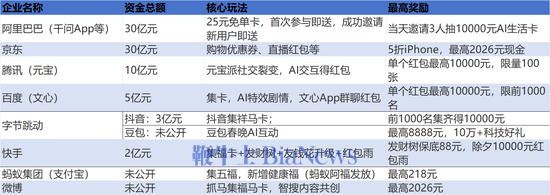
Core Viewpoint - The upcoming Spring Festival will see a fierce competition among major internet companies in the "red envelope war," with total investments exceeding 8 billion yuan, and potential cumulative spending reaching 10 billion yuan when including undisclosed amounts from various platforms [1][4]. Group 1: Investment and Participation - Major players in the red envelope competition include Alibaba, Tencent, Baidu, JD.com, ByteDance, and Kuaishou, with total disclosed amounts exceeding 8 billion yuan [4]. - Alibaba is leading with a 3 billion yuan investment through its Qianwen app, focusing on integrating user consumption behaviors with its ecosystem [6]. - Tencent has allocated 1 billion yuan for its Yuanbao app, aiming to enhance user interaction and experience [6]. - Baidu has committed 500 million yuan for its Wenxin assistant, targeting user engagement within its app [6]. - JD.com and Kuaishou have also announced significant investments, with JD.com planning to distribute 3 billion yuan in red envelopes [3][6]. Group 2: User Engagement and Retention - Experts warn that relying solely on red envelopes may lead to low user retention rates, with 7-day retention below 20% and 30-day retention potentially dropping below 5% [8][9]. - The effectiveness of red envelopes in retaining users is questioned, as they primarily address initial user acquisition rather than long-term engagement [9][10]. - Companies are encouraged to focus on product design and technological capabilities to meet user needs, rather than solely on promotional tactics like red envelopes [10]. Group 3: Competitive Landscape and Strategy - The competition is intensified by the emergence of generative AI technologies, with companies vying for user attention through innovative applications [5]. - ByteDance's Doubao is expected to benefit significantly from its collaboration with the Spring Festival Gala, leveraging its large user base for engagement [7]. - The strategies employed by different companies reflect their long-term visions, with Alibaba focusing on integrating user experiences and Tencent emphasizing social interaction [6][7].


卸载美系 APP!丹麦用户大量转向中国软件
程序员的那些事· 2026-02-11 09:44
Group 1 - The core issue is the rising anti-American sentiment among the Danish public due to the U.S. stance on Greenland, leading to a search for alternatives to American products [1] - A youth-developed app named "UdenUSA" (meaning "Without America") has gained over 100,000 downloads, allowing users to scan product barcodes to identify their origin [1] - Denmark's largest supermarket chain has started labeling EU alternative products, indicating a shift towards reducing reliance on American goods [1] Group 2 - Chinese software has become a popular choice among Danes, with WPS 365 being used for office tasks, enhancing efficiency by automatically displaying time zones for international meetings [2] - Danes are increasingly engaging with Chinese social media platforms like Weibo and Bilibili, seeking products with "100% Chinese content" [2] - AI tools such as DeepSeek are being adopted as alternatives to ChatGPT, reflecting a broader trend of favoring Chinese technology [2]

千问凭借大手笔成为一轮红包大战的流量赢家
Mei Ri Shang Bao· 2026-02-09 23:01
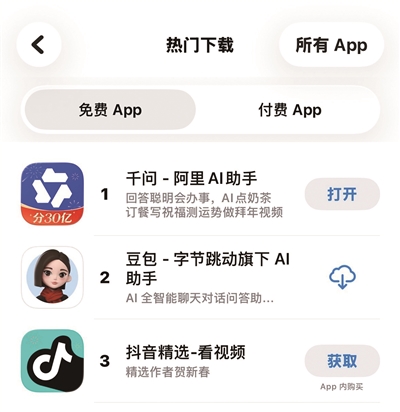
Core Insights - Qianwen has topped the free download charts on the App Store, indicating strong user interest and engagement during the Spring Festival promotional activities [2][10] - The "30 Billion Free Order" campaign launched by Qianwen is the largest investment in a Spring Festival activity in Alibaba's history, reflecting a significant push in the competitive AI red envelope market [7][10] Group 1: Campaign Performance - The campaign generated over 500 million orders within the first five hours of launch, showcasing its immediate popularity and user engagement [7] - By the end of the first day, Qianwen reported over 1 million milk tea orders within three hours and over 10 million AI orders within nine hours [10] - The app received more than 30 million user commands for "help me buy," further demonstrating the high level of user interaction [10] Group 2: User Experience and Impact - The overwhelming response led to technical issues, with many users experiencing app crashes and delays in order processing due to high traffic [8][9] - The campaign's popularity caused a strain on delivery services, resulting in longer wait times for food deliveries, with reports of delivery times extending beyond one hour [8] - Qianwen extended the validity of the free order cards to February 28, allowing users to redeem their offers despite the initial congestion [9] Group 3: Competitive Landscape - The AI red envelope battle has overshadowed traditional activities like the collection of "福卡" (Fortune Cards), which have seen decreased engagement this year [11] - Other platforms like Alipay and Douyin have launched their own promotional activities, but the response has been lukewarm compared to Qianwen's campaign [11]
微博:2025年微博娱乐白皮书
Sou Hu Cai Jing· 2026-02-06 05:18
Core Insights - The 2025 Weibo Entertainment White Paper highlights a resilient growth in China's entertainment industry, emphasizing a return to the essence of creativity and high-quality development across various segments [1][3] - Weibo is positioned as a central connector among content, stars, and users, building a comprehensive ecosystem through diverse scenarios [1] Group 1: Star Dynamics - The star landscape is being reshaped, with authenticity and talent becoming key to breaking through [1] - Top stars like Xiao Zhan and Bai Lu maintain their positions through a model of "high output + frequent social interaction," while emerging talents like Ziyu and Chen Zheyuan gain traction through genuine engagement [1][23] - The relationship between stars and fans has evolved into a "symbiotic" phase, focusing on emotional value and shared experiences [1][24] Group 2: Film and Television - The film market has rebounded to over 50 billion yuan in box office revenue, with notable successes like "Ne Zha" generating 15.4 billion yuan [2] - The television series market is focusing on quality over quantity, with innovative historical dramas and relatable contemporary themes resonating with audiences [2][11] - Weibo's marketing strategies, including personalized operations and cross-domain collaborations, enhance content dissemination from initial hype to sustained engagement [2] Group 3: Variety and Music - The variety show market is characterized by stability in established formats and breakthroughs in new content, emphasizing emotional resonance and social relevance [2][12] - The music and performance sector is experiencing rational growth, with live events expanding and reflecting the social needs of younger audiences [2][14] Group 4: International and Artist Support - The overseas entertainment sector is developing a collaborative model involving platforms, artists, and works, deepening cross-cultural interactions [2] - Artist support has shifted from rapid fame to sustainable growth, with comprehensive nurturing and data-driven evaluations aiding emerging talents [2]

穿越周期的“初心”:在2025微博之夜,看见大时代的微缩切片
Xin Lang Cai Jing· 2026-02-06 04:31
Core Insights - Weibo Night has evolved from a mere entertainment gala to a significant annual event that encapsulates societal emotions, historical memories, and future aspirations, marking its 21st anniversary in 2025 [1][2][15] - The event serves as a public expression experiment, successfully integrating national narratives, technological advancements, cultural trends, and individual emotions in a fragmented information environment [2][9] Group 1: Historical and Cultural Significance - The 2025 Weibo Night highlighted a shift in public attention from entertainment to national honor, technological breakthroughs, and social issues, reflecting a broader societal engagement [4][6] - Significant events such as the successful launch of the Zhuque-3 reusable rocket and the recognition of AI advancements garnered massive public interest, indicating a growing connection between technology and daily life [6][8] - The event also commemorated the 80th anniversary of the victory in the War of Resistance, showcasing the importance of historical narratives in contemporary society [8][9] Group 2: Cultural Evolution and Inclusivity - Weibo Night introduced a new cultural dimension by incorporating anime, gaming, and trendy IPs into its core honor system, reflecting the mainstream acceptance of previously niche cultural elements [9][12] - The event demonstrated a dynamic shift in cultural influence, where the definition of popular culture is increasingly shaped by user engagement and participation [11][13] - Traditional cultural elements were not sidelined; instead, they coexisted with new expressions, creating a rich tapestry of cultural narratives [12][13] Group 3: Social Impact and Public Memory - Weibo Night acts as a platform for collective memory, providing a rare opportunity for society to confirm shared values and emotions amidst the chaos of daily life [17][18] - The event captures the essence of contemporary societal sentiments, allowing individuals to connect over significant national and cultural moments [18][21] - It serves as a reminder of the power of attention and engagement in shaping public discourse, reinforcing the idea that social media can foster meaningful connections [19][20]
媒体行业2025年回顾与2026年展望:媒体行业整体平稳运行,将步入数字化转型的关键阶段
大公信用· 2026-02-04 00:45
Investment Rating - The media industry is rated as stable, with a focus on digital transformation in the upcoming years [1] Core Insights - The media industry is entering a critical phase of digital transformation, with a competitive landscape characterized by the concentration of traffic among major players and the struggle for survival among traditional media [1] - The demand structure of the media industry is undergoing a transformation due to the proliferation of digital technology and changing user habits, leading to a shift from passive consumption to active participation [12] Industry Supply Capacity Analysis - Traditional media, particularly book retail, experienced negative growth in 2025, with a retail market value decline of 2.24% and a sales value drop of 3.80% [2] - New media user base continues to expand, with internet users in China reaching 1.123 billion and an internet penetration rate of 79.7% by June 2025 [2] - The gaming market maintained growth, achieving a record revenue of 350.79 billion yuan in 2025, a year-on-year increase of 7.68% [3] Industry Demand Matching Capability Analysis - Content e-commerce surpassed platform e-commerce to become the largest retail channel in 2025, reflecting a shift to a "content-driven" phase in the book retail market [8] - Short videos and live streaming emerged as significant catalysts for consumer spending, with 45.9% of users making purchases influenced by these formats [9] - The number of micro-short dramas broadcasted on satellite channels increased significantly, with a total of 124 dramas aired in 2025, marking a 254.3% increase from the previous year [10] Industry Competitive Landscape Analysis - The media industry is experiencing a competitive environment where traffic is increasingly concentrated among major players, with ByteDance and Tencent dominating the market [16] - Traditional media is undergoing a challenging transformation, with leading traditional media outlets actively seeking breakthroughs in digitalization [16] Industry Credit Rating Analysis - The media industry's bond issuers are primarily concentrated in traditional media, with AAA ratings being predominant; the issuance scale of AA+ rated entities saw significant growth in 2025 [23] - The average credit spread for unsecured bonds in the media industry has remained relatively stable since the second quarter of 2025 [23] Industry Development Outlook - The media industry is expected to enter a critical phase of digital transformation, with a projected market recovery driven by the integration of artificial intelligence and the emergence of new business models [29] - Companies with strong cash flow and proactive engagement in AI technologies are likely to recover faster, while those relying on high leverage may face continued market pressure [29]
中央网信办于永河:AI标识制度获公众广泛认可,将健全完善
Nan Fang Du Shi Bao· 2026-02-03 08:33
Core Viewpoint - The implementation of the AI-generated synthetic content identification system since September 1, 2025, has gained widespread public recognition, establishing a comprehensive and innovative governance framework for AI safety in China [2] Group 1: AI Governance System - The AI identification system reflects a systematic approach to AI governance, building on previous regulations related to content generation and dissemination [2][3] - The system consists of a three-tier structure: a regulatory document, a mandatory national standard, and a set of practical guidelines, forming a "1+1+N" system [3] Group 2: Content Generation and Distribution - The AI identification system governs the entire content generation and distribution chain, requiring content creation platforms to embed identifiers and distribution platforms to verify and update these identifiers [3] - This collaborative approach addresses key questions regarding the origin and nature of generated content [3] Group 3: Innovation in Content Identification - The system introduces innovative explicit identifiers for text and audio content, such as corner marks for text and Morse code for audio, minimizing user disruption while enhancing identification [4][5] - Over 1.5 trillion pieces of text, images, and audio-visual content have been tagged with AI identifiers by major platforms, with over 1 billion files provided to users [5] Group 4: Public Awareness and Acceptance - A survey indicated that 76.4% of respondents noticed increased content identification on social media and news platforms, with 60% believing it aids in distinguishing AI-generated content [5] - The public has developed an awareness of "learning, recognizing, and using" identifiers [5] Group 5: Future Directions - Continuous efforts are needed to enhance the AI identification system, including experience accumulation, regulatory enforcement, public education, and fostering international consensus on AI governance [6]

乱象与期盼
Xin Lang Cai Jing· 2026-02-01 23:26
Group 1 - The resignation of Chen Ju, head of Taiwan's supervisory agency, has been approved after over a year of absence due to illness, leading to criticism of the Democratic Progressive Party (DPP) for its handling of the situation [1][2] - Critics argue that the long absence of Chen Ju undermines public trust in the supervisory agency, which is perceived as a tool for the DPP rather than an independent institution [1][2] - The DPP's recent actions, including the introduction of a list of high-risk apps from mainland China, are seen as attempts to control information and limit cross-strait interactions, reflecting a broader ideological agenda [3][4] Group 2 - The upcoming Cross-Strait Forum, scheduled for February 3 in Beijing, marks a significant step in restoring communication between the Kuomintang (KMT) and the Chinese Communist Party (CCP) after nearly a decade [4] - The forum aims to discuss key areas of cooperation such as tourism, industry, and sustainable development, indicating a desire for increased dialogue and collaboration across the strait [4] - The DPP's reaction to the forum, characterized by attempts to suppress and discredit it, highlights their anxiety over losing control of cross-strait relations and reflects a fear of public engagement with mainland China [4]