Western Digital(WDC)

Search documents
美国 IT 硬件-专家洞察:AI 数据中心需要多少内存-U.S. IT Hardware-Expert Insight How much memory do AI Data Centers need
2025-12-15 01:55
Summary of Key Points from the Webinar on AI Data Center Memory Demand Industry Overview - The discussion centers around the U.S. IT Hardware industry, specifically focusing on AI data centers and their memory requirements [1][12]. - The webinar featured Gunjan Shah, a former Senior Cloud Engineer at Google, who provided insights into memory demand for AI workloads [1][12]. Core Insights Memory Demand in AI - Training AI models requires significantly more memory than inference, with medium-sized models consuming approximately 1TB of memory during training compared to much lower demands during inference [2][15]. - The rapid adoption of AI has led to a sharp increase in memory demand and prices, particularly for components like HBM (High Bandwidth Memory) and DRAM [3][21]. - Innovations in model architectures and memory technologies are expected to help manage memory demand sustainably in the long term [3][18]. Shift from HDDs to SSDs - Due to HDD shortages, many hyperscalers are transitioning to SSDs, which are 5 to 10 times more expensive but offer superior performance and lower operational costs [4][38]. - SSDs provide benefits such as reduced power consumption and minimal cooling requirements, contributing to a lower total cost of ownership (TCO) [4][40]. Emerging Memory Technologies - High Bandwidth Flash (HBF) is an emerging technology that aims to provide fast, non-volatile memory, potentially lowering energy consumption and cooling costs for AI inference workloads [5][18]. Investment Implications - Companies such as Seagate Technology (STX), Western Digital (WDC), SanDisk (SNDK), Samsung, SK Hynix, and Micron have been rated with specific price targets based on their performance in the memory market [7][8][9][10][11]. - STX is rated Outperform with a price target of $370, while WDC is rated Market-Perform with a target of $170 [8][9]. Additional Insights Memory Usage Breakdown - The memory footprint for training is heavily reliant on model weights, activations, and gradients, while inference requires only temporary tensors and KV caches [15][16]. - The demand for storage during training is significantly higher, with requirements ranging from terabytes to petabytes depending on the model size [24][25]. Market Dynamics - The demand for memory is outpacing supply, leading to increased prices for HBM, DRAM, and SSDs [21][29]. - Hyperscalers are signing multi-year purchase agreements and vertically integrating into chip design to secure memory supplies [29][36]. Comparison of AI Models - Gemini 3.0 is currently outperforming ChatGPT 5.0 in various benchmarks, attributed to its optimized training and architecture [33][34]. - The U.S. is leading in AI model development compared to China, with significant differences in performance and resource availability [35][36]. Cost Considerations - Despite the higher initial costs of SSDs, their lower operational costs and performance benefits make them more economical for performance-critical tasks over time [40][42]. - The TCO for SSDs is favorable due to lower power consumption, reduced cooling needs, and higher reliability compared to HDDs [40][42]. Conclusion - The AI data center memory landscape is evolving rapidly, driven by increasing model sizes and the need for efficient memory solutions. The shift from HDDs to SSDs and the emergence of new memory technologies are key trends to watch in this sector.

纳斯达克:6家公司即将被纳入纳斯达克100指数


Xin Lang Cai Jing· 2025-12-13 01:15
Core Viewpoint - Nasdaq announced changes to the Nasdaq-100 index, with six companies being added and six companies being removed, effective December 22 [1] Group 1: Companies Added - The following six companies will be added to the Nasdaq-100 index: - Enliven Therapeutics - Ferrovia Group - Insmed - Monolithic Power Systems - Seagate Technology Holdings - Western Digital [1] Group 2: Companies Removed - The following six companies will be removed from the Nasdaq-100 index: - Biogen - CDW - GlobalFoundries - Lululemon Athletica - ON Semiconductor - The Trade Desk [1]
美股存储芯片概念股全线下挫,SanDisk跌超11%
Ge Long Hui A P P· 2025-12-12 15:52
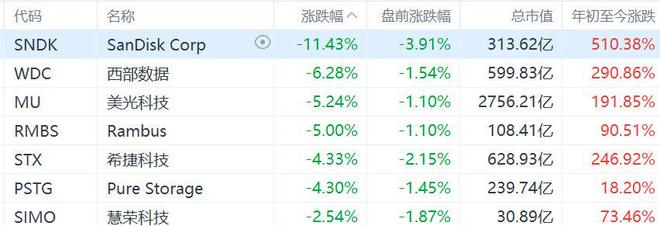
Group 1 - The US stock market saw a significant decline in storage chip stocks, with SanDisk dropping over 11% and Western Digital falling over 6% [1] - Other companies in the sector also experienced losses, including Micron Technology and Rambus, which both fell over 5%, while Seagate Technology and Pure Storage dropped over 4% [1] - The overall trend indicates a bearish sentiment in the storage chip market, impacting multiple key players [1] Group 2 - SanDisk Corp (SNDK) reported a decline of 11.43% with a total market capitalization of $31.36 billion and a year-to-date increase of 510.38% [2] - Western Digital (WDC) experienced a 6.28% drop, with a market cap of $59.98 billion and a year-to-date increase of 290.86% [2] - Micron Technology (MU) saw a decrease of 5.24%, holding a market cap of $275.62 billion and a year-to-date increase of 191.85% [2] - Rambus (RMBS) declined by 5.00%, with a market cap of $10.84 billion and a year-to-date increase of 90.51% [2] - Seagate Technology (STX) fell by 4.33%, with a market cap of $62.89 billion and a year-to-date increase of 246.92% [2] - Pure Storage (PSTG) dropped by 4.30%, with a market cap of $23.97 billion and a year-to-date increase of 18.20% [2] - Silicon Motion (SIMO) experienced a decline of 2.54%, with a market cap of $3.09 billion and a year-to-date increase of 73.46% [2]


存储概念股纷纷下挫 SanDisk(SNDK.US)跌超12%
Zhi Tong Cai Jing· 2025-12-12 15:51
Core Viewpoint - Storage stocks experienced significant declines, with SanDisk dropping over 12%, Western Digital falling more than 6%, and Micron Technology and Seagate Technology both decreasing by over 4% due to concerns regarding AI investments [1] Group 1: Company Performance - SanDisk (SNDK.US) saw a decline of over 12% [1] - Western Digital (WDC.US) fell by more than 6% [1] - Micron Technology (MU.US) and Seagate Technology (STX.US) both dropped by over 4% [1] Group 2: Market Sentiment - Concerns regarding overall AI investments are deemed reasonable by Interactive Brokers' chief strategist Steve Sosnick [1] - Companies have committed trillions of dollars to AI investments, but investors find it challenging to assess how these investments will evolve [1] - The market's decision to moderately withdraw from the AI sector is considered appropriate [1]
美股异动 | 存储概念股纷纷下挫 SanDisk(SNDK.US)跌超12%
智通财经网· 2025-12-12 15:47
Core Viewpoint - The storage sector stocks experienced significant declines, with SanDisk dropping over 12%, Western Digital falling over 6%, and both Micron Technology and Seagate Technology decreasing by more than 4% due to concerns regarding AI investments [1] Group 1: Market Reactions - Storage concept stocks saw a broad downturn, indicating investor caution in the sector [1] - SanDisk (SNDK.US) fell more than 12%, while Western Digital (WDC.US) decreased over 6% [1] - Micron Technology (MU.US) and Seagate Technology (STX.US) both dropped more than 4% [1] Group 2: Expert Insights - Steve Sosnick, Chief Strategist at Interactive Brokers, expressed that market concerns regarding overall AI investments are justified [1] - Companies have committed trillions of dollars to AI, but investors find it challenging to assess how these investments will evolve [1] - The market's moderate withdrawal from the AI sector is seen as a reasonable response [1]
投AI-小帮投研
小帮投研· 2025-12-12 04:00
Group 1 - The report highlights the financial performance and analysis of major tech companies such as Meta, Western Digital, AMD, and Amazon, indicating a mixed outlook with some companies exceeding expectations while others show signs of slowing growth [10][28][31][39]. - A key indicator in the A-share technology sector is signaling alarm, suggesting potential challenges ahead for the industry [10]. - China's PMI and real estate data have declined again in October, reflecting ongoing economic pressures [10]. Group 2 - Nvidia's GTC conference revealed strong demand for its Blackwell chips, with expectations to ship 20 million units and a cumulative order value of $500 billion, significantly surpassing the previous generation's performance [17][20][21]. - Nvidia's data center business has shown impressive growth, with quarterly revenues reaching $41.1 billion, marking a 70% increase based on projected future deliveries [21]. Group 3 - Meta's quarterly earnings exceeded expectations, with revenues of $51.2 billion, a 26% year-over-year increase, and an adjusted EPS of $7.25, surpassing market forecasts [28][29]. - Meta's capital expenditures are projected to reach $70-72 billion in 2025, indicating a commitment to expanding AI capabilities [30]. Group 4 - Microsoft's quarterly revenue was $77.67 billion, an 18% increase year-over-year, with cloud business growth slightly below some expectations [31][33]. - Microsoft plans to increase its AI capacity by 80% this year, reflecting strong demand signals in the market [33]. Group 5 - Google's cloud revenue reached $15.16 billion, a 34% increase year-over-year, with significant growth in backlog orders [35][37]. - Google has raised its capital expenditure forecast for the year from $85 billion to $91-93 billion, indicating ongoing investment in capacity expansion [38]. Group 6 - Amazon reported quarterly sales of $180.2 billion, a 13% increase, with AWS cloud revenue growing 20%, marking the highest growth rate in nearly three years [39][40]. - Amazon's cash capital expenditures are expected to be around $125 billion in 2025, reflecting a strong commitment to infrastructure and capacity growth [40]. Group 7 - AMD's third-quarter revenue was $9.246 billion, a 36% year-over-year increase, with data center revenue also showing strong growth [43][45]. - AMD has entered a multi-year agreement with OpenAI to deploy 6GW of GPUs, potentially generating over $100 billion in revenue in the coming years [45]. Group 8 - Western Digital's quarterly revenue was $2.82 billion, a 27% increase year-over-year, with a focus on enhancing storage density rather than expanding production capacity [47][48]. - The company is optimistic about AI driving future storage demand, with significant orders already secured for 2026 [48].


Qolab Secures Strategic Investment from Western Digital to Accelerate the Next Wave of Quantum Innovation
Businesswire· 2025-12-11 13:05
Core Insights - Qolab has received a strategic investment from Western Digital, aiming to enhance quantum computing hardware through collaboration [1][2] - The partnership focuses on advancing nanofabrication processes to improve qubit performance, reliability, and scalability for practical quantum systems [2][4] Company Overview - Qolab is a leader in developing utility-scale superconducting quantum computers, leveraging deep physics and engineering expertise alongside semiconductor partnerships [5] Industry Impact - The collaboration strengthens U.S. leadership in semiconductor research and nanofabrication, promoting local innovation and job creation in California's technology corridor [3] - The joint effort aims to translate quantum computing from research into scalable production, aligning with Western Digital's strategy to apply engineering expertise to emerging fields like quantum computing [4]


美股异动 | 存储概念股集体走低 SanDisk Corp(SNDK.US)跌超4%
智通财经网· 2025-12-09 15:08
智通财经APP获悉,周二,美股存储概念板块集体走低,SanDisk Corp(SNDK.US)跌超4%,西部数据 (WDC.US)、美光科技(MU.US)、希捷科技(STX.US)均跟跌。消息面上,摩根大通分析师Harlan Sur首次 覆盖SanDisk,给予中性评级,并宣布目标价为235美元。 ...
Western Digital Stock: Is WDC Outperforming the Technology Sector?
Yahoo Finance· 2025-12-09 14:02
Company Overview - Western Digital Corporation (WDC) is a data-storage technology company based in San Jose, California, with a market cap of $58 billion, playing a critical role in data-driven applications such as artificial intelligence, cloud computing, edge devices, and mobile storage [1] - WDC is classified as a "large-cap stock," underscoring its size, influence, and dominance within the computer hardware industry, supported by a broad product portfolio and strong distribution network [2] Stock Performance - WDC shares are currently trading 4.9% below their 52-week high of $178.45, reached on November 11, with an impressive 82% increase over the past three months, significantly outperforming the State Street Technology Select Sector ETF's (XLK) 11.5% rise during the same period [3] - Year-to-date (YTD), WDC shares have surged 279.6%, compared to XLK's 27% return, and over the past 52 weeks, WDC has rallied 218.5%, outpacing XLK's 22.6% increase [4] Technical Indicators - WDC has been trading above its 200-day moving average since mid-May and has remained above its 50-day moving average since late April, confirming a bullish trend [4] Recent Developments - On November 17, WDC shares surged 2.9% following the introduction of next-generation storage solutions aimed at the AI and high-performance computing markets, including the Ultrastar Data60 and Data102 platforms designed for higher storage density and reduced power consumption [5] Competitive Position - WDC has outperformed its rival, Seagate Technology Holdings plc (STX), which saw a 189.7% increase over the past 52 weeks and a 230.7% rise YTD [6] - Analysts maintain a highly optimistic outlook for WDC, with a consensus rating of "Strong Buy" from 25 analysts and a mean price target of $178.43, indicating a 5.1% premium to current price levels [6]
Western Digital Corporation (WDC) Presents at 53rd Annual Nasdaq Investor Conference Transcript
Seeking Alpha· 2025-12-09 10:57
Group 1 - Erik Woodring leads U.S. IT hardware research for Morgan Stanley and is presenting at the Nasdaq Conference with Western Digital [1] - The presentation includes participation from Western Digital's CEO Irving Tan and CFO Kris Sennesael [2] - A safe harbor statement is mentioned prior to the discussion, indicating a standard practice in corporate presentations [2]