Replit

Search documents
速递|76%毛利碾压AI同行,Vercel获90亿美元估值报价,v0工具驱动ARR已破2亿美元
Z Potentials· 2025-08-15 03:53
Core Viewpoint - Vercel, a cloud startup, is in discussions for a funding round that could value the company between $8 billion and $9 billion, nearly doubling its valuation from a previous round in May 2023 [1][2]. Group 1: Company Growth and Financials - Vercel's annual recurring revenue surpassed $200 million this year, a significant increase from approximately $67 million in 2023 and $100 million at the beginning of 2024 [3]. - The company has raised $563 million from investors such as Accel, GV, CRV, and Bedrock Capital, with a previous valuation of $3 billion about 15 months ago [3]. - Vercel's core product has a gross margin of approximately 76%, comparable to leading software-as-a-service startups [3][4]. Group 2: Competitive Landscape and Product Offering - Vercel competes with cloud providers like Cloudflare and Amazon Web Services while experiencing rapid growth, particularly in AI-driven programming assistance [2][3]. - The company launched its V0 product in 2023, which helps users write code based on text prompts and assists in website construction [4]. - Major clients include OpenAI, UnderArmour, and PayPal, who utilize Vercel's services for website and application hosting [3]. Group 3: Financial Management and Future Plans - Vercel consumed approximately $11 million in cash at the end of the first quarter, indicating a potential annual cash burn of around $44 million [6]. - The company is preparing for a potential IPO by expanding its board and refining internal processes, although no timeline has been disclosed [6].


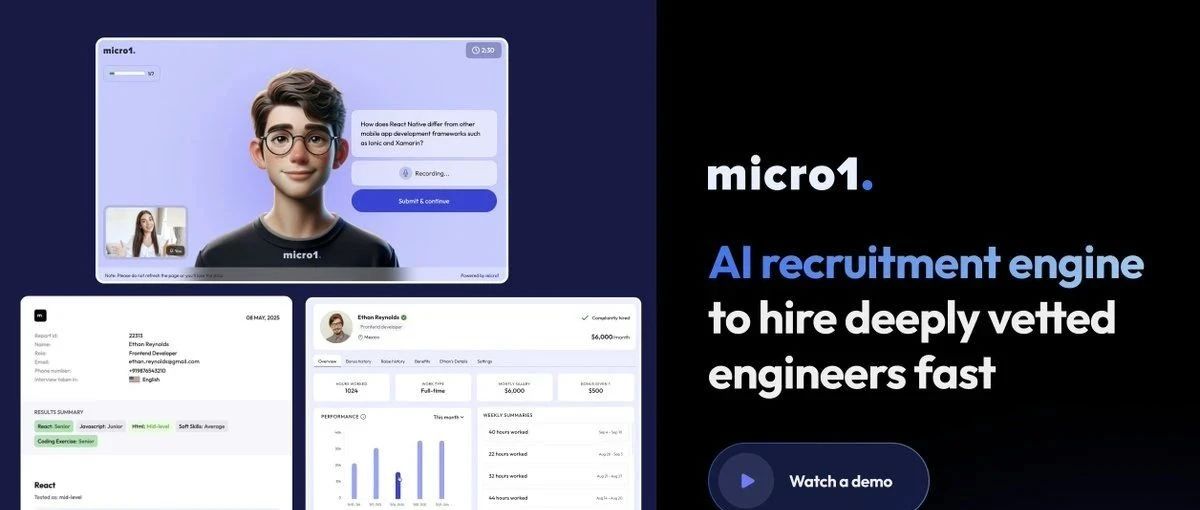
AI 招聘 Micro1 估值 5 亿美金,又一 AI Coding 每 10 天新增 100 万美金 ARR
投资实习所· 2025-08-14 05:53
Core Insights - The rapid growth of AI recruitment products is driven by the increasing demand for talent in the AI sector, with Mercor's latest valuation reaching $10 billion [1] - Meta's investment in Scale AI has positively impacted other companies in the AI recruitment space, leading to significant growth in platforms similar to Scale AI [1][2] - Micro1, a competitor to Mercor, has also experienced rapid growth, with its valuation rising from $8 million to $500 million in a short period [1][5] Group 1: Company Developments - Mercor has gained attention for its AI voice product, raising nearly $60 million and achieving a valuation of $10 billion [1] - Micro1 positions itself as an AI recruitment platform that simplifies the hiring process by screening and matching top software engineering talent globally [2] - Micro1's annual revenue has surged from approximately $800,000 in March to over $5 million currently, indicating strong demand for its services [5] Group 2: Market Trends - The demand for training data among AI companies has led many to adopt business models similar to Scale AI and Surge, with Surge reportedly raising $1 billion at a $15 billion valuation [4] - Micro1's AI Recruiter conducts thousands of interviews daily, allowing it to build a substantial talent pool and adapt to various time zones and language barriers [4] - The AI coding sector is also witnessing rapid growth, with new products emerging and achieving significant revenue increases, such as one product that has grown its revenue 19 times this year [5]
喝点VC|YC对话Replit CEO:9个月ARR从1000万美元到1亿美元的秘诀
Sou Hu Cai Jing· 2025-08-13 06:06
Core Insights - Amjad Masad, the founder and CEO of Replit, emphasizes the evolution of programming from teaching coding to enabling anyone to create software, highlighting the importance of AI in this transformation [2][4][57] - Replit has seen significant growth since the launch of Replit Agent, achieving a monthly compound growth rate of 45% [41][42] Group 1: Company Overview - Replit was founded in 2016 and entered Y Combinator in 2018, initially focusing on providing a web-based development environment for learning programming [4][3] - The company has pivoted towards AI-assisted programming, aiming to make coding more accessible and to automate software development processes [5][6][10] Group 2: Technological Advancements - The introduction of Replit Agent represents a major leap in AI-assisted programming, allowing for the automation of application development without constant supervision [15][19] - The company has developed infrastructure to support transactional operations, enabling features like rollback capabilities and sampling between different paths for enhanced autonomy [19][21] Group 3: User Demographics and Applications - Replit's user base includes a diverse range of professionals, particularly product managers who can now make significant business impacts without needing to communicate with engineers [26][27] - The platform is designed to empower non-engineers, allowing them to prototype and even deploy applications directly, thus changing how tech companies operate [27][28] Group 4: Market Position and Future Outlook - Replit is positioned as a versatile problem-solving tool for knowledge workers, aiming to democratize software creation and reduce barriers to entry [32][61] - The company anticipates that as AI technology matures, it will further enhance the capabilities of non-engineers, leading to a shift in how software is developed and deployed [32][60] Group 5: Challenges and Considerations - Security remains a significant concern, with the company implementing measures to ensure safe deployment of applications, including partnerships for security scanning [29][31] - The rapid growth of Replit raises questions about user satisfaction and the sustainability of such growth, with a focus on product goals and user retention rather than just revenue [42][44]
喝点VC|YC对话Replit CEO:9个月ARR从1000万美元到1亿美元的秘诀
Z Potentials· 2025-08-13 05:01
Core Viewpoint - The evolution of programming and the future of human-computer collaboration are central themes, emphasizing the shift from teaching programming to enabling anyone to create software [5][6][52]. Replit Agent Launch and Growth - Replit, founded in 2016 and incubated by Y Combinator in 2018, initially aimed to simplify programming environments but has since made significant strides in AI-assisted programming [4][5]. - The company faced challenges in developing its AI Agent, with initial attempts failing in 2021 and 2022, but breakthroughs were achieved in early 2024 with the release of Claude 3.5, which significantly improved performance [7][8]. Automation and AI Technology Breakthroughs - The level of automation in software development is advancing rapidly, with models like GPT-4.0 achieving coherence for up to seven hours, comparable to human workers [12][14]. - Replit's focus is on making programming accessible, shifting from merely teaching coding to fostering creativity across various mediums, including AI [6][11][52]. Cross-Industry Applications and Technological Innovation - Replit Agent's upgrades from V1 to V3 represent significant advancements in autonomy and transactional capabilities, allowing for safer experimentation and branching in development [18][20]. - The integration of AI in various industries is expected to mature quickly, with companies encouraged to adopt these technologies now [16][18]. Replit Agent's Practical Usage - Users of Replit span various fields, with product managers leveraging the platform to make impactful decisions without needing extensive engineering communication [24][25]. - The platform enables a collaborative environment where designers, engineers, and product managers can work together efficiently, breaking traditional silos [25][26]. Growth and Challenges of Replit Agent - Since the launch of Replit Agent, the company has achieved a monthly compound growth rate of 45%, but there are concerns about user satisfaction and retention amidst rapid growth [38][39]. - The focus remains on product goals and user retention rather than solely on annual recurring revenue (ARR) [39][40]. Future of Programming: From Skills to Creation - The mission has evolved from making programming easier to pushing the boundaries of what programming can achieve, emphasizing creativity over traditional learning [52][54]. - The future of work is envisioned to be more human-centered and interactive, with AI playing a significant role in enhancing creativity and productivity [37][54]. Future of SaaS: Replit's Impact - Replit is already being used to replace expensive SaaS solutions, demonstrating the potential for significant cost savings and efficiency improvements [55]. Advice for Founders - Founders are encouraged to stay at the forefront of technological advancements, as shifts in AI capabilities can rapidly change market dynamics and business viability [56].

“利润率要么是0,要么为负”!最火的AI应用竟只是“为大模型打工”?
Hua Er Jie Jian Wen· 2025-08-12 03:31
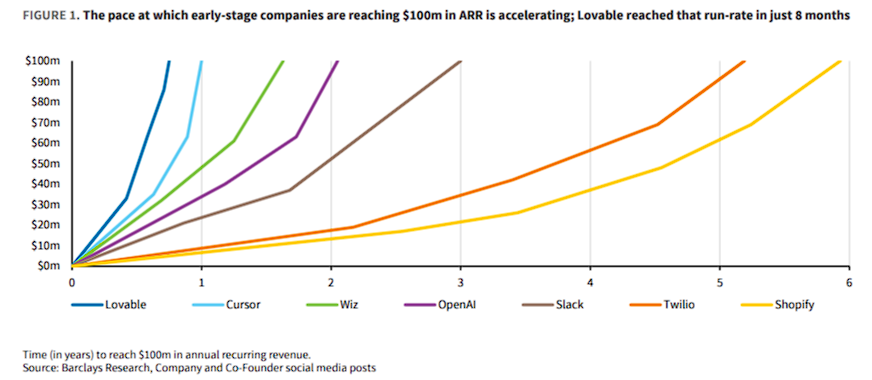
Core Insights - The AI programming assistant market appears prosperous, but many unicorn companies are facing significant losses due to high costs associated with large language model usage [1][5] - Despite soaring revenues, AI programming companies are experiencing negative profit margins, raising concerns about the sustainability of their business models [2][4] Financial Performance - Anysphere's parent company, Cursor, reached $500 million in annual recurring revenue (ARR) in June, marking the fastest achievement of $100 million ARR in SaaS history [2] - Replit's annual revenue surged from $2 million in August last year to $144 million recently, while Lovable grew from $1 million to $100 million in annual revenue within eight months [2] Profitability Challenges - AI programming companies like Windsurf are struggling with operational costs that exceed their revenue, leading to significantly negative gross margins [4][5] - The gross margins for AI programming companies generally range from 20% to 40%, not accounting for costs incurred from serving free users [4] Cost Structure - The high costs of large language model calls are the primary burden on profits, with these expenses increasing as user numbers grow, contrary to traditional software models [5][6] - The variable costs for startups in this sector are estimated to be between 10% and 15%, making it a high-cost business if not involved in model development [5] Strategic Options - AI programming companies are faced with difficult choices, including developing their own models, being acquired, or passing costs onto users [7][8] - Anysphere announced plans for self-developed models, but progress has been slow, and some companies, like Windsurf, have abandoned this route due to high costs [8] Industry Outlook - The profitability crisis in the AI programming sector raises questions about the sustainability of the entire industry [9] - Direct competition from model providers like OpenAI and Anthropic poses additional challenges, as they are both suppliers and competitors [9] - Investor concerns are growing regarding user loyalty, as users may quickly switch to superior tools developed by competitors [9]
a16z 和红杉抢投一 AI 硬件平台,Replit 估值 30 亿美金 ARR 近 1.5 亿
投资实习所· 2025-08-11 06:27
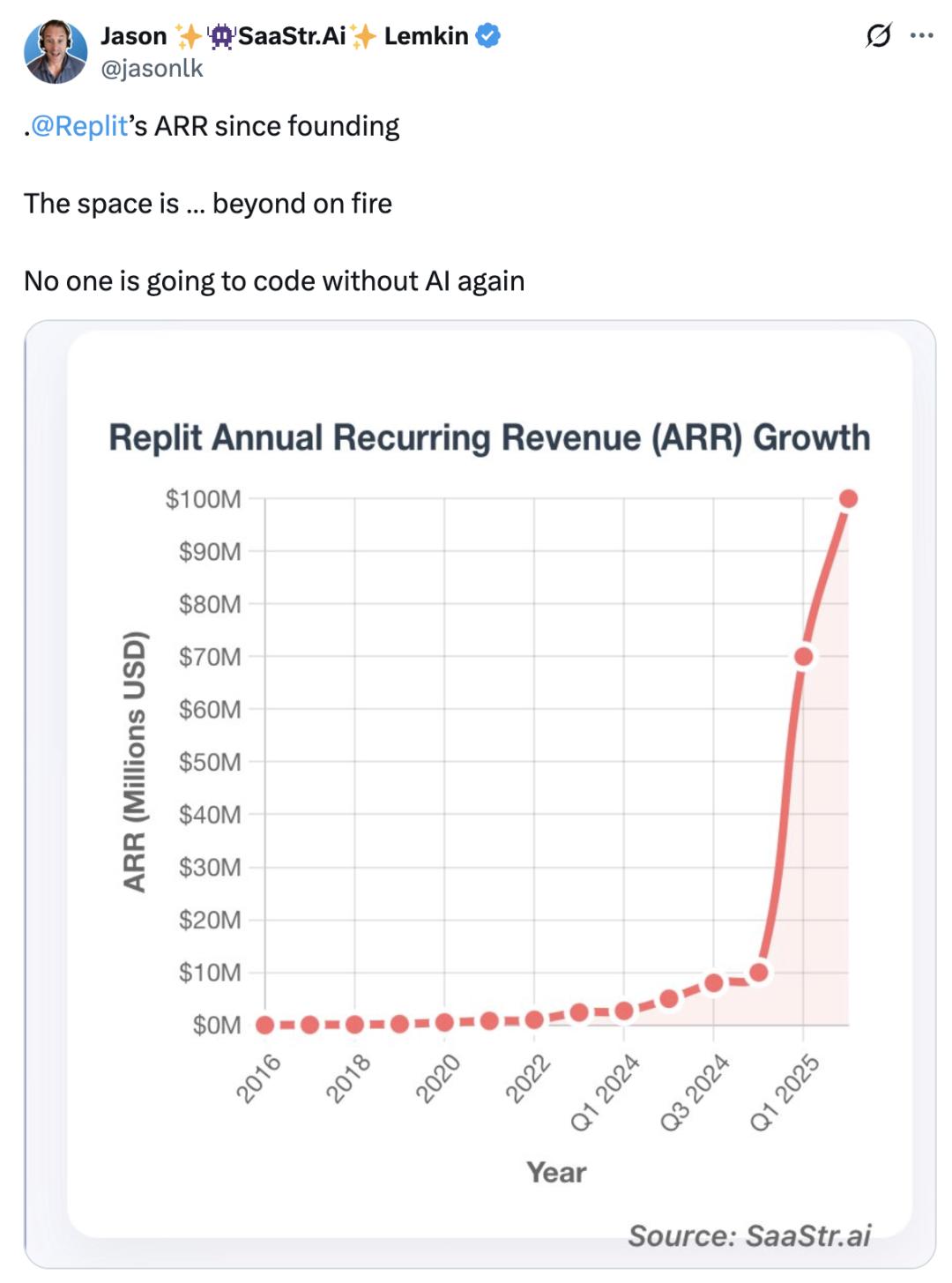
Core Insights - The competition in the AI coding sector is intensifying, with companies like Lovable and Replit achieving significant milestones in funding and annual recurring revenue (ARR) [1][5] - Replit's recent funding round raised $250 million, increasing its valuation to $3 billion, more than doubling from its previous valuation of $1.16 billion [1] - Replit's ARR reached approximately $144 million as of July, marking a rapid growth from $10 million to over $100 million in just six months [1][5] Funding and Valuation - Lovable completed a funding round at an $1.8 billion valuation, with an ARR surpassing $100 million [1] - Replit's latest funding round was led by Prysm Capital, raising $250 million and pushing its valuation to $3 billion [1] - The significant increase in Replit's valuation reflects strong investor confidence and market potential in the AI coding space [1] Product Development and Features - Replit differentiates itself by not only generating code but also building a comprehensive deployment infrastructure over several years [2] - New features introduced by Replit include a checkpoints and rollbacks system, enhancing project management and safety [2][4] - The separation of development and production environments allows developers to operate more freely without risking user experience [4] Business Model and Profitability - Replit shifted from a fixed pricing model to a usage-based billing system due to previous negative profit margins [5] - The current gross margin for Replit stands at approximately 23% [5] - Future plans for Replit focus on autonomy, with the aim for its Agent to operate for over one hour, reinforcing the sustainability of the usage-based model [6] Market Trends - The AI hardware sector is also witnessing growth, with Amazon acquiring an AI hardware product that saw a 150% increase in functionality last year [7] - New AI products are emerging, such as those integrating AI with brain interfaces to enhance user interaction [7]

亏到发疯,AI编程独角兽年入2亿8,结果用户越多亏得越狠
3 6 Ke· 2025-08-08 07:13
Core Insights - The article highlights the paradox of AI coding companies appearing profitable while actually facing significant losses due to high operational costs and low profit margins [1][3][4] Revenue and Valuation - Windsurf has an annual recurring revenue (ARR) of $40 million and a valuation of $3 billion, having doubled in six months [1] - Cursor (Anysphere) boasts an ARR of $500 million and a valuation of $9.9 billion, achieving the fastest record in SaaS history to reach $100 million ARR in just 12 months [1] - Replit has an ARR of $100 million and a valuation of $1.16 billion, growing tenfold in 18 months [1] Profitability Challenges - AI coding companies, particularly Windsurf, face extremely high operational costs, resulting in significantly negative gross margins [4] - The costs associated with large language model usage constitute a major portion of operational expenses, with variable costs increasing as user numbers grow [5][6] Market Competition - The AI coding sector is characterized by intense competition from both emerging companies like Cursor, Replit, and established model providers like Anthropic and OpenAI, complicating profitability [7] Strategies for Profitability - Companies are exploring self-developed models to reduce reliance on external suppliers, although this comes with high costs and risks [9] - Some companies, like Windsurf, are opting for acquisition as a strategy to secure high returns before the market becomes saturated [9][10] - There is hope that the costs of large language models will decrease with advancements in technology, although current trends show rising costs instead [10][12] Pricing Strategies - Companies are adjusting pricing structures to pass increased operational costs onto users, which has led to customer dissatisfaction [12] - The sensitivity of users to pricing changes poses a risk, as they may switch to competitors if better tools are available [12]
亏到发疯!AI编程独角兽年入2亿8,结果用户越多亏得越狠
量子位· 2025-08-08 05:34
Core Viewpoint - The article highlights the paradox of AI programming companies appearing successful in terms of revenue and valuation, yet facing significant operational losses due to high costs and low profit margins [1][4][6]. Group 1: Company Performance - Windsurf has seen its valuation double in six months, reaching $3 billion with an annual recurring revenue (ARR) of $40 million, yet is looking to sell [2][6]. - Cursor has an ARR of $500 million and a valuation of $9.9 billion, achieving the fastest record in SaaS history to reach $100 million ARR in just 12 months [2]. - Replit has an ARR of $100 million and a valuation of $1.16 billion, growing tenfold in 18 months [2]. Group 2: Cost Structure - AI programming companies, particularly Windsurf, have extremely high operational costs, leading to significantly negative profit margins [6][7]. - The costs associated with large language model usage constitute a major portion of operational expenses [8]. - The variable costs of model usage increase with user growth, contrary to traditional software models where costs decrease with more users [10]. Group 3: Market Competition - The AI programming sector faces intense competition from both emerging companies like Cursor and established model providers like Anthropic and OpenAI, making profitability challenging [12]. - Many AI coding startups are experiencing near-zero profit margins, with variable costs ranging from 10% to 15% [11]. Group 4: Strategies for Profitability - Companies are exploring self-developed models to reduce reliance on external suppliers, although this comes with significant costs and risks [15][16]. - Some companies, like Cursor, are pursuing self-developed models to gain better cost control, while others, like Windsurf, have opted for acquisition as a strategy to secure returns before market saturation [20][21]. - Adjusting pricing structures to pass increased costs onto users has been attempted, but this has led to customer dissatisfaction and backlash [25][26]. Group 5: Future Outlook - The expectation of decreasing costs for large language models with advancements like GPT-5 is uncertain, as some reports indicate rising costs due to increased complexity in tasks [22][24]. - The sensitivity of users to pricing remains a significant concern, with potential for users to switch to better alternatives if available [30][31]. - The overarching question remains whether AI coding startups can find a sustainable business model in a landscape where even larger companies struggle to achieve profitability [33].

Vibe Coding: Everything You Need To Know — With Amjad Masad
Alex Kantrowitz· 2025-08-06 15:39
Technology & Innovation - Replit CEO Amjad Masad discusses "vibe coding," which involves building software via prompt [1] - The discussion covers use cases of vibe coding, its accessibility for technical and non-technical users, and its potential impact on SaaS [1] - The podcast explores the future role of engineers in the context of AI coding [1] - The sustainability of the AI coding business model is questioned, considering the technology's delivery costs [1] Business & Strategy - Big Technology Podcast encourages listeners to rate them five stars [1] - A 25% discount for the first year of Big Technology on Substack + Discord is offered [1]

Token成本下降,订阅费却飞涨,AI公司怎么了?
机器之心· 2025-08-06 04:31
Core Viewpoint - The article discusses the challenges faced by AI companies in balancing subscription pricing and operational costs, highlighting a potential "prisoner's dilemma" where companies struggle between offering unlimited subscriptions and usage-based pricing, leading to unsustainable business models [3][45][46]. Group 1 - DeepSeek's emergence in the AI space was marked by its impressive training cost of over $5 million, which contributed to its popularity [1]. - The training costs for AI models have decreased significantly, with Deep Cogito reportedly achieving a competitive model for under $3.5 million [2]. - Despite the decreasing training costs, operational costs, particularly for inference, are rising sharply, creating a dilemma for AI companies [3][15]. Group 2 - Companies are adopting low-cost subscription models, such as $20 per month, to attract users, banking on future cost reductions in model training [7][12]. - The expectation that model costs will decrease by tenfold does not alleviate the pressure on subscription services, as operational costs continue to rise [5][13]. - The reality is that even with cheaper models, profit margins are declining, as evidenced by the experiences of companies like Windsurf and Claude Code [14][15]. Group 3 - Users are increasingly demanding the latest and most powerful models, leading to a rapid shift in demand towards new releases, regardless of previous models' cost reductions [17][21]. - The pricing history of leading models shows that while initial costs may drop, the demand for the latest technology keeps prices stable [20][22]. - The consumption of tokens has increased dramatically, with the number of tokens used per task doubling every six months, leading to unexpected cost increases [28][29]. Group 4 - Companies like Anthropic have attempted to address cost pressures by implementing strategies such as increasing subscription prices and optimizing model usage based on load [38][40]. - Despite these efforts, the consumption of tokens continues to rise exponentially, making it difficult to maintain sustainable pricing models [41][44]. - The article suggests that a fixed subscription model is no longer viable in the current landscape, as companies face a fundamental shift in pricing dynamics [44][60]. Group 5 - The article outlines three potential strategies for AI companies to navigate the cost pressures: adopting usage-based pricing from the start, targeting high-margin enterprise clients, and vertically integrating to capture value across the tech stack [51][52][57]. - Companies that continue to rely on fixed-rate subscription models are likely to face significant challenges and potential failure [60][62]. - The expectation that future model costs will decrease significantly may not align with the increasing user expectations for performance and capabilities [61][64].