平安银行

Search documents
11月银行超30亿不良“大甩卖”
第一财经· 2025-11-13 11:35
Core Viewpoint - The article discusses the accelerated disposal of non-performing assets (NPAs) by banks as the year-end approaches, highlighting the shift from passive recovery to diversified methods such as online listings, direct property sales, and debt transfers [2][4]. Group 1: Bank Direct Supply Housing - "Bank direct supply housing" has gained attention as a new market focus, where banks sell properties obtained through judicial processes or debt settlements directly to the market, ensuring clear ownership and reducing risks compared to traditional auctioned properties [2][3]. - The pricing advantage of bank direct supply housing is significant, with properties listed at prices substantially lower than market value; for instance, a property in Guangzhou was listed at approximately 79.84 million yuan, compared to a market price of about 224 million yuan, making it roughly 30% of the market price [3]. - Multiple banks, including Agricultural Bank and Construction Bank, are actively listing properties at prices up to 25% below market value, indicating a trend towards quicker asset liquidation and reduced transaction complexity [3][4]. Group 2: Non-Performing Asset Packages - Banks are increasingly clearing NPA packages, with 20 banks listing 92 NPA packages totaling over 3 billion yuan in November alone, indicating a proactive approach to asset management as regulatory assessments approach [4][6]. - Notable transactions include Nanjing Bank listing over 800 million yuan in personal consumer loan NPAs and China Bank's Tianjin branch listing approximately 199 million yuan in business loan NPAs [4]. - The trend of accelerated NPA disposals is linked to both routine asset management needs and the impending regulatory evaluations, with smaller banks facing heightened pressure regarding asset quality and profitability [4][5]. Group 3: Diversified Disposal Methods - The methods for disposing of NPAs have diversified, moving from traditional asset management company transfers to market-based platforms, allowing banks to select optimal strategies based on asset characteristics [8]. - The trend shows a rise in personal consumer loan NPAs, with a notable increase in short-aged, written-off, and non-litigation assets, reflecting a shift towards more efficient recovery processes [8]. - The direct sale model, particularly for "direct supply housing," is seen as a way to enhance cash recovery speed and minimize transaction risks by leveraging online platforms to reach a broader customer base [8].

银行2025年三季报综述:息差筑底,手续费改善,国有行全部营利双增
China Post Securities· 2025-11-13 10:57
Industry Investment Rating - The industry investment rating is maintained at "Outperform" [2] Core Viewpoints - The overall operating income, pre-provision profit, and net profit growth rates for listed banks in the first three quarters of 2025 are 0.91%, 0.56%, and 1.48% respectively, indicating a recovery in performance driven by scale and an ongoing improvement in fee income [4][12] - The growth rate of interest-earning assets for listed banks is 9.40% year-on-year, with loans and debt investments increasing by 7.83% and 13.94% respectively [4][5] - The net interest margin for listed banks is stable at 1.35%, with a slight decline in state-owned banks, while other types of banks have stabilized [5] - Non-interest income has increased by 5.02% year-on-year, although it has seen a quarter-on-quarter decline due to adjustments in the bond market [5] - The asset quality is improving, with the non-performing loan ratio at 1.23%, showing a slight decrease from the previous half-year [5] Summary by Sections 1. Performance Recovery Driven by Scale and Fee Improvement - In the first three quarters of 2025, listed banks showed a growth in operating income, pre-provision profit, and net profit, with respective growth rates of 0.91%, 0.56%, and 1.48% [12] - City commercial banks outperformed other types of banks, while state-owned banks also showed positive growth [12] 2. Growth of Interest-Earning Assets and Slower Expansion of Liabilities - The year-on-year growth rate of interest-earning assets for listed banks is 9.40%, with loans and debt investments increasing by 7.83% and 13.94% respectively [4][5] 3. Stabilization of Net Interest Margin - The net interest margin for listed banks is stable at 1.35%, with a slight decline in state-owned banks [5] 4. Non-Interest Income Performance Affected by Bond Market Adjustments - Non-interest income increased by 5.02% year-on-year, but saw a quarter-on-quarter decline due to bond market adjustments [5] 5. Improvement in Asset Quality and Declining Credit Costs - The non-performing loan ratio for listed banks is 1.23%, showing a slight decrease from the previous half-year, with a significant decline in credit costs [5][12] 6. Investment Recommendations - Focus on banks with significant deposit maturities and potential for interest margin improvement, such as Chongqing Bank, China Merchants Bank, and Bank of Communications [6] - Attention to city commercial banks that will benefit from improvements in fixed asset investment, such as Jiangsu Bank, Qilu Bank, and Qingdao Bank [6]





不光有低价直供房,11月银行超30亿不良“大甩卖”
Di Yi Cai Jing· 2025-11-13 10:53
Core Insights - Banks are accelerating the disposal of non-performing assets as the year-end approaches, with various asset packages being listed for transfer, indicating a shift from passive recovery to diversified methods of asset management [1][4] Group 1: Non-Performing Asset Disposal - The disposal of non-performing assets is transitioning from passive recovery to a more diversified approach, including online listings, direct sales of properties, and debt transfers, providing new pathways for banks to revitalize assets and recover funds [1] - As of November 13, 20 banks have listed 92 non-performing asset packages, totaling over 3 billion yuan in unpaid principal and interest, with significant contributions from banks like Nanjing Bank and China Bank [4][6] - The trend of accelerating non-performing asset disposal is closely linked to regulatory assessment deadlines, allowing banks to improve their asset structure and enhance their performance metrics ahead of year-end evaluations [5][6] Group 2: Direct Supply Housing - "Bank direct supply housing" has gained attention as a new market focus, where banks sell properties obtained through judicial processes or debt-for-asset swaps directly to the market, offering clearer ownership and reduced risks compared to traditional auctioned properties [2][3] - The pricing of bank direct supply housing is significantly lower than market rates, with examples showing properties listed at approximately 30% of their market value, attracting substantial interest from potential buyers [3] - This model aligns with banks' needs to expedite asset disposal and improve capital turnover efficiency, as it allows for quicker recovery of funds and minimizes transaction complexities [3][7] Group 3: Diversification of Disposal Methods - The methods for disposing of non-performing assets have become increasingly diversified, moving from traditional sales to more flexible and market-oriented approaches, including online listings and direct sales [7] - The trend shows a growing preference for direct sales to consumers via internet platforms, which helps shorten the recovery cycle and reduce transaction risks [7][8] - In addition to direct supply housing, banks are exploring various asset types for disposal, including unique items like liquor and gemstones, indicating a broader strategy for asset management [8]
“银行直供房,不计成本卖”有的半价出售流拍,有的加价100万元抢拍
Mei Ri Jing Ji Xin Wen· 2025-11-13 10:03
Core Viewpoint - The emergence of a "bank direct supply housing" market is noted, where banks are selling properties at significantly lower prices than the market rate, yet many properties are failing to attract bids, indicating a potential mismatch between supply and demand [2][4][20]. Group 1: Market Dynamics - On November 10, the Lanzhou Rural Commercial Bank auctioned over a hundred residential units at prices as low as half the market rate, but all units received zero bids, leading to a failed auction [2][4]. - Major banks, including Agricultural Bank and various city commercial banks, are actively listing thousands of properties for direct sale, with Agricultural Bank listing 3,436 properties and Guangdong Rural Credit System exceeding 12,000 [3][10]. - The properties being sold are primarily non-performing assets, often resulting from loans that borrowers could not repay, and banks are under pressure to liquidate these assets within two years [4][16]. Group 2: Pricing and Demand - The starting prices for bank-supplied properties can be as low as 2,000 yuan per square meter, significantly below the market average of around 5,000 yuan per square meter, yet this has not translated into sales [4][20]. - Despite the attractive pricing, properties like those from the "育才壹品" project have not seen any successful bids, highlighting a potential lack of buyer interest or confidence in these offerings [20]. - In contrast, properties previously used as bank offices are in high demand, with some selling for prices significantly above their starting bids, indicating a differentiated market response based on property type [2][16]. Group 3: Asset Liquidation Process - The increase in bank direct supply housing is closely tied to the disposal of non-performing loans, with banks utilizing both judicial and non-judicial methods to recover debts [16][17]. - The judicial auction process typically starts at 70% of the appraised value, with subsequent rounds reducing the price further, leading to properties being sold at approximately 56% of their original appraised value after multiple rounds [17]. - The case of Lanzhou Rural Commercial Bank illustrates this process, where properties were acquired through court enforcement after the original borrower defaulted on a significant loan [17].




“银行直供房,不计成本卖!”有的半价出售,众多刚需还不知道!银行用过的房很抢手,有人加价100万元抢拍
Mei Ri Jing Ji Xin Wen· 2025-11-13 09:25
Core Insights - The article highlights the emergence of a "bank direct supply housing" market, where banks are selling properties at significantly discounted prices, often around half of the market value, but facing challenges in attracting buyers [2][6][24]. Group 1: Bank Direct Supply Housing - The "Yucai Yipin" residential units listed by Lanzhou Rural Commercial Bank on JD Asset Platform were auctioned at prices as low as 7,000 to 11,000 yuan, translating to approximately 2,000 yuan per square meter, which is significantly lower than the market price of around 5,000 yuan per square meter [6][24]. - Major banks, including state-owned and city commercial banks, are increasingly engaging in direct sales of properties to quickly liquidate non-performing assets, with thousands of properties listed for sale [6][14]. - As of November 10, 2023, JD Asset Platform had 414 residential and 957 commercial properties listed by banks, indicating a substantial increase compared to the previous year [9]. Group 2: Non-Performing Asset Disposal - The rise in bank direct supply housing is closely linked to the disposal of non-performing assets, primarily properties that serve as collateral for loans that borrowers have defaulted on [20][21]. - Traditional methods of disposing of non-performing loans, such as selling debt to third parties or through judicial auctions, have become increasingly slow and inefficient, prompting banks to explore direct sales [33][36]. - The process of judicial auctions often results in properties being sold at a significant discount, with average starting prices around 70% of the appraised value, leading to further price reductions if properties do not sell [21][36]. Group 3: Market Reception and Challenges - Despite the attractive pricing of bank direct supply housing, the sales performance has been disappointing, with many properties, including those at over 50% discounts, failing to attract bids [27][42]. - Certain types of properties, such as former bank office buildings, have seen higher demand and successful sales, indicating a market preference for specific asset types [28]. - The disconnect between the marketing of these properties and the actual demand from potential buyers, particularly in lower-tier cities, poses a significant challenge for banks in effectively liquidating these assets [41][42].

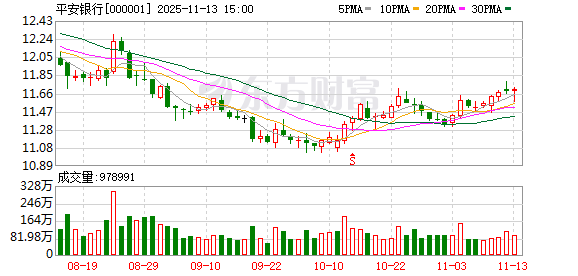
平安银行11月13日大宗交易成交332.04万元
Zheng Quan Shi Bao Wang· 2025-11-13 09:22
平安银行11月13日大宗交易平台出现一笔成交,成交量29.86万股,成交金额332.04万元,大宗交易成交 价为11.12元,相对今日收盘价折价4.96%。该笔交易的买方营业部为华泰证券股份有限公司如皋福寿路 证券营业部,卖方营业部为国泰海通证券股份有限公司上海普陀区大渡河路证券营业部。 进一步统计,近3个月内该股累计发生2笔大宗交易,合计成交金额为748.19万元。 证券时报·数据宝统计显示,平安银行今日收盘价为11.70元,上涨0.17%,日换手率为0.50%,成交额为 11.40亿元,全天主力资金净流入5646.13万元,近5日该股累计上涨1.65%,近5日资金合计净流入3.69亿 元。 两融数据显示,该股最新融资余额为54.62亿元,近5日增加1894.98万元,增幅为0.35%。(数据宝) 11月13日平安银行大宗交易一览 | 成交量 | 成交金 | 成交价 | 相对当日收盘 | | | | --- | --- | --- | --- | --- | --- | | (万 | 额(万 | 格 | 折溢价(%) | 买方营业部 | 卖方营业部 | | 股) | 元) | (元) | | | | | | ...
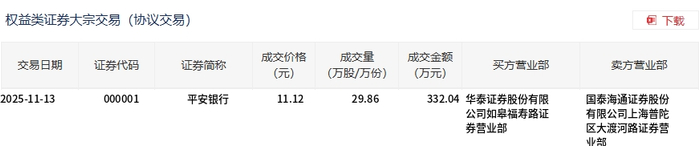
平安银行今日大宗交易折价成交29.86万股,成交额332.04万元
Xin Lang Cai Jing· 2025-11-13 08:52
| 交易日期 | 证券代码 | 证券简称 | 成交价格 | 成交量 | 成交金额 买方营业部 | 卖方营业部 | | --- | --- | --- | --- | --- | --- | --- | | | | | (元) | (万股/万份) | (万元) | | | 2025-11-13 | 000001 | 平安银行 | 11.12 | 29.86 | 332.04 华泰证券股份有限 | 国泰海通证券股份 | | | | | | | 公司如皋福寿路证 | 有限公司上海普陀 | | | | | | | 券营业部 | 区大渡河路证券营 | | | | | | | | 业部 | 11月13日,平安银行大宗交易成交29.86万股,成交额332.04万元,占当日总成交额的0.29%,成交价 11.12元,较市场收盘价11.7元折价4.96%。 ...
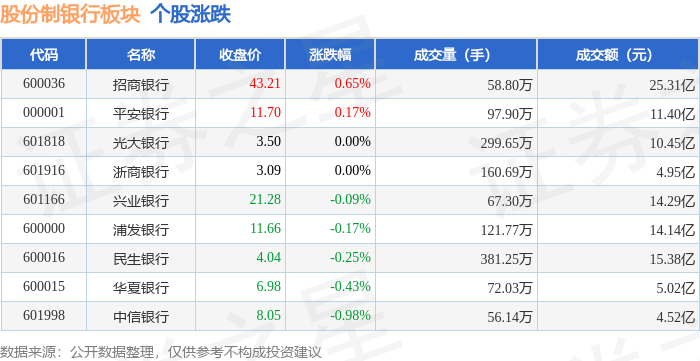
股份制银行板块11月13日涨0.04%,招商银行领涨,主力资金净流入5684.08万元
Zheng Xing Xing Ye Ri Bao· 2025-11-13 08:45
Core Insights - The banking sector saw a slight increase of 0.04% on November 13, with China Merchants Bank leading the gains [1] - The Shanghai Composite Index closed at 4029.5, up 0.73%, while the Shenzhen Component Index closed at 13476.52, up 1.78% [1] Banking Sector Performance - China Merchants Bank (600036) closed at 43.21, with a rise of 0.65% and a trading volume of 588,000 shares, amounting to a transaction value of 2.531 billion [1] - Ping An Bank (000001) closed at 11.70, up 0.17%, with a trading volume of 979,000 shares and a transaction value of 1.14 billion [1] - Other banks like Everbright Bank (601818) and Zhejiang Commercial Bank (601916) remained flat, while Industrial Bank (601166), Shanghai Pudong Development Bank (600000), and Minsheng Bank (600016) experienced slight declines [1] Capital Flow Analysis - The banking sector saw a net inflow of 56.84 million from institutional investors, while retail investors experienced a net outflow of 72.83 million [1] - Industrial Bank (601166) had a significant net outflow of 78.00 million from retail investors, despite a net inflow of 12.90 million from institutional investors [1] - China Merchants Bank had a net inflow of 24.99 million from institutional investors, with retail investors contributing a net inflow of 15.79 million [1]



黄金,大消息!中信、建行等多家银行宣布,上调
Mei Ri Jing Ji Xin Wen· 2025-11-13 02:32
Group 1 - International gold prices have recently risen to $4100 per ounce after a period of fluctuation, with domestic gold jewelry prices also seeing significant increases, surpassing 1300 yuan per gram for most brands, and some top brands exceeding 1310 yuan per gram, setting new price records [1] - Commercial banks are adjusting the minimum investment amounts for gold accumulation products in response to rising gold prices, with Citic Bank announcing an increase in the minimum investment from 1000 yuan to 1500 yuan starting November 15, 2025 [3][5] - Several banks have shifted their gold accumulation product models from fixed amounts to variable amounts based on gold prices, allowing for more flexibility in investment [4][6] Group 2 - The gold accumulation business allows financial institutions to open gold accounts for clients, recording the weight of gold deposited over time, with a minimum unit of 1 gram [5] - As gold prices rise, banks are increasing the thresholds for gold accumulation products, with many banks raising their minimum investment amounts above 1000 yuan [5][6] - Analysts suggest that gold retains its status as a risk-hedging asset in investment portfolios, with its inflation-hedging properties remaining reliable despite recent price volatility [6][7]

银行股逆势走强成避风港
Di Yi Cai Jing· 2025-11-13 01:53
Core Viewpoint - The banking sector has emerged as a "safe haven" amid market downturns, with significant gains in stock prices, particularly among state-owned banks, driven by rising risk aversion, institutional fund inflows, and expectations of loose monetary policy [2][5][8]. Group 1: Market Performance - On November 12, the banking index rose by 0.46%, outperforming the Shanghai Composite Index, which fell by 0.07%, and the Shenzhen Component Index, which declined by 0.36% [2]. - The banking sector has seen a cumulative increase of 8.73% as of the same date, indicating strong performance in the fourth quarter [2]. - Agricultural Bank of China led the sector with a 3.49% increase, reaching a market capitalization of over 3 trillion yuan [3]. Group 2: Fund Flows and Investment Trends - The banking sector experienced a net inflow of 1.076 billion yuan in principal funds, with Agricultural Bank, Ping An Bank, and Construction Bank being the top beneficiaries [4]. - The E Fund Bank ETF attracted 567 million yuan over nearly 22 trading days, reflecting strong investor interest [4]. Group 3: Factors Driving Performance - Analysts attribute the banking sector's resilience to a combination of heightened risk aversion, sustained long-term fund allocation, and reinforced expectations of monetary policy easing [5][6]. - The average dividend yield for the banking sector is approximately 6.5%, significantly higher than the 1.80% yield on 10-year government bonds, making it an attractive option for low-risk investors [5]. Group 4: Future Outlook - Institutions are optimistic about the banking sector's investment prospects, anticipating that the high dividend theme will continue to dominate the market [8]. - Analysts predict that the banking sector's net interest margin is likely to stabilize and improve, supported by monetary policy easing and regulatory measures aimed at reducing funding costs [7][8]. - The ongoing structural adjustments in banking services towards technology, green finance, and pension finance are expected to enhance long-term growth potential and valuation recovery [8].