
中国人民银行

Search documents
人民银行将发行中国京剧艺术普通纪念币
Bei Jing Shang Bao· 2025-11-03 10:05
Core Points - The People's Bank of China will issue a commemorative coin celebrating Chinese Peking Opera on November 25, 2025 [1] - The coin will feature the national emblem of the People's Republic of China on the front, along with the year "2025" and images of traditional Chinese opera instruments [1] - The reverse side will depict a character from Peking Opera, with a colorful design and the inscription "Chinese Peking Opera" along with a denomination of "5 yuan" [1] - The coin will have a face value of 5 yuan, a diameter of 30 millimeters, and will be made of brass alloy, with a total issuance of 60 million pieces [1]
人民币大消息,央行签4000亿元大单
21世纪经济报道· 2025-11-03 09:57
Core Viewpoint - The People's Bank of China (PBOC) has renewed a bilateral currency swap agreement with the Bank of Korea, with a swap scale of 400 billion RMB / 70 trillion KRW, effective for five years, which aims to deepen monetary cooperation and stabilize financial markets [1][4]. Group 1: Bilateral Currency Swap Agreement - The renewed agreement is expected to enhance financial cooperation between China and South Korea, facilitate bilateral trade, and maintain financial market stability [4]. - Bilateral currency swaps allow central banks to exchange their currencies to obtain liquidity, which is crucial for stabilizing financial markets [4]. - This arrangement is a manifestation of deepening economic and financial cooperation between countries, helping to mitigate exchange rate risks and support trade and investment [4]. Group 2: Positive Impacts of Currency Swaps - The currency swap has become an important part of the global financial safety net, enhancing market confidence and contributing to regional and global financial stability [5]. - The funds from the swap can support bilateral trade and investment activities, helping market participants save on exchange costs and reduce currency risk [5]. - It provides necessary liquidity to offshore markets, optimizing the currency usage environment, as seen in the arrangement with the Hong Kong Monetary Authority [5]. Group 3: Recent Developments in Currency Cooperation - In 2023, the PBOC has been actively deepening currency cooperation with various countries, including renewing agreements with Turkey and Thailand, and signing new agreements with European central banks [6]. - The swap agreements with Turkey and Thailand have scales of 35 billion RMB / 189 billion TRY and 70 billion RMB / 37 billion THB respectively, both effective for five years [6]. - New agreements with European central banks include a swap of 350 billion RMB / 45 billion EUR with the European Central Bank and 1.5 billion RMB / 170 billion CHF with the Swiss National Bank, both effective for five years [6].

中韩续签4000亿本币互换协议 央行报告部署人民币国际化新局
Di Yi Cai Jing· 2025-11-03 09:43
Core Insights - The People's Bank of China (PBOC) and the Bank of Korea have renewed a bilateral currency swap agreement with a scale of 400 billion RMB / 70 trillion KRW, effective for five years, which can be extended by mutual consent [1] - The renewal of the agreement aims to deepen monetary and financial cooperation between the two countries, facilitate bilateral trade, and maintain financial market stability [1] Bilateral Currency Cooperation - As of June 30, 2025, the PBOC has signed bilateral currency swap agreements with 43 countries and regions, with 32 effective agreements totaling over 4.5 trillion RMB [2] - The actual utilization of RMB by foreign central banks reached 80.67 billion RMB, while the PBOC's utilization of foreign currency swap funds was approximately 3.8 billion RMB [2] - The internationalization of the RMB has accelerated, showing progress in cross-border trade settlement, financial market opening, and reserve currency status [2] Offshore RMB Market Development - The offshore RMB market is steadily developing, with the PBOC collaborating with the Hong Kong Monetary Authority to facilitate RMB transactions and support a new 100 billion RMB trade financing arrangement [3] - As of the first quarter of 2025, offshore RMB deposits reached approximately 1.6 trillion RMB, a historical high, and offshore RMB bond issuance amounted to 1.2 trillion RMB in 2024, reflecting a 27% year-on-year increase [3] Policy and Framework Enhancements - The "14th Five-Year Plan" emphasizes advancing RMB internationalization and enhancing capital account openness, indicating a more proactive approach compared to previous plans [4] - The PBOC aims to eliminate policy bottlenecks and integrate cross-border and offshore RMB financial services, promoting RMB settlement for overseas project loans and encouraging more entities to issue RMB-denominated securities [4] Financial Market Opening - The report outlines a gradual opening of the financial services sector, allowing qualified foreign institutions to participate in financial business trials and optimizing channels for domestic institutions to invest abroad [5] - It also proposes the development of RMB foreign exchange derivatives and the promotion of RMB trading with neighboring countries and regions involved in the Belt and Road Initiative [5] Cross-Border Payment System - The report highlights the construction of a self-controlled cross-border payment system for RMB, expanding the coverage of the Cross-Border Interbank Payment System (CIPS) and enhancing cross-border RMB clearing services [6] - It emphasizes the need for a robust regulatory framework for cross-border RMB business to ensure risk prevention while promoting internationalization [6]
人民币,大消息!
中国基金报· 2025-11-03 09:26
Core Viewpoint - The People's Bank of China and the Bank of Korea have renewed their bilateral currency swap agreement, which is aimed at enhancing monetary cooperation and facilitating bilateral trade while maintaining financial market stability [3][4]. Group 1: Agreement Details - The renewed swap agreement has a scale of 400 billion RMB / 70 trillion KRW and is valid for five years, with the possibility of extension upon mutual consent [3]. - The initial agreement was signed in 2008 with a scale of 180 billion RMB, which has increased over time, reaching 400 billion RMB in the latest renewal [3]. Group 2: Importance of Currency Swap - Bilateral currency swaps are collateralized financing arrangements that allow one central bank to obtain the equivalent currency of another, playing a significant role in maintaining financial stability, providing liquidity support, and supporting bilateral trade and investment [4]. - As of September 30, the People's Bank of China has signed effective bilateral currency swap agreements with 32 countries and regions, covering major economies across Asia, Europe, Africa, the Americas, and Oceania, with a total scale of approximately 4.5 trillion RMB [6]. Group 3: Recent Activities - In 2023, the People's Bank of China has actively pursued international cooperation, renewing several bilateral currency swap agreements with various countries, including Iceland, the European Central Bank, and others, with varying scales and durations [5].

中国人民银行与韩国银行续签双边本币互换协议 有效期五年
Jing Ji Guan Cha Wang· 2025-11-03 07:40
Group 1 - The core point of the article is the renewal of the bilateral currency swap agreement between the People's Bank of China and the Bank of Korea, with a swap scale of 400 billion RMB / 70 trillion KRW, effective for five years and extendable by mutual agreement [1] Group 2 - The renewal of the currency swap agreement aims to deepen financial cooperation between China and South Korea [1] - It is expected to facilitate bilateral trade and maintain financial market stability [1]
4000亿元大单!央行与韩国银行签双边本币互换协议
2 1 Shi Ji Jing Ji Bao Dao· 2025-11-03 07:24
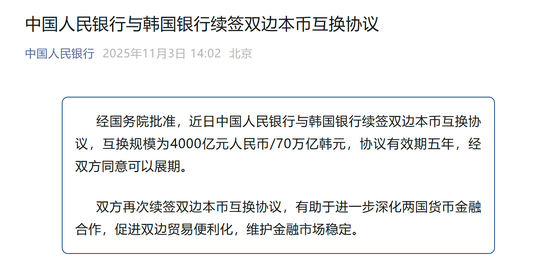
11月3日,据中国人民银行官方披露,经国务院批准,近日中国人民银行与韩国银行续签双边本币互换 协议,互换规模为4000亿元人民币/70万亿韩元,协议有效期五年,经双方同意可以展期。 号) 官方公告称,双方再次续签双边本币互换协议,有助于进一步深化两国货币金融合作,促进双边贸易便 利化,维护金融市场稳定 (来源:央行官方微信 今年以来,中国人民银行不断深化与境外央行间货币合作。 今年6月,中国人民银行与土耳其中央银行续签双边本币互换协议,互换规模为350亿元人民币/1890亿 土耳其里拉,协议有效期为三年。双方还签署了在土耳其建立人民币清算安排的合作备忘录。 今年8月,中国人民银行行长潘功胜会见来访的泰国银行行长社他布·素提瓦纳吕布。经国务院批准,潘 功胜与社他布·素提瓦纳吕布签署《中国人民银行与泰国银行人民币/泰铢双边本币互换协议的第三次展 期与修订协议》,互换规模为700亿元人民币/3700亿泰铢,协议有效期五年。 今年9月,潘功胜在出席国际清算银行行长例会期间分别与欧洲中央银行行长拉加德、瑞士国家银行行 长施莱格尔和匈牙利国家银行行长沃尔高签署双边本币互换协议。中欧双边本币互换规模为3500亿元人 民币/ ...
数字人民币真的要来了?11月起,应用场景将全面铺开
Sou Hu Cai Jing· 2025-11-03 05:11
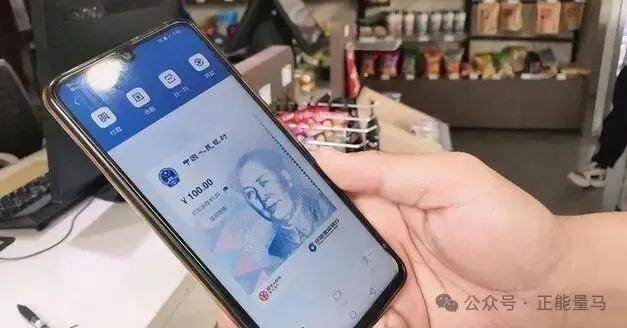
Core Insights - The People's Bank of China has announced the implementation of a "dual-center" framework for the digital yuan, marking a significant shift towards a digital currency era starting from November 2025 [1][6] - The digital yuan will expand its application scenarios beyond pilot programs to cover retail consumption, public services, cross-border trade, and green finance, indicating a comprehensive integration into the economy [1][8] Retail and Public Services - In Jiangsu, the digital yuan has ranked first in consumption for two consecutive years, with public hospitals supporting digital payments reaching 53% and key tourist attractions at 45% as of October 2023 [3] - The integration of digital yuan in property transactions in Nanjing and the use of smart contracts in Suzhou for housing fund transactions have shown significant advancements, with monthly transaction volumes exceeding 2.1 billion yuan [3] Cross-Border and Industry Applications - The internationalization of the digital yuan is set to achieve a breakthrough by 2025, with a cross-border digital payment platform in Shanghai expected to facilitate real-time transaction tracking and smart contract supervision [5] - The digital yuan is becoming a core tool for empowering the new energy industry, with significant loans issued to renewable energy companies in Fujian, exceeding 7 billion yuan [5] Technology and Ecosystem - Continuous breakthroughs in underlying technologies, such as blockchain 3.0 and quantum security encryption, have significantly enhanced transaction speeds and security [6] - The dual-center structure signifies a transition from "technical validation" to "ecosystem operation," with distinct roles for Beijing and Shanghai in managing domestic and international financial infrastructures [6] Future Outlook - The comprehensive rollout of the digital yuan will transform it from merely a payment method to a strategic tool for restructuring the monetary circulation system and promoting green transformation [8][9] - The digital currency revolution is expected to enhance user experience through zero-fee transfers, real-time subsidies, and improved accessibility in remote areas, ultimately leading to a more inclusive and efficient financial future [9]

香港特首李家超:香港将放宽资本投资者入境计划 引投金融科技
2 1 Shi Ji Jing Ji Bao Dao· 2025-11-03 04:45
南方财经 21世纪经济报道记者 张伟泽 实习生 谢巧云 香港报道 陆磊指出,中国人民银行将继续深化新一代人工智能技术金融应用。中国人民银行高度重视新一代人工 智能技术的金融应用工作,研究制定了人工智能加金融的一系列政策文件,引导内地金融机构在安全合 规的前提下,稳妥发挥大模型智慧大脑作用,统筹任务规划调度,串联复杂金融业务,实现能力有效整 合和业务高效协同,探索拓展金融的生产可能性边界(PPF)。 陆磊认为,中国人民银行探索拓展金融生产的可能性边界,目的在于能够用更低的成本提供当前已有的 金融产品和服务,或者拓展出原本没有的金融产品和服务,赋能金融机构经营模式变革升级。 11月3日,在香港金融科技周上,香港特区政府行政长官李家超表示,香港将放宽资本投资者入境计 划,以鼓励更多的投资者进入金融科技领域。香港金管局正在通过Ensemble沙盒探索常规金融的代币 化,同时应用监管沙盒来促进创新和审慎的风险管理。 李家超指出,今年 9 月,香港在全球金融中心指数中总体排名第三、亚洲第一,该指数同时将香港评为 全球金融科技第一城。目前香港已拥有超过1200家金融科技公司,同比增长10%。预计到2032年,香港 金融科技 ...
首次提出一次性个人信用救济政策意义何在?
Jin Rong Shi Bao· 2025-11-03 02:11
Core Viewpoint - The People's Bank of China (PBOC) is planning to implement a one-time personal credit relief policy to help individuals who have defaulted on loans due to the COVID-19 pandemic but have since repaid them, by removing their default information from credit reports [1][2]. Group 1: Policy Details - The policy will specifically target individuals who have defaulted on loans below a certain amount since the onset of the pandemic and have fully repaid their debts [1][2]. - The PBOC aims to execute this policy early next year after necessary procedures and technical preparations with financial institutions [1][2]. Group 2: Impact on Individuals - Many individuals have faced difficulties in obtaining new loans due to past defaults, even after repayment, as negative credit information remains on their records for five years under current regulations [2][3]. - The implementation of this policy is expected to provide a significant opportunity for those affected by external factors to regain access to financial support, thereby improving their financial situations [2][3]. Group 3: Historical Context - This is the first time the PBOC has proposed a personal credit relief policy, although it has previously issued guidelines to protect credit rights during the pandemic [3]. - In 2020, the PBOC provided specific protections for certain groups affected by COVID-19, allowing for more lenient treatment of overdue loans during the pandemic [3]. Group 4: Industry Reactions - Some financial institutions have already begun to relax strict credit policies, allowing for more flexible loan approvals for individuals with past defaults who have since repaid their debts [3]. - The implementation of the credit relief policy may lead to increased scrutiny and responsibility for loan officers, as they will need to balance risk with the opportunity to lend to previously "restricted" clients [3][4]. Group 5: Future Considerations - The one-time nature of this credit relief policy emphasizes the importance of maintaining credit discipline and awareness among consumers [4]. - The PBOC is also looking to refine credit management practices, as indicated by recent proposals for categorizing and managing credit information based on severity [4].
人民银行:9月境外机构在中国债券市场托管余额为3.8万亿元
Bei Jing Shang Bao· 2025-10-31 14:04
Core Insights - The People's Bank of China released the financial market operation report for September 2025, indicating the status of foreign institutions in the Chinese bond market [1] Group 1: Foreign Institutions in Bond Market - As of the end of September, the custody balance of foreign institutions in the Chinese bond market reached 3.8 trillion yuan, accounting for 2.0% of the total custody balance in the market [1] - The custody balance of foreign institutions in the interbank bond market is also 3.8 trillion yuan [1] Group 2: Breakdown by Bond Type - Foreign institutions hold 2.0 trillion yuan in government bonds, representing 52.9% of their total holdings [1] - The holdings in interbank certificates of deposit amount to 0.9 trillion yuan, which is 22.8% of the total [1] - Policy bank bonds held by foreign institutions total 0.8 trillion yuan, making up 20.4% of their total holdings [1]