
常熟银行

Search documents
社融增速放缓,信贷仍是企业强、居民弱:银行业周报(20260112-20260118)-20260118
Huachuang Securities· 2026-01-18 09:46
Investment Rating - The report maintains a "Buy" recommendation for the banking sector [1]. Core Insights - The report highlights a slowdown in social financing growth, indicating that credit remains strong for enterprises but weak for households [1]. - In December 2025, the social financing growth rate decreased by 0.2 percentage points to 8.3%, continuing the trend observed in the second half of 2025 [4]. - The report emphasizes that government bonds are the main support for social financing, contributing significantly to the overall increase in financing [4]. - The investment logic for 2026 is expected to shift from purely defensive to a combination of dividends and growth, with a focus on banks with high dividends and low valuations [5]. Summary by Sections Industry Basic Data - The banking sector consists of 42 listed companies with a total market capitalization of approximately 1.15 trillion yuan and a circulating market value of about 790 billion yuan [1]. Market Performance - The absolute performance of the banking sector over the past month is 5.0%, with a relative performance of 2.8% compared to the broader market [2]. Financing and Credit Data - In December 2025, new social financing amounted to 2.21 trillion yuan, which is a year-on-year decrease of 646.2 billion yuan, primarily due to a reduction in government bonds [4]. - The report notes that new RMB loans in December were 910 billion yuan, a year-on-year decrease of 80 billion yuan, with household loans showing a negative growth trend [4]. Investment Recommendations - The report suggests focusing on three main investment lines: state-owned banks and large commercial banks, quality joint-stock banks and city commercial banks with strong performance, and city commercial banks benefiting from regional policies [5]. - Specific banks recommended for investment include China Merchants Bank, CITIC Bank, Ping An Bank, and several city commercial banks [5].




银行周报(2026/1/12-2026/1/16):12月收支表:居民存款边际活化,中小银行配债意愿或有下降-20260118
GUOTAI HAITONG SECURITIES· 2026-01-18 07:44
股 票 研 究 12 月收支表:居民存款边际活化,中小银行配债意愿或有下降 [Table_Industry] 商业银行 银行周报(2026/1/12-2026/1/16) | [姓名table_Authors] | 电话 | 邮箱 | 登记编号 | | --- | --- | --- | --- | | 马婷婷(分析师) | 021-23185608 | matingting@gtht.com | S0880525100001 | | 陈惠琴(分析师) | 021-38676666 | chenhuiqin@gtht.com | S0880525100003 | 本报告导读: 12 月收支表:负债端,居民储蓄存款出现边际活化迹象;资产端,大型银行票据压 降力度较大,中小银行中长期贷款增幅较为显著,12 月债市波动,中小银行配债意 愿或有下降。 投资要点: [Table_Summary] 负债端:低基数下非银存款大幅多增 1)个人存款:同比多增 4287 亿元,其中活期储蓄存款、定期储蓄 存款分别同比多增 1000 亿元、少增 391 亿元,居民储蓄存款出现边 际活化迹象,定期储蓄存款延续由中小银行向大型银行迁 ...
银行行业:对公中长贷同比多增,居民存款流向非银仍不明显
Dongxing Securities· 2026-01-16 12:07
Investment Rating - The industry investment rating is "Positive" [4] Core Views - The report highlights that corporate medium to long-term loans have increased year-on-year, while the flow of household deposits to non-bank institutions remains insignificant [1][2] - The growth rate of social financing (社融) has decreased to 8.3% year-on-year, with a month-on-month decline of 0.2 percentage points [2] - The report anticipates that the macroeconomic policies will strengthen in 2026, with the central bank lowering several structural monetary policy tool rates to improve banks' funding costs and encourage credit growth in key areas [9] Summary by Sections Social Financing and Loans - As of December, social financing increased by 2.21 trillion yuan year-on-year, which is a decrease of 642.7 billion yuan compared to the previous year [2] - The net financing of government bonds was 686.4 billion yuan, a year-on-year decrease of 1.07 trillion yuan [2] - New RMB loans amounted to 910 billion yuan, a year-on-year increase of 135.5 billion yuan [2] - Corporate loans showed significant growth, particularly in medium to long-term loans, which increased by 2.9 trillion yuan year-on-year [2][3] Household Loans and Deposits - Household loan demand remains weak, with a decrease of 916 billion yuan in December, which is a year-on-year decline of 4.416 trillion yuan [3] - The report indicates that there has not been a significant outflow of household deposits to non-bank institutions, attributed to seasonal factors related to the maturity of wealth management products [3] Monetary Aggregates - M2 growth rate increased to 8.5% year-on-year, with a month-on-month increase of 0.5 percentage points [3] - New RMB deposits totaled 1.68 trillion yuan, with a year-on-year increase of 3.08 trillion yuan [3]
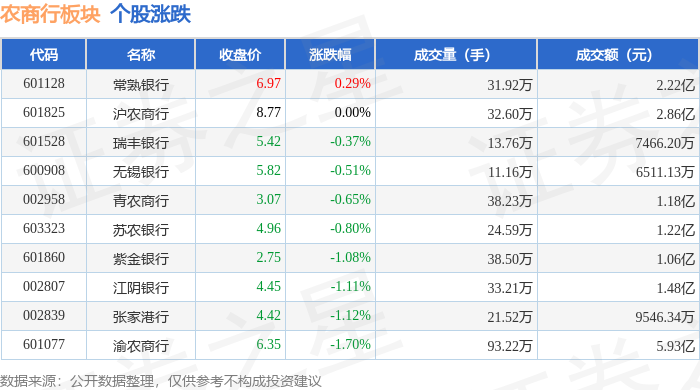
农商行板块1月16日跌0.64%,渝农商行领跌,主力资金净流出617.66万元
Zheng Xing Xing Ye Ri Bao· 2026-01-16 08:56
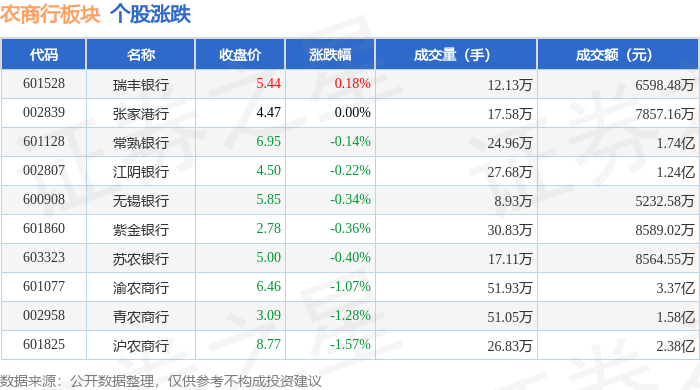
Group 1 - The agricultural commercial bank sector experienced a decline of 0.64% on January 16, with Yunnan Agricultural Commercial Bank leading the drop [1] - The Shanghai Composite Index closed at 4101.91, down 0.26%, while the Shenzhen Component Index closed at 14281.08, down 0.18% [1] - The trading volume and turnover for various agricultural commercial banks are detailed, with Changshu Bank closing at 6.97, up 0.29%, and Yunnan Agricultural Commercial Bank closing at 6.35, down 1.70% [1] Group 2 - The net outflow of main funds from the agricultural commercial bank sector was 6.1766 million yuan, while retail funds saw a net outflow of 12.6 million yuan [1] - The table shows the net inflow and outflow of funds for individual banks, with notable figures such as 14.69% net inflow for Shanghai Agricultural Commercial Bank from main funds [2] - Jiangyin Bank had a significant net outflow of 30.1445 million yuan from main funds, indicating a 20.35% decrease [2]



银行“十万亿俱乐部”成员达10家
21世纪经济报道· 2026-01-16 03:03
记者丨叶麦穗 编辑丨方海平 银行业绩快报捷足先登,截至1月15日,已经有浦发银行、中信银行2家银行先后发布了2025 年的"成绩单",双双实现归母净利润正增长,不过从业绩快报来看,两家银行去年的发展路 径,有一定的区别,其中中信银行"稳扎稳打",浦发银行则是"高举高打",值得一提的是, 两大股份行还联袂迈入"10万亿俱乐部",至此该俱乐部的成员达到10家 。 规模指标上,报告期末,浦发银行集团口径下资产总额达100817.46亿元,较上年末增加 6198.66 亿 元 , 增 长 6.55%; 负 债 总 额 92573.16 亿 元 , 较 上 年 末 增 加 5402.17 亿 元 , 增 长 6.20%。 资产质量方面,两家银行则全部得以改善。中信银行不良率1.15%,略降0.01个百分点;拨备 覆盖率203.61%,同比下降5.82个百分点。整体来看算是"稳扎稳打"。 浦发银行则明显更加"进攻"。不良率1.26%,同比下降0.10个百分点;拨备覆盖率200.72%, 同比上升13.76个百分点显示出要将"蛋糕做大"的想法。 浙商证券银行业分析师邱冠华的观点认为,2025年浦发银行规模增长方面,总资产同 ...



继续聚焦风险化解:金融监管总局 2026 年监管工作会议学习体会
Guoxin Securities· 2026-01-15 15:17
Investment Rating - The investment rating for the industry is "Outperform the Market" (maintained) [1][5]. Core Insights - The Financial Regulatory Bureau held a meeting to summarize the work of 2025 and arrange key tasks for 2026, with a continued focus on risk resolution, particularly for small and medium-sized financial institutions [2][3]. - The meeting emphasized five main areas: risk resolution for small financial institutions, prevention of risks in real estate and financing platforms, enhancement of high-quality development capabilities, improvement of financial regulation, and better financial services for economic and social quality [3][4]. - Compared to 2025, the requirements for 2026 remain largely unchanged, with a strong emphasis on preventing "explosive" risks in small financial institutions and a focus on normalizing the operation of real estate financing coordination mechanisms [3][6]. Summary by Sections Risk Resolution - The primary focus remains on resolving risks in small and medium-sized financial institutions, with a goal to firmly maintain the bottom line of preventing "explosive" risks [3][6]. - In 2025, nearly 400 banks were approved for dissolution or merger, and this trend is expected to continue into 2026 [3]. High-Quality Development - The requirement to enhance the industry's high-quality development capabilities remains unchanged, with new directives to cautiously advance the reduction and quality improvement of small financial institutions and to address disorderly competition [4][6]. Financial Regulation - There is a strong emphasis on strengthening and improving financial regulation, focusing on substantive risks and practical issues, and enhancing regulatory capabilities [4][6]. Financial Services - The meeting called for continuous improvement in financial services to enhance economic and social quality, including support for major strategies and sectors [4][6]. Investment Recommendations - The industry is expected to benefit from a narrowing of net interest margin declines, leading to an improvement in fundamentals for 2026, maintaining the "Outperform the Market" rating. Recommended stocks include Ningbo Bank and Changshu Bank, with attention to Changsha Bank and Chongqing Rural Commercial Bank. Stable high-dividend stocks such as China Merchants Bank, Industrial and Commercial Bank of China, and Jiangsu Bank are also considered valuable for allocation [7].
银行治理结构20年大变革:首席合规官接棒监事会,“硬制衡”取代“软监督”
Xin Lang Cai Jing· 2026-01-15 14:14
Core Viewpoint - The governance structure of Chinese commercial banks, which has been in place for over 20 years, is undergoing significant changes as the supervisory board is being replaced by Chief Compliance Officers (CCOs) in response to regulatory requirements [3][32][57] Group 1: Regulatory Changes - The "Compliance Management Measures for Financial Institutions" was released on December 25, 2024, mandating the establishment of CCO positions at financial institutions [4][32] - By March 1, 2025, all financial institutions must complete the appointment of CCOs and related compliance structures, marking the end of the supervisory board's role [4][32] - As of early 2026, at least 56 financial institutions have had their CCO qualifications approved by regulators, with over 20 banks and branches already in compliance [3][6][35] Group 2: Transition from Supervisory Board to CCO - The supervisory board, which has been in place for over 20 years, is officially being phased out, leaving only the board of shareholders and the board of directors [3][32] - The transition signifies a shift from "soft supervision" to "hard checks and balances" within the governance framework of Chinese commercial banks [3][32][57] - The responsibilities of the supervisory board will now be taken over by the CCO, who will have enhanced authority and independence [4][32] Group 3: CCO Responsibilities and Powers - CCOs are tasked with compliance risk monitoring, internal audits, and ensuring compliance with new products and business strategies [4][32] - The CCOs will have significant independence, with the authority to access all internal documents and data necessary for compliance assessments [21][25] - CCOs will also have the power to halt operations on projects that pose compliance risks and will be involved in the performance evaluations of business line leaders [23][25] Group 4: Historical Context and Need for Change - The effectiveness of the supervisory board has been questioned, as it has not met the expectations of policymakers regarding compliance oversight [8][39] - Regulatory scrutiny has intensified since 2018, with a shift in focus from growth to compliance, leading to increased penalties for violations [10][39] - The transition to CCOs is seen as a necessary evolution to address the shortcomings of the previous governance structure [8][39][48]

农商行板块1月15日跌0.94%,沪农商行领跌,主力资金净流出4296.1万元
Zheng Xing Xing Ye Ri Bao· 2026-01-15 08:59
Group 1 - The agricultural commercial bank sector experienced a decline of 0.94% on January 15, with Hu Nong Commercial Bank leading the drop [1] - The Shanghai Composite Index closed at 4112.6, down 0.33%, while the Shenzhen Component Index closed at 14306.73, up 0.41% [1] - The trading volume and turnover for various agricultural commercial banks are detailed in a table, showing mixed performance among individual stocks [1] Group 2 - The net outflow of main funds from the agricultural commercial bank sector was 42.961 million yuan, while retail funds saw a net outflow of 56.997 million yuan [1] - The table of fund flows indicates that some banks, like Changshu Bank and Zhangjiagang Bank, had positive net inflows from retail and speculative funds, while others like Yunnan Agricultural Bank and Jiangyin Bank faced significant outflows [2] - Specific data shows that Changshu Bank had a main fund net inflow of 8.1314 million yuan, while Yunnan Agricultural Bank had a net outflow of 25.5857 million yuan [2]


农商行板块1月14日跌1.28%,瑞丰银行领跌,主力资金净流入1.14亿元
Zheng Xing Xing Ye Ri Bao· 2026-01-14 08:58
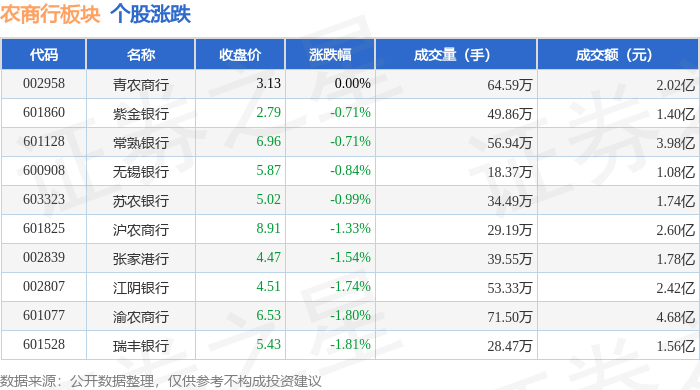
Core Viewpoint - The rural commercial bank sector experienced a decline of 1.28% on January 14, with Ruifeng Bank leading the drop, while the Shanghai Composite Index fell by 0.31% and the Shenzhen Component Index rose by 0.56% [1] Group 1: Market Performance - The closing price of Qingnong Commercial Bank was 3.13, unchanged from the previous day, with a trading volume of 645,900 shares and a transaction value of 202 million yuan [1] - Zijin Bank closed at 2.79, down 0.71%, with a trading volume of 498,600 shares and a transaction value of 140 million yuan [1] - Changshu Bank's closing price was 6.96, also down 0.71%, with a trading volume of 569,400 shares and a transaction value of 398 million yuan [1] - Wuxi Bank closed at 5.87, down 0.84%, with a trading volume of 183,700 shares and a transaction value of 108 million yuan [1] - The overall rural commercial bank sector saw a net inflow of 114 million yuan from main funds, while retail investors experienced a net outflow of 1.41 billion yuan [1] Group 2: Fund Flow Analysis - Changshu Bank had a main fund net inflow of 22.95 million yuan, accounting for 5.77% of its total, while retail investors had a net outflow of 5.30 million yuan [2] - Yunnan Agricultural Commercial Bank saw a main fund net inflow of 20.12 million yuan, representing 4.30%, but a retail net outflow of 34.64 million yuan [2] - Zhangjiagang Bank recorded a main fund net inflow of 15.78 million yuan, with a retail net outflow of 29.95 million yuan [2] - Wuxi Bank had a main fund net inflow of 12.01 million yuan, which is 11.10% of its total, while retail investors faced a net outflow of 9.00 million yuan [2] - Ruifeng Bank experienced a main fund net inflow of 3.60 million yuan, with a retail net outflow of 9.82 million yuan [2]


招行本周五“发红包” 超半数A股银行进行2025年度中期分红
Mei Ri Jing Ji Xin Wen· 2026-01-13 12:30
Core Viewpoint - The number of A-share listed banks implementing mid-term dividends is increasing, with several banks announcing their dividend plans for 2025, reflecting a commitment to shareholder returns and financial stability [1][4]. Group 1: Dividend Announcements - China Merchants Bank announced a cash dividend of approximately RMB 20.897 billion (including tax) for the first half of 2025, with a per-share dividend of RMB 1.013 (including tax) [1][2]. - As of now, over half of the 42 A-share listed banks have disclosed their mid-term dividend plans for 2025, with three banks, including China Merchants Bank, Postal Savings Bank, and Jiangsu Bank, announcing dividends this week [1][2][4]. - Postal Savings Bank distributed a cash dividend of RMB 0.123 per share (including tax) on January 12, 2026, while Jiangsu Bank announced a cash dividend of RMB 0.3309 per share (including tax) on January 14, 2026 [2]. Group 2: Regulatory Environment - The Chinese government has introduced guidelines to enhance cash dividend regulations for listed companies, encouraging multiple dividend distributions within a year and promoting higher dividend yields [3][4]. Group 3: Industry Trends - The mid-term dividend distribution among A-share listed banks has been growing, with 23 banks confirming their mid-term profit distribution plans for 2025, some of which are initiating mid-term dividends for the first time [4]. - Analysts note that the increase in the number of banks planning mid-term dividends and the stability of dividend rates indicate the banking sector's robust dividend value, which is attractive to long-term investors [5]. Group 4: Market Conditions - Despite a strong overall performance in 2025, many listed banks remain in a state of net asset value decline, primarily due to concerns over net interest margins and asset quality amid economic pressures [6]. - The average dividend yield for bank stocks is above 3%, with most banks expected to maintain a dividend yield of over 2% for their mid-term dividends in 2025 [6].