
纳微科技

Search documents
苏州工业园区:ESG赋能278平方公里绿色实践
Zhong Guo Zheng Quan Bao· 2025-11-23 20:06
Core Insights - Suzhou Industrial Park is leveraging ESG (Environmental, Social, and Governance) principles to drive sustainable economic growth and ecological balance, achieving significant reductions in energy consumption and carbon emissions compared to national averages [1][11] - The park has established a comprehensive ESG framework that includes policy support, standardization, and financial incentives, positioning itself as a national benchmark for ESG practices [3][4] Group 1: ESG Implementation and Impact - The park's ESG initiatives have led to the establishment of a "310 industrial system," integrating ESG as an independent industry that collaborates with key sectors like biomedicine and nanotechnology [5] - By 2024, the park aims to generate nearly 900 billion yuan in output from new energy and green industries, with a target of 650 billion yuan in ESG industry scale by the end of 2025 [1][4][10] - The ESG Innovation Center has provided customized services to over 500 enterprises, enhancing their ESG capabilities and facilitating a shift from passive compliance to proactive innovation [6][7] Group 2: Policy and Financial Support - The park has introduced a "policy combination" to promote ESG development, including financial incentives and innovative standards that align with international benchmarks [3][4] - A sustainable development loan program links interest rates to ESG performance, encouraging companies to improve their environmental impact while reducing financing costs [7] - By 2024, the park's green finance initiatives are expected to exceed 80 billion yuan, providing substantial funding for corporate transitions to sustainable practices [7] Group 3: International Collaboration and Recognition - Suzhou Industrial Park is actively engaging in international ESG standardization efforts, collaborating with organizations like the United Nations Environment Programme to share best practices [8][9] - The park's ESG practices have been recognized globally, being featured in the "ESG Standardization Blue Book" and awarded by the United Nations for sustainable development [9][10] - The park's model is being replicated in other regions, enhancing the overall quality of development in the Yangtze River Delta [9]

如东加速构建 “1+3+N”现代化产业体系
Shang Hai Zheng Quan Bao· 2025-11-23 18:04
Core Viewpoint - The 17th Coastal Economic Cooperation Conference in Rudong, Jiangsu, focused on the themes of "Towards the Sea, Towards Innovation, Towards the Future," highlighting the region's commitment to high-quality development and the signing of industrial projects with a total investment of approximately 15 billion yuan [1][4]. Group 1: Coastal Development - Rudong, with a coastline of 86 kilometers and a sea area of 4,555 square kilometers, emphasizes its connection to the sea as a foundation for technological and industrial innovation [2]. - The establishment of Yangkou Port as a deep-water port has positioned Rudong as a key player in the marine economy, with significant achievements in LNG energy and offshore wind power [2][3]. - The marine industry value added in Rudong has surpassed 50 billion yuan, ranking 28th among China's county-level economies [2]. Group 2: Industrial Innovation - Rudong aims to increase the marine production value's share of GDP to over 40% by 2030, with a target of exceeding 80 billion yuan in marine industry value added [3]. - The region is focusing on seven major industries, including marine renewable energy and marine modern services, to foster the development of leading enterprises [3][5]. - The conference showcased a series of signed projects in new energy, new materials, and new equipment, with a total investment of about 15 billion yuan [4][5]. Group 3: Future Development - Rudong is leveraging its geographical advantages and infrastructure improvements to enhance its role in the Yangtze River Delta integration strategy [6]. - The completion of the first phase of the Jinniu Terminal, with an investment of approximately 2.3 billion yuan, aims to improve the logistics capacity of Yangkou Port [6]. - Strategic agreements were signed to promote industrial transfer, project co-construction, and technological collaboration with various organizations, enhancing the region's innovation ecosystem [7].
专访天工所张以恒 | 近100%转化率破秸秆制粮天花板,体外生物转化如何重构 “中国饭碗”?
合成生物学与绿色生物制造· 2025-11-23 01:58
Core Viewpoint - The research led by Zhang Yiheng's team at the Tianjin Institute of Industrial Biotechnology has achieved a breakthrough in converting cellulose into starch with a conversion rate of 93.3%, significantly improving the previous theoretical limit of 50% and addressing food security issues in China [4][11][12]. Group 1: Food Security Challenges - China faces a food security dilemma with 1.58 billion tons of imported grain in 2024, including 26.4 million tons of starch-based grains and approximately 100 million tons of soybeans, while 600 million tons of straw are wasted annually [9][10]. - The annual production of terrestrial plants generates about 2 billion tons of lignocellulose, which is 26 times the current grain production, indicating a potential to create a new agricultural scale by utilizing just 4% of this resource [10]. Group 2: Technological Breakthroughs - The new "multi-enzyme molecular machine" technology allows for the conversion of cellulose to starch with a theoretical yield of nearly 100%, overcoming the limitations of traditional microbial metabolism [4][11]. - The innovative design includes a "recycling system" for glucose, which was previously wasted, and employs a seven-enzyme system to achieve the conversion [11][12]. Group 3: Industrial Applications - The first application target is in the chiral drug separation market, where the newly synthesized starch can meet high precision separation needs, previously dominated by Japanese companies [14][19]. - The team has established a collaboration with Suzhou Nano Micro Technology to utilize their expertise in surface modification, enhancing the performance of the new starch for drug separation [14][19]. Group 4: Commercialization Strategy - Zhang Yiheng emphasizes the importance of aligning technology with market needs, introducing the concept of "PC value" (Product Cost ratio) to guide the commercialization of biomanufactured products [15][18]. - The strategy includes a three-step approach to maximize the value of lignocellulosic resources, starting with the extraction of hemicellulose for high-value products before processing cellulose into starch [17][18]. Group 5: Future Directions - The team aims to reduce enzyme costs and scale up the production process while exploring applications in plant-based capsules and biodegradable materials [18][19]. - Zhang Yiheng's vision includes transforming agricultural waste into valuable food sources, contributing to China's food security and economic growth [18][22].


中证1000ETF增强(561280)跌0.20%,半日成交额278.42万元
Xin Lang Cai Jing· 2025-11-20 04:40
Core Viewpoint - The article discusses the performance of the Zhongzheng 1000 ETF Enhanced (561280) as of November 20, highlighting its slight decline and the performance of its major holdings [1] Group 1: ETF Performance - As of the midday close, the Zhongzheng 1000 ETF Enhanced (561280) decreased by 0.20%, priced at 1.467 yuan, with a trading volume of 2.7842 million yuan [1] - Since its establishment on August 31, 2023, the fund has achieved a return of 47.02%, with a monthly return of 1.14% [1] Group 2: Major Holdings Performance - Major stocks within the ETF include: - Boqian New Materials: down 0.90% - Haoyuan Pharmaceutical: down 0.42% - Yingjixin: down 1.27% - Caixun Co.: up 0.49% - Jinma Amusement: down 0.19% - Panjiang Co.: unchanged - Jindawei: down 1.21% - Yiyuan Communication: down 0.50% - Minxin Co.: down 1.22% - Nami Technology: down 0.03% [1]
化学制药板块11月19日跌1.44%,海南海药领跌,主力资金净流出22.78亿元
Zheng Xing Xing Ye Ri Bao· 2025-11-19 08:52
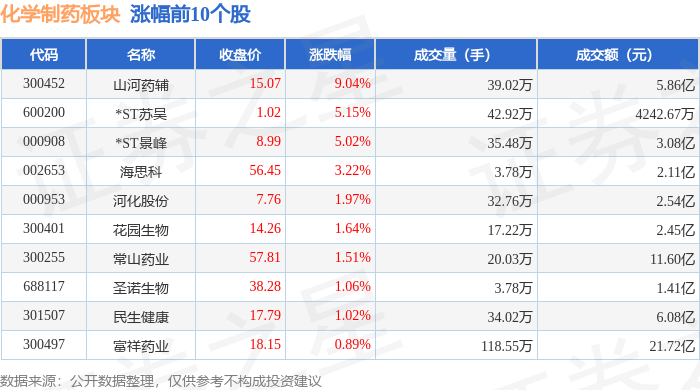
Market Overview - The chemical pharmaceutical sector experienced a decline of 1.44% on November 19, with Hainan Haiyao leading the drop [1] - The Shanghai Composite Index closed at 3946.74, up 0.18%, while the Shenzhen Component Index closed at 13080.09, unchanged [1] Stock Performance - Notable gainers in the chemical pharmaceutical sector included: - Shanhe Pharmaceutical (300452) with a closing price of 15.07, up 9.04% and a trading volume of 390,200 shares, totaling 586 million yuan [1] - ST Suhao (600200) closed at 1.02, up 5.15% with a trading volume of 429,200 shares [1] - ST Jingfeng (000908) closed at 66.8, up 5.02% with a trading volume of 354,800 shares [1] - Major decliners included: - Muan Nanhai (000566) with a closing price of 7.20, down 10.00% and a trading volume of 2,192,500 shares, totaling 1.625 billion yuan [2] - Sitaili (603520) closed at 10.66, down 6.74% with a trading volume of 315,600 shares [2] - Yatai Pharmaceutical (002370) closed at 7.79, down 6.59% with a trading volume of 1,044,700 shares [2] Capital Flow - The chemical pharmaceutical sector saw a net outflow of 2.278 billion yuan from institutional investors, while retail investors contributed a net inflow of 2.139 billion yuan [2] - The top stocks by net inflow from institutional investors included: - Changshan Pharmaceutical (300255) with a net inflow of 71.90 million yuan, accounting for 6.20% of total inflow [3] - Xingqi Eye Medicine (300573) with a net inflow of 70.33 million yuan, representing 12.29% [3] - Shanhe Pharmaceutical (300452) with a net inflow of 68.13 million yuan, making up 11.62% [3]


纳微科技(688690) - 苏州纳微科技股份有限公司2025年第一次临时股东大会决议公告
2025-11-17 10:00
证券代码:688690 证券简称:纳微科技 公告编号:2025-039 苏州纳微科技股份有限公司 2025年第一次临时股东大会决议公告 本公司董事会及全体董事保证公告内容不存在任何虚假记载、误导性陈述或 者重大遗漏,并对其内容的真实性、准确性和完整性依法承担法律责任。 重要内容提示: 本次会议是否有被否决议案:无 一、 会议召开和出席情况 2、 公司在任监事3人,出席3人; (一) 股东大会召开的时间:2025 年 11 月 17 日 (二) 股东大会召开的地点:江苏省苏州市工业园区百川街 2 号研发中心大楼 会议室 (三) 出席会议的普通股股东、特别表决权股东、恢复表决权的优先股股东及 其持有表决权数量的情况: | 1、出席会议的股东和代理人人数 | 74 | | --- | --- | | 普通股股东人数 | 74 | | 2、出席会议的股东所持有的表决权数量 | 176,061,462 | | 普通股股东所持有表决权数量 | 176,061,462 | | 3、出席会议的股东所持有表决权数量占公司表决权数量的比 | 43.9332 | | 例(%) | | | 普通股股东所持有表决权数量占公司表决权数量 ...
纳微科技(688690) - 北京市中伦(上海)律师事务所关于苏州纳微科技股份有限公司2025年第一次临时股东大会法律意见书
2025-11-17 09:46
北京市中伦(上海)律师事务所 关于苏州纳微科技股份有限公司 2025 年第一次临时股东大会 法律意见书 二〇二五年十一月 北京 • 上海 • 深圳 • 广州 • 武汉 • 成都 • 重庆 • 青岛 • 杭州 • 南京 • 海口 • 东京 • 香港 • 伦敦 • 纽约 • 洛杉矶 • 旧金山 • 阿拉木图 Beijing • Shanghai • Shenzhen • Guangzhou • Wuhan • Chengdu • Chongqing • Qingdao • Hangzhou • Nanjing • Haikou • Tokyo • Hong Kong • London • New York • Los Angeles • San Francisco • Almaty 法律意见书 北京市中伦(上海)律师事务所 关于苏州纳微科技股份有限公司 2025 年第一次临时股东大会 法律意见书 致苏州纳微科技股份有限公司: 北京市中伦(上海)律师事务所(以下简称"本所")作为苏州纳微科技股 份有限公司(以下简称"公司")的法律顾问,受公司委托,指派律师出席公司 2025 年第一次临时股东大会(以下简称"本次股东 ...
中国生命科学上游行业景气度上行
Zhao Yin Guo Ji· 2025-11-17 08:03
Investment Rating - The report rates the Chinese life sciences upstream industry as "outperforming the market" [38]. Core Insights - The Chinese life sciences upstream industry is experiencing an upward trend, benefiting from increased R&D spending in the pharmaceutical sector, a recovery in financing for innovative drugs, and a surge in domestic innovative drug exports [1][4]. - There is significant potential for domestic substitution, which is expected to drive long-term growth in the domestic upstream industry [1][4]. - Domestic companies are narrowing the technological gap with international giants through continuous investment in technology, gaining customer recognition and market share [1]. Summary by Sections Industry Overview - The report highlights that the pharmaceutical industry is the most important client for the life sciences upstream sector in China, with R&D demand maintaining growth despite fluctuations [4]. - Key indicators of recovery include sustained growth in R&D spending by large pharmaceutical companies and biotech firms post-COVID-19, a significant increase in domestic innovative drug export transactions, and a resurgence in financing for innovative drugs [4][18]. Domestic Companies - Domestic companies are leveraging technological barriers, cost advantages, and policy opportunities to increase market share [4]. - The average R&D expense ratio for leading domestic upstream companies was 13.0% in the first half of 2025, exceeding levels during the pandemic [4]. - Notable domestic companies include Nanwei Technology, Nuoviz, and Aopumai, which have shown strong revenue growth and technological advancements [1][4][29]. Market Trends - The report indicates that the domestic market for life sciences is characterized by a fragmented structure, with significant growth opportunities arising from the need for domestic substitution due to geopolitical risks and supply chain disruptions [4]. - The report provides data on the increasing domestic market share of various products, such as culture media and chromatography materials, with notable growth in their localization rates [28][30].
每日投资策略-20251117
Zhao Yin Guo Ji· 2025-11-17 07:02
Macro Economic Overview - China's economy is experiencing a comprehensive slowdown in October, but is expected to achieve an annual growth target of 5%. Real estate prices are declining rapidly, and retail sales growth has dropped to a one-year low due to the phasing out of old-for-new subsidy policies [5][6] - Fixed asset investment has seen a significant decline, the second largest since February 2020, with fiscal expansion slowing down and anti-involution measures suppressing infrastructure and manufacturing investments. However, due to a strong economic growth rate in the first half of the year, a GDP growth rate of only 4.5% is needed in the fourth quarter to meet the annual target [5][6] Industry Insights - The Chinese life sciences upstream industry is benefiting from several positive trends, including increased R&D spending by downstream pharmaceutical companies, a recovery in financing for innovative drugs, and a continued surge in the export of Chinese innovative drugs. Domestic companies are narrowing the technological gap with international giants through sustained investment [6][7] - The domestic upstream industry is expected to see considerable growth driven by domestic substitution, with companies like Nanwei Technology, Novozymes, and Aopumai being highlighted as key players [6][7] - The domestic pharmaceutical industry has maintained growth momentum in R&D demand, with significant increases in financing for innovative drugs, which surged by 443.6% year-on-year in Q3 2025 [6][7] Company Analysis - Baidu is focusing on accelerating AI application deployment, having launched the Wenxin large model 5.0 and new Kunlun chips. The company aims to enhance its core products and expand its global services, with a target price set at $148.40, maintaining a "Buy" rating [8]

纳微科技11月14日获融资买入2253.72万元,融资余额3.61亿元
Xin Lang Cai Jing· 2025-11-17 01:27
Group 1 - The core business of Nanwei Technology involves the research, large-scale production, sales, and application services of high-performance nano microsphere materials, serving clients in biomedicine, flat panel displays, analytical testing, and in vitro diagnostics [2] - As of September 30, 2025, Nanwei Technology achieved operating revenue of 671 million yuan, representing a year-on-year growth of 22.01%, and a net profit attributable to shareholders of 108 million yuan, with a significant year-on-year increase of 156.56% [2] - The company has distributed a total of 115 million yuan in dividends since its A-share listing, with 86.84 million yuan distributed over the past three years [3] Group 2 - On November 14, Nanwei Technology's stock price fell by 1.02%, with a trading volume of 142 million yuan [1] - The financing buy-in amount for Nanwei Technology on November 14 was 22.54 million yuan, while the financing repayment was 21.62 million yuan, resulting in a net financing buy-in of 918,600 yuan [1] - The total balance of margin trading for Nanwei Technology as of November 14 was 363 million yuan, with the financing balance accounting for 2.98% of the circulating market value, indicating a high level compared to the past year [1]