
Heineken

Search documents
Heineken U.S. CEO on non-alcoholic beer: Part of the future but not all the answer
CNBC Television· 2025-08-20 18:28
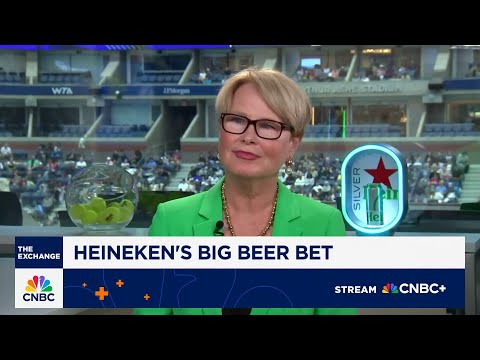
Hey Leslie. Yep. Thanks.I am joined by the Heineken US CEO Maggie Ty. Maggie, thank you for taking the time. >> Thank you Brendan.Thanks for having me. >> Let's start there with the rise in popularity of these non-alcoholic offerings. Right.It's what you're bringing here to the US Open. He hinekin love. I we've seen the long-standing history of partnerships between alcohol brands and these big sports brands as well.Is non-alcoholic the future in terms of those types of partnerships. >> I think it's part of ...

Carlsberg CEO notes changing beer habits amid cost pressures
CNBC· 2025-08-15 06:33
Core Insights - Spending pressures are leading to a division in beer drinking habits, with consumers increasingly favoring premium or economy brands over core brands [1][2] - Carlsberg reported a 1.7% decline in organic volumes for the second quarter, reflecting a broader trend among brewers facing declining sales [4][5] - The global beer market is experiencing a shift, with consumers opting for high-end products while core brands struggle [9][11] Industry Trends - The beer industry is facing several consecutive quarters of declining volume growth, as consumers resist higher prices and seek alternatives [2][5] - Carlsberg's CEO noted that the core brands are most affected by a consumer base that is becoming more selective in spending [9] - There is a notable shift from on-trade consumption (bars and restaurants) to off-trade consumption (supermarkets and retail), as rising prices in bars make at-home drinking more appealing [11][12] Competitive Landscape - AB InBev and Heineken have also reported declines in volume growth, with AB InBev experiencing a 1.9% year-on-year decline and Heineken a 0.4% dip [5] - Despite the challenges, some industry leaders express confidence in the resilience of the beer category, citing continued revenue and operating profit growth [6]

喜力啤酒全球销量下降,中国市场增长30%成为亮点
Sou Hu Cai Jing· 2025-07-30 03:07
Core Insights - Heineken Group reported a decline in operating profit by 7.1% year-on-year for the first half of 2025, amounting to €1.433 billion, with global beer sales down by 1.2% to 11.64 million kiloliters [1] - The company experienced a significant growth in the Chinese market, with licensed beer sales increasing by over 30%, contributing to a rise in market share [1][2] - The European market faced challenges, with organic net revenue declining by 4% and sales down by 4.7%, primarily due to stalled negotiations in Western European supermarkets and reduced demand in Poland and Austria [1] - The Americas market also showed a slight decline, with net revenue down by 0.8% and sales down by 1.2%, although Mexico's growth helped mitigate some losses [1] - The Asia-Pacific and Middle East-Africa markets were the main growth drivers, with the Asia-Pacific region seeing a 3.1% organic growth in beer sales, and licensed beer sales soaring by 32.1% [1] Financial Performance - Heineken's total revenue for the first half of 2025 reached €16.924 billion [1] - The Middle East and Africa markets reported a 19.8% increase in net revenue and a remarkable 102.8% increase in operating profit [3] - The company anticipates that overall sales for 2025 will remain roughly flat, with an expected organic growth in operating profit of 4% to 8% for the year [3] Market Strategies - Heineken has intensified its marketing efforts in China, achieving double-digit growth in its unique offerings, with specific brands like Heineken Star Silver and Red爵 seeing significant sales increases [2] - The company has partnered with China Resources Beer to enhance its market presence, becoming an official supplier at major sporting events [2]


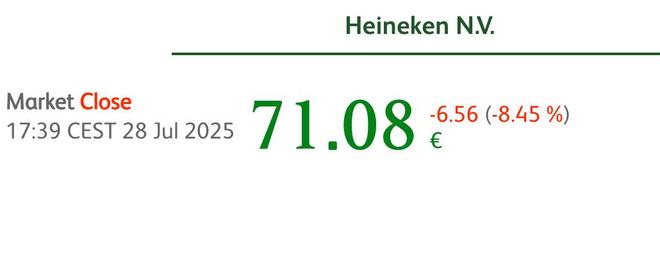
喜力啤酒业绩下行股价大跌8% 中国成增长救星|酒业财报观察
2 1 Shi Ji Jing Ji Bao Dao· 2025-07-29 04:20
Core Insights - Heineken's revenue for the first half of 2025 was €16.924 billion, with a volume of 11.64 million hectoliters and an operating profit of €1.433 billion, all showing a year-on-year decline [1] - The company attributed part of the revenue decline to the strength of the euro, but reported organic growth in net revenue of 2.1%, organic growth in revenue per hectoliter of 3.3%, and organic growth in operating profit of 7.4% compared to the first quarter [1] Group 1: Market Performance - Global beer sales for Heineken decreased by 1.2% compared to the same period last year, with Europe experiencing the largest decline [2] - In Europe, net revenue fell by 4% and sales volume dropped by 4.7%, attributed to stalled negotiations in Western Europe and declining sales in Poland and Austria [2] - The Americas saw a smaller decline, with net revenue down 0.8% and sales volume down 1.2%, as growth in Mexico was offset by declines in Brazil and the U.S. [2] Group 2: Regional Growth - The Asia-Pacific and Africa-Middle East markets, which are smaller than Europe and the Americas, showed significant growth, with Africa-Middle East net revenue increasing by 19.8% and operating profit rising by 102.8% [4] - The Asia-Pacific market saw the highest beer sales growth, with an organic increase of 3.1%, driven by strong performances in Vietnam, India, Myanmar, and Laos [4] - In China, Heineken's licensed beer sales grew by over 30%, with specific brands like Heineken Silver and Red爵 seeing substantial increases [4] Group 3: Marketing Strategy - Heineken has intensified its marketing efforts in China, becoming an official supplier for the "Super League" alongside local brands, marking a shift from its previous sponsorship of only top-tier international events [5] - The company maintains its forecast for organic operating profit growth of 4% to 8% for the year, consistent with prior expectations [5]
Low spirits for alcohol stocks despite better-than-feared trade deal
CNBC Television· 2025-07-28 16:08
Trade Deal Impact - EU trade deal provides a breath of relief but no cheers yet for European wine and spirits makers, who find themselves left out [1] - A 15% tariff on EU imports to the US is better than the feared 30%, but no decision regarding a wine and spirits carveout has been made [2] - EU officials say an agreement for the sector will be examined in the coming weeks [2] - Spirits stocks initially ticked slightly higher but then moved lower as investor uncertainty settled in [3] Financial and Market Concerns - A 15% tariff is still a big hit, as a previous 10% blanket tariff on EU imports led to a 12% decline for wine producers [3] - Leading wine makers may have to increase prices or exit the US market overall [4] - The EU exported 105 billion (10.5% billion) of alcohol to the US in 2024, with 12 billion (1.2% billion) coming back in return [4] - Beer maker Heineken reported an earnings beat but warned of softening demand in the US and EU [5] Industry Trends and Challenges - The industry faces the impact of cannabis, GLP1s, and generational shifts leading to decreased alcohol consumption [7] - Legal drinking age Gen Z consumers are drinking less, turning to non-alcoholic options [7] - Weaker consumer demand and rising prices are anticipated, according to producers [9] - Steel and aluminum tariffs also weigh on the sector, in addition to tariffs on the products themselves [6]
X @Bloomberg
Bloomberg· 2025-07-28 10:26
"What's important is there is a deal, there's clarity, and further escalation has been avoided."Heineken CEO Dolf van den Brink says 15% US tariffs on EU exports are largely in line with expectations and can be absorbed by the brewer https://t.co/wjqSXGP1VZ https://t.co/3EyGcUeA26 ...
#Heineken can absorb 15% US #tariffs on #EU, #CEO says
Bloomberg Television· 2025-07-28 10:24
Business Environment & Strategy - A deal providing clarity and avoiding further escalation is important for the industry [1] - European companies and economies will adapt to a new reality, which the company can absorb, explicitly implied in its profit outlook for the rest of the year [1] - Predictability, consistency, and outlook are very important for the beer industry [2] - The company will closely follow developments, but its setup this year and outlook are broadly in line with what it has assumed since the beginning of the year [2] Capital Investment & Manufacturing - Beer is a very capital-intensive business, with breweries built to last for decades [2] - Moving manufacturing would be a big decision with long-term ramifications for the company [2]

X @Bloomberg
Bloomberg· 2025-07-28 05:30
Heineken saw a decline in beer volumes, as retailer disputes across Europe dragged on sales and limited its ability to take advantage of the summer heat wave https://t.co/Qcldejcs4v ...
2025年全球酒精饮料品牌价值排行榜报告
Sou Hu Cai Jing· 2025-07-26 03:01
Core Insights - The 2025 Brand Finance report highlights the global alcoholic beverage market's shift towards health-conscious consumption and premiumization, with non-alcoholic and low-alcohol (NoLo) drinks emerging as significant growth areas [2][10][30]. Industry Trends - The NoLo segment is rapidly expanding, particularly in the beer category, with non-alcoholic beer drinkers showing a higher interest in sports and fitness [2][30]. - Premiumization is a key trend, with consumers opting for higher-quality, premium-priced products, especially among younger and more diverse demographics [2][32]. Beer Market Overview - Corona Extra retains its position as the most valuable beer brand globally, valued at $13.4 billion, marking a 29% increase from the previous year [3][20]. - Heineken and Budweiser follow as the second and third most valuable beer brands, valued at $12.9 billion and $11.86 billion, respectively [3]. - Asian brands are gaining traction, with China's Snow Beer valued at $4.66 billion and Tsingtao at $3.634 billion, the latter having the highest brand strength index (BSI) at 95.6 [3][4]. Spirits Market Overview - Moutai continues to dominate the spirits category with a brand value of $58.377 billion, a 16.5% increase, maintaining its position for ten consecutive years [5][20]. - Wuliangye ranks second with a brand value of $27.778 billion, growing by 7.3% [5]. - Don Julio, a tequila brand, is noted for its strong brand strength, with a BSI of 94.2, despite a lower brand value of $1.6 billion [5][20]. Champagne and Wine Market Overview - Moët & Chandon leads the champagne and wine category with a brand value of $2.072 billion, reflecting a 49% increase [7][20]. - Barefoot and Penfolds follow, valued at $1.235 billion and $1.134 billion, respectively, with Penfolds achieving a BSI of 86.2 [7][8]. Brand Strategy Insights - Successful brands leverage cultural resonance and youth engagement, as seen with Guinness's introduction of its non-alcoholic variant, which has improved its perception among younger consumers [9]. - Sustainability is becoming a critical competitive factor, with brands like Mumm and Mahou leading in environmental and social governance (ESG) assessments [9]. Overall Market Outlook - The report indicates that the global alcoholic beverage market is evolving, with brands needing to balance traditional heritage with modern consumer demands to maintain leadership [10].



2025年AI的行业颠覆性影响与机遇面向创业者的分行业指南
2025-07-25 07:15
Summary of Key Points from the Conference Call Industry Overview - The report focuses on the impact of generative artificial intelligence (genAI) across various sectors, highlighting its potential to transform industries and create new investment opportunities [6][24][41]. Core Insights and Arguments 1. **Generative AI as a Platform Shift**: genAI is viewed as a significant technological transition with the potential to enhance productivity across multiple sectors, including technology, healthcare, and finance [6][41]. 2. **Investment Opportunities**: The report suggests that the productivity gains from genAI could surpass those seen during the internet boom, with a projected capital expenditure cycle for AI data centers expected to exceed traditional data centers [7][12]. 3. **Sector-Specific Impacts**: - **Technology Sector**: Companies like Alphabet and Microsoft are leading in AI adoption, with returns on total capital expected to rise from 22% in 2022 to 29% in 2024 [7][10]. - **Financial Sector**: AI is anticipated to improve cost efficiency and revenue generation, with estimates suggesting a EUR 750 million AI value creation target by 2026 [31]. - **Healthcare Sector**: While AI can enhance R&D efficiencies, its impact on overall healthcare revenue is expected to be limited due to regulatory constraints [33]. - **Consumer Staples**: AI is enhancing productivity through better demand forecasting and inventory management, leading to cost reductions and improved efficiency [28]. - **Energy Sector**: AI is expected to increase electricity demand significantly, particularly for data centers, which could boost capital investment in infrastructure [52][53]. Additional Important Insights 1. **Cultural Factors**: The ability of firms to capture value from genAI will depend significantly on their organizational culture and readiness to adapt to new technologies [11]. 2. **AI Unicorns**: AI startups are achieving unicorn status faster than traditional SaaS companies, indicating a shift in the startup landscape [18][14]. 3. **Regulatory Challenges**: The integration of AI in sectors like finance and healthcare faces regulatory hurdles that could limit its potential benefits [31][33]. 4. **Long-Term Trends**: The report emphasizes that while AI will drive significant changes, the benefits will vary across sectors and depend on existing market dynamics and competitive pressures [24][41]. Conclusion - The report underscores the transformative potential of genAI across various industries, highlighting both the opportunities and challenges that lie ahead. Companies that effectively leverage AI technologies are likely to gain a competitive edge, while those that fail to adapt may face disruption.
