沪农商行

Search documents
农商行板块1月23日跌0.91%,常熟银行领跌,主力资金净流入977.76万元
Zheng Xing Xing Ye Ri Bao· 2026-01-23 09:04
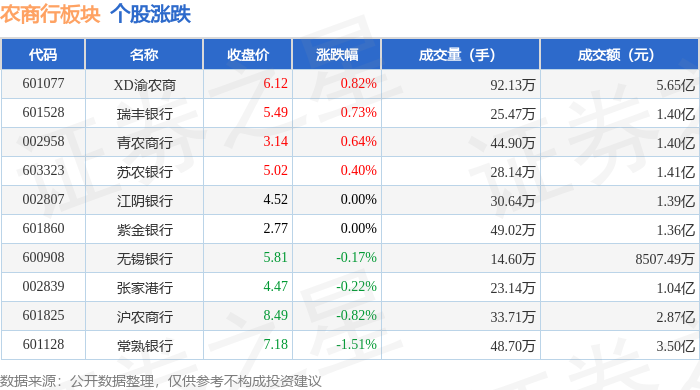
Core Viewpoint - The agricultural commercial bank sector experienced a decline of 0.91% on January 23, with Changshu Bank leading the drop, while the Shanghai Composite Index rose by 0.33% and the Shenzhen Component Index increased by 0.79% [1] Group 1: Market Performance - The closing price of Changshu Bank was 7.18, reflecting a decrease of 1.51% [1] - The sector's main stocks showed mixed performance, with XD Yunnong Bank increasing by 0.82% to 6.12, and Wuxi Bank decreasing by 0.17% to 5.81 [1] - The total trading volume for the agricultural commercial bank sector was significant, with XD Yunnong Bank recording a volume of 921,300 shares and a transaction value of 565 million [1] Group 2: Capital Flow - The agricultural commercial bank sector saw a net inflow of 9.78 million from main funds, while retail investors experienced a net outflow of 76.56 million [1] - Among individual banks, Shanghai Agricultural Commercial Bank had the highest net inflow from main funds at 26.90 million, while Changshu Bank faced a net outflow of 22.49 million [2] - Retail investors showed a significant net inflow into Qingnong Bank at 24.98 million, despite the bank experiencing a net outflow from main and speculative funds [2]





实力银行理财、商业银行、养老金管理人荣膺济安群星汇多项殊荣奖项 私募基金评选隆重上线
Zhong Guo Jing Ji Wang· 2026-01-23 08:02
1月23日,中国资管群星汇颁奖典礼暨私募基金高质量发展论坛在京召开,论坛由济安金信及华泰 证券共同举办,邀请在2025年表现优异的银行理财、商业银行、养老金管理人、私募基金等资管机构、 主流媒体行业精英共探发展趋势、分享前沿洞见,共建开放、协作、共赢的金融生态圈。 此次论坛上,重磅发布2025年养老金产品及管理人"群星汇"多项大奖榜单。本次颁奖盛典在予以表 彰优秀资管管理人的同时,全新增设私募基金评选赛道。 济安金信作为中国证监会备案、具备证券投资基金公开评级与评奖双资质的独立第三方机构,始终 秉持"公平、公正、公开"的原则,以科学、独创的评级体系助力行业生态建设,致力于"济安群星汇"资 管评奖,推动行业健康有序发展。 "济安群星汇"的奖项评选是济安金信以济安研究院五大研究中心为 载体,中国人民大学金融信息中心为学术指导单位,联合上海金融与发展实验室、龙马学院、中央财经 大学银行业研究中心等权威研究机构行业专家联手打造。 获得2025年度济安群星汇理财公司综合奖——群星奖的机构是:光大理财有限责任公司、信银理财 有限责任公司、招银理财有限责任公司、南银理财有限责任公司和华夏理财有限责任公司。 获得2025年度 ...
头部农商行再添一员 中国银行业格局生变
2 1 Shi Ji Jing Ji Bao Dao· 2026-01-22 23:10
Core Viewpoint - A new force characterized by regional deepening is rapidly emerging in China's banking industry, with Chengdu Rural Commercial Bank becoming the fifth rural commercial bank to surpass 1 trillion yuan in assets, highlighting a structural change in the industry towards localized service models [1][2]. Group 1: Emergence of Regional Banks - Chengdu Rural Commercial Bank officially announced its asset scale surpassed 1 trillion yuan on January 1, 2026, joining the ranks of four other major rural commercial banks [1]. - The five banks that have reached this milestone are all urban rural commercial banks headquartered in national central cities, which have high urbanization levels and strong economic radiation capabilities [1]. - The success of these banks is attributed to their deep understanding of local economies and a strategic focus on localized services, aligning with regulatory guidance emphasizing support for local communities and agriculture [2]. Group 2: Development Strategies - Each of the trillion-yuan rural commercial banks has developed unique advantages based on local characteristics, such as Beijing Rural Commercial Bank focusing on "three rural" services and Shanghai Rural Commercial Bank developing technology and elderly finance [3]. - Chengdu Rural Commercial Bank aims to be a bank that understands rural revitalization and local industries, optimizing its branch layout to enhance service breadth and depth [3]. - The bank has achieved over 80% account opening rates for new agricultural operators and over 72% credit coverage for major grain producers, demonstrating its effective local engagement [3][4]. Group 3: Financial Performance - Since the end of 2019, Chengdu Rural Commercial Bank's asset scale has grown from less than 500 billion yuan to over 1 trillion yuan by early 2026, with an annual growth rate significantly above the industry average [4]. - The bank maintains a stable asset quality, with a non-performing loan ratio of 1.02% and a provision coverage ratio of 441.83% as of mid-2025, indicating strong financial health compared to peers [4]. Group 4: Challenges and Transformation - Surpassing the 1 trillion yuan mark signifies a new development stage for these regional banks, necessitating a restructuring of their development models and management capabilities [6]. - The banks face three core challenges: pressure on profit growth due to narrowing net interest margins, accelerated capital consumption from risk-weighted asset expansion, and increased difficulty in risk management amid economic adjustments [6][7]. - To address these challenges, banks must diversify their income structures, enhance capital accumulation, and strengthen risk management through digital means [7][8]. Group 5: Digitalization and Future Outlook - Chengdu Rural Commercial Bank is focusing on digitalization by enhancing mobile banking and online service platforms, with over 4 million mobile banking users and a community service platform linking 110 communities [8]. - The emergence of trillion-yuan rural commercial banks indicates that impactful financial institutions can be cultivated in regional economies, emphasizing the importance of local engagement for sustainable development [8].

金砖国家新开发银行签署绿色金融协议 助力上海绿色发展
Xin Hua Wang· 2026-01-22 14:19
Core Viewpoint - The New Development Bank (NDB) has signed a cooperation agreement with Shanghai Rural Commercial Bank for a green loan project, emphasizing financial support for Shanghai's green development [1] Group 1: Project Details - The NDB will provide an equivalent of 100 million USD in five-year RMB funding specifically for renewable energy, energy efficiency, environmental protection, and digital infrastructure [1] - The project is centered around the theme of "Financial Support for Shanghai's Green Development" [1] Group 2: Strategic Importance - The chairman of Shanghai Rural Commercial Bank, Xu Li, stated that green development has become a global consensus and that green finance is essential for achieving carbon neutrality goals and driving comprehensive green transformation [1] - NDB's Vice President, Roman Shcherov, highlighted Shanghai's status as a global financial hub and the ideal environment it provides for this cooperation [1] Group 3: Institutional Background - The NDB was established in 2015 by Brazil, Russia, India, China, and South Africa to support infrastructure and sustainable development projects in BRICS and other emerging economies and developing countries [1] - The bank aims to complement existing multilateral and regional financial institutions to promote global growth and development [1]
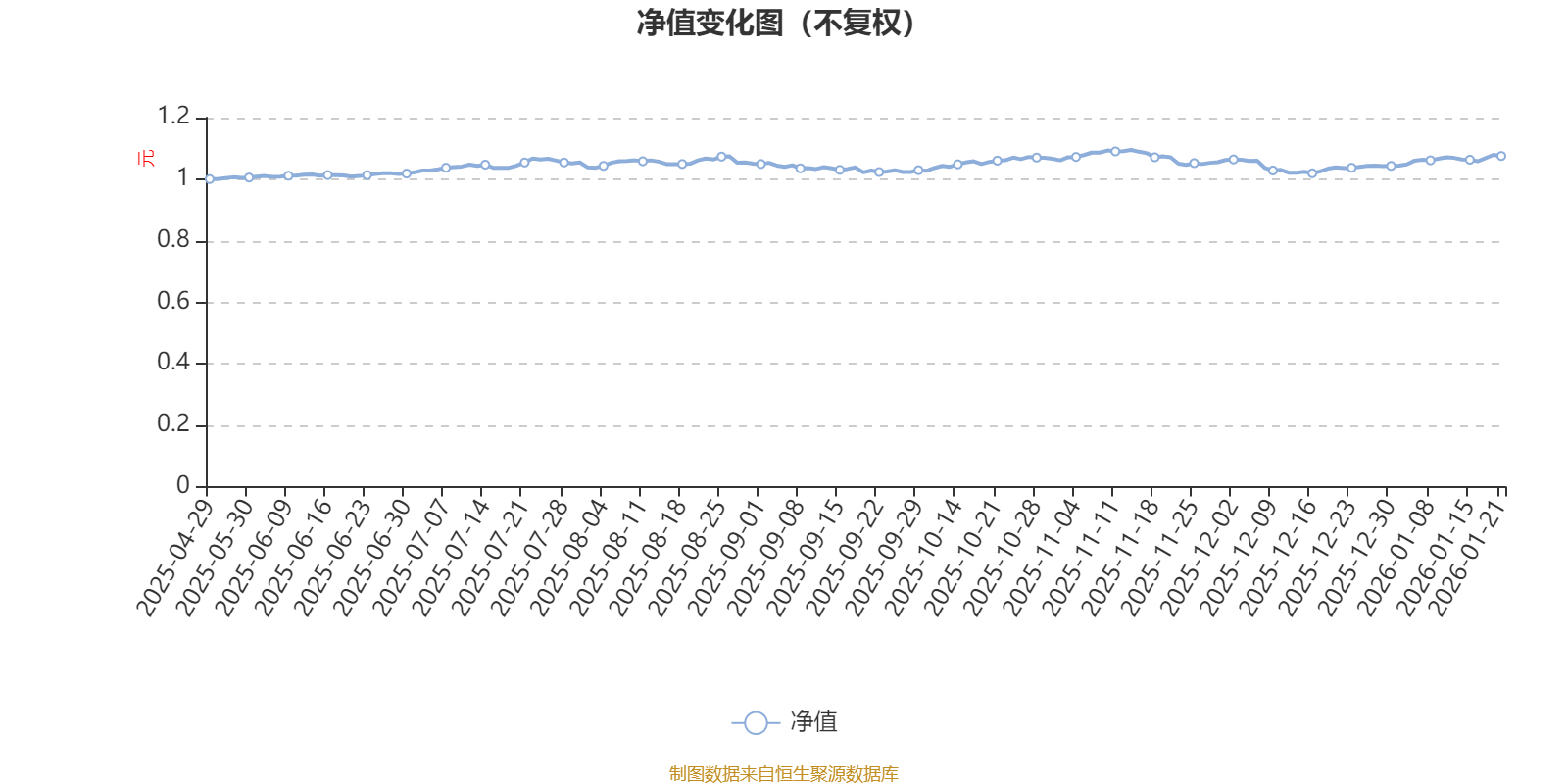
泓德红利优选混合(LOF)A:2025年第四季度利润249.87万元 净值增长率3.66%
Sou Hu Cai Jing· 2026-01-22 13:41
Core Viewpoint - The AI Fund Hongde Dividend Preferred Mixed (LOF) A (501227) reported a profit of 2.4987 million yuan for Q4 2025, with a weighted average profit per fund share of 0.0155 yuan. The fund's net value growth rate was 3.66%, and the fund size reached 206 million yuan by the end of Q4 2025. The fund manager anticipates a continued structural performance in the A-share market driven by technological innovation and long-term capital inflows, focusing on sectors with high growth and performance improvement [3][11]. Fund Performance - As of January 21, the unit net value was 1.075 yuan. The fund's three-month cumulative net value growth rate was 3.30%, ranking 507 out of 621 comparable funds, while the six-month growth rate was 5.90%, ranking 563 out of 621 [3]. - The fund's Sharpe ratio since inception was 0.1791 as of December 31 [4]. - The maximum drawdown since inception was 5.15%, occurring in Q4 2025 [7]. Investment Strategy - The fund maintains an average stock position of 71.83% since inception, compared to the peer average of 85.83%. The highest stock position reached 90.44% at the end of 2025, while the lowest was 51.24% at mid-2025 [10]. - The fund's top ten holdings include Jizhong Energy, Sichuan Road and Bridge, Hu Nong Commercial Bank, Shangfeng Cement, Yuntianhua, Shanghai Bank, Yunnan Agricultural Commercial Bank, Shaanxi Coal and Chemical Industry, COSCO Shipping Holdings, and Yanzhou Coal Mining [14].
农商行板块1月22日涨0.58%,常熟银行领涨,主力资金净流入9380.13万元
Zheng Xing Xing Ye Ri Bao· 2026-01-22 09:01
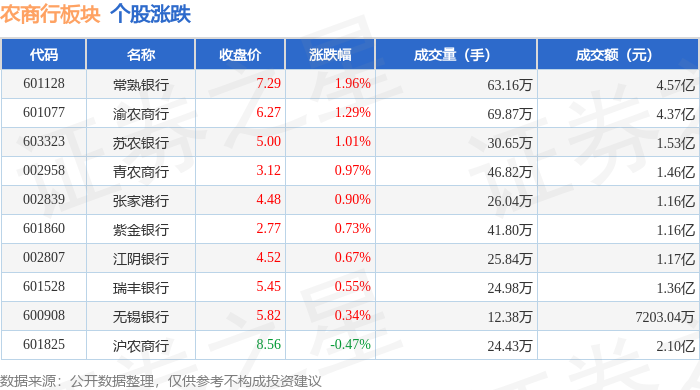
Core Viewpoint - The rural commercial bank sector experienced a rise of 0.58% on January 22, with Changshu Bank leading the gains, while the Shanghai Composite Index and Shenzhen Component Index also saw slight increases [1] Group 1: Market Performance - The Shanghai Composite Index closed at 4122.58, up 0.14% [1] - The Shenzhen Component Index closed at 14327.05, up 0.5% [1] - Changshu Bank's stock price increased by 1.96% to 7.29, with a trading volume of 631,600 shares and a transaction value of 457 million yuan [1] Group 2: Individual Stock Performance - Yunnan Rural Commercial Bank's stock rose by 1.29% to 6.27, with a trading volume of 698,700 shares and a transaction value of 437 million yuan [1] - Jiangyin Bank's stock price increased by 0.67% to 4.52, with a trading volume of 258,400 shares and a transaction value of 117 million yuan [1] - Wuxi Bank's stock price rose by 0.34% to 5.82, with a trading volume of 123,800 shares and a transaction value of 72 million yuan [1] Group 3: Fund Flow Analysis - The rural commercial bank sector saw a net inflow of 93.8 million yuan from main funds, while retail investors experienced a net outflow of 80.29 million yuan [1] - Yunnan Rural Commercial Bank had a main fund net inflow of 37.2 million yuan, but retail investors had a net outflow of 26.99 million yuan [2] - Changshu Bank experienced a main fund net inflow of 15.36 million yuan, with retail investors seeing a net inflow of 33.52 million yuan [2]


上海农商银行与新开发银行签署绿色金融合作协议
Xin Lang Cai Jing· 2026-01-22 08:41
徐力董事长表示,绿色发展已成为超越国界的全球共识,绿色金融正是撬动"双碳"目标落地、驱动经济 社会全面绿色转型的核心引擎。作为扎根上海、服务长三角的金融国企,上海农商银行始终践行"金融 向善",持续打造"长三角最具绿色底色的银行",构建全链条绿色金融服务体系。此次与新开发银行的 携手,是上海农商银行完善ESG管理,促进自身和利益相关方共同可持续发展,实现经济效益、社会效 益和生态效益的良性结合。 来源:i上农商行 1月22日,上海农商银行与新开发银行举行绿色转贷款项目合作签约仪式。上海农商银行党委书记、董 事长徐力与新开发银行副行长罗曼·谢罗夫签署协议,上海农商银行行长汪明、副行长占玲灵、董事会 秘书姚晓岗,新开发银行副行长拉吉夫·兰詹、周强武等出席。 本次是上海农商银行首度与国际多边开发银行开展的绿色转贷款合作,项目以"金融助力上海绿色发 展"为核心,新开发银行将提供等值一亿美元的五年期人民币资金,专项用于支持可再生能源与能效、 环境保护及数字基础设施三大关键绿色领域,是上海农商银行跨境绿色金融的崭新实践。 谢罗夫副行长表示,上海作为全球金融枢纽及新开发银行总部所在地,为本次合作提供了理想的发展环 境。上海 ...

数字人民币2.0:从M0到M1的质变
GF SECURITIES· 2026-01-22 05:07
Investment Rating - The report provides a "Buy" rating for all major banks analyzed, indicating a positive outlook for the banking sector [7]. Core Insights - The digital renminbi has entered its 2.0 era, transitioning from a central bank liability (M0) to a commercial bank liability (M1), allowing it to earn interest and be included in deposit insurance and reserve requirements [6][14]. - This transformation positions China as the first economy to offer interest on its central bank digital currency (CBDC), fundamentally altering its monetary attributes and creating a new financial paradigm in the digital economy [27]. - The digital renminbi's interest-bearing feature enhances user motivation to hold it, shifting its perception from a mere payment tool to a viable store of value, thus promoting its integration into everyday financial activities [27][28]. Summary by Sections 1. Digital Renminbi 2.0 Era - The digital renminbi (e-CNY) is now classified as a digital deposit currency, which can earn interest and is managed under a new regulatory framework [14]. - Major state-owned banks have begun offering interest on digital renminbi wallet balances, marking a significant shift in its utility and appeal [14][27]. 2. Development Progress and Application Status - The development of the digital renminbi began in 2014, with significant milestones including pilot tests in various cities and the establishment of a comprehensive operational framework by 2025 [32][33]. - As of November 2025, the digital renminbi has processed 34.8 billion transactions amounting to 16.7 trillion yuan, with extensive coverage across multiple provinces and cities [37]. 3. Global CBDC Development Trends - The report identifies three main trends in global CBDC development: active retail CBDC initiatives, innovation in payment systems, and cautious approaches in some countries like the U.S. [6]. - China's proactive stance in developing its CBDC positions it favorably in the global digital economy landscape, particularly in cross-border trade applications [30].




上海农商银行将在3月26日起停止微信银行定向付服务
Jin Tou Wang· 2026-01-22 03:10
2026年1月22日,上海农商银行发布公告称,感谢您一直以来对上海农商银行的支持,因业务调整,自 2026年3月26日起,上海农商银行将停止微信银行定向付服务。您可通过上海农商银行手机银行、网上 银行等渠道完成资金转账,由此给您带来的不便敬请谅解。 如有疑问,可致电上海农商银行客户服务热线021-962999,感谢您的理解与支持! ...
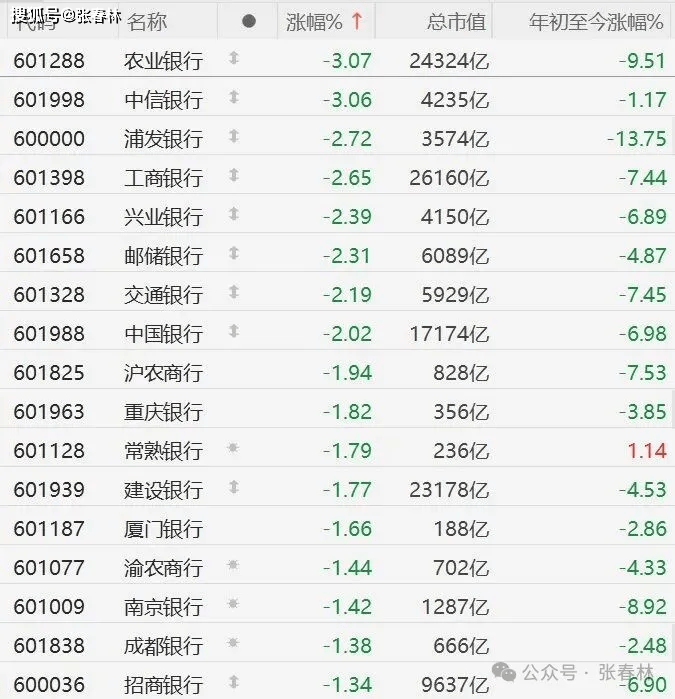
尾盘,又有大动作
Sou Hu Cai Jing· 2026-01-21 11:29
Market Overview - The market experienced a high and then a pullback, with the STAR 50 Index rising over 3%, indicating a mixed sentiment among investors [1] - Large funds are actively managing the market to prevent rapid index increases, aiming for a slow bull market [2] Index and Sector Performance - The Shanghai Composite Index is expected to fluctuate around the 4100-point mark, with an upper limit of 4190 points and a lower limit of 4000 points, suggesting a range-bound trading environment [3] - Key sectors showing strong performance include metals, gold, chips, and lithography machines, with the STAR 50 Index catching up after lagging behind other indices [3] Stock Performance - Traditional consumer stocks, particularly in the liquor sector, are experiencing a decline, while other sectors remain active [4] - A detailed table shows various banks' stock performance, with significant declines noted for major banks like Agricultural Bank (-9.51%) and Industrial and Commercial Bank (-7.44%) [5] Liquor Industry Insights - The liquor sector is anticipated to enter a new cycle around 2026, driven by economic recovery and potential monetary easing from the Federal Reserve [6][7] - Historical cycles of the liquor industry since 2003 indicate that demand has been influenced by various economic factors, suggesting a pattern that could repeat [6] Investment Strategy - The current market sentiment suggests a preference for sectors like chips and aerospace, while traditional sectors like liquor are viewed with skepticism [8] - The concept of contrarian investing is highlighted, emphasizing the challenges and potential rewards of investing in underperforming sectors [9]