蔚来

Search documents
蔚来第100万台车下线,李斌称未来每年销量要增长40%~50%
Di Yi Cai Jing· 2026-01-06 02:47
(本文来自第一财经) 2026年1月6日,蔚来公司第100万台量产车在位于安徽合肥的蔚来先进制造新桥二工厂下线。仪式现 场,蔚来创始人、董事长、CEO李斌表示,未来将保持每年40%~50%的销量增长;同时,到2030年充 换电站都突破一万座。(第一财经记者 葛慧) ...

蔚来与奇瑞、江汽、龙迅半导体签约合作,推动技术共享
Xin Lang Ke Ji· 2026-01-06 02:47
责任编辑:江钰涵 当日,蔚来公司还与奇瑞汽车、江淮汽车共同签署《关于共建汽车产业发展协同创新平台的框架协 议》,与龙迅半导体完成车芯协同产业化合作项目签约。蔚来将与产业伙伴携手推动安徽企业之间的技 术共享,进一步推动安徽和合肥开放协同、互利共赢的产业生态。 新浪科技讯 1月6日上午消息,在今日的蔚来公司第100万台量产车下线仪式上,蔚来创始人、董事长、 CEO李斌发表演讲。 他宣布,蔚来公司第100万台量产车正式下线,第100万台量产车为全新蔚来ES8。 ...


李斌:蔚来发展迈入第三阶段,未来将保持每年40%-50%销量增长
Xin Lang Cai Jing· 2026-01-06 02:42
Core Viewpoint - NIO has entered its third development stage, focusing on high-quality growth as its core objective [1][2] Group 1: Strategic Goals - NIO will continue to invest in its full-stack technology to ensure a leading advantage in both technology and products [1][2] - The company aims to build over 10,000 charging and battery swap stations by 2030 [1][2] - NIO plans to enhance brand synergy across its three brands, aiming for a market share increase in various segments while maintaining an annual growth rate of 40%-50% [1][2] - The company will deepen its focus on the Chinese market while expanding globally in a more stable and efficient manner [1][2]
蔚来第100万台车下线,李斌称未来每年销量要增长约50%
第一财经· 2026-01-06 02:33
记者|葛慧 编辑 |瑜见 2026年1月6日,蔚来公司第100万台量产车在位于安徽合肥的蔚来先进制造新桥二工厂下线。 仪式现场,蔚来创始人、董事长、CEO李斌表示,未来将保持每年40%~50%的销量增长;同时,到 2030年充换电站都突破一万座。 ...


蔚来第100万台车下线 李斌称未来每年销量要增长40%~50%
Di Yi Cai Jing· 2026-01-06 02:30
Group 1 - The core point of the article is that NIO has achieved a significant milestone by producing its one millionth vehicle at its advanced manufacturing facility in Hefei, Anhui [1] - NIO's founder, chairman, and CEO Li Bin stated that the company aims to maintain an annual sales growth of 40% to 50% in the future [1] - By 2030, NIO plans to have over 10,000 battery swap stations [1]
蔚来公司第100万台量产车下线,李斌:目标到2030年充换电站均突破一万座
Zheng Quan Shi Bao Wang· 2026-01-06 02:29
Core Viewpoint - NIO has successfully rolled out its one millionth production vehicle, indicating significant growth and production capability in the electric vehicle market [1] Group 1: Company Strategy - NIO's founder and CEO, Li Bin, emphasized the commitment to invest in a full-stack technology approach to maintain a competitive edge in technology and products [1] - The company aims to enhance its infrastructure, targeting over 10,000 charging and battery swap stations by 2030 [1] Group 2: Market Growth - NIO plans to deepen its presence in the Chinese market while expanding globally in a more stable and efficient manner [1] - The company aims to achieve an annual growth rate of 40% to 50% by enhancing collaboration among its three brands and increasing market share in various segments [1]
中国汽车-重估拐点框架:2026 年增长放缓背景下的资本支出扩张与竞争-China Automobiles_ Revisiting inflection framework_ Capex expansion & competition amid slowing growth into 2026
2026-01-06 02:23
Summary of China Automobiles Conference Call Industry Overview - The China automobile industry is experiencing a cyclical assessment regarding overcapacity and competition, particularly as growth is expected to slow into 2026 [1] - Government subsidies and anti-involution policies have been implemented to stabilize pricing and profitability within the industry [1] Key Financial Metrics - OEMs raised a total of **US$15.6 billion (Rmb111 billion)** through equity issuance in 2025, facilitating new product investments and market competition [1][31] - OEM combined capital expenditure (capex) increased by **31% year-over-year** in Q3 2025, although this was a moderation from **66% year-over-year** in Q2 2025 [4][7] - Industry cash profit (EBITDA) declined by **10% year-over-year** in Q3 2025, compared to a **1% decline** in Q2 2025 [4][24] Market Dynamics - In 2026, **119 new NEV models** are expected to be launched, with domestic passenger vehicle growth projected to slow to **-2%** and new energy vehicle (NEV) growth at **+11% year-over-year** [2] - Exports are anticipated to be a bright spot, with overseas markets poised for NEV mass adoption [2] Competitive Landscape - Managements of various OEMs remain optimistic about their individual company growth despite a conservative outlook for the overall auto industry in 2026 [4][18] - The majority of OEMs are still above cash cost levels, indicating that industry consolidation may be prolonged due to less concern over cash positions [18][19] Company-Specific Insights - **BYD** and **XPeng** are highlighted as better positioned for overseas exposure, with expanding sales networks and new export models [2] - **Li Auto** plans to launch facelift models and increase R&D expenses while focusing on overseas markets [36] - **Nio** aims for a monthly sales volume of **50,000 units** in 1H26, driven by new model launches and improved pricing strategies [38] - **SAIC** targets **1 million units** in sales for 2026, with a focus on new model launches and cost-cutting measures [36] - **GAC** aims to increase export volume to **250,000 units** in 2026, up from **130,000 units** in 2025 [36] Investment Considerations - The effectiveness of government subsidies is expected to weaken, with a projected **15%** stimulation effectiveness in 2026, leading to an estimated **1.8 million** units of stimulated demand [51] - Domestic NEV retail sales volume is forecasted at **14 million** units in 2026, reflecting an **11% year-over-year** increase [52] - Export volume for passenger vehicles is expected to reach **7.4 million** units in 2026, with NEV exports projected to grow by **35% year-over-year** [53] Conclusion - The China automobile industry is at a critical juncture with intensifying competition and a shift towards overseas markets. Companies are focusing on cost control, R&D investments, and expanding their international presence to navigate the challenges ahead [18][35]


蔚来宣布第100万台量产车下线,车型为全新蔚来ES8
Xin Lang Cai Jing· 2026-01-06 02:19
他宣布,蔚来公司第100万台量产车正式下线,第100万台量产车为全新蔚来ES8。他表示,这是蔚来发 展的重要里程碑,自2018年蔚来首台量产车下线以来,到今天三个品牌协同发展实现了这一成就。 责任编辑:江钰涵 责任编辑:江钰涵 新浪科技讯 1月6日上午消息,在今日的蔚来公司第100万台量产车下线仪式上,蔚来创始人、董事长、 CEO李斌发表演讲。 新浪科技讯 1月6日上午消息,在今日的蔚来公司第100万台量产车下线仪式上,蔚来创始人、董事长、 CEO李斌发表演讲。 他宣布,蔚来公司第100万台量产车正式下线,第100万台量产车为全新蔚来ES8。他表示,这是蔚来发 展的重要里程碑,自2018年蔚来首台量产车下线以来,到今天三个品牌协同发展实现了这一成就。 ...
中国汽车第一城,易主
Di Yi Cai Jing· 2026-01-06 01:42
Core Insights - The competition for the title of "Automobile Capital" in China by 2025 is becoming clearer, with traditional automotive hubs facing transformation pressures and emerging cities leveraging their advantages in the new energy vehicle (NEV) sector [1] Group 1: Current Leaders - Chongqing leads in overall vehicle production with nearly 2.5 million units, showing a year-on-year increase of 12.1% [2] - Hefei ranks first in NEV production with over 1.2 million units, benefiting from a strategic industrial layout that includes major brands like Jianghuai, NIO, and BYD [4][3] Group 2: Emerging Competitors - Anhui province surpassed Guangdong to become the top province in automotive production, with a total output of 3.335 million vehicles and NEV production of 1.635 million units, both ranking first nationally [3] - Cities like Wuhu and Liuzhou are also making significant strides, with Wuhu's automotive production expected to rise and Liuzhou achieving a production of 1.331 million vehicles, a 37.8% increase year-on-year [5][4] Group 3: Statistical Adjustments and Impacts - The statistical reform initiated by the National Bureau of Statistics in 2021 is reshaping the automotive industry landscape, affecting production data and competitive dynamics among cities [1] - Shenzhen's automotive production has declined, with the city no longer maintaining a competitive edge in the rankings due to changes in statistical methods [7] Group 4: Future Projections - Cities like Xi'an, Zhengzhou, and Qingdao are approaching the "million vehicle club," with Xi'an's production reaching 1.576 million vehicles and Zhengzhou's expected to exceed one million units [9][10] - Wuhan aims to surpass one million vehicles in total production by the end of 2025, with current figures showing a 7.6% increase year-on-year [10]
滚动更新丨沪指高开微涨0.06%,脑机接口概念持续发酵
Di Yi Cai Jing· 2026-01-06 01:39
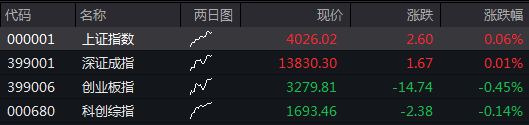
盘面上,脑机接口概念股持续发酵;能源金属题材走强,锂矿方向领涨。 09:28 港股有色金属板块高开,中国宏桥涨3%,江西铜业股份涨3%,五矿资源涨2%, 赣锋锂业涨 2%。消息面上,国内期货主力合约涨多跌少,碳酸锂涨超4%,沪银、沪铝、国际铜涨超2%。 09:25 A股开盘丨沪指涨0.06% 沪指涨0.06%,深成指涨0.01%,创业板指跌0.45%,科创综指跌0.14%。 | 代码 | 名称 | 两日图 | 现价 | 涨跌 | 涨跌幅 | | --- | --- | --- | --- | --- | --- | | 000001 | 上证指数 | 3 | 4026.02 | 2.60 | 0.06% | | 399001 | 深证成指 | ﺮ | 13830.30 | 1.67 | 0.01% | | 399006 | 创业板指 | W | 3279.81 | -14.74 | -0.45% | | 000680 | 科创综指 | | 1693.46 | -2.38 | -0.14% | 盘面上,脑机接口概念股持续发酵;能源金属题材走强,锂矿方向领涨;CPO、商业航天、AI应用概念 股走弱。 个股方面,登 ...