
浦发银行

Search documents
旺季“抢单”进行时!银行密集推购车金融方案,最低0息起
Bei Jing Shang Bao· 2025-11-20 14:24
Core Viewpoint - The automotive consumer finance business of banks is entering a "sprint period" as the year-end car purchasing season approaches, with various banks launching attractive loan schemes to stimulate demand and enhance customer experience [1][3]. Group 1: Marketing Strategies - Multiple banks, including Postal Savings Bank and Ping An Bank, are intensifying marketing efforts for auto loans, offering incentives such as 0% interest rates and financial subsidies [3][4]. - Postal Savings Bank is providing up to 4,500 yuan in financial subsidies for specific new models, with annual interest rates ranging from 0% to 6% [3]. - Ping An Bank has introduced a year-end promotion with a minimum interest rate of 0%, allowing loans from 10,000 yuan to 1 million yuan, with specific terms based on loan approval [3][4]. Group 2: Market Trends - The automotive consumer finance sector is becoming a focal point for banks amid slowing retail credit growth and increasing scarcity of quality assets [4][5]. - As of September, Ping An Bank's automotive consumer finance loan balance reached 300.3 billion yuan, a 2.2% increase from the previous year, while personal loans for new energy vehicles saw a 23.1% year-on-year growth [4]. - Shanghai Bank reported an automotive consumer loan balance of 50.33 billion yuan, up 16.95% year-on-year, with new energy vehicle loans growing by 63.08% [5]. Group 3: Regulatory Changes - Some banks are relaxing early repayment restrictions to improve customer experience and adapt to competitive market conditions [6][7]. - For instance, Guangfa Bank has adjusted its early repayment penalty structure, allowing borrowers to apply for early repayment from the first repayment date, maintaining an 8% penalty on the remaining principal for the first 12 months [6][7]. - Analysts suggest that further relaxation of early repayment rules may occur to enhance market competitiveness and customer retention [7]. Group 4: Industry Transformation - The automotive finance sector is shifting from high-interest, high-reward models to a focus on service and customer experience due to regulatory pressures [8][9]. - Banks are encouraged to innovate and provide personalized financial products that align with consumer needs, integrating financial services into the entire car purchasing process [9][10]. - The emphasis is on creating a comprehensive ecosystem that covers the entire lifecycle of vehicle ownership, leveraging technology for improved efficiency and risk management [9][10].



A股市场银行股涨幅继续扩大 中国银行、工商银行均创历史新高
Xin Lang Cai Jing· 2025-11-20 14:07
Core Viewpoint - The A-share market has seen a significant increase in bank stocks, with both Bank of China and Industrial and Commercial Bank of China reaching historical highs on November 20, 2023 [1] Group 1: Stock Performance - Bank of China rose over 4%, while Postal Savings Bank and China Construction Bank increased by over 3% [1] - Other banks such as Minsheng Bank, Huaxia Bank, Everbright Bank, Nanjing Bank, and Bank of Communications saw gains exceeding 2%, and Shanghai Pudong Development Bank and Industrial and Commercial Bank rose over 1% [1] - Year-to-date, Bank of China has accumulated a 19% increase, and Industrial and Commercial Bank has risen by 26% [1] Group 2: Market Position - Industrial and Commercial Bank has surpassed Agricultural Bank of China in market capitalization, reclaiming the top position [1]


两年减超500家!中小银行重组加速,“抱团”组建市级农商行破局?
Guo Ji Jin Rong Bao· 2025-11-20 13:17
Group 1 - The core viewpoint of the articles highlights the ongoing reforms in rural credit cooperatives in Guizhou Province, with several cities and autonomous prefectures moving towards establishing unified municipal rural commercial banks [1][2][3] - The establishment of unified municipal rural commercial banks is seen as a way to enhance economies of scale, improve resource integration, and strengthen the financial capabilities of local institutions [4] - The reform process is accelerating, with multiple rural financial institutions in Guizhou announcing shareholder meetings to discuss the formation of new banking entities [2][3] Group 2 - The restructuring of small and medium-sized banks is expected to increase, with projections indicating that over 500 banks will be reduced through mergers and acquisitions between 2024 and 2025, primarily focusing on rural financial institutions [5] - The ongoing "village reform" initiatives are being supported by major state-owned and joint-stock banks, indicating a broader trend of consolidation in the rural banking sector [6] - The reform process is entering a "deep water zone," suggesting that the challenges faced by local financial institutions will require external resources for resolution, and the scope of risk mitigation may expand to include non-bank financial institutions [6]
“村改支”浪潮来袭!村镇银行加速“离场”,银行业开启减量提质新阶段
Jin Rong Shi Bao· 2025-11-20 13:07
Core Viewpoint - The recent approvals by the National Financial Supervision Administration for several banks to acquire their affiliated rural banks and convert them into direct branches signify a shift from quantity expansion to quality enhancement in the rural banking sector [1][2]. Group 1: Recent Developments - Multiple cases of "village to branch" transformations have been approved, indicating a significant acceleration in the reform and restructuring of small and medium-sized banks [2]. - In November, Shanghai Pudong Development Bank successfully acquired two rural banks, converting them into branches, showcasing a trend among various banking institutions to engage in mergers and acquisitions of rural banks [2]. - The restructuring methods "village to branch" and "village to division" are becoming mainstream, allowing banks to absorb rural banks and enhance their operational capabilities [2][3]. Group 2: Strategic Implications - The absorption of rural banks into larger banking institutions enhances service capabilities and risk resilience for rural banking services [3]. - For the parent banks, the restructuring expands their business scope and allows for the potential establishment of new branches in areas where they previously had no presence [3]. Group 3: Policy and Market Dynamics - The acceleration of rural bank integration aligns with regulatory directives aimed at reducing the number of financial institutions while improving service quality [4]. - As of mid-2025, the number of rural banks is projected to decrease to 1,440, reflecting a significant reduction in the sector, which is part of a broader strategy to enhance service quality through consolidation [4]. - The integration of rural banks is not merely about reducing the number of branches but represents a strategic shift towards more focused and quality-driven financial services [4].

金融监管总局批复,同意收购!
Jin Rong Shi Bao· 2025-11-20 12:48
Core Viewpoint - The recent approvals by the National Financial Supervision Administration for several banks, including SPDB and Zhengzhou Bank, to acquire their affiliated rural banks and convert them into direct branches indicate a shift from quantity expansion to quality improvement in rural banking services [1][2]. Group 1: Recent Developments - Multiple cases of "village to branch" transformations have been approved in various regions, including Zhejiang and Inner Mongolia, reflecting a significant acceleration in the reform and restructuring of small and medium-sized banks [2]. - SPDB successfully acquired Zezhou Rural Bank and established it as a branch, marking its second acquisition of a rural bank in November [2]. - Zhengzhou Bank announced plans to acquire shares from other shareholders of Xun County Rural Bank and convert it into a branch, showcasing the trend of "village to branch" and "village to division" as mainstream methods of restructuring [2]. Group 2: Strategic Implications - The absorption and conversion of rural banks into branches enhance service capabilities and risk resilience for the main banks, while also broadening their operational scope [3]. - The restructuring aligns with regulatory goals to reduce the number of financial institutions while improving service quality, as evidenced by a reduction in the number of rural banks from 1,440 by mid-2025, down from 1,538 at the end of 2024 [4]. - The integration of rural banks is not merely about reducing the number of branches but represents a strategic shift towards more refined financial services and diversified product offerings to meet varied customer needs [4].
茂硕电源转亏后董事再抛减持计划 近期曾向多家银行申请5.5亿授信额度
Xin Lang Cai Jing· 2025-11-20 12:31
Core Viewpoint - The recent share reduction plan by the company's director has raised concerns about the financial health of the power supply manufacturer, as the company reported a significant net loss despite a slight increase in revenue [1][2]. Group 1: Financial Performance - In the first three quarters of 2025, the company achieved a revenue of 945 million, representing a year-on-year growth of 2.95%, but reported a net loss attributable to shareholders of 57.92 million, a sharp decline from a profit of 38.02 million in the same period last year [1]. - The company's net loss after excluding non-recurring gains and losses reached 65.56 million, indicating a deterioration in the profitability of its core business [1]. - The average cash collection ratio for the company's main business is 81.68%, reflecting weak cash flow [2]. Group 2: Strategic Actions - The director plans to reduce holdings by up to 980,000 shares, accounting for 25% of his total shareholding, which is the maximum allowed for directors during their tenure [1]. - To maintain operations, the company is actively seeking funding, announcing plans to apply for a total credit line of 550 million from multiple banks [2]. - The company has previously revised its half-year performance forecast due to quality risks in some consumer power products, which may lead to additional costs for after-sales service [2]. Group 3: Market Conditions - The company faces challenges that may reflect broader issues in the power supply manufacturing industry, as intensified market competition has forced companies to implement strategic price reductions, which in turn erodes profit margins [2]. - As of the end of the third quarter, the company's total assets amounted to 1.956 billion, with accounts receivable reaching 469 million, indicating challenges in asset operational efficiency [3].

长亮科技(300348) - 2025年11月19日投资者关系活动记录表
2025-11-20 10:02
Group 1: Mergers and Acquisitions - The company prefers horizontal mergers within the industry and acquisitions of new productive forces, actively seeking suitable opportunities [2] - Vertical mergers have limited complementary effects due to the short supply chain in the industry [2] Group 2: Accounts Receivable and Cash Flow - High accounts receivable at the end of Q3 is expected to improve quickly, enhancing year-end cash flow [2] - The company anticipates faster collection of receivables towards the end of the year [2] Group 3: Client Base and Revenue Distribution - Major clients include various commercial banks, with no significant reliance on any single client; the top five clients contribute a small revenue share [3] - The company has established itself as a benchmark in the domestic信创 (new infrastructure) business, gaining recognition from numerous clients [3] Group 4: Employee Growth and Market Expansion - The company has over 7,000 employees, with continuous growth driven by increasing sales contracts [3] - Focus on expanding into overseas markets, particularly Southeast Asia, where opportunities are gradually increasing [3] Group 5: Digital Currency and AI Development - The company is exploring digital asset operations in response to national policies on digital currency, while also monitoring stablecoin developments in Hong Kong [4] - AI technology is being integrated to enhance internal efficiency, with ongoing development of systematic product solutions [4] Group 6: Overseas Mergers and Acquisitions - The company is open to acquiring quality overseas enterprises, although challenges exist in the Southeast Asian market [4] - Past overseas acquisitions have yielded positive results, and the company continues to seek market opportunities that align with its existing product capabilities [4]

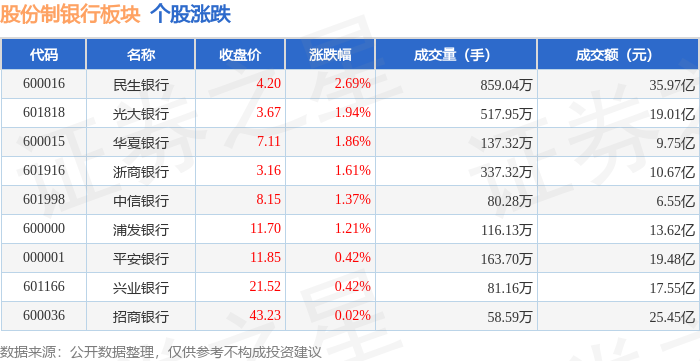
股份制银行板块11月20日涨0.81%,民生银行领涨,主力资金净流入10.74亿元
Zheng Xing Xing Ye Ri Bao· 2025-11-20 09:04
Core Insights - The banking sector saw a rise of 0.81% on November 20, with Minsheng Bank leading the gains [1] - The Shanghai Composite Index closed at 3931.05, down 0.4%, while the Shenzhen Component Index closed at 12980.82, down 0.76% [1] Banking Sector Performance - Minsheng Bank's stock price increased by 2.69% to 4.20, with a trading volume of 8.59 million shares and a transaction value of 3.597 billion [1] - Other notable banks included: - Everbright Bank: closed at 3.67, up 1.94%, with a transaction value of 1.901 billion [1] - Huaxia Bank: closed at 7.11, up 1.86%, with a transaction value of 975 million [1] - Zhejiang Commercial Bank: closed at 3.16, up 1.61%, with a transaction value of 1.067 billion [1] - CITIC Bank: closed at 8.15, up 1.37%, with a transaction value of 655 million [1] Capital Flow Analysis - The banking sector experienced a net inflow of 1.074 billion from main funds, while retail investors saw a net outflow of 451 million [1] - Main fund inflows for specific banks included: - Minsheng Bank: 3.03 billion, with a net outflow from retail investors of 1.10 billion [2] - China Merchants Bank: 2.55 billion, with a net outflow from retail investors of 1.12 billion [2] - Everbright Bank: 1.955 billion from main funds, but a net outflow of 775.33 million from retail investors [2]



上海创投公司原总裁王品高:调动民间资本参与,是风投行业发展出路
Guan Cha Zhe Wang· 2025-11-20 08:30
Core Insights - The forum held at Fudan University focused on "Financial Power and Technological Finance," discussing the definition, international experiences, domestic challenges, and future development paths of technological finance [1] Group 1: Importance of Venture Capital - Venture capital is highlighted as a crucial component of national core competitiveness, as emphasized by former U.S. President Biden [4] - The current private capital ratio in China's venture capital sector has room for improvement, and the limited partnership system can play a more significant role [1][4] - There is a consensus on the increasing importance of venture capital, yet many lack a clear understanding of how to effectively engage in it [7] Group 2: Structural Challenges - Over 80% of the capital in China's venture capital is state-owned, which creates a mismatch with the industry's development needs [7] - The health of the venture capital industry relies on the participation of private capital, and the current dominance of state-owned enterprises is seen as a transitional phase [9] - The shift from government-guided funds to government-dominated funds contradicts the industry's development principles [9] Group 3: Market Dynamics and Innovation - The core of venture capital is to support innovation, with a focus on identifying innovations that are approximately two years ahead of the market [7] - The experience of Silicon Valley Bank in China illustrates the importance of collaboration with venture capital firms rather than direct investment [8] - A call for more theoretical research into the essence, core functions, collaborative mechanisms, and ultimate goals of venture capital is made to avoid superficial development [9]

银行ETF指数(512730)涨超1.6%,银行估值仍处于历史偏低水平
Xin Lang Cai Jing· 2025-11-20 03:43
Group 1 - The core viewpoint indicates a strong performance in the banking sector, with the China Securities Bank Index rising by 1.73% and individual stocks like Bank of China and Construction Bank showing significant gains [1] - The banking sector is experiencing a defensive style resurgence, with the total market capitalization of A-shares surpassing 2.25 trillion [1] - Current credit growth is slowing down, and social financing growth is also retreating from high levels, although policies are in place to support demand recovery [1] Group 2 - The banking sector's retail risk has increased but remains manageable, supported by substantial provisioning and stable dividend policies [1] - The advantages of banks in areas such as gold markets, wealth management, and investment banking contribute to differentiated valuations within the sector [1] - The valuation of banks is still at historically low levels, and there is potential for medium to long-term capital allocation, making increased investment in the banking sector a favorable choice [1] Group 3 - The Bank ETF Index closely tracks the China Securities Bank Index and serves as an analytical tool for investors [2] - As of October 31, 2025, the top ten weighted stocks in the China Securities Bank Index account for 64.87% of the index, highlighting the concentration of investment in major banks [2]


